


You can get SOC 2 without a security team, and the fastest realistic path is a SOC 2 Type 1 report, which tests your controls at a single point in time and can be done in a matter of months, not a year. A Type 2 report comes after, because it needs an observation period. You don't need to hire a full-time security person to get there: a fractional security team can run the program, and security engineers can make the technical changes with your team. This week, ask the customer whether a Type 1 works for now, start talking to auditors, and send back a completed security questionnaire so the deal keeps moving.
At a glance
- Fastest report: SOC 2 Type 1: controls tested as of one date
- Type 2: Tests controls over an observation period. 3 to 12 months is common practice for a first report, and the AICPA doesn't set that number
- Who issues the report: A licensed CPA firm, independent of whoever builds your controls
- What sets the timeline: How much security already exists, the scope, and the auditor's calendar
- Truvo's typical Type 1 timeline: 8 to 12 weeks from kickoff to a Type 1-ready program
- Bridge while waiting: Answer the security questionnaire with evidence. Some customers also accept a letter confirming the audit is booked
So here's the situation I see a lot. A customer or a tender sends over the paperwork, and somewhere in there is one line: "Please provide your SOC 2 report." There's a date attached, and nobody on the team has security as their job.
First, congratulations. Somebody big wants to buy from you. Second, this is very doable.
Services spotlight: SOC 2 help when there's no security team
| Truvo service | What it covers |
| vCISO | A named senior lead who owns the SOC 2 program until you have your own security team |
| Managed Vanta | We set up and operate Vanta for you, through the audit and the observation period |
| Managed Drata | The same, inside Drata |
| Security engineers on demand | Engineers who make the technical fixes: MFA, logging, endpoints, cloud settings |
| Security questionnaire services | Questionnaires and DDQs answered with evidence while the report is in progress |
| Security capability assessment | Shows exactly which gaps stand between you and a Type 1 |
How fast can a company with no security staff get SOC 2?
SOC 2 takes months, and the exact number depends on three things: how much security you already have, how big the scope is, and when the auditor can fit you in. The good news is you control most of those levers. A tight scope (one product, one cloud environment, the people who touch production) moves much faster than "everything we've ever built." Existing MFA, cloud logging and access control give you a head start. And booking the auditor early removes the biggest outside dependency.
For our own engagements, the typical time from kickoff to Type 1 readiness is 8 to 12 weeks, then the auditor's fieldwork and report on their schedule. If your date is tighter than that, tell the customer early and use the bridge options further down. For a full budget and timeline breakdown, see the SOC 2 cost and timeline guide.
One honest warning. The AICPA's Journal of Accountancy has reported CPAs' concerns about "fast and easy" SOC reports, and the AICPA's peer review guidance now has reviewers checking whether engagement timelines are reasonable. Fast is good. Suspiciously fast is a risk for you and for the customer relying on your report.
Should you start with SOC 2 Type 1 or Type 2 when you're on a deadline?
Start with Type 1. A Type 1 report says your controls are designed properly as of one date. A Type 2 says those controls worked over an observation period, and you can't produce 3 months of onboarding records, access reviews and scans in a weekend. Both are defined in the AICPA's SOC suite of services and tested against the Trust Services Criteria.
Before you commit, ask the customer: "Will a Type 1 work for now, with a Type 2 to follow?" In my experience a lot of customers say yes. The SOC 2 Type 1 vs Type 2 guide covers why Type 1 first, and the SOC 2 in 90 days post has the week-by-week plan and how to negotiate Type 1 with the buyer.
Can you get SOC 2 without hiring a security person?
Yes. Many companies I talk to in this spot are 2 to 30 people with no security staff, and recruiting a permanent security lead takes time you don't have. You need senior expertise now, for a defined job, without a permanent salary.
| Option for SOC 2 without a security team | What you get | The catch |
| Hire a full-time security lead | Someone in-house long term | Recruiting takes months, and one person can't cover every specialty |
| Buy a GRC platform alone (Vanta, Drata) | Integrations, automated tests, a dashboard | Someone still has to design the program, configure the platform and fix the gaps |
| Fractional security team running the platform and the program | Senior lead plus specialists, starting now | You still own decisions and give your team's time |
I'm a big fan of Vanta and Drata. We partner with both. But you can't buy a platform and expect a program. Someone still has to decide what your controls are, write procedures that match how your team works, set up the integrations and check that the evidence would convince an auditor. The post on whether Drata automates SOC 2 breaks down which part the platform handles and which part people do.
A fractional security team does that work. On the platform side, we offer managed Vanta services and managed Drata services, where we operate the tool for you. On the program side, we own the plan, the policies and the evidence.
What does the fast path to a SOC 2 Type 1 look like, phase by phase?
The fast path has five phases, and the first three overlap. I won't promise a week count per phase, because scope and the auditor's calendar change the numbers.
Here's the whole path on one page, with the 8 to 12 weeks we typically need to get a company with no security team ready for a SOC 2 Type 1 audit.
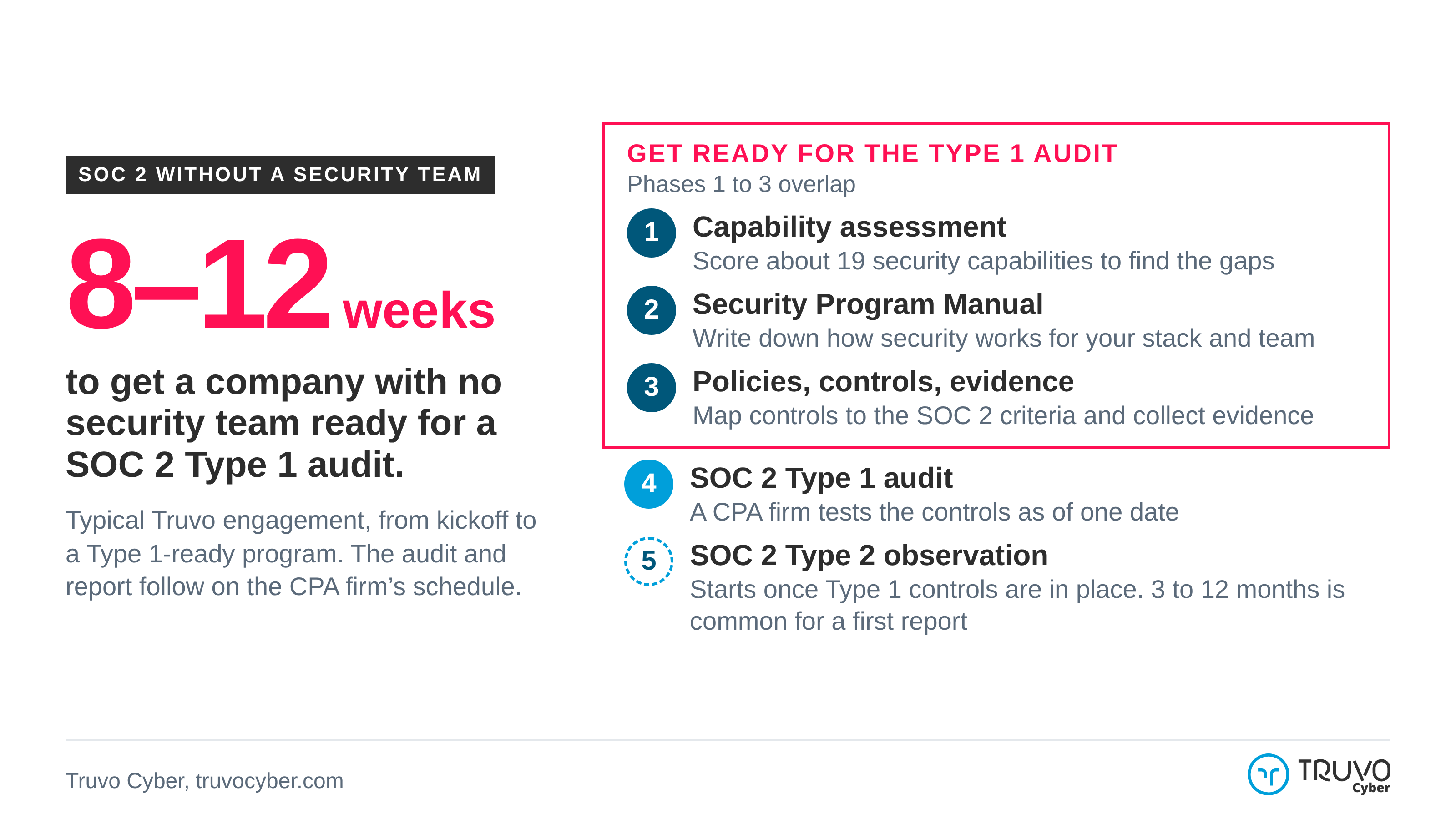
Figure: Timeline of the path to SOC 2 for a company with no security team. In a typical Truvo engagement, it takes 8 to 12 weeks from kickoff to a Type 1-ready program, across three overlapping phases: a capability assessment that scores about 19 security capabilities, the Security Program Manual, then policies, controls and evidence mapped to the SOC 2 criteria. Next, a CPA firm tests the controls as of one date in the SOC 2 Type 1 audit. The SOC 2 Type 2 observation period starts once Type 1 controls are in place, and 3 to 12 months is common for a first report. Click to enlarge.
Key insight
1. Capability assessment.
An effective security program is made up of about 19 security capabilities: access control, change management, vulnerability management, incident response, vendor management, and so on. We score where you are on each one, so you know exactly which gaps stand between you and a report. The SOC 2 readiness assessment guide explains what a good one covers.
Key insight
2. Security Program Manual.
We write down how your security program works, for your stack and your team, as a wiki your team follows day to day. You keep it even if we part ways.
Key insight
3. Policies, controls and evidence.
Policies come from the manual, so they describe what you do instead of template language with your name pasted in. Controls get mapped to the SOC 2 criteria. And evidence gets collected with a short note explaining what each piece shows. The person uploading a screenshot knows what the screenshot proves. The auditor doesn't. A note like "every pull request gets a review before merge" saves a lot of back and forth.
Key insight
4. SOC 2 Type 1 audit.
The CPA firm has the AICPA criteria in front of them and goes down the list: "For this criterion, what do you have?" If phases 1 to 3 went well, you've got an answer for every line. Before the auditor comes in, we have someone on our team who wasn't involved day to day review everything, the way an internal audit would.
Key insight
5. Type 2 observation.
The day your Type 1 controls are in place, your observation period can start.
In this order, compliance becomes a byproduct of effective security. Take vulnerability management. One scan on one server might satisfy an auditor. But vulnerabilities live on laptops, browsers, servers, containers, your own code and the libraries your code pulls in. The hacker doesn't care about your SOC 2 policy. Build the capability properly and the evidence follows.
Who does the technical work when there's no security team?
Hands-on security engineers do the technical work, alongside your team. Buyers ask me: "Are we paying for advice and then doing all the work ourselves?" Fair question. Plenty of companies have paid for advice with no hands behind it.
The assessment usually finds things to fix: MFA gaps, logging that's off, unmanaged laptops, a firewall or web application firewall that needs tightening. Through cybersecurity staff augmentation, you can bring in security engineers as needed to implement those changes, instead of handing your developers a to-do list in a field they don't know.
Let me be direct about scope. Our engineers handle security infrastructure and configuration: identity, MFA, logging, endpoints, firewalls, cloud settings. Your developers own your application code. Some process changes also need your team's time, like tighter change management for production releases and background checks for new hires.
Here's how I split the SOC 2 work when nobody on your team has security as their job.
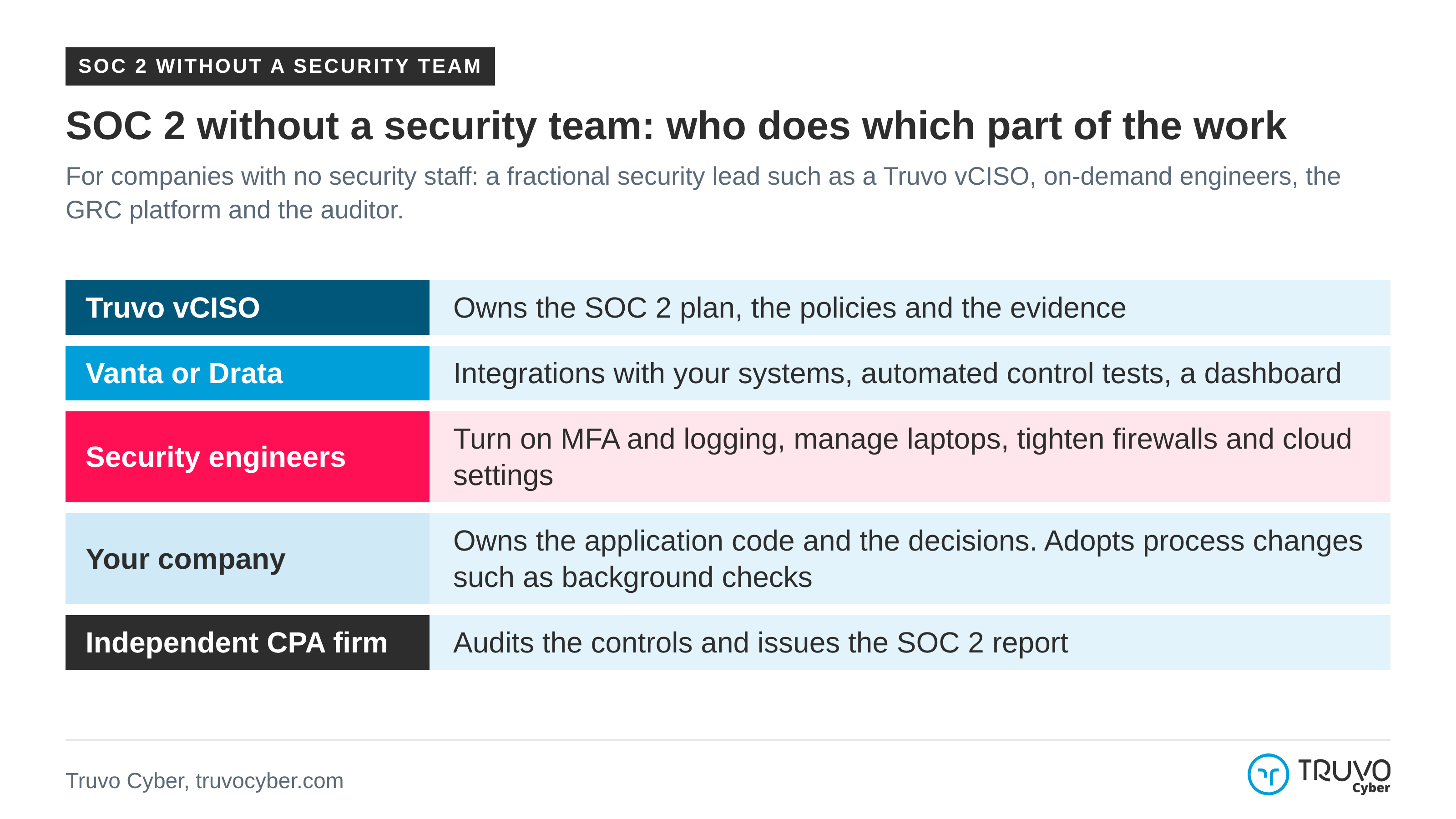
Figure: Who does which part of the SOC 2 work at a company without a security team. Truvo vCISO: owns the SOC 2 plan, the policies and the evidence. Vanta or Drata: provides integrations with your systems, automated control tests and a dashboard. Security engineers: turn on MFA and logging, manage laptops, and tighten firewalls and cloud settings. Your company: owns the application code and the decisions, and adopts process changes such as background checks. Independent CPA firm: audits the controls and issues the SOC 2 report. Click to enlarge.
What can you give the customer while the SOC 2 report is in progress?
You've got two good bridge options, and both work best when you raise them early with the customer.
Key insight
Answer the security questionnaire with evidence.
Many customers who ask for SOC 2 also send a security questionnaire or due diligence questionnaire. Answer it now, honestly, with evidence attached: policies, a network diagram, your sub-processor list, screenshots of MFA and logging settings. A well-assembled package often keeps a deal moving. The security questionnaire process post covers how to build that package, and we handle questionnaires as a service through security questionnaire services.
Key insight
Share the plan and the audit date.
Once you've engaged a CPA firm, some customers will accept a letter confirming the engagement and the expected report date, alongside your roadmap. Be careful here. A readiness letter or engagement letter carries no assurance opinion, and only the CPA firm can issue the SOC 2 report. Ask the customer what they'll accept before you promise anything.
So your answer to the customer becomes: "We're doing SOC 2. Here's our completed questionnaire with evidence, here's the auditor we've booked, and here's when you'll have the Type 1." Procurement teams hear that answer all the time.
How do you keep a fast SOC 2 from turning into a scramble next year?
You keep the program going after the Type 1 and treat the report as the first milestone. Compliance is ongoing. Every quarter there's an access review. Scans happen on a schedule. People join and leave. Someone has to own those tasks through the Type 2 observation period.
Our engagements are front-loaded for this reason. Most of the build work happens in the first 8 to 12 weeks, then settles into a steady rhythm: evidence on schedule, reviews on time, someone checking quality before the auditor does. Always audit ready.
Where SOC 2 fits in closing the deal
Remember why you're doing this. A customer wants to buy, and SOC 2 shows them their data is safe with you. The report also answers a big chunk of the next customer's questionnaire. One customer asked. The next one will too.
The deadline feels scary on day one. With the right path, you've got a clear plan, a clear owner and a date you can hit.
Key insight
Got a SOC 2 deadline?
I'm Ali Aleali, founder of Truvo Cyber. Before Truvo, I worked on security at Payments Canada, KPMG and Accenture, and every engagement is senior-led. Book a call and we'll look at your date, scope and stack, then give you a roadmap with the quote: who does what, and when to expect the report. For the week-by-week plan, see the SOC 2 in 90 days post. For budget, see the SOC 2 cost and timeline guide.
Where to start:
- Someone to own the program: vCISO services
- Someone to run the platform: Managed Vanta or Managed Drata
- Hands for the technical fixes: security engineers on demand
- A customer questionnaire due now: security questionnaire services
Got a SOC 2 deadline?
Book a call and we will look at your date, scope and stack, then give you a roadmap: who does what, and when to expect the report.
Frequently asked questions
How fast can we get SOC 2 without a security team?
SOC 2 usually takes months, with or without in-house security staff. A Type 1 report is the fastest route because the CPA firm tests controls as of a single date. A Type 2 report also needs an observation period, commonly 3 to 12 months for a first report. Exact timing depends on your starting point, scope and the auditor's availability.
Can we get a SOC 2 report without a security team?
Yes. Many companies get SOC 2 with no in-house security staff by working with a fractional security team. The team operates the program and the GRC platform, and security engineers implement technical fixes with your developers.
Is a SOC 2 Type 1 report enough for customers?
A SOC 2 Type 1 report satisfies many customers as a first step, especially with a Type 2 audit already scheduled. Some customers require a Type 2, so ask before you set your plan.
Who issues a SOC 2 report?
A licensed CPA firm issues SOC 2 reports, following AICPA attestation standards. The CPA firm must be independent, so the firm that audits your controls cannot also build them. Consultants and GRC platforms prepare you for the audit.
Is there a minimum observation period for SOC 2 Type 2?
The AICPA sets no fixed minimum observation period for a SOC 2 Type 2 report. In common practice, a first report covers somewhere between 3 and 12 months. Agree the period with your CPA firm and your customer.
What can we send a customer while our SOC 2 audit is underway?
Send a completed security questionnaire with real evidence attached, such as policies, diagrams, a sub-processor list and configuration screenshots. Some customers also accept a letter confirming your CPA firm engagement and expected report date. Neither replaces the SOC 2 report.