

Drata automates part of SOC 2. In our engagements, I'd put it at about 30 to 40% of SOC 2 tests: the technical checks, such as cloud settings, MFA and laptop encryption. The rest is process work that people do, and the biggest gap I see is scoping: setting a complete SOC 2 scope and tailoring policies and procedures to the way your team works. Until that's done, a green Drata dashboard can be a mirage: one scanned system can turn a test green while several others go unscanned. Start this week by listing every system in your SOC 2 scope and checking which ones Drata can see.
At a glance
- Does Drata automate SOC 2?: Partly. In Ali Aleali's estimate from Truvo engagements, about 30 to 40% of SOC 2 tests are technical tests Drata can automate
- What's the biggest gap Drata leaves?: Scoping: a complete scope, plus policies and procedures tailored to the company's environment, tools and team
- Can a green Drata dashboard be misleading?: Yes. One passing check can turn a test green while other in-scope systems stay uncovered
- What do people still do?: Scope, policies, risk assessment, access and vendor reviews, incident response, training, change management
- Who performs the SOC 2 audit?: A licensed CPA firm performs the audit and issues the report
- Can someone run Drata for us?: Yes. A managed Drata service operates the Drata account you own
Services spotlight: who handles the SOC 2 work Drata leaves to people
| Truvo service | What it covers |
| Managed Drata | We operate the Drata account you own: scope review, tailored policies, failing tests, evidence and audit preparation |
| Managed Vanta | The same operating model inside a Vanta account |
| Security engineers on demand | Engineers who extend coverage to every in-scope system and make the technical fixes: scanning, MFA, logging, laptop management |
| vCISO | A named senior lead who owns the security program, sets the scope and faces your auditor and customers |
How much of SOC 2 can Drata automate?
In our engagements, about 30 to 40% of SOC 2 tests are technical tests a platform like Drata can automate. That's my estimate from the programs we build, not an industry figure. Once your systems are connected, Drata does those tests well and keeps doing them around the clock:
- Cloud settings. Drata pulls configuration from your cloud accounts and checks things like storage encryption and admin access.
- Identity. Drata checks that MFA is on for every user and that people who leave lose access.
- Laptops. Drata checks disk encryption and screen lock through Drata's device agent, the agent installed on each laptop.
- Scan results and records. Drata collects vulnerability scan results and stores policies, acknowledgements and evidence in one place, mapped to the SOC 2 Trust Services Criteria.
The Vanta vs Drata API comparison goes deeper on what each platform's integrations and API automate.
The other 60 to 70% is process work: policies, the risk assessment, access reviews, vendor reviews, incident response, security training and change management. People have to do those, even with AI helping. For that part of SOC 2, Drata mostly organizes the evidence: it tracks the task and stores the record.
Here's the split on one page:
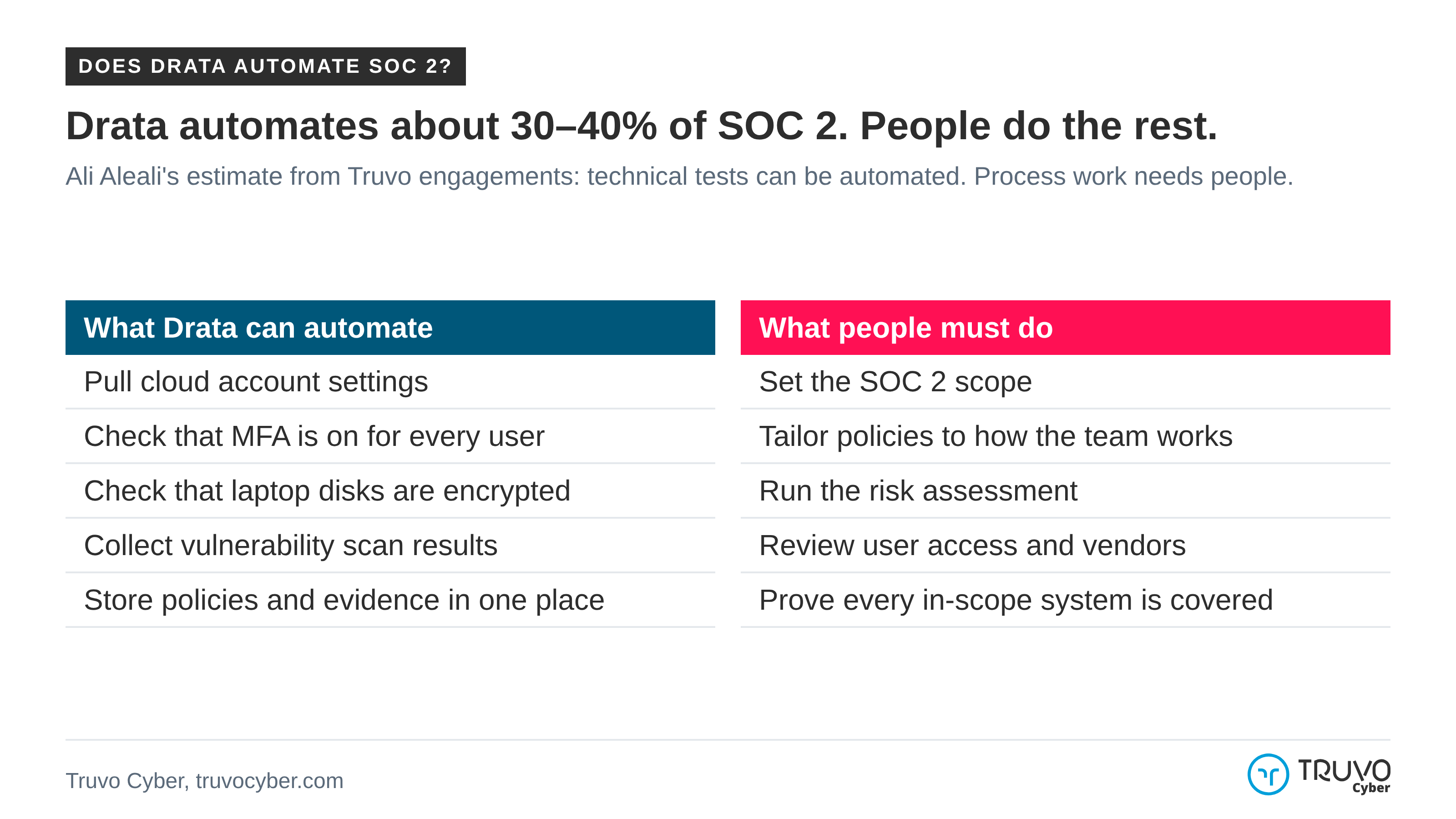
Figure: Drata automates about 30 to 40% of SOC 2, and people do the rest, in Ali Aleali's estimate from Truvo engagements. What Drata can automate: pull cloud account settings, check that MFA is on for every user, check that laptop disks are encrypted, collect vulnerability scan results, and store policies and evidence in one place. What people must do: set the SOC 2 scope, tailor policies to how the team works, run the risk assessment, review user access and vendors, and prove every in-scope system is covered. Click to enlarge.
That's a big time saver, and it's what Drata is built for. You can't buy a platform and expect a program, though, and the program starts with scope.
What is the biggest gap Drata leaves in a SOC 2 program?
Scoping. In our engagements, the biggest gap is three pieces of judgment work that come before any Drata test turns green:
- Setting the scope. Which products, systems, teams and vendors are in your SOC 2 report. Leadership decides this with a security lead, and Drata records whatever you configure.
- Tailoring policies and procedures. Each policy has to describe your real environment, your tools and the way your team operates.
- Making sure scope coverage is complete. Every in-scope system needs its controls covered, including systems Drata has no integration for. The post on what Vanta and Drata can't automate lists the usual ones, and the on-prem SOC 2 guide covers who collects their evidence.
This is normal. Teams tend to set up Drata from the integrations they can connect, because that's the obvious place to start. A scope review fixes it in a few weeks, and the Drata account gets far more useful afterwards. A Drata SOC 2 readiness assessment is a good way to do that review before the audit window.
Why can one scanned system turn a Drata SOC 2 scanning test green?
Because a platform test checks for evidence of the control, and one passing check can be enough to turn it green. Here's an illustrative example from our engagements. A company needs infrastructure vulnerability scanning on several systems: a production cloud account, a second cloud account, a staging environment, servers, containers and an internal admin app. The scanner covers the production account, the Drata scanning test can pass, and the control can look done while the other systems stay unscanned.
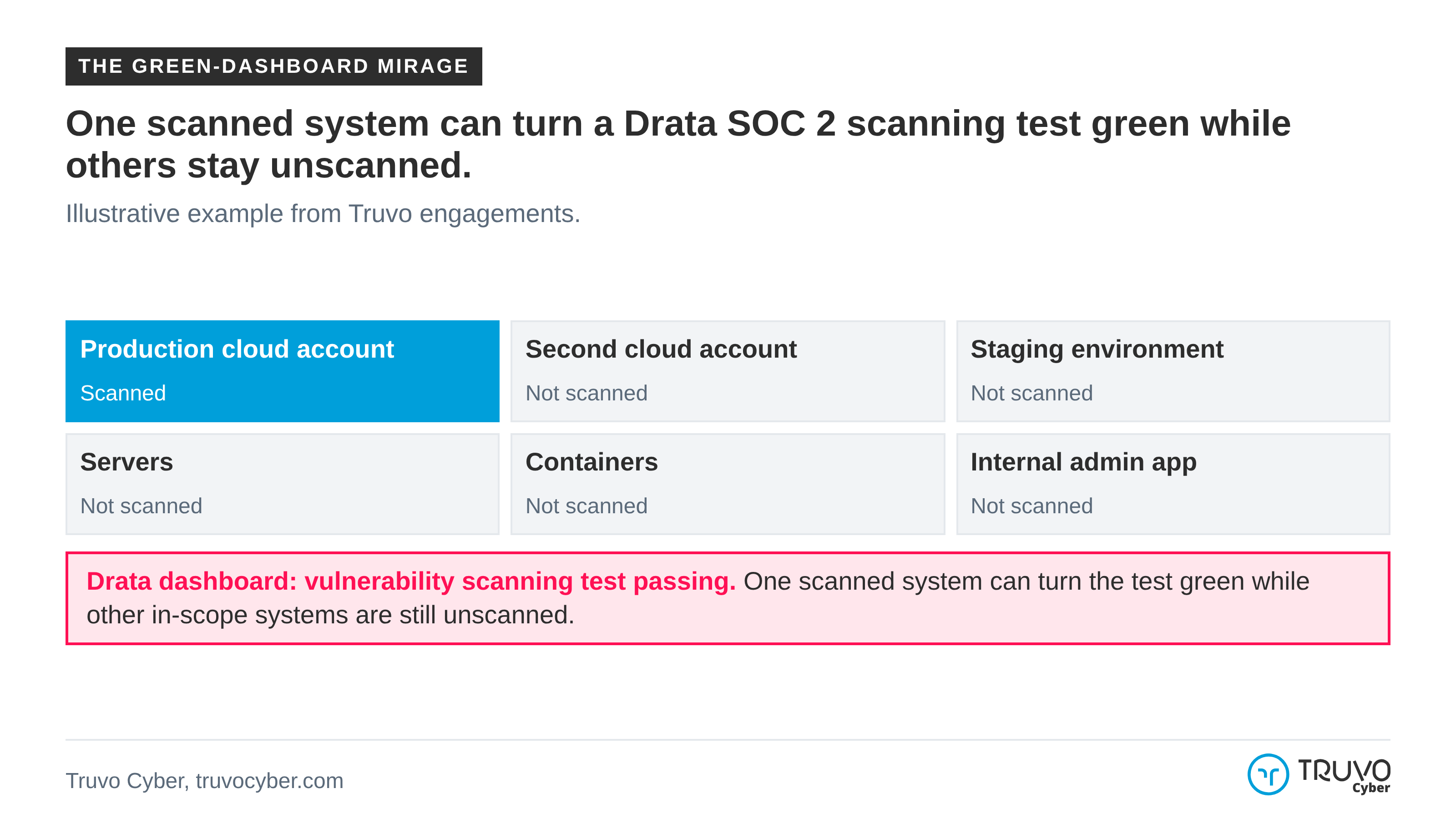
Figure: The green-dashboard mirage in Drata, an illustrative example from Truvo engagements: one scanned system can turn a Drata SOC 2 scanning test green while others stay unscanned. Six in-scope systems need infrastructure vulnerability scanning: a production cloud account, a second cloud account, a staging environment, servers, containers and an internal admin app. Only the production cloud account is scanned, and the Drata dashboard can still show the vulnerability scanning test as passing. Click to enlarge.
I call this the green-dashboard mirage. Green looks finished, and it can be very misleading, for your security and for your audit. The fix is a coverage check: for each control, list every in-scope system and confirm each one has evidence. Our post on why a green GRC dashboard isn't the same as audit-ready walks through how to build that system inventory step by step.
How do you tailor Drata's SOC 2 policies to the way your team works?
Start from Drata's templates, then rewrite each policy and procedure so it matches what your team does every week. An auditor compares the policy with your evidence, so the policy has to describe your real tools and habits:
- Access reviews. If the policy says quarterly reviews of every system, the team needs a quarterly review of every system, with a named reviewer.
- Change management. If your engineers ship through pull requests with required reviews in GitHub, the procedure should say that, in those words.
- Onboarding and offboarding. The procedure should follow the path your HR tool and identity provider take, from offer letter to account removal.
- Incident response. The plan needs real names, real contact paths and a tabletop test. A plan that just says to call the CEO won't get you there.
The hardest part is translating policy into everyday workflow. When we do it, we start with how the team works today and write the procedure around it, then change the workflow only where security needs it. The policies end up shorter, and the team can follow them.
Who fixes failing tests in Drata?
An engineer with admin access to the system behind the test. Drata flags a failing test. Someone has to decide what it means, then make the change: enforce MFA, turn on logging, encrypt laptop disks or extend the scanner to the in-scope systems it missed.
In our managed Drata service, a failing test follows the same path every time:
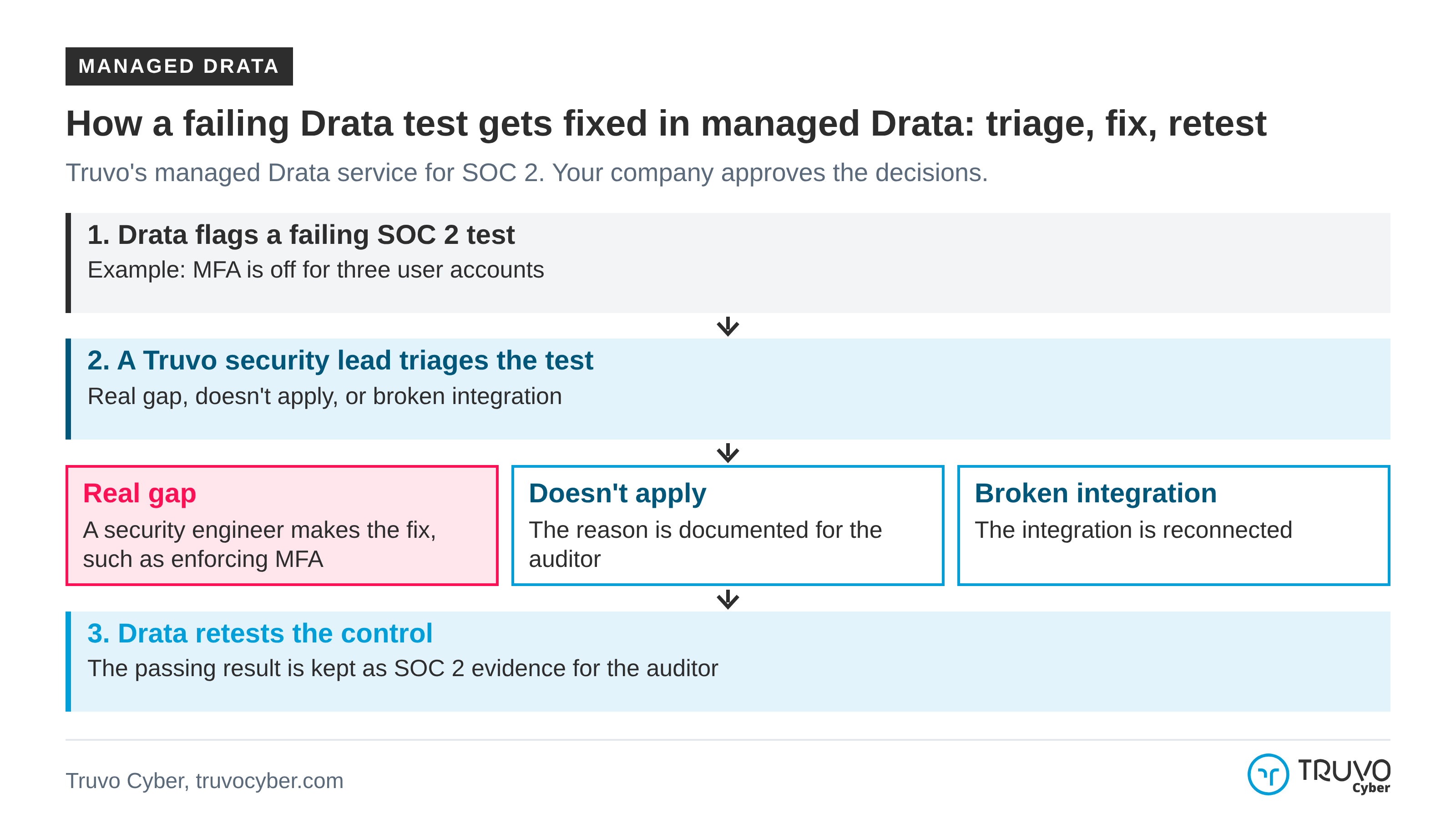
Figure: How a failing Drata test gets fixed in Truvo's managed Drata service. Drata flags a failing SOC 2 test, for example MFA off for three user accounts. A Truvo security lead triages the test into one of three paths: a real gap, where a security engineer makes the fix, such as enforcing MFA. A test that doesn't apply gets the reason documented for the auditor. A broken integration gets reconnected. Drata then retests the control, and the passing result is kept as SOC 2 evidence. Click to enlarge.
We give clients security engineers they use as needed for this work: cloud configuration, identity, logging, endpoint management, vulnerability scanning. Your developers keep your application code, which keeps the scope clear.
Does Drata perform the SOC 2 audit?
A licensed CPA firm performs the SOC 2 audit and issues the report. Drata speeds up the audit, because the auditor can review evidence in one place, and Drata lists audit firms in its Audit Alliance directory.
Here's how I explain it on calls. Everybody wants Type 2, but the thing with Type 2 is that time has to pass. You get your Type 1 first so you have something to show prospects. Then you run an observation period, commonly three months or more for a first report, where you show you're doing the work: vulnerability scanning every week, access reviews every quarter, onboarding and offboarding done properly. The Vanta and Drata SOC 2 guide covers the audit process in more detail.
How does a managed Drata service close the scoping and coverage gap?
A managed Drata service puts a security team in charge of the Drata account you already own. You keep the subscription, the evidence history and the decisions. We build the security program first and let compliance come out of it as a byproduct:
- Capability assessment and scope review. We score around 19 security capabilities and map every in-scope system. Security capabilities are the building blocks of an effective security program.
- Security Program Manual. We write down how your company handles security, for your stack and your team, and tailor every Drata policy to match. You own the manual.
- Controls, coverage and evidence. Engineers extend coverage to every in-scope system, controls get named owners, and evidence follows a schedule.
After the build, we review Drata every business day and send a short status report every Friday. Type 1 readiness typically takes 8 to 12 weeks from kickoff. The result is a company that's always audit ready: compliance like clockwork.
Running Drata in-house works when someone on the team has security as their main job. A managed service works when security is somebody's second or third job. The post on running Vanta or Drata with a managed service compares the two options factor by factor.
Ready for a team to handle the SOC 2 work Drata leaves to you?
If your Drata dashboard is green but you're not sure the scope is complete, that's a normal place to be, and a fixable one. We'll look at your Drata account with you, check scope coverage control by control, and lay out a dated plan to the audit.
Truvo Cyber is a cybersecurity professional-services firm, a fractional security team and a Drata partner. I spent years in security at Payments Canada, KPMG and Accenture before founding Truvo, and every engagement is senior-led. Book a strategy call and bring your Drata dashboard.
Where to start, depending on what you need:
- Someone to operate the platform: Managed Drata or Managed Vanta
- Hands on keyboard to extend coverage and fix tests: security engineers on demand
- A senior owner for scope and the whole program: vCISO services
Check what your Drata dashboard can't see
Truvo reviews your SOC 2 scope, extends coverage to every in-scope system and runs Drata with you, from failing tests to audit day.
Frequently asked questions
Does Drata automate SOC 2?
Drata automates the technical part of SOC 2: evidence collection and continuous tests for connected systems, such as cloud settings, MFA and laptop encryption. People still set the scope, tailor policies, perform process controls, fix failing tests and work with the auditor. A licensed CPA firm performs the SOC 2 audit.
How much of SOC 2 can Drata automate?
In Ali Aleali's estimate from Truvo engagements, about 30 to 40% of SOC 2 tests are technical tests that Drata can automate. The rest is process work: policies, the risk assessment, access reviews, vendor reviews, incident response, training and change management. For that work, Drata tracks tasks and stores the evidence.
Why does Drata show a SOC 2 test as passing when systems are missing?
A platform test checks for evidence of a control, and one passing check can turn the test green. If an infrastructure vulnerability scanner covers the production cloud account but misses other in-scope systems, such as a second cloud account, staging or servers, the test can still pass. A coverage check, system by system, shows the real state of the control.
What is the biggest gap in a Drata SOC 2 program?
In Truvo engagements, the biggest gap is scoping: setting a complete SOC 2 scope, tailoring policies and procedures to the company's real environment, tools and team, and making sure every in-scope system is covered. A scope review early in the program closes the gap.
Who fixes failing tests in Drata?
An engineer with admin access to the system behind the test. Many failing Drata tests need a technical change, such as enforcing MFA, enabling logging, encrypting laptop disks or extending vulnerability scanning. In a managed Drata service, a security lead triages each test and security engineers make the fix.
Can someone run Drata for us?
Yes. A managed Drata service operates the Drata account your company owns: scope review, tailored policies, failing tests, process controls, evidence and audit preparation. Your company keeps the subscription and the decisions. Truvo Cyber is a Drata partner and offers managed Drata alongside vCISO and on-demand security engineering.