


Security engineers on demand do the work a gap assessment leaves behind: they harden your cloud, connect SSO and MFA, turn on logging, enroll laptops and wire up evidence, inside your systems, under a senior security lead. You buy their time for a project, a season or a block of days, with no full-time hire. If you're holding a gap list nobody has hours for, sort it into technical fixes and decisions, and bring in engineers for the technical half.
At a glance
- Who leads: A named vCISO who owns the security program and answers to your board, auditors and customers
- Who implements: Security engineers, GRC engineers and analysts working in your systems and tools
- How engineers are added: On demand, for a project, a season or a set block of hours, under the same senior lead
- Where the GRC platform fits: Vanta, Drata or the platform you own holds the controls and evidence, and our team operates the platform
- Build order: Capability assessment, then the Security Program Manual, then policies, controls and evidence
- Who issues the report: An independent audit firm, separate from the team that builds the program
Services spotlight: leadership and hands-on engineering
| Truvo service | What it covers |
| Security engineers on demand | Security, GRC and cloud engineers placed for a project, a season or a block of days |
| vCISO | Fractional GRC leadership: a named CISSP who owns the program and the security decisions |
| Managed Vanta | We operate your Vanta account: tests, evidence, audit preparation |
| Managed Drata | The same operating model inside your Drata account |
| Security capability assessment | Scores your roughly 19 security capabilities, so engineers start on the gaps that matter |
Why do compliance projects stall after the gap assessment?
Compliance projects stall after the gap assessment because a gap list is a to-do list, and somebody still has to do it. I see this all the time, and the stall usually comes at a good moment: a big customer wants your SOC 2 report, a hospital tender asks for one, or you're moving from Type 1 to Type 2 and the observation period is about to start.
So you hire an advisor, who does a solid assessment, hands over a long spreadsheet and leaves. The spreadsheet goes back to the person who was already carrying everything.
Usually that's the CEO, the CTO or a security team of one, setting up a laptop for Monday's new hire, triaging alerts for a language the stack doesn't use, and answering a security questionnaire at 11 p.m. The GRC dashboard says 80%. A closer look shows a disaster recovery plan that boils down to "phone the founder."
None of that is a failure. The company grew faster than the security program, which is a great problem to have. The fix is simple: the person who writes the plan should be backed by people who can carry the plan out.
What's the difference between compliance advice and security implementation?
Compliance advice tells you what a control needs to achieve. Security implementation makes the control real in your systems and leaves evidence behind. You need both. A sharp assessment is where every program I've built starts.
Here's how I explain the difference to clients. A framework might say "manage your vulnerabilities effectively." Okay, but what does that mean for you? The firewalls? The operating systems? Third-party libraries? Your own code? Container images? Implementation means someone sets up scanning for each one, tunes out the noise, and makes sure the weekly scans leave records an auditor can sample.
Here are three SOC 2 controls side by side: what the advice says, and what a security engineer has to build in your systems.
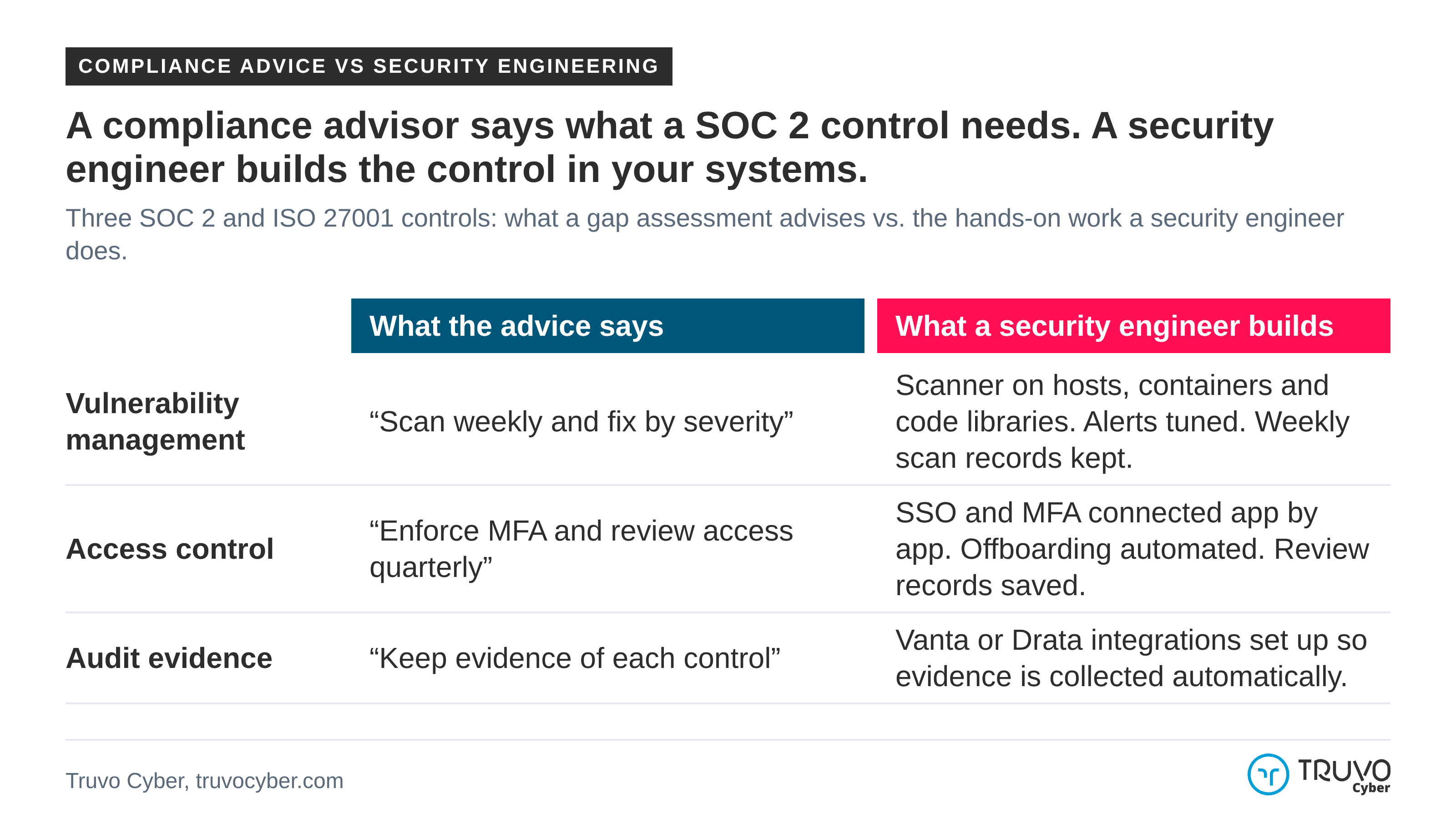
Figure: Comparison of compliance advice and security engineering for three SOC 2 and ISO 27001 controls. Vulnerability management: the advice is to scan weekly and fix by severity. The engineer deploys a scanner on hosts, containers and code libraries, tunes the alerts and keeps weekly scan records. Access control: the advice is to enforce MFA and review access quarterly. The engineer connects SSO and MFA app by app, automates offboarding and saves review records. Audit evidence: the advice is to keep evidence of each control. The engineer sets up Vanta or Drata integrations so evidence is collected automatically. Click to enlarge.
| Compliance advice versus security implementation | Advice | Implementation |
| Vulnerability management | "Scan weekly and remediate by severity" | Scanner deployed across hosts, containers and dependencies, alerts tuned, SLAs agreed, weekly records kept |
| Access control | "Enforce MFA and review access quarterly" | SSO and MFA connected app by app, leaver steps automated, review records saved |
| Evidence | "Keep evidence of each control" | Integrations and tests wired so evidence collects itself |
The policy is the easy part. Honestly, policies are an artifact of the architecture decisions we make. The hardest part is translating policy into everyday workflow.
What do on-demand security engineers do in a compliance program?
On-demand security engineers build and fix the technical controls that a compliance program depends on. They work in your environment, your ticketing and your GRC platform, under the program lead. Here's the work they pick up most often:
- Cloud security configuration: hardening AWS, Azure or GCP accounts, locking down storage, network rules and admin access.
- Identity, SSO and MFA: connecting apps to your identity provider, enforcing MFA, cleaning up local accounts and automating joiner, mover and leaver steps.
- Logging and monitoring: getting the right logs from the right sources into a SIEM, writing detections and tuning out false positives.
- Endpoint and MDM: enrolling Macs, Windows and Linux machines, setting disk encryption and screen lock, deploying EDR.
- Vulnerability management: scanning, triage, remediation timelines, retesting and the records behind them.
- CI/CD hardening: branch protection, required reviews, secrets scanning, dependency checks and locked-down deploy credentials.
- Evidence automation: wiring integrations and custom tests so Vanta, Drata or a pipeline collects evidence on a schedule.
Here's the same list as a map: the seven areas where our engineers do hands-on work for a SOC 2 or ISO 27001 program.
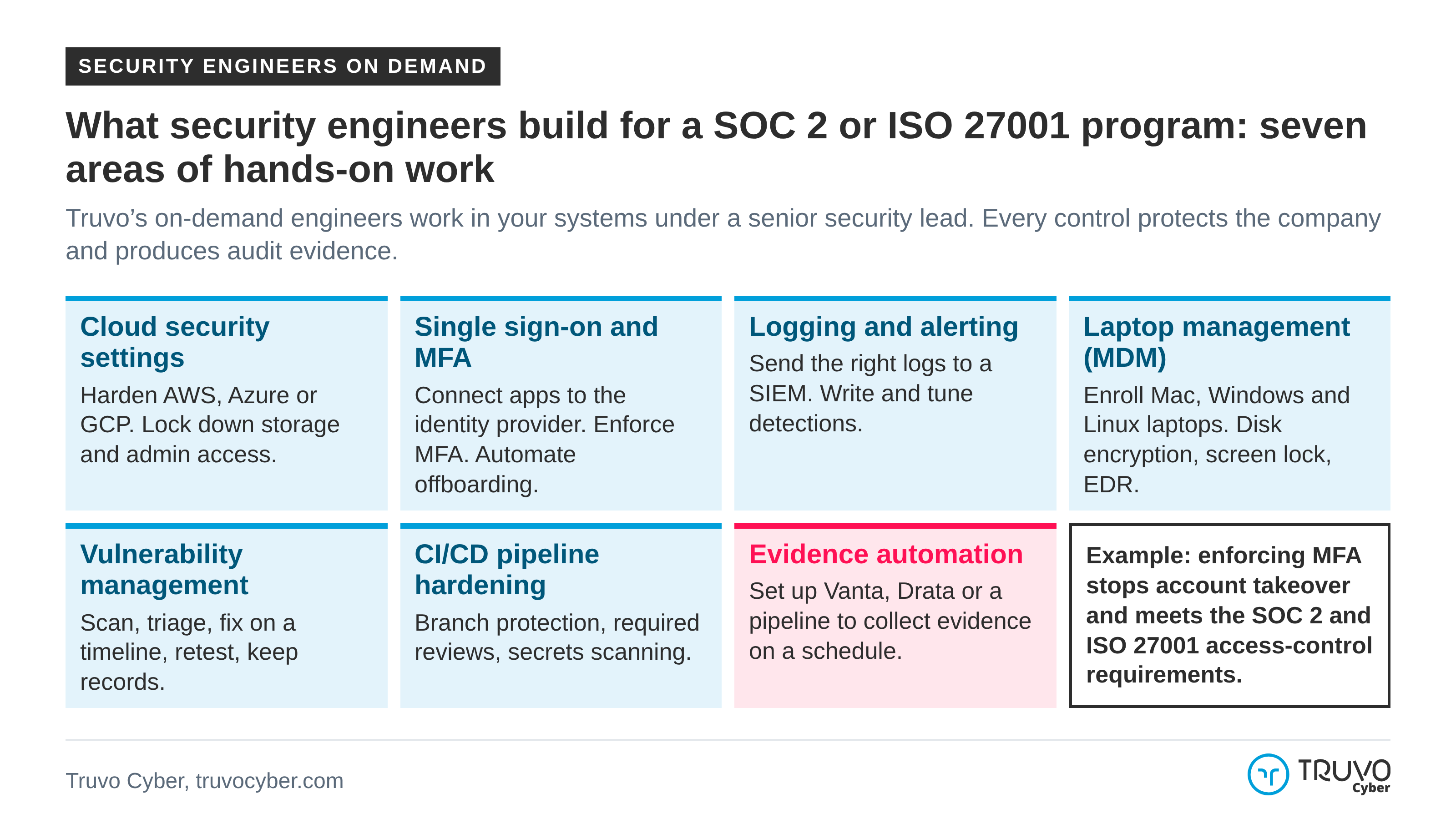
Figure: The seven areas security engineers build for a SOC 2 or ISO 27001 program: cloud security settings in AWS, Azure or GCP; single sign-on and MFA through the identity provider, with automated offboarding; logging and alerting into a SIEM; laptop management with MDM, disk encryption, screen lock and EDR; vulnerability management; CI/CD pipeline hardening; and evidence automation in Vanta, Drata or a pipeline. Example: enforcing MFA stops account takeover and meets the SOC 2 and ISO 27001 access-control requirements. Click to enlarge.
Every item on that list does two jobs. Enforcing MFA stops account takeover and meets the access-control requirements in SOC 2 and ISO 27001. Compliance becomes a byproduct of effective security, and your auditor sees the same system that keeps attackers out.
How do companies use security engineers on demand without hiring?
Companies use security engineers on demand by buying time for a defined piece of work, then scaling up or down as the program needs. A specialist hire typically takes six to nine months. An embedded engineer can start in weeks.
In practice, clients use engineers in three ways:
- A project push. Roll out MDM, get SSO across the SaaS tools, or clear a backlog of failing tests before the audit window.
- A block of hours. We often sell engineering time in five-day blocks. Five days means 40 hours, and those hours can spread over a month or two, so an engineer can investigate and fix findings instead of just flagging something red in Vanta.
- An embedded seat. A named engineer joins your team for a season and documents everything, so the knowledge stays when the engagement ends.
You meet the engineer before anything is signed and you direct the day-to-day. Our senior lead reviews the output monthly. The cybersecurity staff augmentation page lists the roles we place.
How do a vCISO, security engineers and a managed GRC platform work together?
A vCISO, security engineers and a managed GRC platform each handle one part of the same program, under one lead. Here's the split I use with clients:
| Part of the program | Who handles it | What they do |
| Leadership | The vCISO | Owns the program, sets scope and priorities, makes the security decisions and faces the board, the auditor and your customers |
| Implementation | Security and GRC engineers | Build and fix the controls in your cloud, identity provider, endpoints and pipelines |
| Operation | Analysts on the GRC platform | Triage failing tests, chase evidence, run access and vendor reviews, answer questionnaires |
| System of record | Vanta, Drata or your platform | Holds the controls, tests, policies and evidence, and gives the auditor a view |
If you're weighing who should hold the lead seat, the fractional CISO guide for SaaS companies covers what that role does week to week, and the vCISO service starts at USD $2,500 a month, depending on scope. We're a Vanta partner and a Drata partner, so we operate the platform you already bought through managed Vanta or managed Drata.
A GRC platform is a great tool, and I use one every week. The platform tells you what's failing. Someone still has to decide what to fix first. Someone still has to configure the fix. Someone still has to prove the fix held for six months. You can't buy a platform and expect a program. The post on what Vanta and Drata can't automate shows where those hours go, and the breakdown of what Drata automates for SOC 2 shows how much of the work a platform takes on.
In what order should a company build a security program for compliance?
Build the security capabilities first, and let compliance follow. Security capabilities are the building blocks of an effective security program. There are around 19 of them, like identity and access, vulnerability management, and incident response.
The build sequence goes like this:
- Capability assessment. We score each capability on a maturity scale, so you see the gaps as a profile across the program. The security capability assessment also rates each finding by what an attacker or an auditor would do with the gap.
- Security Program Manual. We write down scope, tools, owners and evidence for each capability, built from your real systems, so the program survives turnover and audits.
- Policies, controls and evidence. Policies match how your team works, controls are built in your systems, and evidence collection gets wired into daily operations.
Engineers do most of their work in step three. After the build, we split the year into ten months with two months of slack, and each month covers a couple of capabilities: vulnerability scan samples one month, the disaster recovery tabletop another. No annual scramble. Compliance like clockwork.
How does hands-on security engineering speed up deals?
Hands-on security engineering speeds up deals because enterprise buyers test what's built. Their security teams ask for SSO in your product, audit logs, MFA everywhere, and a SOC 2 Type 2 report with clean findings. Every one of those needs engineering work.
Here's where I see the revenue effect most:
- The report arrives on time. When engineers fix failing controls early, the Type 2 observation period starts on schedule and sales gets the report when promised.
- Questionnaires get faster. With real controls in place, we answer questionnaires and DDQs from one set of evidence and assemble the full package: policies, the report, evidence and the sub-processor list.
- Your CTO goes back to the product. Engineers stop collecting screenshots and the CTO stops project-managing the audit.
- The next framework is mostly mapping. Adding ISO 27001 to SOC 2 reuses most of the same evidence. Laws such as HIPAA and GDPR apply as soon as regulated data is in scope, and the same controls cover much of that work.
So one customer asked this quarter. The next one will too, and you'll be ready.
What should you ask a firm that says it leads and implements?
Ask who does the work and what you keep afterward. Here's what I'd ask:
- Who holds the lead seat, and do I meet that person before signing? A named senior lead and an account manager are different products.
- Will your engineers make changes in my systems? Get the answer in the scope, in writing.
- How do I add engineering hours mid-engagement? Look for a simple unit, like a block of days.
- What happens after the first audit? A program needs operating through every observation period after the push to readiness.
- What do I hold at the end? A Security Program Manual, a control set, evidence pipelines and documentation that stays with you.
For more, see why a green GRC dashboard isn't the same as audit-ready and what GRC managed services should include.
Get a security lead and the engineers who build the program
A gap list with no one to work through the rows, a platform full of red items, a customer waiting on a report: every one of those is a fixable moment, and often a growth moment. I'm a security architect by trade, with security work at Payments Canada, KPMG and Accenture behind me, and every Truvo engagement is senior-led, by a CISSP in the US or Canada.
Book a 30-minute strategy call. We'll look at your environment and the deal in front of you, and I'll tell you plainly what we can take on. Where to start:
- Engineers for the technical fixes: security engineers on demand
- A senior lead who owns the program: vCISO services, for fractional GRC leadership with hands-on execution
- Someone to operate your GRC platform: Managed Vanta or Managed Drata
- A clear map of the gaps first: security capability assessment
- Questionnaires and DDQs waiting on answers: security questionnaire services
Get the lead and the engineers who build it
Truvo pairs senior security leadership with engineers who implement the controls your gap assessment found.
Frequently asked questions
What are security engineers on demand?
Security engineers on demand are security specialists you bring in for a defined piece of work, such as a project, a season or a block of days, instead of hiring full time. They build and fix controls in your cloud, identity provider, endpoints and pipelines under a senior lead. Truvo pairs them with a vCISO when a company also needs someone to own the program.
What does a security engineer do for SOC 2 or ISO 27001?
A security engineer builds the technical controls an auditor tests. Typical work includes cloud hardening, SSO and MFA, logging and SIEM setup, MDM and EDR, vulnerability management, CI/CD hardening and evidence automation. The same controls protect the company and produce the audit evidence.
Can I hire security engineers on demand without a full-time hire?
Yes. Truvo places security engineers for a project, a season or a block of hours, often sold in five-day blocks that can spread over a month or two. You meet the named engineer first, direct the day-to-day work, and get monthly output reviews from a senior lead. A seat can also convert into a permanent hire.
Does Truvo replace Vanta or Drata?
Truvo works with Vanta, Drata, Secureframe, Scrut, Sprinto and other GRC platforms, and is a Vanta partner and a Drata partner. The platform holds controls, tests and evidence. Truvo is the professional-services firm that operates the platform, builds the controls behind each test, and manages audits and questionnaires.
How much do fractional security leadership and engineering cost?
Truvo's vCISO service starts at USD $2,500 a month, with the fee set by frameworks, environment size, systems in scope and how much operating work the team takes on. Engineering time is added as needed and scoped after a call. The audit firm bills the audit and the GRC vendor bills the platform licence separately.