
.svg)
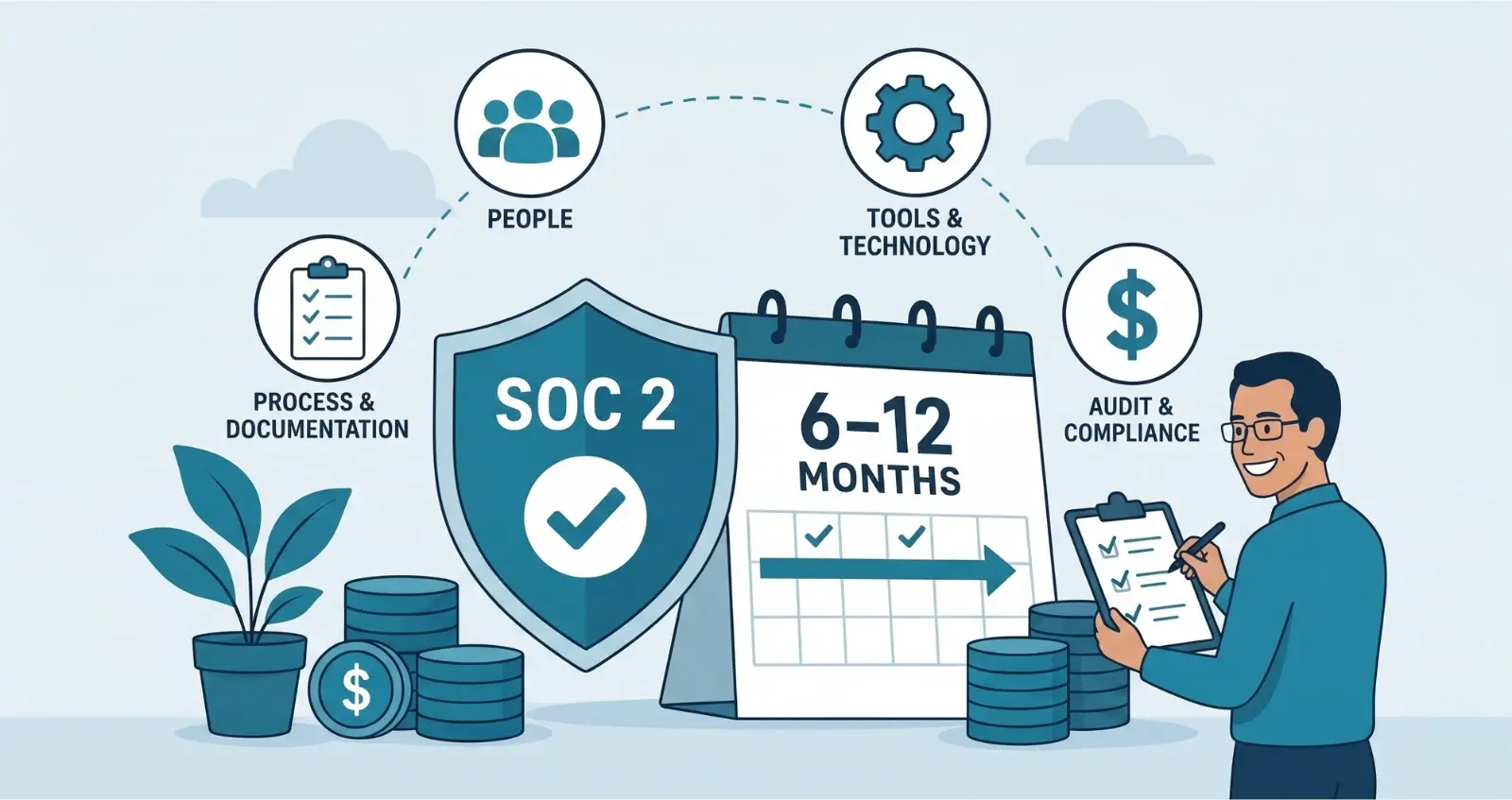
SOC 2 has four cost components. Most companies only budget for two of them, then get surprised by the rest halfway through the engagement.
Here is the full breakdown based on what competent consultants in this market actually charge, not the lowest price on the internet and not the inflated enterprise quotes.
The Four Cost Components
1. Consulting (the implementation work)
This is the engagement where someone designs the security program, writes policies, maps controls to the Trust Services Criteria, configures the GRC platform, and gets the company audit-ready.
| Engagement Type | SMB Range | Enterprise |
| Gap assessment only | A few thousand to $15,000+ | Custom |
| Build (8-12 week implementation) | From $20,000 | $75,000+ |
| Ongoing program management | Monthly subscription | Custom |
| ABO (Assess + Build + Operate annual) | From $45,000/year | Custom |
The price difference between $5,000 and $50,000 is not markup. It is the difference between template policies with the company name swapped in and a security program designed around the actual architecture, team, and risk profile. The cheaper option gets a certificate. The more expensive option gets a program that holds up under enterprise procurement review and actually runs after the consultant leaves. Knowing how to evaluate a SOC 2 consultant before signing is how you tell which you are getting.
What drives the price up
Multi-framework scope (SOC 2 + ISO 27001 + HIPAA), complex infrastructure (on-prem or hybrid vs. cloud-only), large team size, multiple business units, and international operations.
2. GRC platform (the automation engine)
A GRC platform automates evidence collection, tracks control status, and organizes the artifacts the auditor needs. For cloud-native companies, it pulls configuration data, MFA status, vulnerability scan results, and access logs through API integrations.
| Platform Tier | Annual Cost |
| SMB (under 100 employees) | $5,000 to $25,000/year |
| Enterprise | $25,000+/year |
Platforms include Vanta, Drata, Scrut, Secureframe, and Sprinto. Partner pricing through a consultant is often significantly lower than retail.
Can you skip the platform? Technically, yes. SOC 2 does not require one. But manually tracking 70-80 controls, each with 4-5 evidence items, some renewed quarterly, is a compliance risk in itself. Evidence gaps become inevitable. For cloud-native companies, the platform pays for itself in time saved during the observation period.
GRC platform is optional in some engagement models. Companies that prefer to run the program on policies, runbooks, and process documentation without a SaaS platform can do that. The consultant should be able to work either way.
3. The audit (the independent examination)
The audit is conducted by an independent CPA firm. The consultant does not run the audit. The consultant prepares the company, introduces the auditor, and manages the communication through the process.
| Audit Type | SMB Range | Enterprise |
| Type 1 (point-in-time) | $5,000 to $25,000 | $25,000+ |
| Type 2 (observation period) | $7,500 to $40,000 | $40,000+ |
Type 1 examines whether controls exist at a point in time. Type 2 examines whether controls operated effectively over a defined observation period, typically 3 to 12 months. Most companies start with Type 1, then move to Type 2 in the next cycle.
What drives audit cost up
Number of Trust Services Criteria in scope (Security only vs. Security + Availability + Confidentiality), number of subservice organizations, complexity of infrastructure, and size of the control matrix.
4. Ongoing operations (the part people forget)
SOC 2 is not a one-time project. After the first audit, the program needs to run continuously. Evidence needs to be collected. Access reviews need to happen quarterly. Policies need annual updates. Vendor risk assessments need to be current. Security awareness training needs to be delivered.
Someone has to own that year-round, and that is the line item our vCISO engagement is priced against.
| Ongoing Cost | Typical Range |
| GRC platform renewal | Same as year one |
| Annual audit (Type 2) | $7,500 to $40,000 |
| Program management (if outsourced) | Monthly subscription |
| Penetration test (annual) | $5,000 to $20,000 |
The build-to-operate gap
Companies that budget only for the first year and treat everything after as maintenance are the ones whose programs decay between audit cycles. A fractional security team is one way to keep the program running without hiring a full-time CISO. The observation period for Type 2 is where programs stall. Evidence stops being collected. Reviews get skipped. By the time the auditor returns, the period is full of gaps.
Total First-Year Cost
| Component | SMB Range |
| Consulting (Build) | $20,000 to $75,000 |
| GRC platform | $5,000 to $25,000 |
| Audit (Type 1) | $10,000 to $25,000 |
| Penetration test | $5,000 to $15,000 |
| Total | $40,000 to $140,000 |
Most SMBs land between $40,000 and $85,000 for the first year. The range depends on scope, infrastructure complexity, team size, and whether the company already has some security practices in place.
Canadian companies with NRC IRAP funding
The consulting portion is often eligible for IRAP reimbursement, which can significantly reduce the out-of-pocket cost.
Realistic Timelines
Most SMBs (under 100 people) achieve SOC 2 Type 1 readiness in 8 to 12 weeks. Smaller companies with simpler scopes can be audit-ready even faster, and some companies specifically target SOC 2 Type 1 in 90 days when a deal is on the line. Type 2 readiness follows in the same timeframe since the Build covers both, the only difference is the observation period before the Type 2 audit.
Enterprise timelines are longer, typically 6 to 12 months, because more people, more systems, more vendors, and more complexity in scoping and control design.
SMB Type 1: 8 to 12 weeks to audit-ready
| Phase | Duration |
| Scoping and gap assessment | 1-2 weeks |
| Policy and control design | 2-3 weeks |
| GRC platform configuration | 1-2 weeks |
| Control implementation and evidence | 2-3 weeks |
| Audit (Type 1) | 3-4 weeks |
For smaller SMBs (under 30 people, single-framework, cloud-only), the Build can compress to 6 weeks. The audit timeline depends on auditor availability, so engage one early.
SMB Type 2: add the observation period
Type 2 adds an observation period, typically 3 to 6 months for SMBs, during which the program must operate and collect evidence continuously. The observation period starts after controls are in place, not after the Build engagement ends.
| Phase | Duration |
| Build (same as Type 1 prep) | 8-12 weeks |
| Observation period | 3-6 months |
| Type 2 audit | 3-4 weeks |
The strategic move
Start with Type 1 to get a report in hand for active deals, then run Type 2 observation in parallel. Most enterprise buyers will accept a Type 1 report with a contractual commitment to Type 2 within 12 months.
Enterprise timelines
Larger organizations (100+ people, multi-framework, hybrid infrastructure, multiple business units) should expect 6 to 12 months for Type 1 readiness. Enterprise Type 2 engagements typically run 12 to 18 months end-to-end.
What Makes Timelines Slip
Scope creep during the build
Adding Trust Services Criteria mid-engagement (e.g., adding Availability or Confidentiality after starting with Security only) adds weeks.
No one running the program during observation
The Build gets all the attention. Then the observation period starts and nobody has bandwidth to collect evidence, run access reviews, or maintain cadences. This is the build-to-operate gap.
Auditor availability
Popular audit firms book out months in advance. If the auditor is not engaged early, the timeline extends regardless of how fast the build goes.
Remediation surprises
The gap assessment uncovers issues that require infrastructure changes, not just policy changes. Patching, network segmentation, or encryption upgrades take time.
The $10,000 SOC 2 Question
Vendors advertising SOC 2 for under $15,000 (all-in: consulting + platform + audit) exist. At that price point, the consulting portion has almost no margin for real program design. What ships is a template library with the company name inserted, a GRC platform with default controls, and an audit that examines whether the paperwork exists.
The certificate is real. The program behind it is not. The gap surfaces the first time an enterprise buyer reads the report closely, a sophisticated prospect sends a security questionnaire, or an actual incident tests whether the controls work.
The question is not whether SOC 2 costs $10,000 or $50,000. The question is whether the goal is a certificate or a security program that actually runs.
Build an Effective Security Program
Fixed-price SOC 2 engagements. Senior consultants. No hourly surprises.
Frequently Asked Questions
How much does SOC 2 cost for a small SaaS company?
Total first-year cost for most SMBs runs between $40,000 and $85,000. That includes consulting ($20,000-$75,000), a GRC platform ($5,000-$25,000/year), a Type 1 audit ($5,000-$25,000), and a penetration test ($5,000-$15,000). The range depends on scope, infrastructure complexity, and team size.
How long does SOC 2 Type 1 take?
3 to 6 months from kickoff to report. A well-run Build engagement compresses scoping, policy design, platform configuration, and control implementation into 8 to 12 weeks. The audit itself takes 3 to 6 weeks depending on auditor availability.
What is the difference between SOC 2 Type 1 and Type 2?
Type 1 examines whether controls exist at a point in time. Type 2 examines whether controls operated effectively over a defined observation period, typically 3 to 12 months. Most companies start with Type 1 to get a report in hand for active deals, then move to Type 2 in the next cycle.
Can I do SOC 2 without a GRC platform?
Technically, yes. But SOC 2 involves 70-80 controls, each with 4-5 evidence items, some renewed quarterly. Manually tracking all of that across spreadsheets creates compliance risk. For cloud-native companies, the platform automates evidence collection through API integrations and pays for itself in time saved.
Why do some vendors offer SOC 2 for under $15,000?
At that price point, consulting has almost no margin for real program design. What ships is template policies, default GRC platform controls, and an audit that examines whether paperwork exists. The certificate is real. The security program behind it is not.
Is NRC IRAP funding available for SOC 2?
For Canadian companies, the consulting portion of a SOC 2 engagement is often eligible for NRC IRAP reimbursement. IRAP contribution agreements typically cover consulting fees within the Build phase, which can significantly reduce out-of-pocket cost.
Ready to Start Your Compliance Journey?
Get a clear, actionable roadmap with our readiness assessment.
Contact Us
Sample SOC 2 Control List
Input your email to download the list
About the Author

Former security architect for Bank of Canada and Payments Canada. 20+ years building compliance programs for critical infrastructure.