


Yes. A managed Vanta service puts a security team in charge of the Vanta account you already pay for: they connect the integrations, fix the failing tests, keep the evidence current and walk you into the audit. Vanta (or Drata) stays the tool, and the managed service is the team that operates the tool, so you keep your platform and get your time back. If security is somebody's second job at your company, start by naming one accountable owner this week and sorting your red tests into real gaps and tests that don't apply.
At a glance
- Can someone run Vanta or Drata for us?: Yes. A managed service operates the account you own, week to week, through the audit
- Do we have to switch platforms?: No. The service works inside the Vanta or Drata account you already have
- Who fixes failing tests?: Security engineers make the technical changes: cloud config, identity, logging, endpoints
- Who issues the SOC 2 report?: An independent CPA firm. The managed service gets you ready, the auditor attests
- Managed vs internal setup: Internal suits a team with a dedicated security owner. Managed suits a team where security is someone's second job
Services spotlight: who can run Vanta or Drata for you
| Truvo service | What it covers |
| Managed Vanta | We operate the Vanta account you own: integrations, failing tests, evidence and audit preparation |
| Managed Drata | The same operating model inside your Drata account |
| Security engineers on demand | Engineers who make the technical fixes behind red tests: MFA, cloud config, logging, MDM |
| vCISO | A named senior lead who owns the program and faces your auditor and customers |
| Security questionnaire services | Questionnaires, DDQs and the trust center handled as a running service |
What does it look like when a company owns Vanta but nobody owns the program?
I hear the same story on a lot of first calls, and it almost always starts with something good: a big customer, a tender or an enterprise prospect asked for SOC 2. So the team did the smart thing and bought Vanta or Drata.
Then real life happened. Here's what I usually find when I open the account:
- Integrations half-connected. AWS is in, the identity provider is in, but the MDM never got rolled out to every laptop and HR is still a spreadsheet.
- Tests failing, and nobody's sure which ones count. Some are real gaps. Some don't apply to how the team works at all. From the dashboard, both look the same: red.
- A score that feels off. The evidence column says 80%. Meanwhile the disaster recovery plan says "call the CEO."
- One person carrying all of it. Usually the CTO, a founder, or the engineer who raised their hand. They're also setting up laptops, answering customer questionnaires and shipping product.
None of this means anyone did something wrong. It means the company grew faster than its security program, and that's a good problem to have. Vanta did the job Vanta is built for: collecting evidence from connected systems and flagging gaps. The missing piece is a person whose whole job is the program.
Can someone just run Vanta for us?
Yes, and this is what a managed Vanta service does. You keep the subscription. A team takes over the day-to-day: connecting integrations, triaging failing tests, writing the procedures behind each control, collecting evidence on a schedule and preparing you for the auditor.
On calls I explain it with three words: people, process and technology. Vanta and Drata sell the technology, and they sell it well, with customer success teams for product questions. What they don't sell is the people and the process, the security team that decides how your company handles access reviews, vendor risk or incident response, and then makes sure those things happen every week. You can't buy a platform and expect a program.
So the split looks like this:
| Who does what in a managed Vanta or Drata setup | Responsibility |
| Vanta or Drata (the tool) | Pulls evidence from connected systems, runs automated tests, maps evidence to framework controls, hosts policies and the trust center |
| Managed service (the team) | Owns the program: scope, procedures, failing-test triage, evidence quality, technical fixes, audit preparation, questionnaires |
| Your company | Makes the management decisions: risk acceptance, approving policies, who gets access to what |
| Independent CPA firm | Audits the controls and issues the SOC 2 report |
Truvo is a Vanta partner and a Drata partner, and we work as the team in that second row. If you're still deciding whether you need a platform at all, the post on whether you need Vanta for SOC 2 compares the three paths.
Managed service vs internal Drata or Vanta setup: how do the benefits compare?
An internal setup works well when someone on the team has security as their main job and the hours to keep it going. A managed service works well when security is somebody's second or third job. Most of the companies I talk to are in the second group, and that's completely normal before you have a full-time security team.
Here's how I lay out the choice on calls: the same Vanta subscription either way, and the real question is who does the SOC 2 work every week.
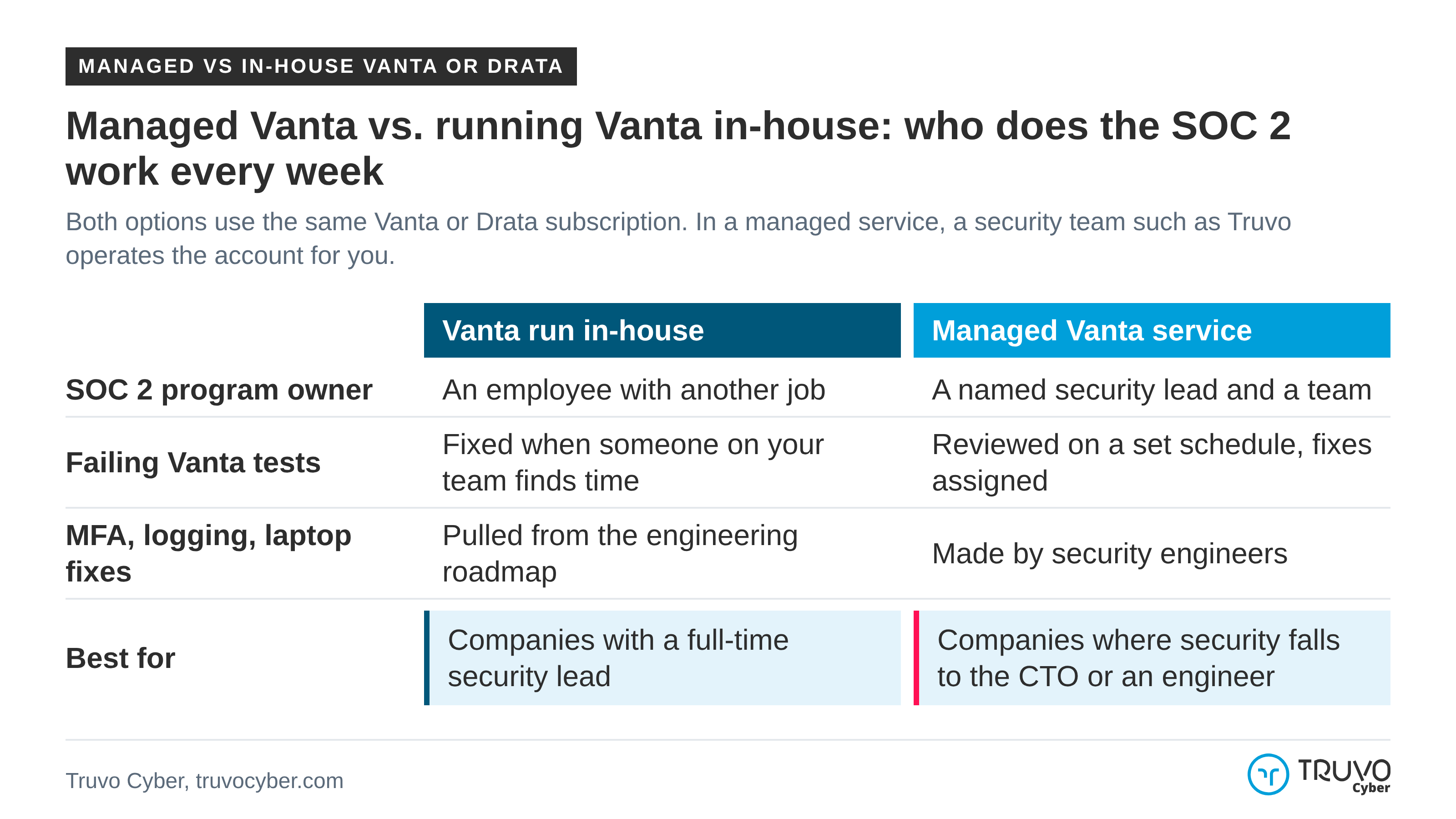
Figure: Comparison of a managed Vanta service and running Vanta in-house for SOC 2. In-house, the program owner is an employee with another job. Failing Vanta tests get fixed when someone on the team finds time, and MFA, logging and laptop fixes come out of the engineering roadmap. With a managed service, a named security lead and a team own the program, failing tests are reviewed on a set schedule with fixes assigned, and security engineers make the technical fixes. In-house suits companies with a full-time security lead. Managed suits companies where security falls to the CTO or an engineer. Click to enlarge.
| Factor | Internal Vanta or Drata setup | Managed Vanta or Drata service |
| Who owns the program | An employee, usually alongside another role | A named security lead plus a team |
| Failing tests | Triaged when the owner has time | Triaged on a set cadence, with fixes assigned |
| Technical fixes | Pulled from the engineering roadmap | Done by security engineers, or scoped with the team |
| Evidence quality | Uploaded to turn the test green | Checked against what an auditor will ask for |
| Systems the platform can't reach | Easy to miss | Inventoried and covered with manual evidence |
| Continuity when someone leaves | Knowledge leaves with the person | Documented in a program manual the company keeps |
| Cost profile | Senior engineering time | A fixed fee, less than a full-time security hire |
The biggest difference is the systems Vanta can't see. A green dashboard covers connected systems, and an auditor looks at your whole environment. The post on green dashboards that aren't audit-ready walks through how that gap opens up, and what Vanta and Drata can't automate lists the work that stays manual on any platform. If you're on Drata, the post on how much of SOC 2 Drata automates puts a number on the split.
How does a managed Vanta engagement get a company audit-ready?
We build the security program first and let compliance come out of it as a byproduct. I'll be honest with you, I treat compliance almost as an excuse to get the company properly secured. Here's the order we do it in.
Key insight
1. Capability assessment.
An effective security program is made of around 19 security capabilities: access management, vulnerability management, logging and monitoring, vendor risk, incident response and so on. Security capabilities are the building blocks of an effective security program. We score where each one stands today, which tells you which red tests are real gaps and which ones don't fit your setup.
Key insight
2. Security Program Manual.
Next we write down how your company runs security, in plain language, for your tech stack and your team. Who does the quarterly access review. Where the vulnerability scan results go. What happens when someone joins or leaves. The hardest part is translating policy into everyday workflow, and the manual is where that translation lives. You own the manual. If you ever part ways with us, you keep everything.
Key insight
3. Policies, controls and evidence.
Only then do we finish the policies, map the controls in Vanta or Drata and set up an evidence schedule. Take vulnerability management. The AICPA Trust Services Criteria ask you to detect and manage vulnerabilities, and that's a high-level statement. Real companies have vulnerabilities on laptops, browsers, servers, containers, their own code and third-party libraries. One scan in one of those places can turn a test green. A real program covers all six. Same audit, very different security.
Then things settle into operate mode. Every week, vulnerability scanning. Every quarter, access reviews. Every new hire, a background check. In our engagements the workload is lopsided: about 60 to 70% of the effort comes in the first two to three months, then we stay with you through the observation period so the evidence keeps flowing. The result is a company that's always audit ready: compliance like clockwork, with no scramble every year.
In our managed Vanta and Drata engagements, most of the effort comes up front, and the work then settles into a weekly and quarterly rhythm.
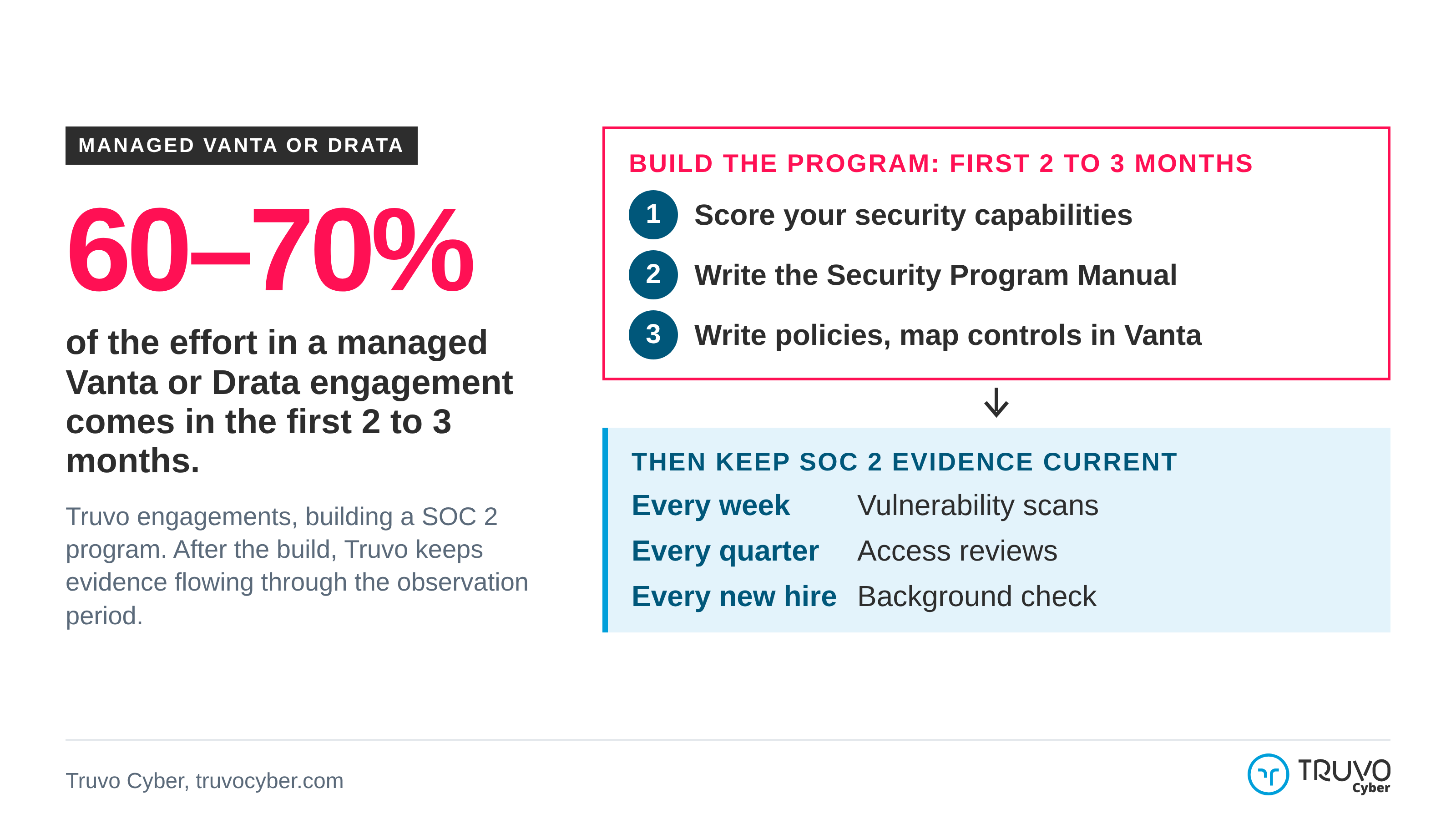
Figure: In Truvo's managed Vanta or Drata engagements, 60 to 70 percent of the effort comes in the first 2 to 3 months, while the SOC 2 program is built: scoring the security capabilities, writing the Security Program Manual, then writing policies and mapping controls in Vanta. After the build, Truvo keeps SOC 2 evidence current through the observation period: vulnerability scans every week, access reviews every quarter and a background check for every new hire. Click to enlarge.
The post on GRC managed services goes deeper into what the operate phase should include.
Who fixes the failing tests in Vanta: an advisor or an engineer?
An engineer. A lot of failing tests are technical work, and advice alone won't turn them green. Somebody has to enforce MFA in the identity provider, turn on logging in the cloud account, roll the MDM agent to every laptop, lock down a storage bucket or tune the alerts nobody has time to read.
Plenty of companies have paid for a year of advice and ended up with a list of recommendations the CTO worked through at night. I get the frustration.
So we give clients security engineers they use as needed to make the technical changes themselves. Cloud configuration, identity, logging, endpoint management, firewalls and web application firewalls. If you need MFA turned on across the company, we do it. The one thing we stay out of is your application source code, which keeps the scope clear and keeps your developers in charge of the product.
How does getting Vanta under control help close deals?
Your customers want the report. Very few of them will read your policies. What closes the deal is a SOC 2 report from an independent CPA firm, a clean answer to the security questionnaire and a trust center that's current.
When Vanta is stalled, all three stall with it. The questionnaire waits in someone's inbox while the CTO answers the same 200 questions again by hand. With a working program, the report covers most of the questionnaire, the trust center covers the rest, and security reviews stop slowing the sales cycle.
One thing worth saying clearly: the managed service gets you ready, and the auditor attests. AICPA independence rules prevent the CPA firm that issues your report from taking responsibility for designing or running the controls under audit. So the team that builds and operates your program and the firm that audits it are always two separate parties.
What can a team do this week to get a stalled Vanta account moving?
You don't need to fix everything at once. Here's what we're going to do in week one, and you can start on most of it today:
- Name an owner. One person, inside or outside the company, accountable week to week.
- Sort the red tests into three buckets. Real gap, doesn't apply (document why), or blocked on an integration.
- Finish the integrations. Identity provider, cloud, MDM, HR, ticketing. Each missing one means manual evidence later.
- List what Vanta can't see. On-prem servers, a colo rack, a homegrown admin tool.
- Put a date on the audit. Work back from the customer deadline.
- Decide build-and-run or build-and-hand-over. We build it and you run it, or we run it for you. Both work. Pick based on who has the hours.
Ready to hand Vanta to a team that runs it?
If your Vanta or Drata account is half set up and one person is holding it together, that's a fixable moment, and usually a sign the business is growing. We'll look at your account with you, tell you which red tests are real gaps, and lay out a dated plan from where you are to the audit.
Truvo Cyber is a cybersecurity professional-services firm and a fractional security team. I spent years in security at Payments Canada, KPMG and Accenture before founding Truvo, and every engagement is senior-led: the people who scope your program are the people who build it with you. Book a strategy call and bring your dashboard.
Where to start, depending on what you need:
- Someone to operate the platform: Managed Vanta or Managed Drata
- Hands on keyboard for the technical fixes: security engineers on demand
- A senior owner for the whole program: vCISO services
- Questionnaires piling up while the audit is pending: security questionnaire services
Hand Vanta to a team that runs it
Truvo runs your Vanta or Drata program end to end, from failing tests to audit day, so your engineers stay on the product.
Frequently asked questions
Can someone run Vanta for us?
Yes. A managed Vanta service operates the Vanta account your company already owns: integrations, failing tests, control procedures, scheduled evidence and audit preparation. Your company keeps the subscription and the management decisions, and an independent CPA firm still issues the SOC 2 report.
What is the difference between a managed service and an internal Drata setup?
With an internal Drata setup, an employee owns the program alongside another job, and fixes come out of engineering time. With a managed Drata service, a named security lead and a team own the program, triage failing tests on a cadence, check evidence and make technical changes. Internal suits a dedicated security owner. Managed suits a stretched team.
Do we have to switch from Vanta or Drata to use a managed service?
A good managed service works inside the platform you already pay for, so you keep your integrations, history and evidence. Truvo is both a Vanta partner and a Drata partner and operates whichever platform the company owns. Switching only makes sense when the current platform can't cover a framework or system you need.
Who fixes failing tests in Vanta?
Security engineers. Many failing Vanta tests need technical work: enforcing MFA, enabling cloud logging, rolling out MDM or restricting storage access. A managed service with engineers available as needed makes those changes directly, so fixes don't wait on the product roadmap. Tests that don't fit get tailored, with the reason documented.
How long does it take to get audit-ready with managed Vanta?
In our engagements, about 60 to 70% of the work happens in the first two to three months: capability assessment, the Security Program Manual, policies, controls and integrations. For a SOC 2 Type 2, the observation period follows, and the team keeps evidence current through that period until the CPA firm completes the audit.
Does a managed Vanta service replace the SOC 2 auditor?
No. AICPA independence rules prevent the CPA firm that issues the SOC 2 report from designing or operating the controls it audits. The managed service builds and runs the program and gets you ready. A separate, independent CPA firm audits the controls and issues the report.