

A managed Vanta or Drata service is a security team operating the platform account you already own. At Truvo, we take the account from kickoff to SOC 2 Type 1-ready in 8 to 12 weeks: scope review, integrations, failing-test triage, tailored policies and an evidence calendar, then an internal audit before the CPA firm arrives. After the audit, the work settles into a daily, weekly and quarterly rhythm. If you want to see that rhythm on one page, grab the sample operating calendar at the end of this post.
| Weeks (typical) | What happens | What you hold afterwards |
| 1 to 2 | Onboarding and SOC 2 scope review | An agreed scope and a list of in-scope systems |
| 2 to 4 | Integrations connected | Vanta or Drata testing your real environment |
| 3 to 8 | Failing tests triaged, policies tailored | Every red test fixed or documented, approved policies |
| 6 to 10 | Evidence calendar set | An owner and a due date for every recurring control |
| 8 to 12 | Internal audit | A readiness check before fieldwork |
| After the audit | Steady state | Daily monitoring, a Friday status report, quarterly reviews |
Services spotlight: who operates Vanta or Drata in a Truvo engagement
| Truvo service | What it covers |
| Managed Vanta | We operate the Vanta account you own, from onboarding through each annual audit |
| Managed Drata | The same process inside a Drata account |
| Security engineers on demand | Engineers who make the technical fixes behind failing tests, sold in five-day blocks |
| vCISO | A named senior lead who owns the whole security program, with the platform included |
| Security questionnaire services | Questionnaires answered from your controls, plus the trust center kept current |
Every engagement is senior-led. The person who scopes your program is the person who builds the program with you.
Here's the whole path to a Type 1-ready account on one page:
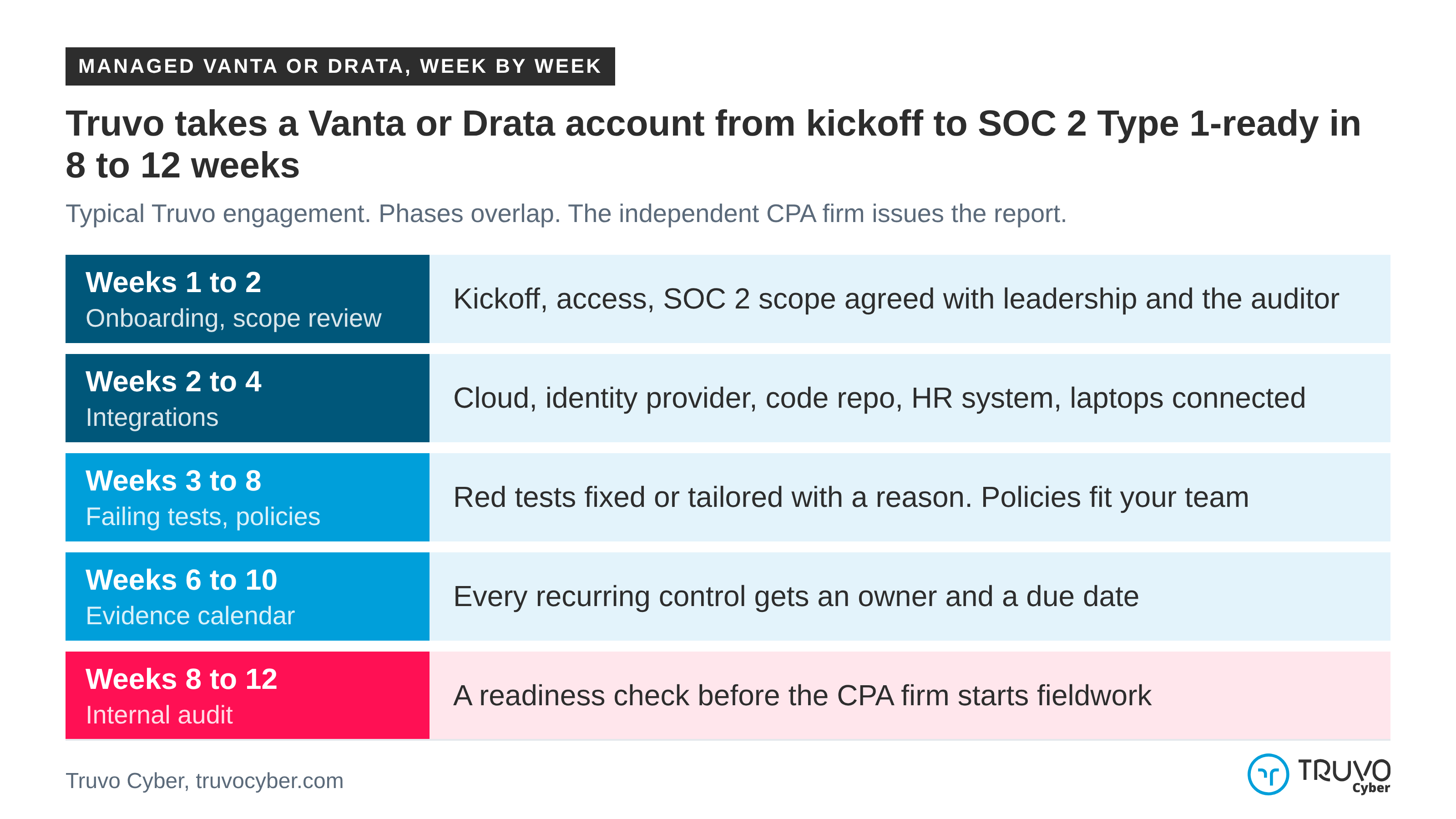
Figure: Truvo takes a Vanta or Drata account from kickoff to SOC 2 Type 1-ready in 8 to 12 weeks. Weeks 1 to 2: onboarding and scope review, with kickoff, access and SOC 2 scope agreed with leadership and the auditor. Weeks 2 to 4: integrations, with cloud, identity provider, code repository, HR system and laptops connected. Weeks 3 to 8: failing tests and policies, with red tests fixed or tailored with a reason and policies edited to fit the team. Weeks 6 to 10: evidence calendar, with every recurring control given an owner and a due date. Weeks 8 to 12: internal audit, a readiness check before the CPA firm starts fieldwork. Phases overlap, and the independent CPA firm issues the report. Click to enlarge.
What happens in the first two weeks of a managed Vanta or Drata engagement?
Weeks one and two are onboarding and scope review. Before the kickoff, we send a short information request: your SaaS tools, code repositories and cloud accounts. Then we get access to your Vanta or Drata account and look at what's connected and what's passing.
The kickoff call covers your business, your team, your infrastructure and the customer or deal that's driving SOC 2. From there we agree the scope: which products, systems, people and vendors go in the report, and which Trust Services Criteria apply. Security is always in. Availability or confidentiality come in when your customers' contracts call for them. We like to confirm the scope with your auditor early, on one call with your team, so nobody is surprised at fieldwork.
Scope is the biggest gap I see in platform accounts, and the gap is completely normal. Teams set up Vanta or Drata from the integrations they can connect, because connected integrations are the obvious place to start. The catch is that one passing check can turn a test green. One scanning integration can mark the vulnerability scanning test as passing while several systems in scope, such as a second cloud account, a staging environment, a few servers or an internal admin app, have no scanning at all. The scope review is where we find those systems and put them on the list.
How does Truvo connect Vanta and Drata integrations, including systems without one?
In weeks two to four, we connect the integrations for every in-scope system: your cloud accounts, identity provider, code repository, HR system and laptops. Once a system is connected, Vanta or Drata tests the system every day, and that daily test is the cheapest evidence you'll ever collect.
Some systems have no integration: an on-premise server, a niche SaaS tool, a database your team manages by hand. For those, we decide with you how evidence gets collected, who collects the evidence and how often, and we write that into the control. The post on what Vanta and Drata can't automate covers the usual suspects.
How are failing Vanta and Drata tests triaged each week?
Failing tests get worked from week three onwards, and the queue usually shrinks fast. We go through the red tests one at a time and sort each one into one of three groups:
- A real gap. MFA missing on an admin account, cloud logging turned off, laptops without disk encryption. We write the fix down and assign the fix to an owner.
- A test that needs tailoring. The control exists, but the test doesn't match how your team works. We adjust the test or the control and record the reason.
- A test that doesn't apply. We mark the test out of scope, with the reason in writing, so the auditor sees a decision instead of a gap.
The technical fixes need hands on keyboard. Your engineers can make them, or our security engineers on demand can make them in five-day blocks, so your roadmap stays on track. Every business day after that, we review the dashboard for new failures and integration errors, and urgent ones get triaged the same day.
How does Truvo tailor Vanta and Drata policies to the way a team works?
Policy tailoring overlaps with test triage, in weeks three to eight. Vanta and Drata both include good policy templates. A template describes a generic company, though, and your auditor will compare each policy with what your team does day to day.
So we meet with the people who do the work and edit each policy to match your stack, your tools and your process. If the policy says access reviews happen quarterly, we make sure someone owns a quarterly review and knows where the record goes. If the policy names a tool you replaced last year, we fix the name. The hardest part is translating policy into everyday workflow, and procedures are where the translation lives. The policy vs procedure guide explains the split.
Leadership approves the final set, employees accept the policies in the platform, and every policy gets an owner and an annual review date.
What is a SOC 2 evidence calendar, and who keeps the calendar in a managed service?
An evidence calendar is the schedule of every recurring control in your SOC 2 program, with an owner and a due date for each one. We set the calendar up in weeks six to ten, once policies are approved, because the policies decide the frequencies.
A typical calendar looks like this:
- Every week: vulnerability scan results reviewed and tickets opened.
- Every quarter: user access reviews for each in-scope system, and a risk register review.
- Every year: policy review, risk assessment, vendor reassessments, security awareness training, an incident response tabletop and a penetration test.
- Every new hire and leaver: background check, policy acceptance and training for joiners, and access removed on time for leavers.
Vanta and Drata handle the automated tests. Manual controls drift first, so we own the reminders and follow up with control owners until the evidence is in. The AICPA Trust Services Criteria expect controls to operate over time, and a Type 2 auditor samples across the whole observation period. A calendar is how the evidence keeps up.
What happens on SOC 2 audit day in a managed Vanta or Drata engagement?
Before the CPA firm arrives, we run an internal audit in weeks eight to twelve. We test the controls the way an auditor would, pull samples and close whatever comes up. Then fieldwork starts, and the work splits like this:
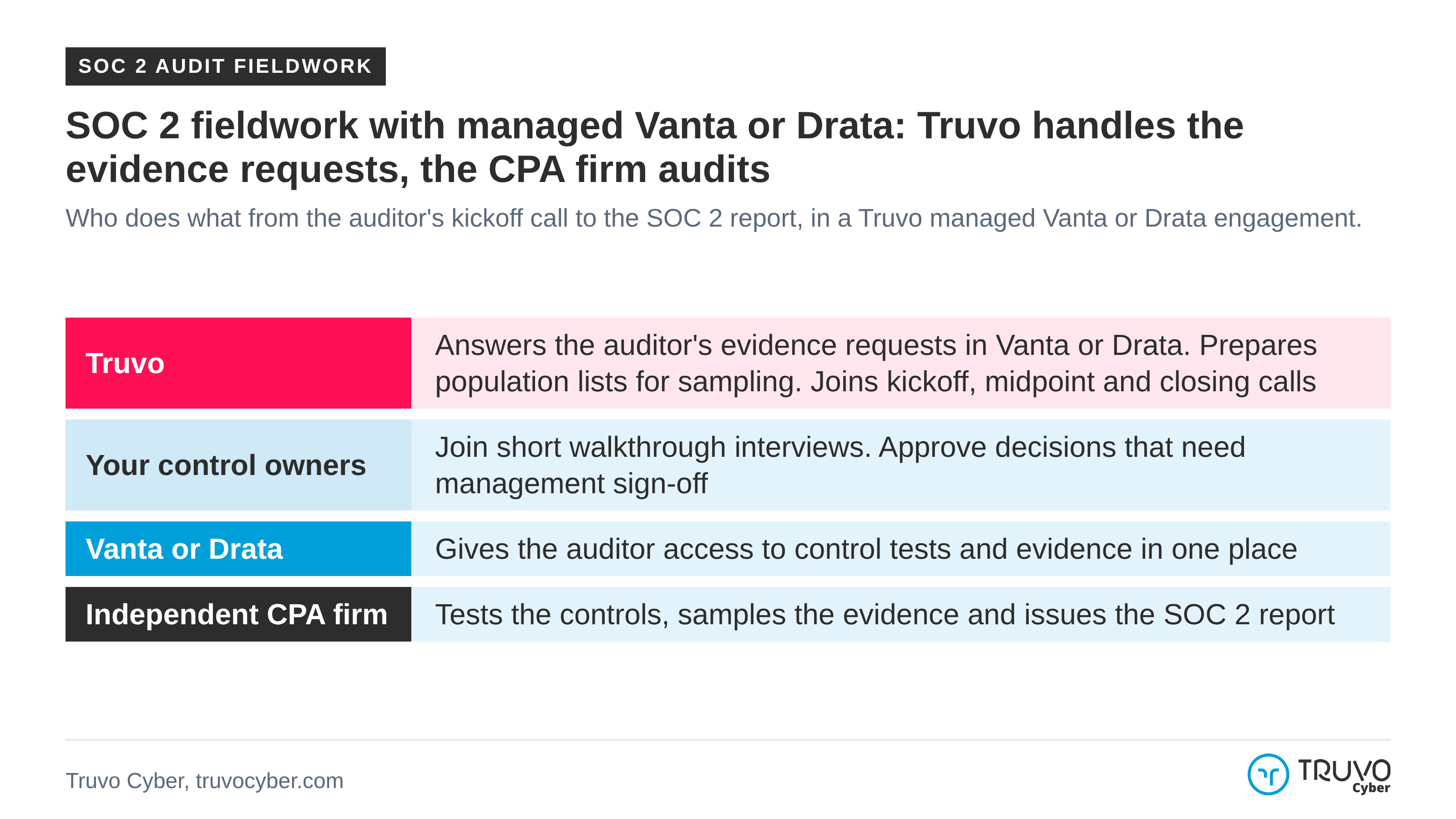
Figure: SOC 2 fieldwork with managed Vanta or Drata: Truvo handles the evidence requests, and the CPA firm audits. Truvo answers the auditor's evidence requests in Vanta or Drata, prepares population lists for sampling, and joins kickoff, midpoint and closing calls. Your control owners join short walkthrough interviews and approve decisions that need management sign-off. Vanta or Drata gives the auditor access to control tests and evidence in one place. The independent CPA firm tests the controls, samples the evidence and issues the SOC 2 report. Click to enlarge.
"Audit day" usually means a few weeks of requests and calls. We prepare the population lists the auditor samples from, such as every new hire or every production change in the period, and answer evidence requests inside the platform. Your team joins a few walkthroughs and signs off on management decisions. The independent CPA firm performs the audit and issues the report. AICPA independence rules keep the firm that issues your report separate from the firm that builds your controls, and that separation protects the value of the report.
What does steady-state managed Vanta or Drata look like after the first audit?
After the first audit, the work becomes a routine. In steady state we:
- review the Vanta or Drata dashboard every business day and triage failures,
- follow up with control owners on evidence every week, with a short status report every Friday,
- walk you through program health on a brief monthly call,
- run the quarterly access reviews and keep the risk register and vendor reviews current,
- review every policy at least once a year, run the internal audit and manage the next annual audit with your audit firm.
When you add a cloud account or a new SaaS tool, we add the system to scope and connect the integration. When a customer asks for ISO 27001 or HIPAA, we map the new framework onto the controls you already run. We call the result compliance like clockwork: always audit ready, with no scramble every year.
How does managed Drata differ from managed Vanta?
Our process follows the same steps on both platforms. The differences are mostly in naming and in how each platform works with auditors:
- Account structure. Drata organizes work into workspaces, and we set up workspaces by product or framework when needed.
- Auditor access. Drata gives your audit firm an auditor view and lists audit firms in the Drata Audit Alliance directory. Many audit firms work as Vanta auditors and review evidence inside Vanta.
- Trust center and questionnaires. Both platforms include a trust center module and questionnaire automation, and we operate both modules.
Truvo is a Vanta partner and a Drata partner, so the platform you already pay for stays yours. If you're still deciding whether a managed service fits at all, the managed vs internal Vanta comparison lays out both options.
Get the sample managed Vanta and Drata operating calendar
If you're about to hand Vanta or Drata to a team, or you're running the account yourself and want a checklist, start with the calendar. Our sample managed Vanta and Drata operating calendar lists every recurring task we run: weekly, monthly, quarterly, annual, and for each new hire and leaver, with the owner and the evidence for each one.
Download the sample operating calendar
Truvo Cyber is a cybersecurity professional-services firm and a fractional security team. I spent years in security at Payments Canada, KPMG and Accenture before founding Truvo, and every engagement is senior-led. Book a strategy call and bring your dashboard. We'll tell you which red tests are real gaps and lay out the weeks from where you are to the audit.
Where to start, depending on what you need:
- Someone to operate the platform: Managed Vanta or Managed Drata
- Hands on keyboard for the technical fixes: security engineers on demand
- A senior owner for the whole program: vCISO services
- Questionnaires piling up while the audit is pending: security questionnaire services
Hand the weekly Vanta and Drata work to a team
Truvo runs the platform you already pay for: scope, failing tests, policies and evidence, through to audit day.
Frequently asked questions
How does a managed Vanta service work?
A managed Vanta service is a security team operating the Vanta account your company owns. At Truvo the process starts with onboarding and a SOC 2 scope review, then integrations, failing-test triage, tailored policies and an evidence calendar, then an internal audit before fieldwork. After the audit, the team reviews the dashboard daily and completes the recurring controls.
How long does managed Vanta or Drata take to get audit-ready?
For a SOC 2 Type 1, our engagements typically take 8 to 12 weeks from kickoff to a ready program. For a SOC 2 Type 2, the observation period follows once controls are in place, and the team keeps evidence current through that period.
What does a SOC 2 evidence calendar include?
Every recurring control with an owner and a due date: weekly vulnerability scan reviews, quarterly access reviews and risk register reviews, annual policy reviews, risk assessment, vendor reassessments, training, tabletop and penetration test, and the tasks for each new hire and leaver.
Who fixes failing tests in a managed Vanta or Drata engagement?
Truvo triages every failing test into a real gap, a test that needs tailoring or a test that doesn't apply. Technical fixes go to your engineers or to Truvo's security engineers on demand, sold in five-day blocks. Tailoring and out-of-scope decisions are documented for the auditor.
Do we keep our Vanta or Drata account with a managed service?
Yes. Your company keeps the subscription, the account and the evidence history. Truvo is a Vanta partner and a Drata partner and operates whichever platform you own.
Does Truvo perform the SOC 2 audit?
An independent CPA firm performs the SOC 2 audit and issues the report. Truvo prepares the account, completes an internal audit beforehand and answers the audit firm's evidence requests during fieldwork.