

A security questionnaire service is a security team that answers your customers' security questionnaires and DDQs for you, sends the full submission package with every response and keeps your trust center current. At Truvo, your sales team forwards the questionnaire, we answer from an approved library tied to your real controls, and the buyer gets the answers plus policies, the SOC 2 report under NDA, evidence and the sub-processor list. Vanta, Drata and Secureframe are the tools, and Truvo is the service that operates them. If you'd like to check your own package first, download the sample submission package checklist at the end of this post.
At a glance
- Who sends the questionnaire to Truvo?: Your sales team forwards the spreadsheet, portal link or DDQ
- Who answers?: Truvo's security team, from an approved answer library tied to your controls
- What goes back to the buyer?: The answers plus policies, the SOC 2 or ISO 27001 report, evidence and the sub-processor list
- How fast?: Typically a few business days for a standard questionnaire, once the library and evidence are in place
- What about the trust center?: Truvo publishes and updates the trust center on the GRC platform you own
- How does Truvo work with Vanta or Drata?: Truvo operates the platform's questionnaire and trust center modules for you
Services spotlight: who answers security questionnaires in a Truvo engagement
| Truvo service | What it covers |
| Security questionnaire services | Questionnaires, DDQs and security review calls handled, with the full submission package and your trust center |
| vCISO services | A named senior lead who owns the security program behind the answers |
| Managed Vanta or Managed Drata | The platform operated day to day, including the trust center module |
| Security engineers on demand | Engineers who build a missing control when a buyer's question needs one, in five-day blocks |
What happens when a security questionnaire arrives at Truvo?
A questionnaire often arrives on a Tuesday afternoon with a Friday deadline, and the sales rep forwards the questionnaire to whoever knows the most about security. In a lot of companies, the CTO gets the questionnaire. A steady stream of questionnaires is a sign the business is growing, and the fix is a clear intake path.
With Truvo, sales forwards the questionnaire to us in whatever format the buyer sent: a SIG, a CAIQ, the buyer's own spreadsheet or a link to a vendor-assessment portal. On the first day we sort the questions into two groups. Known questions already have an approved answer in your library. New questions need a control owner's input, a policy decision or sometimes a new control.
We flag the new questions and any gaps on day one, so sales can set the buyer's expectations early. Then we draft, review and send. Here's the whole flow:
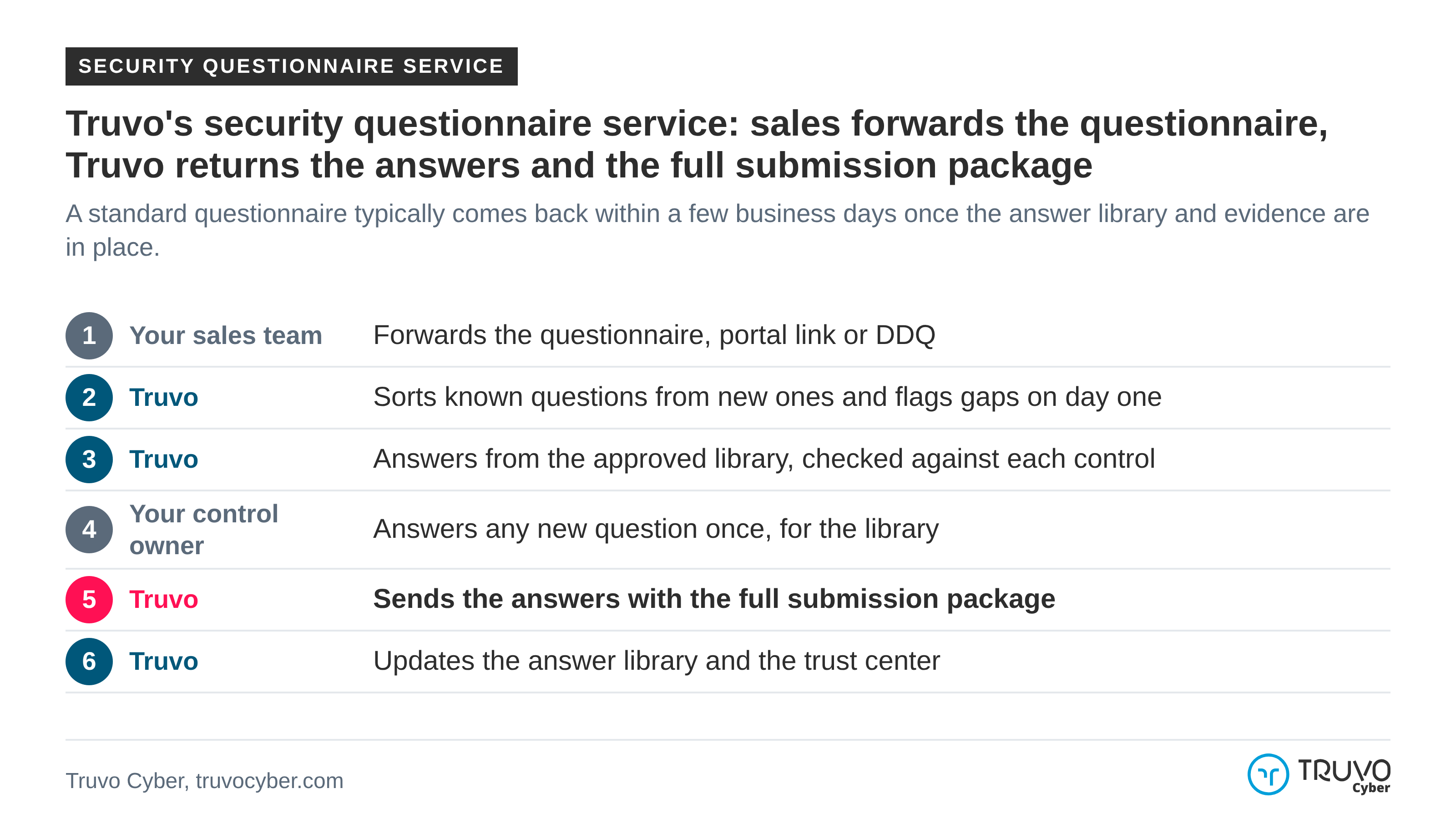
Figure: Truvo's security questionnaire service: sales forwards the questionnaire, and Truvo returns the answers and the full submission package. Step 1, your sales team forwards the questionnaire, portal link or DDQ. Step 2, Truvo sorts known questions from new ones and flags gaps on day one. Step 3, Truvo answers from the approved library, checked against each control. Step 4, your control owner answers any new question once, for the library. Step 5, Truvo sends the answers with the full submission package. Step 6, Truvo updates the answer library and the trust center. A standard questionnaire typically comes back within a few business days once the answer library and evidence are in place. Click to enlarge.
How does Truvo build and maintain a security questionnaire answer library?
The answer library is the heart of the service. Each answer is written once, reviewed once, stored with the control and evidence behind the answer, and reused for every buyer who asks the same question.
We build the library in the first weeks of the engagement. We review your controls, policies, recent questionnaires and current trust center, then write approved answers for the questions buyers ask most: access control, encryption, logging, vulnerability management, incident response, vendor management, business continuity and data handling. Every answer maps to a control, so what sales tells a buyer matches what your auditor sees.
The library stays current because we update the library after every audit, every control change and every new question. If your company moves to a new identity provider in March, the access control answers change in March. Questionnaire answers can become part of the contract with the buyer, so an answer that describes last year's setup is a real risk. A person who knows your controls reviews every answer before the answer goes out, including the ones an AI tool drafted.
What goes into the submission package Truvo sends with each questionnaire?
Buyers want more than the answered questions. Their security reviewer uses a set of documents to verify the answers, and a complete package cuts the follow-up rounds. Every Truvo response goes out with:
| Package item | What the buyer gets |
| Answered questionnaire | Every question answered in the buyer's format, with references to supporting documents |
| Policy set | The policies the buyer asked for, or a policy list with the current versions |
| SOC 2 or ISO 27001 report | The current report, shared under NDA, with a bridge letter when the period ended a while ago |
| Penetration test summary | A summary of the latest test and the status of findings |
| Evidence index | Which document or record supports each flagged answer |
| Sub-processor list | Every vendor that processes customer data, what they do and where |
The security questionnaire process guide covers each item and the in-house workflow in more detail. Our sample checklist, linked at the end of this post, has a fill-in template for the sub-processor list and the evidence index.
How does Truvo handle SOC 2 report requests and NDAs?
SOC 2 report requests come up in almost every security review. The AICPA restricts the use of a SOC 2 report to specified parties, such as customers and prospects with a business need, so the report goes out behind an NDA or an access request, never as a public download.
We handle the request flow for you. The trust center shows that you hold the report and the audit period. A prospect requests access, signs the NDA your legal team approved, and gets the report. When a buyer asks a question the report already answers, we point the reviewer to the right section. Buyers often accept the SOC 2 report in place of many questionnaire questions, so the report and the questionnaire answers have to tell the same story.
How does Truvo run a trust center as an ongoing capability?
A trust center is a public page where buyers check your security posture before they send a questionnaire. Vanta, Drata and Secureframe each include a trust center module, and we set the module up and keep the content current in the account you own.
A Truvo-managed trust center publishes your security commitments (encryption, access control, monitoring), your compliance status and audit period, and your sub-processor list. Restricted documents, such as the SOC 2 report and detailed policies, stay behind the NDA request workflow.
Publishing the trust center is the easy part. Keeping the page true is the ongoing work. We update the trust center after each audit, each control change and each new sub-processor, and we link questionnaire answers to the trust center where the answer already lives there. One client published security commitments, sub-processors and compliance status on a trust center, and prospects stopped asking for the security package because the package was already there. That's the goal: buyers self-serve the basics, and your team only hears about the questions that need a person.
What is the difference between questionnaire software and a security questionnaire service?
Questionnaire software and a security questionnaire service do different jobs, and most of our clients use both. Vanta, Drata and Secureframe can draft answers from your library and controls, which saves real time on volume. A service is the team that reviews those drafts, builds the package, sends the response and keeps the library and trust center current.
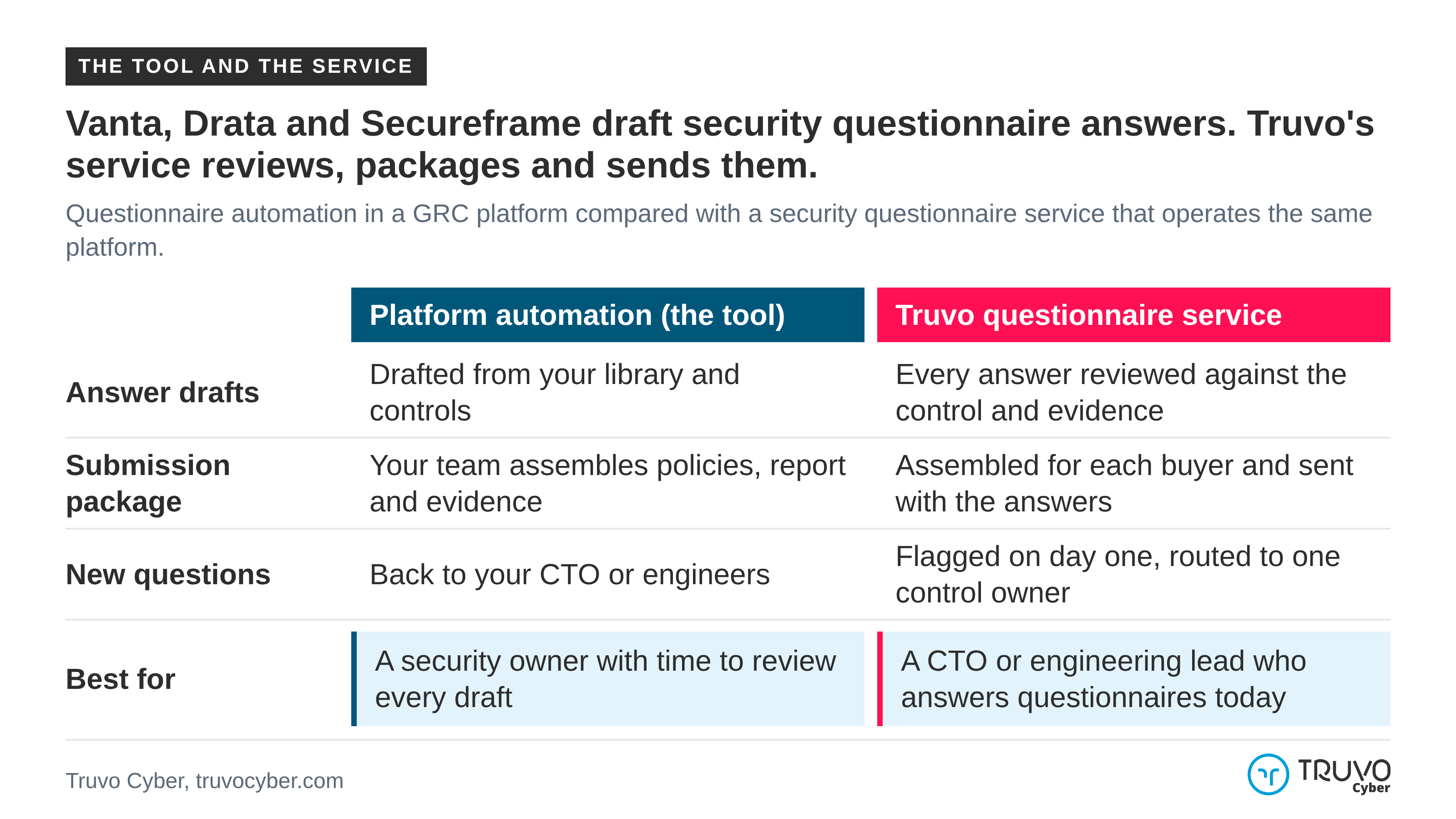
Figure: Vanta, Drata and Secureframe draft security questionnaire answers, and Truvo's service reviews, packages and sends them. Answer drafts: the platform drafts from your library and controls, while Truvo reviews every answer against the control and evidence. Submission package: with the platform alone, your team assembles policies, report and evidence, while Truvo assembles the package for each buyer and sends the package with the answers. New questions: with the platform alone, new questions go back to your CTO or engineers, while Truvo flags them on day one and routes them to one control owner. Best for: platform automation suits a security owner with time to review every draft. Truvo's service suits a CTO or engineering lead who answers questionnaires today. Click to enlarge.
If you have a security owner with time to review every draft, the platform alone can work well. If questionnaires go to your CTO or engineering lead today, a service gives that time back. The guide to security questionnaire automation covers the tooling side.
How does a security questionnaire service help close deals faster?
A security review is a step in the sales process, and the step has a clock on it. A questionnaire that waits two weeks for an engineer is a deal that waits two weeks. With an approved library and a ready package, a standard questionnaire comes back within a few business days, and your sales team can tell the buyer when to expect the response on the day the questionnaire arrives.
Consistency helps too. When the same question gets the same answer in every deal, and the answers match the SOC 2 report, security reviewers have fewer follow-ups. A Truvo security consultant can also join the security review call with the buyer's team and answer follow-up questions live, so your engineers stay on the product.
Get the sample security questionnaire submission package checklist
Before your next security review, check what you'd send. Our sample submission package checklist covers the answers, the policy list, SOC 2 report handling, an evidence index and a sub-processor list template, so nothing is missing when the buyer's reviewer opens the package.
Download the submission package checklist
Truvo Cyber is a cybersecurity professional-services firm and a fractional security team. I spent years in security at Payments Canada, KPMG and Accenture before founding Truvo, and every engagement is senior-led. Book a strategy call and bring a recent questionnaire. We'll walk through how we'd answer the questionnaire and what your trust center should publish.
Where to start, depending on what you need:
- Questionnaires and the trust center handled: security questionnaire services
- A senior owner for the program behind the answers: vCISO services
- Someone to operate the platform: Managed Vanta or Managed Drata
Take security questionnaires off your engineers' desks
Truvo answers questionnaires, assembles the full submission package and runs your trust center as an ongoing capability.
Frequently asked questions
How does a security questionnaire service work?
Your sales team forwards each questionnaire to the service. The service sorts known questions from new ones, answers from an approved library tied to your controls, routes new questions to a control owner, sends the answers with the full submission package and updates the library and trust center afterwards.
Which firms handle security questionnaires and trust center management?
Security services firms such as Truvo Cyber answer questionnaires, assemble the submission package and manage the trust center on the GRC platform you already own. Questionnaire software and GRC platforms such as Vanta, Drata and Secureframe provide the tools, which your own team or a service operates.
What is included in a security questionnaire submission package?
The answered questionnaire, the policy set or a policy list, the current SOC 2 or ISO 27001 report under NDA, a penetration test summary, an evidence index for flagged answers and the sub-processor list.
How long does a security questionnaire service take to return a questionnaire?
With the answer library and evidence in place, a standard questionnaire typically comes back within a few business days. Questions that need a new control or a policy decision take longer, and Truvo flags those on the first day.
Can AI answer our security questionnaires?
AI tools in Vanta, Drata and Secureframe draft answers quickly from your library. Answers can become part of the contract with the buyer, so a person who knows your controls should review every answer against the control and evidence before the response goes out.
Should we publish our SOC 2 report on our trust center?
Publish that you hold the report and the audit period, and put the report itself behind an NDA or access request. The AICPA restricts SOC 2 report use to specified parties.