


An ISO 27001 internal audit plan template sets out which security capability is audited each quarter, which controls and assets are tested, how deeply, and by whom. This free template is a Google Sheet with three working tabs: a scoping worksheet, the quarterly audit plan, and a three-year coverage check.
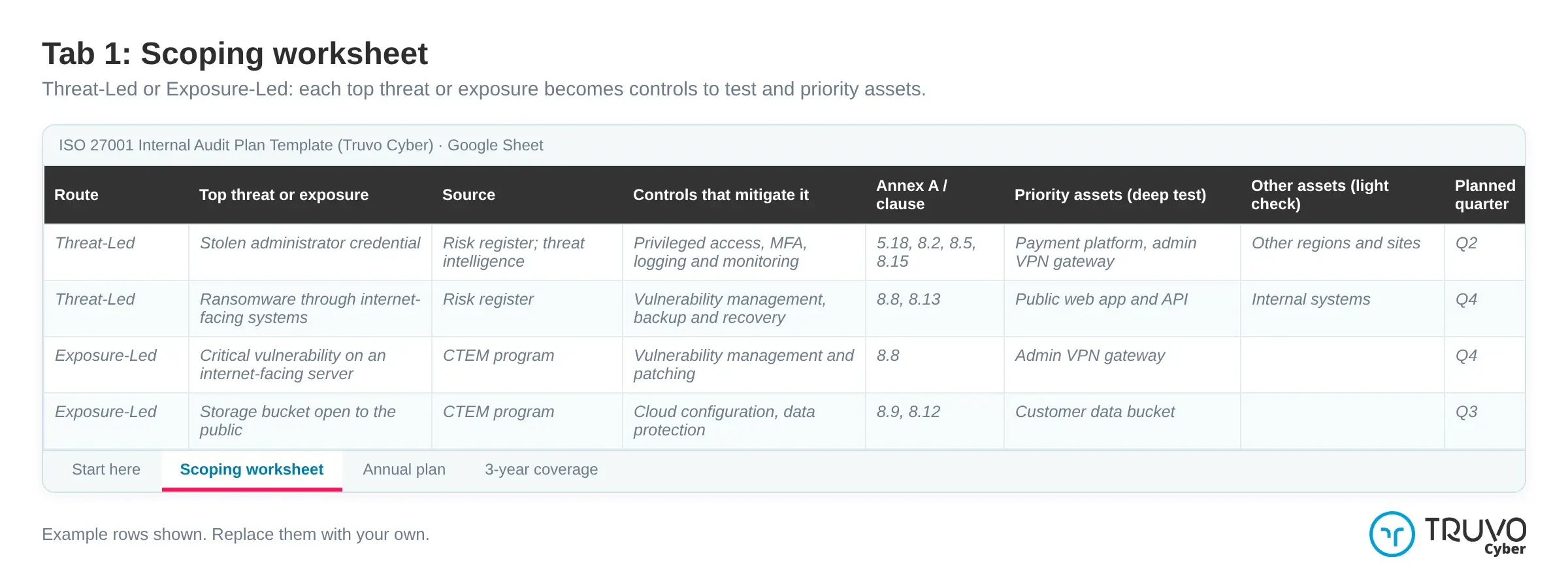
1 of 3Scoping worksheet
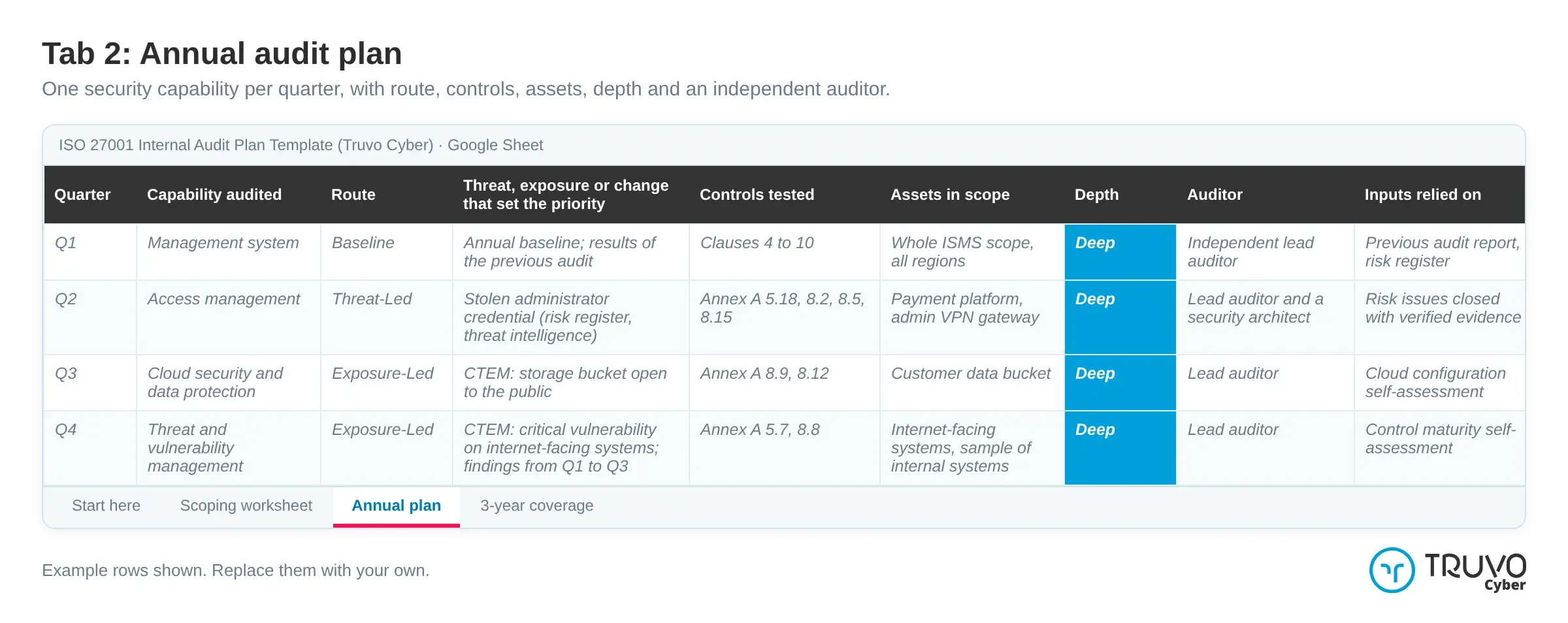
2 of 3Annual audit plan
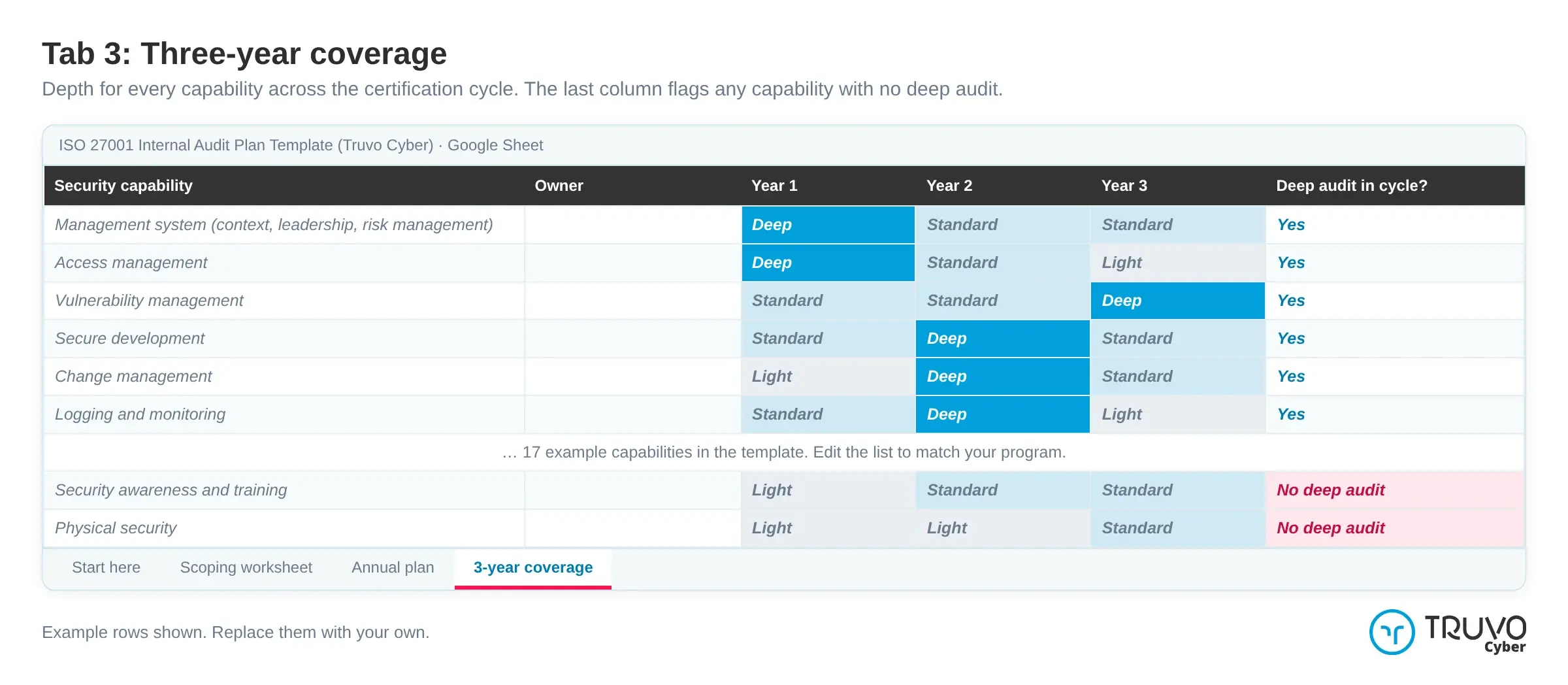
3 of 3Three-year coverage
Swipe or use the arrows to see all three tabs. Click a tab to enlarge.
At a glance
- Format: Google Sheet, copy or download as Excel
- Tabs: scoping worksheet, annual audit plan, three-year coverage
- Method: Truvo Threat-Led and Exposure-Led Scoping
- Requirement: ISO/IEC 27001:2022 clause 9.2
- Price: free, email required
Free download · Google Sheet
ISO 27001 Internal Audit Plan Template
The scoping worksheet, the quarterly audit plan with dropdowns, and the three-year coverage check that flags any capability without a deep audit. Enter your email to get it.
What is in the ISO 27001 internal audit plan template?
The ISO 27001 internal audit plan template has three tabs that you fill in order.
| Tab | What you record | What you get |
| Scoping worksheet | Top threats or CTEM exposures, the controls that mitigate each threat or exposure, and the priority assets | The controls and assets worth deep testing |
| Annual plan | One security capability per quarter, with route, controls, assets, depth, auditor and inputs relied on | A dated plan that meets clause 9.2 |
| 3-year coverage | The depth for every capability in each year of the certification cycle | A flag on any capability with no deep audit in the cycle |
Example rows are in grey italics. Replace them with your own.
How do you fill in the scoping worksheet?
The scoping worksheet turns risk into two lists: the controls to test and the assets to test them on. Pick a route for each row.
- Threat-Led Scoping: start from a top threat in the risk register, name the controls that mitigate the threat, then pick the priority assets.
- Exposure-Led Scoping: start from a top exposure in your continuous threat exposure management (CTEM) program, then name the controls that should have caught the exposure.
The risk-based ISO 27001 internal audit guide explains both routes in four steps.
What does each column of the annual audit plan mean?
Each row of the annual audit plan is one quarter.
- Route: Threat-Led, Exposure-Led, or Baseline for the management system.
- Depth: Deep means evidence, interviews and a walkthrough on the in-scope assets. Standard means a sample of evidence. Light means the auditor confirms an earlier validated record.
- Auditor: someone independent of the capability, because clause 9.2 requires objective and impartial auditors.
- Inputs relied on: maturity assessments or closed risk issues the auditor accepts, so validated controls get a light check instead of a full re-test.
Review the plan every quarter and save each update as a new dated version.
How does the three-year coverage tab prove full coverage?
The three-year coverage tab lists every security capability with a depth for each year of the certification cycle. The last column flags any capability that has no deep audit in the cycle, so gaps show up before the certification auditor finds them.
Which other Truvo templates pair with the audit plan?
Risk register template ›
12 columns, scoring and a heat map
Incident response plan template ›
Roles, severity levels and playbooks
Incident response policy template ›
The policy that sits above the plan
Vulnerability management policy template ›
Policy, SLAs and an exceptions tracker
AI agent threat model template ›
Threats and controls for AI agents
Frequently Asked Questions
What should an ISO 27001 internal audit plan include?
An ISO 27001 internal audit plan should include the scope of each audit, the controls and assets tested, the depth of testing, the auditor, and the schedule. ISO/IEC 27001:2022 clause 9.2 asks for an audit programme that considers the importance of the processes and the results of previous audits.
What is a risk-based audit plan?
A risk-based audit plan gives the most audit time to the areas with the highest risk. In this template, the scoping worksheet sets those areas from top threats or CTEM exposures, and the annual plan schedules a deep audit of each area.
Is the ISO 27001 internal audit plan template free?
Yes. Enter your email to open the Google Sheet. Use File, then Make a copy, to edit your own version, or File, then Download, for Excel.
How often should an ISO 27001 internal audit plan be updated?
Update the ISO 27001 internal audit plan every quarter. New threats, new CTEM exposures, material changes and the latest findings enter at each quarterly review.