
.svg)
TL;DR
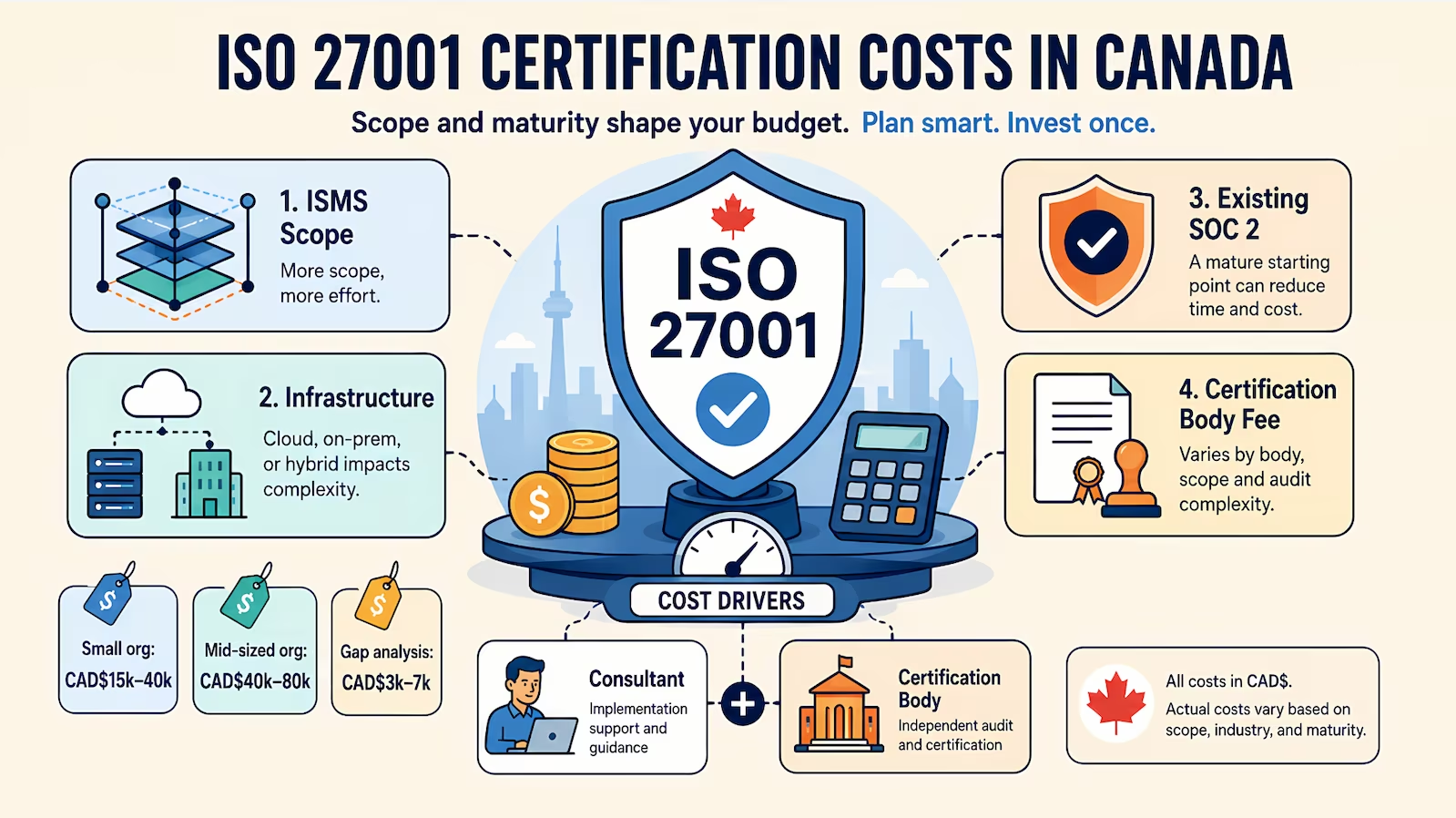
For a Canadian company, ISO 27001 typically costs between CAD$15,000 and $40,000 for a small organization (under 50 employees) and CAD$40,000 to $80,000 for a mid-sized one (51 to 250 employees). A standalone gap analysis runs CAD$3,000 to $7,000. Four variables move that number: how wide you scope your ISMS, whether your infrastructure is cloud, hybrid, or on-prem, whether you already hold SOC 2, and the separate fee charged by the accredited certification body that issues the certificate. The implementation consultant cannot also certify you, so budget those two costs separately.
There is no single price for ISO 27001, and any vendor quoting one before understanding your environment is quoting a template, not your program. The range above is real, but where you land inside it is a function of decisions you make about scope and a few facts about your business you cannot change. The four factors below turn an opaque quote into a number you can predict and defend to your board.
The question matters now, in 2026, because ISO 27001 has shifted from a nice-to-have to a revenue gate. Enterprise buyers, European customers, and an increasing number of Canadian procurement teams ask for it by name. The cost of certification is small next to the value of the deals it unblocks, but only if you scope it correctly. Overscope and you spend money proving controls over systems no customer cares about. Underscope and the certificate does not cover the part of your business the buyer was asking about.
What does ISO 27001 cost in 2026?
Across the market, the consulting and implementation effort for ISO 27001 falls into fairly consistent bands. A small organization, under 50 employees with a focused product and cloud infrastructure, generally spends CAD$15,000 to $40,000 to design and implement the Information Security Management System (ISMS) and reach audit-readiness. A mid-sized organization, 51 to 250 employees with more systems and more people in scope, lands in the CAD$40,000 to $80,000 range.
If you only want to know where you stand before committing, a gap analysis is the cheapest meaningful step. A focused assessment against the ISO 27001:2022 Annex A controls runs CAD$3,000 to $7,000 and tells you which of the 93 controls you already satisfy, which need work, and what the Statement of Applicability will look like. For companies bringing in external consultants to run the full build, the consulting line item alone commonly sits in the US$10,000 to $30,000 range depending on scope and maturity.
None of those figures include the certification-body audit, which is a separate cost covered under the fourth factor. With the bands established, here is what moves you within them.
The two costs you must budget separately
The implementation effort (CAD$15,000 to $80,000) and the certification-body audit are two distinct invoices. Accreditation rules forbid the firm that builds your ISMS from also certifying it, so never assume a single quote covers both.
Factor 1: How wide is your ISMS scope?
Scope is the single largest lever on cost, and it is the one most companies get wrong by reflex. ISO 27001 lets you define the boundary of your ISMS: which products, business units, locations, and systems the certificate covers. The Statement of Applicability then documents which of the Annex A controls apply and why, and which you have excluded with justification.
A tightly scoped ISMS, covering one SaaS product and its supporting cloud infrastructure, requires fewer controls to implement, fewer pieces of evidence to maintain, and fewer interviews during the audit. A broad scope that pulls in corporate IT, multiple office locations, a legacy on-prem system, and a second product line multiplies the control surface and the cost with it. The work is roughly proportional to the number of in-scope systems and the people whose activities touch them.
The discipline here mirrors the one we apply to SOC 2: scope to what your customers are asking you to prove, not to everything you own. A defensible, narrow scope covering the product under procurement review is worth more than a sprawling one that dilutes effort across systems no buyer will ever ask about.
Factor 2: Is your infrastructure cloud, hybrid, or on-prem?
Where your systems run changes both the implementation effort and the evidence burden. A company running entirely on managed cloud infrastructure inherits a large amount of physical and environmental control coverage from the provider. AWS, Azure, and Google Cloud carry their own ISO 27001 certifications, so the Annex A controls covering physical access, environmental protection, and hardware lifecycle largely shift to the shared-responsibility line. That leaves you implementing the logical controls: access management, change control, logging, and the rest.
A hybrid environment, part cloud and part on-prem, is the most expensive of the three: you cannot inherit those physical controls for the on-prem half, and you have to demonstrate consistent coverage across two operating models. A fully on-prem environment carries the full weight of physical security, environmental controls, and asset management as your direct responsibility, with the evidence to match. The more of your environment you move under a certified cloud provider's shared-responsibility model, the lower your implementation cost.
Factor 3: Do you already hold SOC 2?
This is where the calculus changes most, and where it pays to think about the two frameworks together rather than as separate projects. SOC 2 and ISO 27001 share roughly 80% of their underlying controls. The AICPA maintains a mapping between the SOC 2 Trust Services Criteria and ISO 27001 Annex A, and the overlap is substantial: access control, change management, risk assessment, incident response, vendor management, and the rest of the operational core appear in both.
The 80% overlap
SOC 2 and ISO 27001 share roughly 80% of their underlying controls under the AICPA mapping. Holding SOC 2 first does not make ISO 27001 free, but it removes the most expensive part of the work: standing up the security program itself.
If you already hold SOC 2, most of the security program ISO 27001 asks for already exists and is already generating evidence. What ISO 27001 adds is the management system: the formal ISMS, a documented risk treatment methodology, the Statement of Applicability, management review cadence, and internal audit. You are not rebuilding a security program; you are wrapping an existing one in the management system ISO requires. That is a meaningfully smaller, cheaper, and faster project than starting from zero, which is why we package the SOC 2 to ISO 27001 transition as a single motion rather than two independent builds. We cover that overlap in our guide on ISO 27001 and SOC 2 control mapping, and where to start if you hold neither in ISO 27001 vs SOC 2: which to pursue first.
The stage you are at matters too. A gap assessment is the CAD$3,000 to $7,000 entry point; a full implementation, designing and operating the ISMS to audit-readiness, is the bulk of the cost. Running the gap assessment first tells you which one you need and prevents paying for a full build when targeted remediation would do.
Factor 4: When do you need the certification-body audit?
Here is the fact that surprises most first-time buyers and the most important one for budgeting accurately. ISO 27001 certification is issued by an independent, accredited certification body, one accredited by a recognized authority such as ANAB in North America or UKAS in the UK. The consultant who helps you implement the ISMS cannot also certify you. ISO's accreditation rules require the certification body to be independent of the implementation work, so these are two separate engagements with two separate invoices.
The certification body runs a two-stage audit. Stage 1 reviews your documentation and readiness. Stage 2 is the full assessment that, if passed, results in the certificate. Certification then runs on a three-year cycle: the certificate is valid for three years, with lighter surveillance audits in years two and three before recertification. The certification-body fees scale with the size and complexity of your ISMS, which means the same scope decisions from Factor 1 show up again here.
Watch the timing
You do not have to engage the certification body the moment your ISMS is built. Unless a specific deal sets the date, you control when the Stage 2 cost lands, which lets you spread cost across budget periods or accumulate operating evidence first.
The timing lever is this: you do not have to engage the certification body the moment your ISMS is built. Many companies reach full audit-readiness and operate the program for a quarter or two before scheduling Stage 2, either to spread cost across budget periods or to accumulate the operating evidence that makes the audit smoother. If a specific deal requires the certificate by a date, that sets your timeline. If not, you control when the certification-body cost lands.
Already have SOC 2 vs starting fresh
The cleanest way to see the effect of these factors together is to compare the two most common starting points.
| Cost element | Already hold SOC 2 | Starting fresh |
| Security controls in place | ~80% via AICPA mapping | Built from zero |
| Gap analysis | CAD$3,000-$7,000 (lighter) | CAD$3,000-$7,000 |
| ISMS implementation effort | ISMS only (risk method, SoA, management review, internal audit) | Full program plus management system |
| Typical consulting spend | Lower end of band | Mid to upper band |
| Internal audit | Required before CB audit (standalone Truvo service) | Required before CB audit |
| Certification-body audit (Stage 1 + 2) | Separate, scope-based | Separate, scope-based |
| Time to audit-ready | Compressed | Longer |
The pattern is consistent across the companies we work with: holding SOC 2 first does not make ISO 27001 free, but it removes the most expensive and time-consuming part of the work, which is standing up the security program itself.
What you can do to control the number
You have more control over ISO 27001 cost than the quote ranges suggest. A few concrete moves:
- Define scope before you ask for quotes. Decide which product and infrastructure the certificate needs to cover based on what customers are asking for, then get quotes against that boundary. A vendor pricing a vague scope will price defensively.
- Run the gap analysis first. CAD$3,000 to $7,000 buys you a clear picture of how far you are from audit-ready and prevents paying for remediation you do not need.
- Count your SOC 2 overlap. If you hold SOC 2, map your existing controls against ISO 27001 Annex A before scoping the build. Most of the work may already be done.
- Move what you can to certified cloud. Every system under a certified provider's shared-responsibility model is a set of physical controls you do not implement or evidence yourself.
- Sequence the certification-body audit deliberately. Unless a deal sets the date, schedule Stage 2 when your evidence and your budget cycle align.
- Plan the internal audit as its own step. An independent internal audit is required before the certification body will assess you. Truvo runs ISO 27001 internal audit as a standalone service so it is done correctly and on time.
Get a Defensible ISO 27001 Number
We map your scope, SOC 2 overlap, and infrastructure to a real budget and an effective security program.
The cost that matters is the deal you unblock
ISO 27001 is not an expense you absorb to satisfy a checklist; it is the cost of access to a tier of customers who will not sign without it. Scoped well, it runs CAD$15,000 to $80,000 for most companies, plus a separate certification-body audit, and it compounds because the program keeps proving itself through the three-year cycle rather than collapsing the day after Stage 2. Scoped badly, it becomes Compliance Theater you pay for twice. The four factors above are how you tell the difference before you spend a dollar.
If you want a defensible number for your environment rather than a template range, book a scope call with Truvo. We map your scope, your SOC 2 overlap, and your infrastructure to a real budget. You can also see standard engagement pricing on our pricing page and our ISO 27001 work on our services page. Prices are listed in USD; Canadian clients are billable in CAD.
Want a fast read on where your program stands before any of that? Run the free security scorecard.
Frequently Asked Questions
How much does ISO 27001 cost in Canada in 2026?
For most Canadian companies, ISO 27001 costs CAD$15,000 to $40,000 for a small organization (under 50 employees) and CAD$40,000 to $80,000 for a mid-sized one (51 to 250 employees). A standalone gap analysis runs CAD$3,000 to $7,000. The certification-body audit is a separate cost on top of these implementation figures.
Is the certification-body audit included in consulting fees?
No. ISO 27001 certificates are issued only by an independent, accredited certification body such as an ANAB or UKAS-accredited firm. Accreditation rules require that body to be independent of your implementation consultant, so the audit is always a separate engagement with its own fee, billed across the three-year certification cycle.
Does having SOC 2 make ISO 27001 cheaper?
Yes, significantly. SOC 2 and ISO 27001 share roughly 80% of their controls under the AICPA mapping. If you hold SOC 2, the security program ISO 27001 requires largely exists already, so the project is mostly adding the management system: risk methodology, Statement of Applicability, management review, and internal audit. That is faster and cheaper than building from zero.
How does infrastructure affect ISO 27001 cost?
Cloud-only environments are cheapest because certified providers like AWS, Azure, and Google Cloud carry the physical and environmental controls under shared responsibility. Hybrid environments cost the most, since you cannot inherit those controls for the on-prem portion and must demonstrate consistent coverage across two models. Fully on-prem setups carry the full physical and environmental control burden as your direct responsibility.
How long is an ISO 27001 certificate valid?
The certificate is valid for three years. After passing the Stage 1 and Stage 2 audits, the certification body conducts lighter surveillance audits in years two and three to confirm the ISMS is still operating, followed by a recertification audit at the end of the cycle. Budgeting for ISO 27001 should account for this ongoing surveillance, not just the initial certification.
Ready to Start Your Compliance Journey?
Get a clear, actionable roadmap with our readiness assessment.
Contact Us
Free Report: The CPCSC Compliance Playbook
Join the waitlist for a free copy when it’s released.
About the Author

Former security architect for Bank of Canada and Payments Canada. 20+ years building compliance programs for critical infrastructure.