


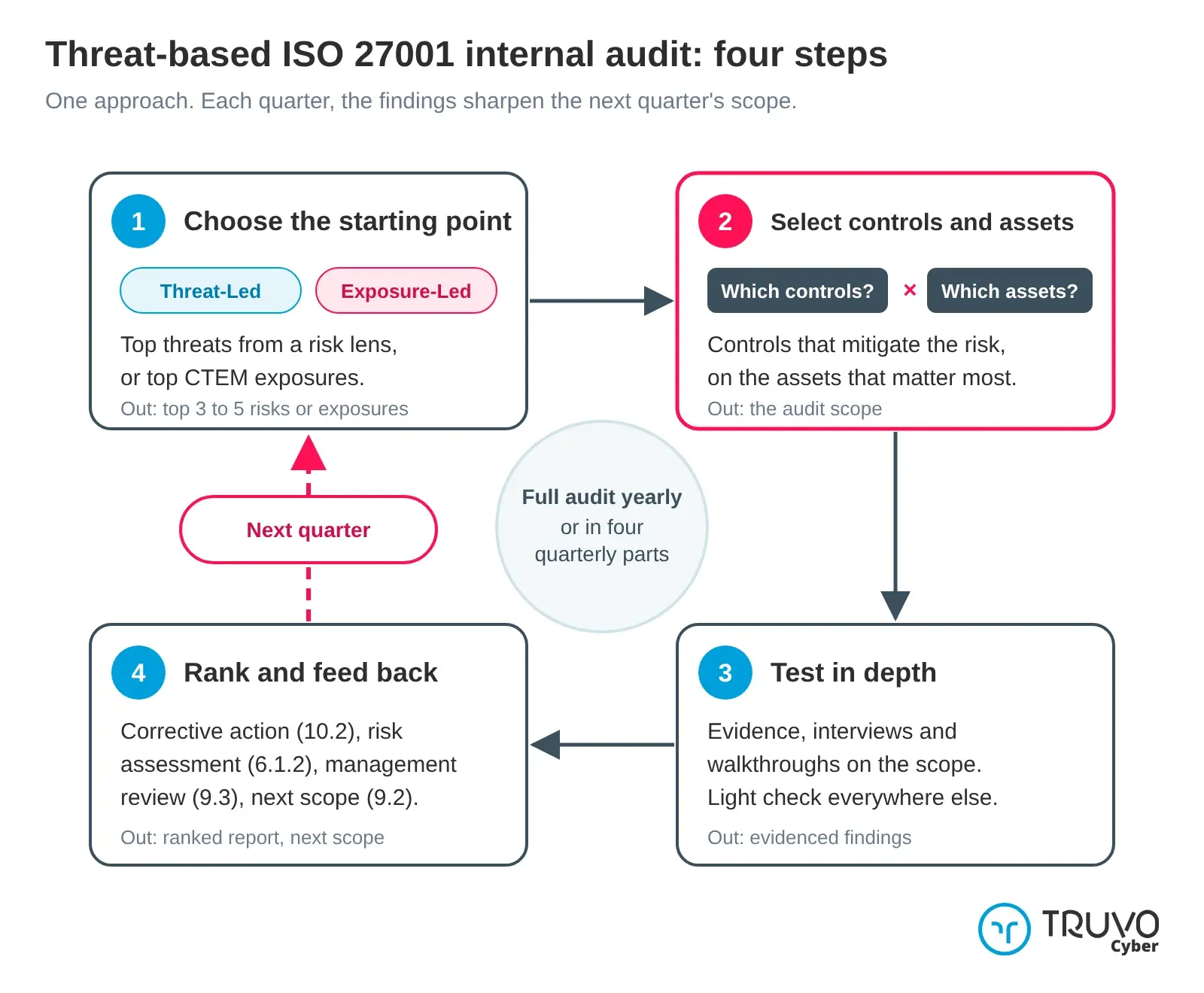
A risk-based ISO 27001 internal audit puts the audit hours where the risk sits. The scope comes down to two lists: which controls to test, and which assets to test them on. You build both lists from your top threats or your exposure management data, test those controls on those assets in depth, and feed the findings into the next quarter's scope.
1 of 3The four steps
2 of 3Two ways to select the audit scope
3 of 3An example audit year
Swipe or use the arrows to see all three diagrams. Click a diagram to enlarge.
The full management system still gets covered for certification. Risk-based scoping is one approach to the ISO 27001 internal audit. A control-by-control checklist audit also meets clause 9.2, and many programs blend the two: a light pass across every control, with deep testing reserved for the highest-risk areas.
At a glance
- Requirement: ISO/IEC 27001:2022 clause 9.2: internal audits at planned intervals
- Four steps: Choose the starting point, select controls and assets, test in depth, rank and feed back
- Scope: The controls that mitigate the top risks, tested on the priority assets
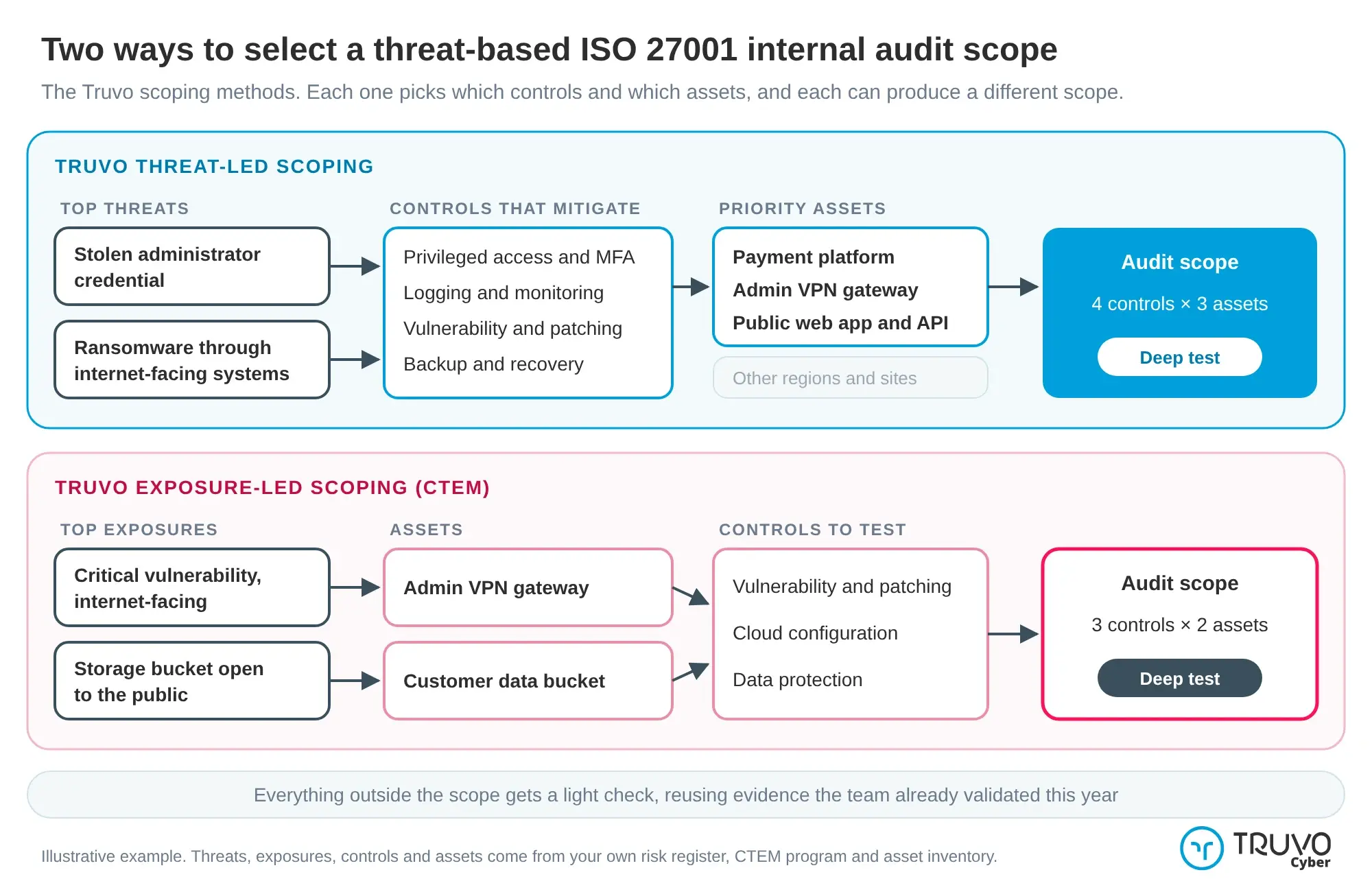
- Truvo scoping methods: Threat-Led Scoping (threats to controls to assets) or Exposure-Led Scoping (CTEM exposures to assets to controls)
- Cadence: One full audit a year or four quarterly parts, scope refreshed every quarter
- Independence: The auditor stays separate from the risk assessment
When does a risk-based ISO 27001 internal audit make sense?
A checklist audit spreads the same attention across all 93 Annex A controls, like a flashlight with a wide, even beam. For a first certification, that even coverage is useful. For a program that has held the certificate for years, the auditor walks the same path every year and confirms what the security team already knows: the access policy exists, the access review happened, the asset register has an owner column.
A risk-based audit narrows the beam onto the areas that matter most. The approach fits when:
- The checklist audit returns the same clean results every year.
- The team already produces maturity assessments, control self-assessments or closed risk issues with verified evidence that the audit can reuse.
- Security leaders want the audit to say something new about the risks they worry about.
Does ISO 27001 allow a risk-based internal audit?
Yes. Under ISO/IEC 27001:2022 clause 9.2, the organization plans an audit programme that takes into account the importance of the processes concerned and the results of previous audits. The standard sets no rule that every Annex A control receives the same test every year. Many certified organizations cover the full management system across the three-year certification cycle and vary the depth by risk. Your certification body can confirm the coverage the certification auditors expect.
ISO 19011, the guidance standard for auditing management systems, lists a risk-based approach among the principles of auditing. A risk-based audit keeps the baseline internal audit steps and changes how the scope is chosen.
Step 1: Where does a threat-based ISO 27001 internal audit start?
Input: the risk register, threat intelligence, exposure management data, legal obligations. Output: the top three to five risks or exposures for the coming quarter.
A threat-based ISO 27001 internal audit starts from one of two Truvo scoping methods. Truvo Threat-Led Scoping starts from what could go wrong. Truvo Exposure-Led Scoping starts from where the organization is already weakest. For Threat-Led Scoping, pick one or two risk lenses.
| Risk lens | Starting question | Good fit when |
| Threat scenarios | What could happen to us? | The risk register already describes scenarios, such as ransomware through a stolen administrator credential |
| Threat actors | Who targets organizations like ours, and how? | A SOC or threat intelligence feed tracks attacker techniques, often in MITRE ATT&CK terms (see the A.5.7 threat intelligence guide) |
| Regulatory exposure | Which laws carry the heaviest fines and orders? | The audit covers privacy under ISO/IEC 27701, with GDPR or HIPAA data in scope |
| Business impact | Which systems can the business least afford to lose? | The crown jewels are clearly named |
| Change | What is new since the last audit? | An acquisition, a cloud migration or the adoption of AI coding assistants |
For Exposure-Led Scoping, the starting point is the output of a continuous threat exposure management (CTEM) program: a ranked list of assets and the highest exposures on each asset, such as an internet-facing server with a critical vulnerability or a storage bucket open to the public.
Step 2: How do you select the controls and assets for a threat-based ISO 27001 internal audit?
Input: the top risks or exposures from step 1. Output: two lists, the controls to test and the assets to test them on.
The scope of a threat-based ISO 27001 internal audit is where two lists cross: the controls to test and the assets to test them on. Each Truvo scoping method fills the two lists in a different order, so the two methods can produce different scopes.
Threat-Led Scoping: threats, then controls, then assets. For each top threat, the audit team names the controls that mitigate the threat. A stolen administrator credential points to privileged access management, multi-factor authentication and logging. With a global footprint, testing those controls on every asset in every region is out of reach, so the team then picks the assets: the crown jewels, the internet-facing systems, and the region or business unit carrying the most exposure.
Exposure-Led Scoping: exposures, then assets, then controls. CTEM has already named the assets with the highest exposures. The audit team maps each exposure to the controls that should have caught or stopped the exposure. A critical vulnerability left open on an internet-facing server points to vulnerability management and patching. A public storage bucket points to cloud configuration and data protection.
Either method ends with a short list of controls, a short list of assets, and a scope narrow enough to test properly.
Key insight
The audit scope is two lists: which controls and which assets
Threat-Led Scoping and Exposure-Led Scoping fill the two lists in a different order. Both end with a scope narrow enough for the ISO 27001 internal audit to test in depth instead of sampling everything lightly.
Figure: The two Truvo scoping methods for a threat-based ISO 27001 internal audit: Threat-Led Scoping (threats to controls to priority assets) and Exposure-Led Scoping (CTEM exposures to assets to controls). The selected controls on the selected assets get deep testing, and everything else gets a light check. Click to enlarge.
Step 3: How deep should the ISO 27001 internal audit test the selected controls?
Input: the selected controls and the selected assets. Output: findings backed by evidence, interviews and walkthroughs.
Deep testing in an ISO 27001 internal audit means watching the control work on the specific asset, the way the team runs the control on a Tuesday afternoon. For a stolen-credential scenario against a payment system, the auditor checks:
- Who holds administrator rights today, compared with who is approved to hold them.
- Every path an administrator can use to log in, and whether each path enforces multi-factor authentication.
- What gets logged when an administrator acts, and who reads the log.
- How fast access is removed when a person changes role or leaves.
Controls outside the priority scope still get a light check. Where the team validated a control in detail during the year, through a maturity assessment or a closed risk issue with verified evidence, the auditor confirms the record is sound and moves on.
Key insight
Evidence the team already validated counts toward the internal audit
Maturity assessments and closed risk issues with verified evidence give the ISO 27001 internal auditor a record to confirm. The audit hours that frees up go to the selected controls on the selected assets.
Step 4: Where do risk-ranked ISO 27001 internal audit findings go?
Input: the findings from step 3. Output: a risk-ranked report and the scope for next quarter.
The ISO 27001 internal audit report ranks weak controls by risk, with a recommendation for each (see how to write internal audit findings). Each finding then travels to four places.
| Where the finding goes | ISO/IEC 27001:2022 clause | What happens |
| Corrective action | 10.2 | The owner fixes the nonconformity and the cause |
| Risk assessment | 6.1.2 and 8.2 | The risk team updates the risk picture |
| Management review | 9.3 | Top management sees the results |
| Next audit scope | 9.2 | The audit team re-tests weak controls and the systems connected to them |
The last row closes the loop. Step 4 hands step 1 a sharper risk picture, so each quarter starts better informed than the one before.
How do you schedule a threat-based ISO 27001 internal audit across the year?
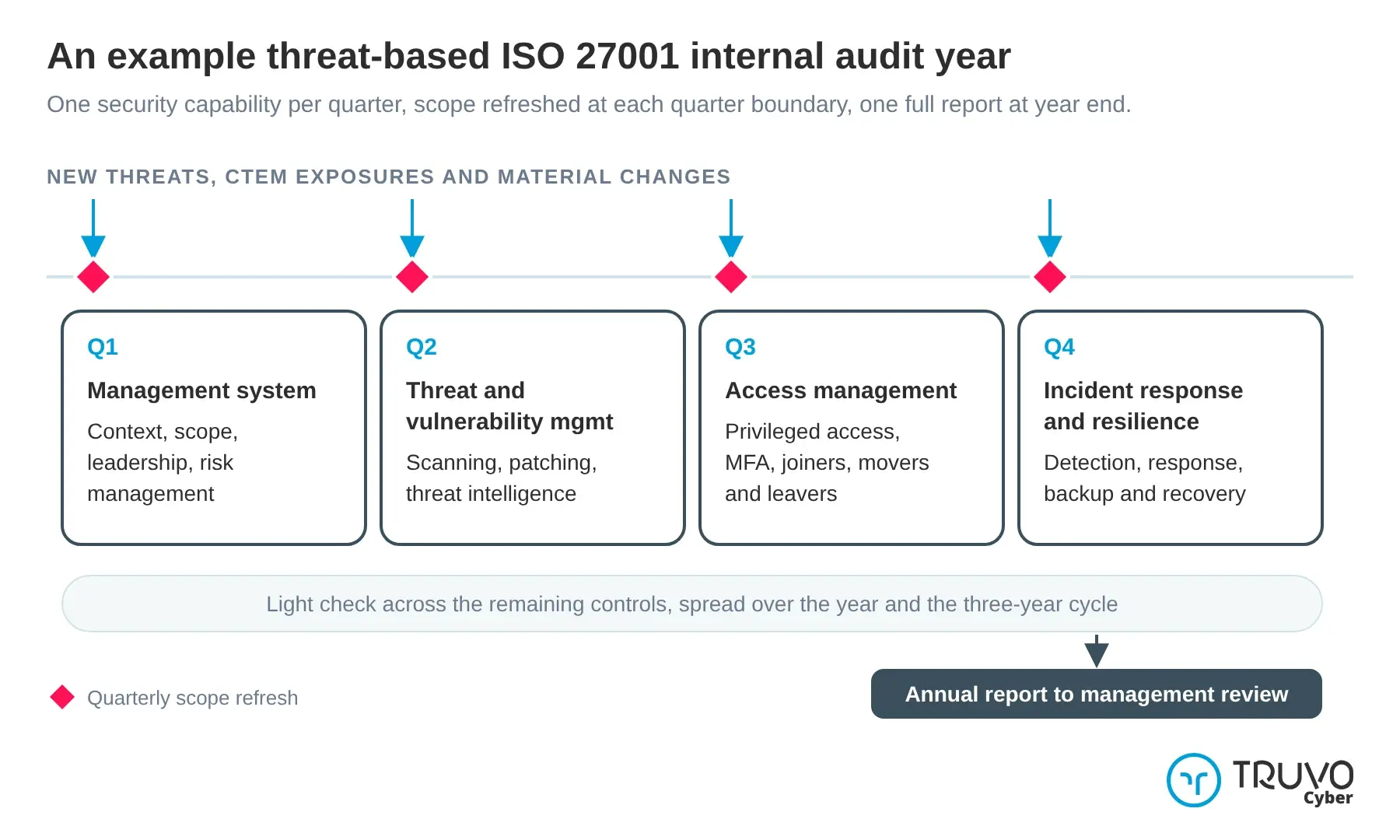
A threat-based ISO 27001 internal audit can run as one full audit a year or as four quarterly parts, with the scope refreshed every quarter. Quarterly refreshes keep the plan current and spreads the evidence work across twelve months instead of one scramble. Divide the quarters by security capability when functions such as access management are shared globally, or by region when each region runs separate systems.
Figure: An example threat-based ISO 27001 internal audit year: one security capability deep-dive per quarter, a scope refresh at each quarter boundary, and the annual audit report at year end. Click to enlarge.
In this example, the management system goes first, because the result tells the auditor where to look next. New threats, new CTEM exposures and material changes enter at the next quarterly refresh.
To put the year on paper, use the free ISO 27001 internal audit plan template: a scoping worksheet, the quarterly plan and a three-year coverage check in one Google Sheet.
Who owns the ISO 27001 risk assessment, and who performs the internal audit?
The ISO 27001 risk assessment and the internal audit need different owners. Clause 9.2 requires auditors to be objective and impartial, and an auditor cannot audit their own work. The risk team owns the risk assessment. The auditor reviews how the risk assessment process works and passes findings back as input. The same independence rule leads many organizations to outsource the ISO 27001 internal audit.
Watch out
The internal auditor cannot audit the risk assessment they built
Clause 9.2 requires objective and impartial auditors. Keep the ISO 27001 risk assessment with the risk team, and pass internal audit findings to that team as input.
How do you start a threat-based ISO 27001 internal audit?
Take the top threat from your register or the top exposure from your CTEM program, name the controls that mitigate the threat or exposure, pick the assets that matter most, and give one quarter of audit time to those controls on those assets. The findings from that quarter show whether the approach earns a place in the full programme.
Truvo Cyber runs ISO internal audits for ISO 27001, ISO 27701 and ISO 42001, led by senior auditors and supported by security architects and privacy specialists.
Make your internal audit find real risk
Scope the audit around the threats and exposures that matter to your effective security program.
Frequently Asked Questions
What is a risk-based ISO 27001 internal audit?
A risk-based ISO 27001 internal audit sets audit scope and depth by risk. The audit team selects the controls that mitigate the top threats or exposures, selects the priority assets, and tests those controls on those assets in depth. Lower-risk controls get a light check, and the full management system is still covered for certification.
Does ISO 27001 require every control to be audited every year?
ISO/IEC 27001:2022 clause 9.2 requires internal audits at planned intervals and an audit programme that considers the importance of the processes and previous audit results. The standard sets no annual test for every Annex A control. Many organizations cover the full system across the three-year certification cycle. Confirm expectations with your certification body.
Can the internal auditor also perform the ISO 27001 risk assessment?
The internal auditor should stay independent of the risk assessment. Clause 9.2 requires auditors to be objective and impartial. A separate person or team owns the risk assessment, and audit findings flow to that team as input.
How is a risk-based ISO 27001 internal audit different from a penetration test?
A risk-based internal audit checks whether controls are designed, operated and evidenced well enough to handle a given risk, using evidence review, interviews and walkthroughs. A penetration test tries to break in through technical attack. Penetration test results make a useful input to the audit scope.