
.svg)

Security architecture is the practice of understanding a system component by component and connection by connection. In practice it comes down to two jobs: making sure systems under construction follow security best practices (build securely), and making sure systems already running are hardened, patched, monitored, and operable by an effective security operations team (operate securely).
At a glance
- Two jobs: secure the design of systems being built, and secure the operation of systems that exist
- Core method: walk every component and every connection, and secure each one
- Starts with: discovery interviews covering how the system works and what business function it serves
- Key input: a solution blueprint or documented system architecture (the architect documents it when none exists)
- Two clients: the security operations team, which inherits the design, and the business, whose needs the design must meet
- Involved: from project inception through to operation
What does security architecture mean in practice?
Formal definitions describe security architecture as the structure of security controls across an enterprise, and frameworks like SABSA and TOGAF offer full methodologies for it. Practitioners describe it more directly: take a system, understand what it does and why the business cares, then go through each component and each connection and secure it.
That work requires unusual breadth. A security architect carries wide and deep experience across technology and compliance, and can speak to the security aspects of every other area of IT: networking, identity, endpoints, cloud, applications, data. Nobody is an expert in all of them, but the architect holds a sound working understanding of each, plus the compliance requirements the system must meet, and often the legal and business context around it.
That breadth is what separates the role from adjacent ones. A network engineer secures the network. An application security engineer secures the code. The security architect is accountable for the whole system holding together as something securable, from the WAF in front of a web application to the privileged accounts behind it.
What are the two jobs of a security architect?
The security architect's first job is making sure systems being built follow security best practices. That means reviewing designs before they ship: examining trust boundaries, authentication flows, data handling, and network segmentation, with a measure of threat modeling to test the design against realistic attack paths.
The advisory output of that job works at two levels. At the abstract level, the architect states which controls should be in place; at the concrete level, the architect specifies security requirements the engineering team can build against, and how each control can realistically be implemented in that environment. Those requirements draw on four inputs: what the business needs, what security operations needs to run the system, security best practices, and the threat model.
The architect's second job is making sure systems already in production are secure as operated. Concretely, that means hardening is applied and maintained, patching happens on a cadence, EDR is installed on the endpoints and servers, privileged accounts live in a PAM rather than a spreadsheet, and a WAF fronts anything web-facing. Design-time security decays without this second job; a well-architected system that misses six months of patches is not a well-architected system anymore.
| Securing the build | Securing the operation | |
| When | Design and build phases | Production, ongoing |
| Activities | Design review, threat modeling, control selection | Hardening, patching, EDR coverage, PAM enrollment, WAF tuning |
| Output | Approved design with security capabilities overlaid | Evidence the system stays secure as it runs |
| Handoff to | Engineering teams building the system | Security operations team running detection and response |
How does threat modeling fit into security architecture?
Threat modeling tells the security architect which components of a system matter and how much security should be applied to each. That is its job in architecture work: sizing the investment to the asset, so an internet-facing payment service gets a different treatment than an internal reporting tool.
It stops earning its keep when it re-litigates questions the industry has already answered. Whether MFA is needed or whether encryption is needed is not a debate any individual threat model needs to reopen; that threat modeling has been done by the industry as a whole, and the answer is settled. Baseline controls come from best practice, and a team that spends workshop hours deriving them from scratch is paying for conclusions it could have looked up.
Key insight
The industry has already done that threat modeling
Baseline controls like MFA and encryption are settled questions. Spend threat modeling hours on decision support for significant security investments, not on re-deriving conclusions the industry has already reached.
Where threat modeling delivers real value is decision support on significant security investments: when it is unclear whether a spend is the right call, or where money should be applied more and less across systems, a threat model supplies the prioritization. In practice that prioritization points the same way repeatedly: internet-facing systems first, then the systems that hold sensitive data or carry operational significance. Used that way a threat model directs budget; used as a requirements generator from a blank page, it burns time.
What are the three types of security requirements?
When a security architect designs or deploys a security capability like EDR, a WAF, a firewall, or a SIEM, its requirements fall into three types:
| Requirement type | What it covers | Example |
| Threat functional | Directly addresses a specific security threat | A WAF must provide SQL injection protection |
| Operational security | What security operations needs to succeed with the capability | Access to the dashboard, APIs, and data; the ability to take defensive actions such as blocking a port or blocking a user across systems |
| Non-functional security | Availability and security of the security tooling itself | The SIEM must be highly available; the tooling itself protected with MFA |
These three types apply to security capabilities themselves. Alongside them sit general security requirements for the solution as a whole: servers hardened, networking properly configured, and the other baseline expectations that apply to any system regardless of its function. Keeping the two categories separate is what stops a requirements document from mixing the firewall must block these ports with the firewall appliance itself must be patched, which are different obligations owned at different points in the design.
How does a security architecture engagement start?
Every credible security architecture effort starts with discovery, and discovery draws on three sources: interviews, existing documentation, and technical discovery. The interviews cover the SMEs who know the system or are planning to build it (enterprise architects, solution architects, network architects, database specialists) and, separately, the business stakeholders: what business function does this system serve, and which components matter most to that function. Existing documents, diagrams, and flowcharts get collected rather than redrawn, and technical discovery scripts and tools enumerate what is really deployed; cloud environments answer quickly through their APIs, while an on-premises network can be tapped to reveal the real traffic map.
That second question changes the outcome. Two components can look identical on a network diagram while one processes payments and the other serves a marketing page. Ranking components by business value is what lets the architect prioritize controls where failure costs the business real money, instead of spreading effort evenly across the diagram.
With the business context established, the walk begins: each component, each connection, examined and secured. Discovery that skips the business interviews produces technically defensible designs that protect the wrong things first.
Who is the security architect's client?
The security operations team is the first client, because everything the architect designs feeds the security operations work stream. A design is only finished when the SOC can operate it: logs are generated correctly, shipped to a centralized logging facility, and matched with detection use cases that tell analysts what to look for. An architecture that produces no usable telemetry hands the operations team a system they can neither watch nor defend.
The security logging and monitoring architecture guide covers what that pipeline looks like in detail: which sources to collect, where collectors sit, and how retention and detection requirements shape the design.
The business is the second client. The architect exists to design and secure systems that meet business needs, and the translation runs both directions: business requirements get translated into security terms, and security findings get translated back into business consequences. Security architects function as chief translators, in and out of security.
Key insight
Two clients, one design
Every architecture serves the security operations team that inherits it and the business whose needs it must meet. A design either client cannot live with is unfinished, however elegant the diagram.
How do security architects work with enterprise and solution architects?
Enterprise and solution architects design the systems; the security architect overlays security capabilities onto those designs. The relationship is hand in hand: the solution architect decides that a web tier talks to an application tier which talks to a database, and the security architect decides where authentication is enforced, how the tiers are segmented, what gets logged at each boundary, and which controls satisfy the compliance requirements in scope.
The security architect's essential input is a solution blueprint: a documented system architecture to overlay onto. When no blueprint exists, which is common outside large enterprises, the security architect ends up wearing the solution architect hat and documenting the system architecture first, because there is no securing a system nobody has drawn.
Those documents are less exotic than the title suggests. They are boxes and arrows: boxes for key components, arrows for data flow or network flow depending on what the diagram needs to show. The two flows sometimes run in opposite directions: a laptop makes an outbound network connection to a web server, but the data of interest flows from the server back to the laptop, and controls for the connection differ from controls for the data.
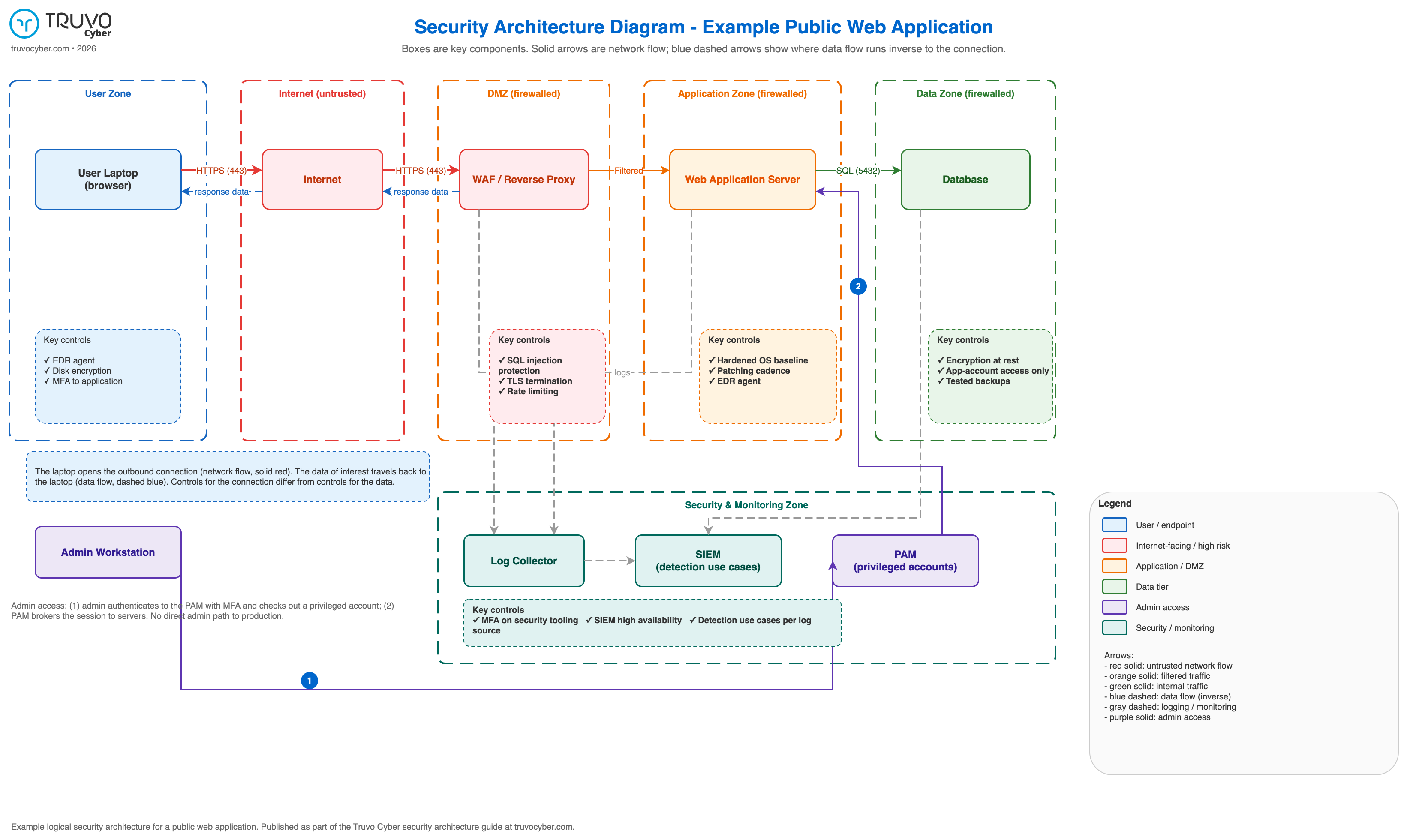
Figure: example security architecture diagram for a public web application, drawn to the conventions described in this guide. Click the diagram to enlarge it.
The guide to creating a security architecture diagram walks through the conventions in the example above step by step.
What do security architects deploy and coordinate?
Security architects frequently design and lead the deployment of the security technologies themselves. An EDR rollout, a SIEM implementation, a logging pipeline: someone has to decide where the log collectors sit, what they collect, and how the pieces are configured, and that design work lands on the security architect. The role covers designing security for systems and designing security systems in their own right.
The role also coordinates offensive testing: penetration tests, red team exercises, and purple team engagements. The architect scopes the test against the components that matter, briefs the testers on the architecture, and translates the findings into design changes rather than a filed PDF. Pen testing advisory covers scoping that work; the vulnerability assessment services guide explains where assessment fits before deeper testing.
Because the role runs from project inception to operation, the security architect is often the only security person who has seen the system through its whole life: design reviews at the start, deployment decisions in the middle, detection use cases and test findings at the end.
How does security architecture scale across many systems?
Most systems are not new. Once the diagram exists, the next actions tend to become obvious, because the vast majority of systems repeat known designs, and security architecture scales by capturing those designs as reusable security patterns rather than re-deriving them per project.
Three mechanisms do the scaling:
- Security patterns. An established set of preferred methods, in order of preference, that teams reference and reuse. For system-to-system API integrations, prefer OAuth; for user authentication, maintain an ordered list from strongest acceptable method down. A team that can look up the preferred pattern does not need an architect in the room for every integration.
- Anti-patterns. The documented list of what not to do, which prevents entire classes of findings: accepting a user's identity without verifying it, and treating user input as an authoritative source, are two that recur across reviews.
- Secure blueprints. Infrastructure-as-code templates with the security baseline built in, reused for every deployment in Azure, AWS, or wherever the environment lives. The blueprint carries the hardening, the network configuration, and the logging hooks, so each new system starts secure instead of being secured after the fact.
How does security architecture connect to compliance?
Security architects translate compliance requirements into something practical that executes on a real system. A requirement like SOC 2 CC6.1 or ISO 27001 A.8.2 does not say which PAM to deploy or how to segment a network; the architect reads the requirement, understands the intent, and maps it to concrete controls on concrete components.
The translation runs the other way too. Compliance teams often lack hands-on security experience, so the architect explains how a system meets a requirement in terms an auditor and a compliance analyst can carry forward. The compliance function supplies the requirement; the architect supplies the mechanism; the evidence connects the two.
Seen through a capabilities lens, security architecture is one of the capabilities an effective security program is built from, alongside capabilities like vulnerability management, logging and monitoring, and identity management. Organizations that build the architecture capability early find compliance requirements land on systems already designed to meet them, which is how compliance becomes a byproduct of effective security. The guide to building a security program without audit pressure covers how those capabilities sequence.
How to put this to work
For a team without a security architect, the method is more important than the title. The sequence practitioners follow:
- Document the architecture first. Boxes and arrows: key components, and the data or network flows between them. If no diagram exists, drawing one is step one.
- Interview for business value. Ask which components serve which business functions, and which failures would cost revenue or trust. Rank them.
- Walk each component and connection. For every box: hardened? patched? EDR present? privileged access in a PAM? For every arrow: authenticated? encrypted? logged?
- Check the operational handoff. Confirm logs from the important components reach a central facility and that someone has written detection use cases against them.
- Map controls to requirements. Take the compliance requirements in scope and record, per requirement, which component and control satisfies it. Gaps in that mapping are the work list.
A team that completes those five steps has performed a security architecture review, whatever anyone's job title says. The security architecture review process guide expands each phase into a checklist with the deliverables to expect.
Teams that would rather have an architect walk their system can start with Truvo's security architecture review service, which covers discovery through the mapped remediation plan.
Systems get built either way. The only question is whether security is designed into them by someone walking every component and connection, or discovered in them later by an auditor, a customer security review, or an attacker. Security architecture is choosing the first option on purpose.
Get a Security Architecture Review
A scoping call maps the component-and-connection walk into an effective security program, compliance as the byproduct.
Frequently Asked Questions
What is a security architecture diagram?
A security architecture diagram is a boxes-and-arrows drawing of a system: boxes represent key components, arrows represent data flows or network flows, and security controls are annotated at the components and boundaries where they apply. It is the primary working document of a security architecture review.
What is the difference between a security architect and an enterprise architect?
Enterprise and solution architects design systems: components, integrations, and technology choices. Security architects overlay security capabilities onto those designs: segmentation, authentication, logging, and hardening. The two roles work hand in hand, and when no documented design exists, the security architect often documents the system architecture first.
What is a security architecture review?
A security architecture review is a structured walk through a system's components and connections, checking each against security best practices: hardening, patching, endpoint protection, privileged access management, encryption, logging, and detection coverage. It starts with discovery interviews and ends with a prioritized list of gaps mapped to business impact.
Who advises on security architecture and design?
Security architects advise on architecture and design, whether staffed in-house, engaged through a consultancy, or provided as part of a fractional security team. The typical profile is ten or more years in cybersecurity, at least five in architecture, with CISSP, CCSP, CISA, or similar certification. The advisor overlays controls onto designs and stays involved from inception to operation.
What are the elements of security architecture?
The recurring elements are: a documented system architecture (components and flows), identity and privileged access management, network segmentation, endpoint and server hardening, patching, detection and response tooling such as EDR, centralized logging with detection use cases, and a mapping from compliance requirements to the controls that satisfy them.
Does a small company need a security architect?
Small companies rarely need the full-time role, but they need the work: someone documenting the architecture, walking components and connections, and preparing systems for security operations and compliance requirements. Fractional security teams and advisory engagements cover this without a dedicated hire.