Almost every first call I get starts the same way. Someone outside the company is suddenly asking for a security artifact. A prospect sent a 200-question vendor assessment. An enterprise customer wants SOC 2. An RFP requires CPCSC by a date that already feels tight.
It is the same set of policies, controls, and evidence any reasonable program would include. The only variable is how much time there is to do it.
The core idea
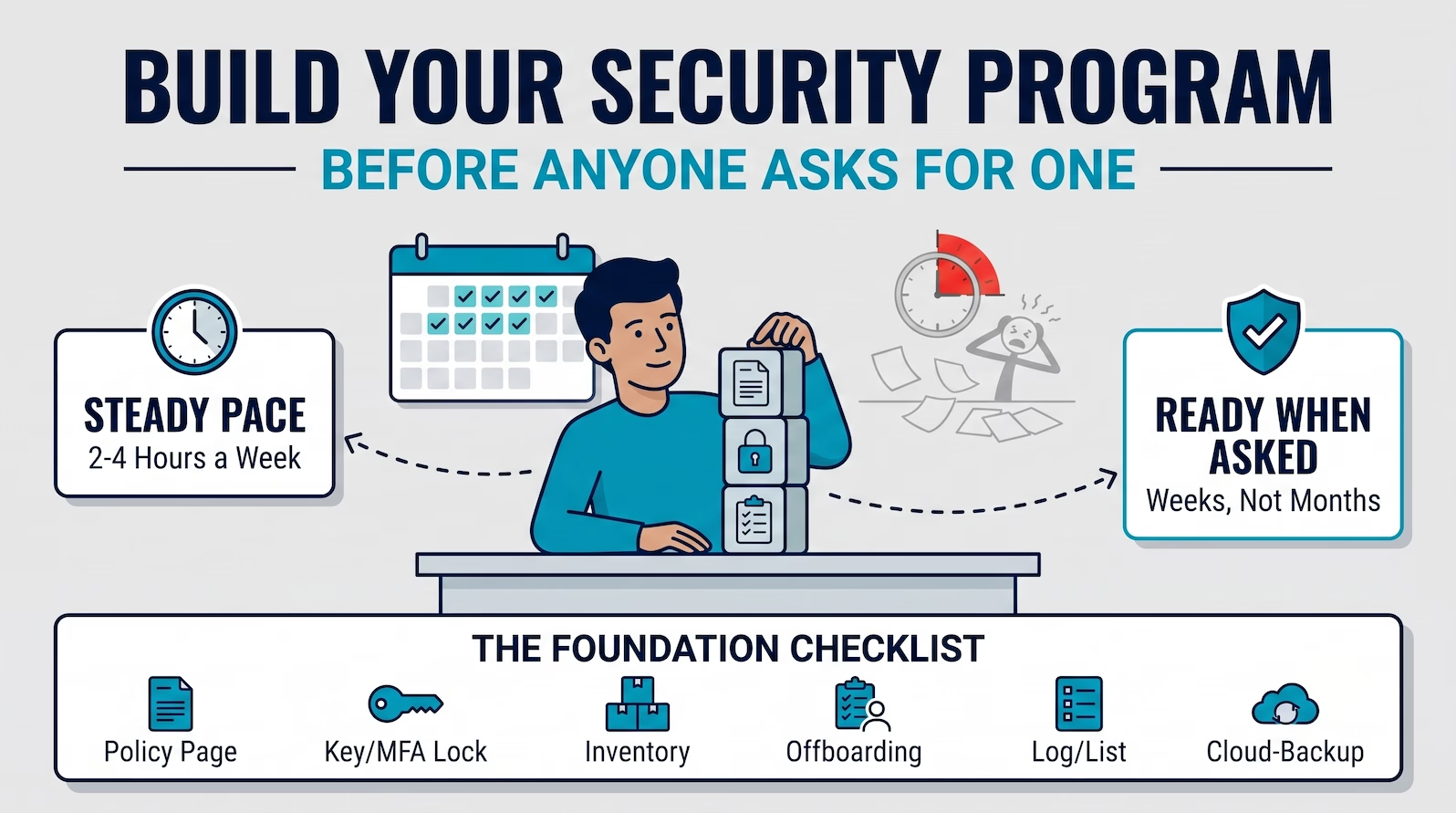
The expensive version of a security program is not the program. It is the compressed timeline. Companies that start before the pressure do the same work at two to four hours a week, without panic, without weekends, without consultants on speed dial.
Why compressed timelines are the real cost
Companies that start under pressure squeeze a year of work into eight weeks. They pull engineers off product. They lean on templates that do not match reality. They end up with a program built to clear a single bar, not one designed to operate.
I had a client last year who engaged us to chase a SOC 2 their largest prospect wanted. Halfway through the build, the deal went quiet. Most teams in that situation stop the work. This one did not. They kept going at a slower pace, a few hours a week, no audit booked. Eighteen months later, they are further along than peers still waiting for someone to ask. When the next enterprise deal shows up, the answer will be scheduling, not building.
What background work looks like
- One policy a week, written in plain language, reviewed by the people who actually do the work.
- An offboarding checklist built the next time someone leaves, then made standard.
- An asset inventory started in a spreadsheet. It is fine in a spreadsheet for a long time.
- A vendor list pulled from the next monthly SaaS bill.
- MFA fixed on the next account that is missing it.
A consultant on a light retainer helps a lot here, and so does a GRC platform set up early so evidence accumulates as the work happens. Both make the slower pace easier, not harder. What the work needs most is a decision that security is a permanent part of how the company operates, not an event that happens because a customer demanded it.
Where to start
Focus on controls that are cheap, do not depend on outside vendors, and survive any framework the company eventually picks. SOC 2, ISO 27001, CPCSC, and ISO 42001 are all built on the same primitives.
Policies and acknowledgments. Acceptable use, access control, change management, incident response, data classification, vendor management. Drafted in plain language. Signed off annually. The acknowledgment trail is itself evidence.
Identity hygiene. MFA everywhere it is supported. Conditional access blocking legacy auth. A documented joiner-mover-leaver process so access changes when roles change.
Asset and vendor inventories. Current, owned by someone, reviewed on a cadence. Not fancy. Current.
Offboarding. A checklist that runs every time someone leaves. Access revoked. Devices recovered. Data ownership transferred. The single most common audit finding across every framework is access that was never removed.
Logs turned on. Cloud audit logs, identity provider logs, source control logs. Not a SIEM. Just turning on the logs that already exist and confirming they are retained.
Backups verified. They are running. They have been restored at least once.
What to defer
Full SIEM build-outs before the logs are even centralized. Third-party audits with no customer actually asking for one. Penetration testing on a fixed cadence against a system with no patching process. Custom security tooling before the off-the-shelf controls are working. All of these are useful later. Premature when the basics are not in place. Do not optimize a system that does not yet exist.
The reuse dividend
The reason this works is that frameworks are mostly lenses on top of the same program. SOC 2 Common Criteria, ISO 27001 Annex A, CPCSC ITSP.10.171 control families, ISO 42001 management system requirements, all assume the same primitives: asset inventory, identity controls, change management, incident response, vendor management, policy governance, evidence of operation.
A company that has spent eighteen months on those primitives is not starting a SOC 2 project from zero. It is mapping what already exists to a specific framework and filling the small gaps that are genuinely framework-specific.
The marginal cost of converting an existing program into a framework-aligned program is small. The marginal cost of building both at the same time, under deadline, is large and largely avoidable.
The full argument for an effective security program
Effective Security First is our field report on why the companies that build the program early avoid the compliance scramble. Download the PDF.
When to switch from background to active
The signals are usually obvious when they show up. A customer sends a questionnaire referencing a specific framework, a SIG Lite, a CAIQ, a SOC 2 report request. An RFP requires certification within a defined window. A regulated industry customer signs a contract that makes attestation a condition of go-live. The board or an investor asks about the security program in a way that implies they expect a framework to already be in place.
That is when the audit gets booked, a GRC platform gets evaluated, the cadence shifts from a few hours a week to a focused block. The difference, compared to companies starting cold, is that the foundation is already there. The question becomes which framework, which auditor, what timeline, not do we have any of this yet.
If you want a read on where you stand against a specific framework before that signal arrives, Truvo's readiness scorecards cover SOC 2, ISO 27001, ISO 42001, and CPCSC Level 1 in about five minutes.
Frequently Asked Questions
Is it worth investing in security if nobody is asking us to?
The foundation work is worth it. A few hours a week on policies, identity, inventories, and logging is durable across every framework and pays back twice. It reduces operational risk that exists regardless of compliance, and it shortens the eventual certification timeline by months. Spending on auditors and paid GRC seats before a customer or regulator is asking is harder to justify.
How many hours per week does this take?
Two to four hours a week from someone with admin access and a working understanding of the systems. The cadence matters more than the volume. Three hours a week for a year covers more ground than forty hours in a sprint followed by nothing.
What is the lowest-cost way to start?
A shared drive for policies. A spreadsheet for asset and vendor inventories. The logging and identity features already included in the cloud and identity platforms in use. A documented offboarding checklist. None of this needs new vendor spend.
Will this help close deals later?
It changes the shape of the sales conversation. Companies with policies, an inventory, and operational evidence already in place answer security questionnaires in days instead of weeks. They can credibly say a SOC 2 report is twelve weeks out, not nine months. For deals where security is a real gating factor, that is often the difference between winning and losing.

.svg)