
.svg)
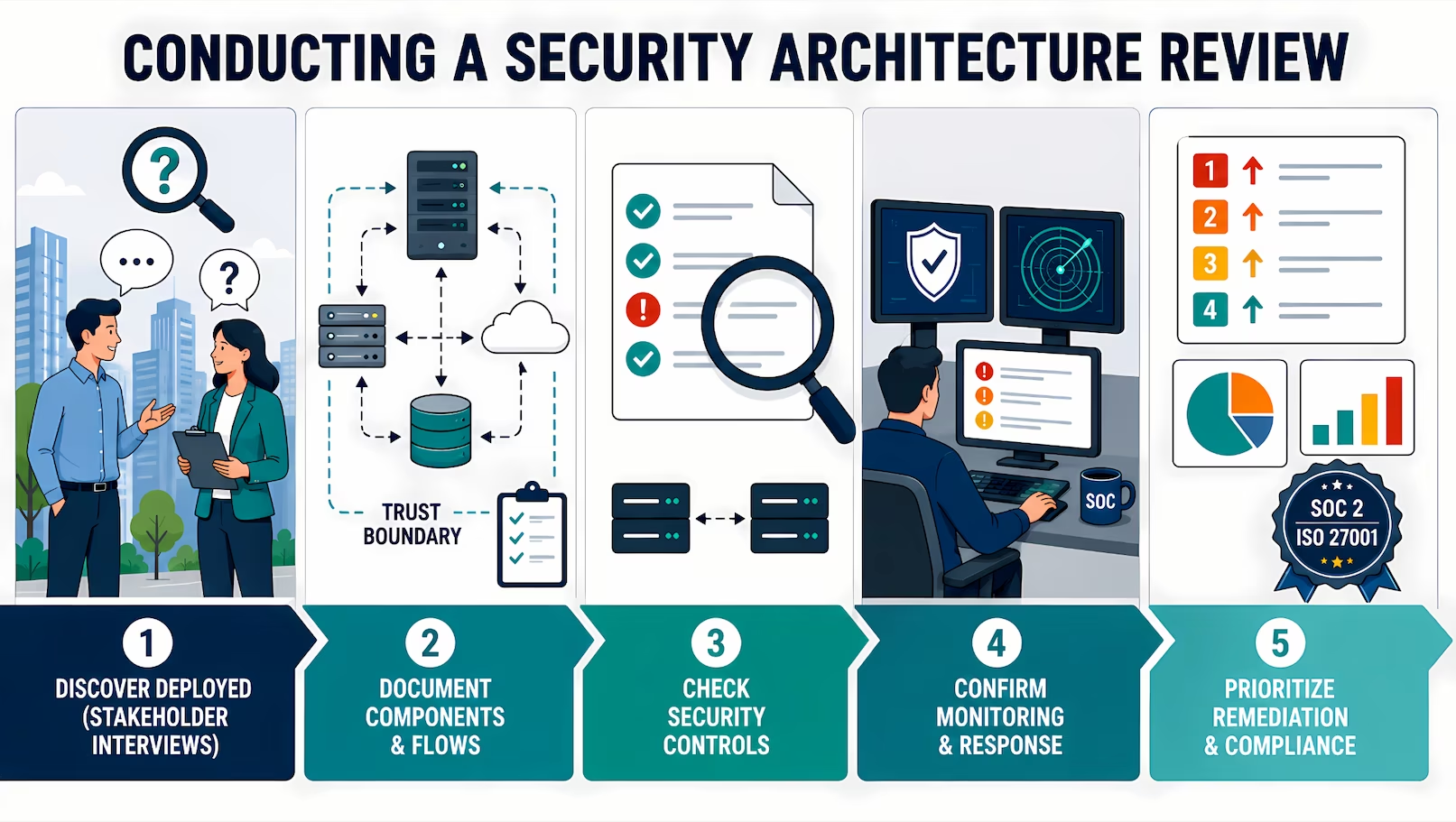
A security architecture review is a structured walk through a system's components and connections, checking each against security best practices and confirming the system can be operated securely in production. The process runs in five phases: discovery interviews, documenting the architecture, the component-and-connection walk, an operational handoff check, and a requirements-and-mapping exercise that turns findings into a prioritized work list.
At a glance
- Five phases: discovery, documentation, component-and-connection walk, operational handoff check, requirements and mapping
- Key inputs: solution blueprints (or time to draw them), stakeholder access for interviews
- Deliverables: current-state architecture document with diagrams, findings per component and connection, telemetry gap list, prioritized remediation plan, control-to-requirement mapping
- Typical triggers: a new system or integration, a SOC 2 or ISO 27001 requirement, a customer security review, a planned SIEM, EDR, WAF, or cloud deployment
- Red flag: a review that starts with a product recommendation instead of interviews
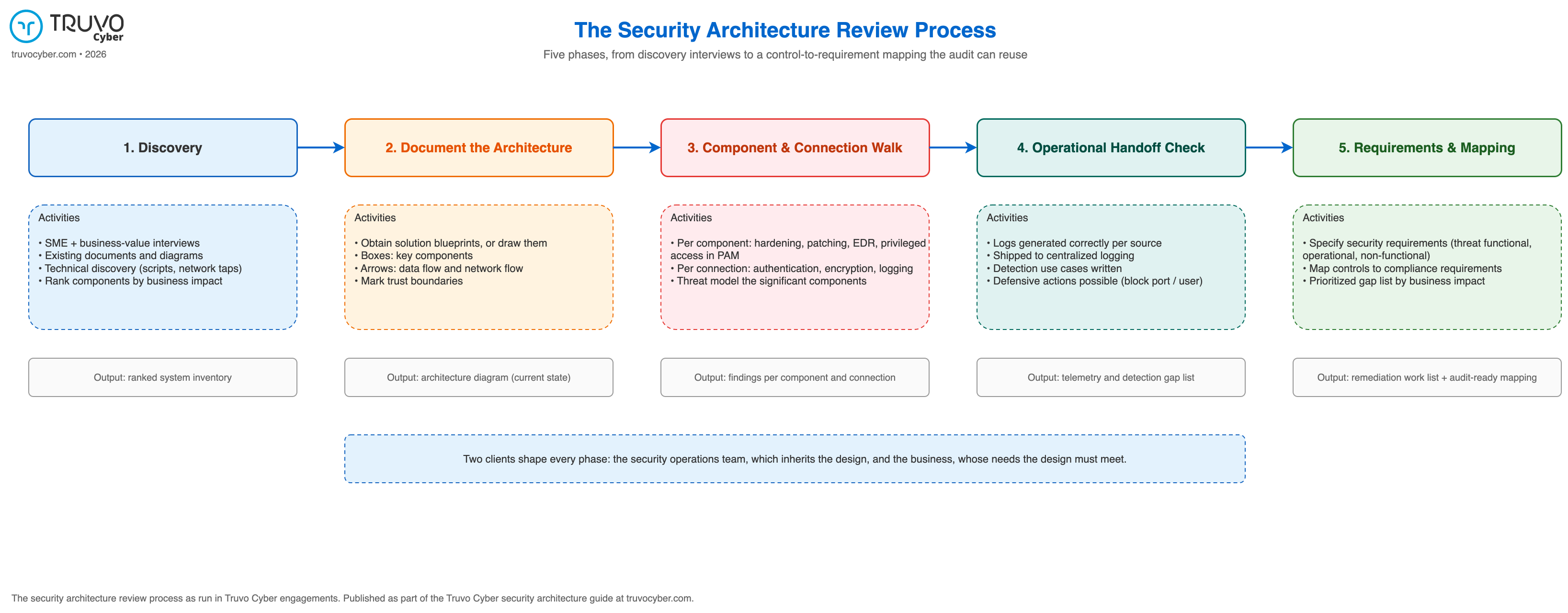
Figure: the five phases of a security architecture review, each with its activities and output. Click the diagram to enlarge it.
PHASE 1 OF 5
Discovery interviews
Discovery in a security architecture review draws on three sources:
- Interviews. The security architect sits with the SMEs who know the system or are planning to build it: enterprise architects, solution architects, network architects, database specialists. Separately, business stakeholders answer the value questions: what business function does this system serve, and which components matter most to that function.
- Existing documentation. Architecture documents, diagrams, and flowcharts that already exist get collected and verified against reality rather than redrawn from scratch.
- Technical discovery. Scripts and tools enumerate what is really deployed. Cloud environments answer quickly through their APIs, which makes this work especially well there; on-premises, tapping the network to observe traffic reveals the real connection map. The architecture diagram gets built from what the environment reports, not only from what people remember.
The business interviews are what turn the inventory into a ranking. A payment service and a marketing page can look identical on a network diagram, and only the business interview tells the architect which one deserves the deeper treatment. The phase closes with a system inventory ranked by business impact, which drives the depth of every later phase.
PHASE 2 OF 5
Document the architecture
The security architect needs a documented system architecture to work against: boxes for key components, arrows for data flows and network flows, and marked trust boundaries. When solution blueprints exist, this phase is collection and verification. When they do not, which is common outside large enterprises, the architect draws them, because there is no reviewing a system nobody has drawn.
A thorough current-state document covers more than the diagram. The areas a full security architecture review documents:
| Review area | What gets recorded |
| Infrastructure | Cloud providers, deployment model, environments, infrastructure-as-code tooling |
| Key systems | Purpose, hosting, and data classification per system |
| Data flows | Entry points, storage, processing, third-party integrations, egress, retention, residency |
| Identity and access | End-user vs. administrative access paths, identity provider, MFA scope, SSO coverage, PAM, role assignments |
| Endpoints | Device management and endpoint protection coverage |
| Logging and monitoring | Per source: technology, scope, retention |
| Software development | Repositories, release process, security testing in the pipeline |
| Backup and DR | Recovery objectives and the phased response to an outage |
| Vendors | Dependencies, and whether each sits in compliance scope |
Key insight
Document the planned changes, not just the present
One area separates a good security architecture review from a snapshot: planned changes. Systems in flight, migrations underway, and integrations on the roadmap change the security architecture and often the compliance scope, so the document records the near-future state and the risks the planned changes introduce, not just what exists today.
The guide to security architecture diagrams covers the diagram conventions in detail, including the distinction between data flow and network flow.
PHASE 3 OF 5
The component and connection walk
This phase is the core of the review and the core method of security architecture: go through each component and each connection, and check that it is secured. Three questions drive the walk at each component: what does this component do, what could go wrong, and how do we secure it. Connections get the same treatment: what does this connection do, then the considerations in turn (authentication, authorization, encryption, logging). Secure each component and each connection independently, and the system as a whole becomes secure.
In practice the walk cross-references the entire body of security controls against the component list. Per component: is the operating system hardened against a baseline, is patching happening on a cadence, is EDR installed, are privileged accounts stored in a PAM rather than shared and remembered. Per connection: is it authenticated, is it encrypted, is it logged, and does it cross a trust boundary that needs a control at the crossing.
Key insight
The inventory is the ground truth
The component-and-connection list is the inventory, the ground truth of the security architecture review. A review without it is working from an incomplete picture, and findings on unlisted components are the ones that hurt later.
Threat modeling enters here with a specific job: sizing the effort. The significant components, typically internet-facing systems and the systems holding sensitive data or carrying operational significance, get modeled against realistic attack paths. The rest get the baseline checks. An architecture review that spends threat modeling hours debating whether MFA or encryption is needed is wasting them; the industry settled those questions, and the review's job is to confirm the settled answers are implemented.
PHASE 4 OF 5
The operational handoff check
A system can pass every design check and still be indefensible in production, so the review verifies the security operations team can secure the system operationally.
Key insight
The SOC is the security architect's first client
What the security architect designs feeds the security operations work stream, which makes the SOC the security architect's first client.
Concretely, the check covers four things: logs are generated correctly by each significant source, they ship to a centralized logging facility, detection use cases exist that tell analysts what to look for in them, and defensive actions are possible when a detection fires, such as blocking a port or blocking a user across the affected systems. The security logging and monitoring architecture guide covers the pipeline design this check validates.
Watch out
The cost of skipping this phase
Architecture reviews that skip this phase produce systems that are secure on paper and invisible in the SOC. The gap tends to show up in the first incident, which is the most expensive possible place to discover it.
PHASE 5 OF 5
Requirements and mapping
The final phase of the security architecture review converts findings into work. Gaps become security requirements at two levels: the abstract control that should be in place, and the concrete requirement the engineering team can implement, drawing on business input, security operations input, best practices, and the threat model. For security capabilities themselves (an EDR, a WAF, a SIEM), requirements split into three types: threat functional (the WAF must block SQL injection), operational security (the SOC can reach dashboards, APIs, and data, and take defensive action), and non-functional security (the tooling is highly available and itself secured with MFA).
The same phase maps existing and planned controls to the compliance requirements in scope. SOC 2 CC6 and CC7 criteria, ISO 27001 Annex A controls, and customer security review questions all ask for evidence the architecture work already produced; recording the mapping during the review means the audit reuses the review instead of repeating it. The output is a remediation work list ranked by business impact, plus a control-to-requirement mapping the compliance program carries forward.
When should a company commission an architecture review?
The triggers that repay a security architecture review fastest:
- A new system, platform, or significant integration is being designed. Review at design time costs a document cycle; redesign after launch costs a project.
- A security technology deployment is planned. SIEM, EDR, WAF, firewall, and cloud security rollouts all benefit from an architecture pass before the purchase order, because the review shapes where the technology sits and what it must produce for operations.
- A compliance requirement has landed. SOC 2 and ISO 27001 audits examine access, change, and monitoring against the real architecture; a customer security review asks for the diagrams directly. A review run before the audit produces the diagrams, the control mapping, and the gap list in one exercise.
- Nobody can produce a current diagram. If the honest answer to can we see the architecture is a whiteboard photo from two years ago, the review is overdue regardless of other triggers.
Security architecture reviews scale down as well as up. A focused review of one application before go-live is a short engagement with a bottom-line verdict and a numbered pre-launch list; a full-environment review for a first SOC 2 audit is a multi-week exercise producing the complete document set. The vulnerability assessment services guide covers the adjacent engagement that often pairs with a review, and pen testing advisory covers the offensive testing a completed review scopes well.
Truvo's security architecture review service page lists the deliverables and timeline for a scoped review.
Scope Your Architecture Review
A scoping call fits the review into an effective security program, standalone or inside a full program build.
Frequently Asked Questions
What is checked in a security architecture review?
Every component (hardening, patching, endpoint protection, privileged access management) and every connection (authentication, encryption, logging, trust boundary controls), plus the operational plane: whether logs reach centralized logging with detection use cases, and whether the security operations team can take defensive action across the systems involved.
How long does a security architecture review take?
A focused review of a single application runs one to two weeks including interviews and the report. A full-environment review covering infrastructure, identity, data flows, development, and vendors typically runs three to six weeks depending on system count and how much architecture documentation already exists.
Who performs a security architecture review?
A security architect, whether in-house, part of a fractional security team, or engaged through a consultancy. The guide to security architecture advisors compares the options. The typical qualification bar is ten or more years in cybersecurity with at least five in architecture, and CISSP, CCSP, or CISA-level certification.
How is an architecture review different from a penetration test?
An architecture review examines the design and its operability: components, connections, controls, and telemetry, working from documentation and interviews. A penetration test attacks the running system to prove what an attacker can do. The review typically comes first and produces the asset understanding that makes a later penetration test well-scoped.
How often should the review be repeated?
Re-review when the architecture changes: a new system, a major integration, a cloud migration, or a new compliance framework in scope. Absent change, an annual refresh aligned to the audit cycle keeps the diagrams, the control mapping, and the near-future-state section current.
Does a security architecture review satisfy SOC 2 or ISO 27001?
Not by itself, but it produces artifacts both frameworks ask for: system and data flow diagrams, an access model, a logging inventory, and a control mapping. SOC 2 CC criteria and ISO 27001 Annex A controls are evidenced against the real architecture, and the review is where that evidence trail starts.