


Agentic AI security architecture starts with a map of the components of an AI agent system and the connections between them, which sets the scope, and then applies controls to each component and connection so a company can give agents real tools and authority with confidence in what they do and proof of what they did. It is the next application of the lifecycle used for wireless, remote work and BYOD (identify, protect, detect, respond, recover, the core functions of NIST CSF 2.0), with audit logging as the record that connects all five. A company that builds this once approves new agent use cases faster, because each agent inherits a tested control set.
At a glance
- Scope first: Map the components and connections of the AI agent system, then attach controls to each one.
- Lifecycle: Identify, protect, detect, respond and recover, with audit logging across all five.
- Autonomy tiers: Read, internal write, external send, and financial or irreversible actions each get their own level of control.
- Audit logging: Trace IDs, tamper-evident storage and retention support incident response and forensics.
- Evidence: The same controls map to AIUC-1, ISO 42001 and the EU AI Act.
The table below summarizes the five lifecycle functions as applied to an AI agent: the question each answers and the core controls it uses.
| Lifecycle function | Question answered for an AI agent | Core controls |
| Identify | What agents exist, what can each one access, and what is the worst outcome? | Architecture map, inventory, owners, autonomy tiers, threat model |
| Protect | How does the agent get the access to do its job, and nothing beyond it? | Agent identity, task-scoped tools, data boundaries, approval gates |
| Detect | How does the team know when an agent behaves differently? | Telemetry in the SIEM, policy and behavior alerts |
| Respond | How does the team contain an agent and find out what it did? | Kill switch, evidence preservation, agent incident playbook |
| Recover | How does the business return to normal work, with a better agent? | Reversible actions, rollback, credential rotation, fallback process |
| Audit logging (all five) | Can anyone reconstruct who made the request, which inputs the agent processed, and which actions it took? | Traceable, tamper-evident, retained tool-call records |
How Does Agentic AI Security Compare With Wireless, Remote Work and BYOD Security?
Agentic AI security follows the same playbook as wireless, remote work and BYOD: security identifies the risks, applies mitigations and lets the business use the technology. Wi-Fi, Bluetooth, remote work and BYOD each arrived with real security concerns, and agents are the latest technology the business wants to adopt. A program that only restricts the agent produces one too limited to deliver value, and teams tend to work around it, as they did with blocked personal devices.
| Technology | Risk identified | Mitigation that enabled business use |
| Wireless networks | Unauthorized access, eavesdropping | WPA-class encryption, segmentation, authenticated access |
| Remote work | Untrusted networks, unmanaged endpoints | VPN or zero trust access, MFA, endpoint management |
| BYOD | Data on unmanaged devices, lost devices | Mobile device management, conditional access |
| AI agents | Excess access, hijacked instructions, unattributed actions | Agent identity, scoped tools, approval gates, monitoring, audit logging |
How Do AI Agents Differ From Chatbots, and Why Are Model Defenses Not Enough?
LLM security protects what a model says: harmful output, leaked training data, jailbreaks of a chat interface. Agentic AI security protects systems where a model takes actions with real credentials. An AI agent adds tools (APIs, databases, code execution, email, payments), permissions (the tokens and service accounts that make tool calls succeed) and memory (stored context carried between sessions). For a chatbot, the worst case is a bad answer. For an agent, the worst case is a bad action: a refund issued in error, a customer record emailed to an outside address.
An AI agent also processes retrieved text as potential instructions, so any document, email, web page or ticket in its inputs becomes a channel for an attacker. The attack is called indirect prompt injection, or agent hijacking. In the EchoLeak case (2025, CVE-2025-32711), a crafted email caused Microsoft 365 Copilot to exfiltrate data from the user's context with no click from the user. In a public red-teaming competition hosted by Gray Swan and analyzed by NIST's Center for AI Standards and Innovation (CAISI), the UK AI Security Institute and frontier AI labs, more than 250,000 attack attempts from over 400 participants found at least one successful hijack against every one of the 13 frontier models tested.
Key insight
Architecture assumes some prompt injections will succeed
Model-level defenses (system prompts, input filters, guard models) reduce the success rate and are worth running. The architecture assumes a hijack will sometimes succeed, limits what a hijacked agent can reach, shows the team when one misbehaves, and supports recovery.
What Are the Components and Connections of an AI Agent System?
An AI agent system is a set of components joined by connections, and the map of both defines the scope of the security work. Each control attaches to a specific component or connection, so anything missing from the map ends up with no controls. The same method applies to any architecture review, whether the system is a payment platform or an AI agent.
The components of a typical agent system are:
- Users and triggers: the people and events that start work, such as an employee request, customer email, scheduled job or webhook.
- Agent runtime (orchestrator): the software that plans steps and calls the model and tools.
- Model endpoint: the LLM that selects the next step, hosted by a provider or self-hosted.
- Tools and MCP servers: the interfaces through which the agent acts, such as ticketing, databases, code execution, email and payments.
- Data sources and retrieval: document stores, knowledge bases, web content and vector databases.
- Memory: conversation history and long-term stores that persist context.
- Identity and secrets: the identity provider, token service and secrets manager.
- Approval workflow: the queue where a person authorizes high-impact actions.
- Logging and monitoring: the audit log store and the SIEM.
- Other agents: sub-agents and partner agents that receive delegated work.
The diagram below groups the components by trust boundary: untrusted inputs, the company boundary, and external parties. The agent runtime box includes memory and other agents, and the control plane (identity, approval, logging) governs every connection.
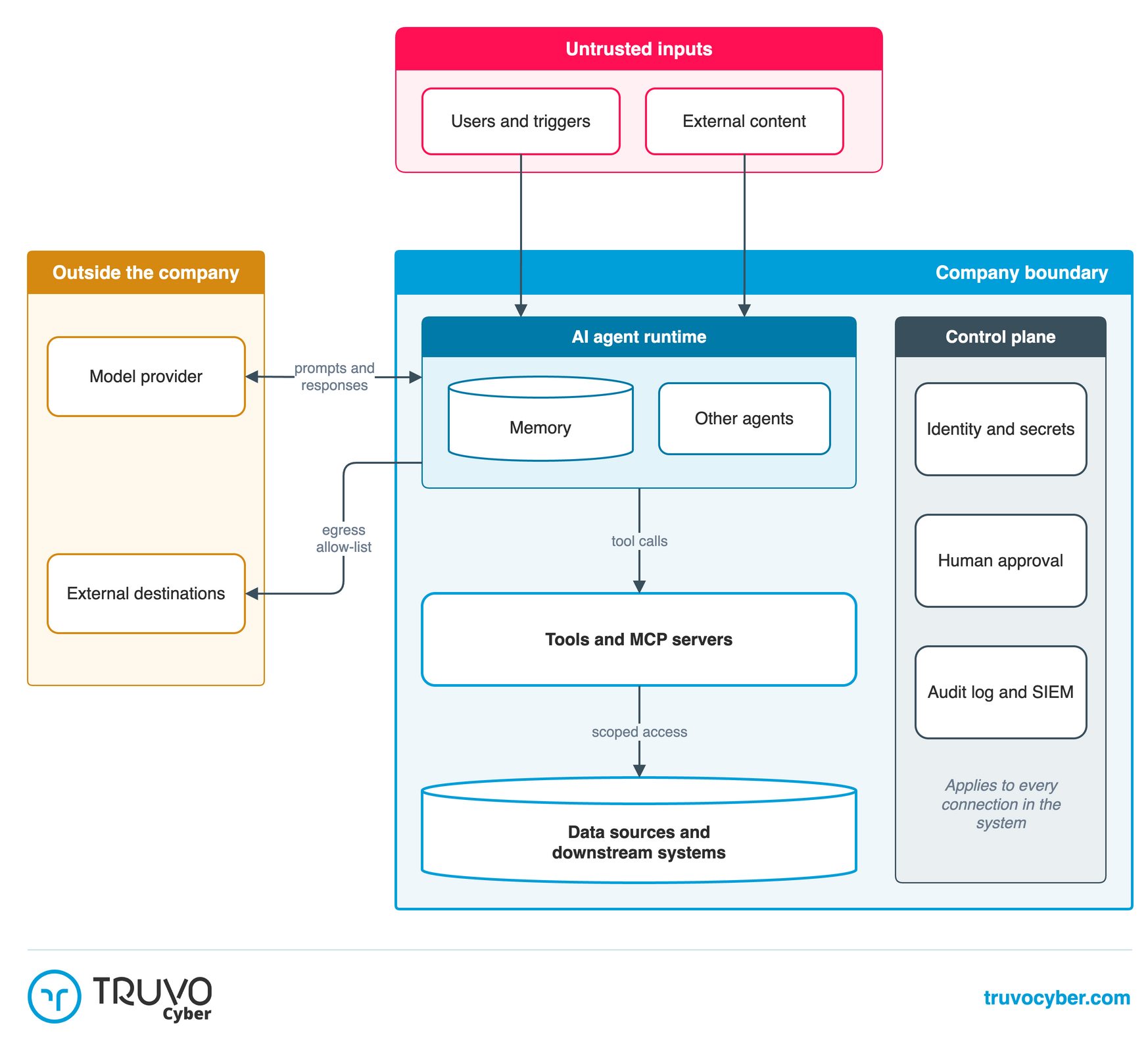
Figure: reference architecture of an AI agent system with trust boundaries marked. Click the diagram to enlarge it.
Each connection between components is a data flow that crosses a trust boundary, with its own risk and controls:
| Connection | Main risk | Controls that apply |
| Users and triggers to agent | Prompt injection through the request or attachments | Requester authentication, input logging |
| Data sources and retrieval to agent | Indirect prompt injection from untrusted content | Source trust levels, detection alerts |
| Agent to model endpoint | Data exposure, provider retention | Data classification limits, private or in-environment endpoints, vendor review |
| Agent to tools and MCP servers | Tool misuse, token passthrough, unexpected code execution | Tool allow-list, short-lived scoped tokens, MCP server review, sandboxing |
| Tools to downstream systems | Privilege abuse, over-broad data access | Per-agent identity enforced downstream, classification-based access |
| Agent to memory | Memory and context poisoning | Access control, retention limits, inspect and clear |
| Agent to other agents | Insecure inter-agent communication, cascading failures | Own identity per agent, authenticated messages |
| Agent to human approver | Approver misled by the agent's summary | Approval screen built from tool call parameters |
| Agent to external destinations | Exfiltration | Egress allow-lists, data loss controls |
| Every component to logging | Gaps or tampering in the record | Complete, tamper-evident, correlated audit logs |
The map answers the scoping questions before any control is chosen: which components exist, which data crosses which boundary, which connections carry the highest-impact actions, and which parts the company operates versus a model provider or tool vendor.
Identify: How Should a Company Inventory AI Agents, Owners and Autonomy Tiers?
The identify function turns the architecture map into a register of every agent, with a named owner, its purpose, the tools and data it can access, its dependencies (model provider, frameworks, MCP servers, with versions) and an autonomy tier. Agents adopted by individual teams without review are often the first gap an inventory finds.
The autonomy tier is the central business decision. Tiering by action keeps routine work fast and applies more control to the highest-impact actions:
| Autonomy tier (AI agent actions) | Examples | Control applied |
| Read | Search tickets, read docs, query reporting data | Logged |
| Internal write | Draft a reply, update a ticket field | Logged, sampled review |
| External send | Email a customer, post to a shared channel | Human approval |
| Financial or irreversible | Refunds, payments, deletes, permission changes | Human approval, sometimes two people |
Key insight
Agent authority grows tier by tier as controls are proven
Authority follows evidence. An agent starts at the read tier with logged activity, moves to internal writes after its behavior has been observed, and reaches external-send or financial actions once the approval, detection and rollback controls for those actions are proven.
Threat modeling walks each connection in the map through known agent attacks. The OWASP Top 10 for Agentic Applications lists ten risks (ASI01 Agent Goal Hijack through ASI10 Rogue Agents), and MITRE ATLAS catalogs adversary techniques against AI systems in the style of MITRE ATT&CK. For each tool, the team asks what a hijacked agent could do with it, and which control limits, detects or reverses that action.
Protect: How Should a Company Give AI Agents Identity and Scoped Access?
The protect function gives each AI agent exactly the access its task requires, so the worst outcome has a known and acceptable size. Five controls carry most of the weight.
- Agent identity. Every agent has its own identity in the identity provider, separate from the humans who use it and from other agents. A shared service account or borrowed user token makes attribution and revocation difficult. A dedicated identity allows permissions smaller than the invoking user's, attribution in logs, and a kill switch that stops one agent. NIST's NCCoE draft concept paper on software and AI agent identity and authorization (February 2026) examines how existing standards apply to agents, including OAuth 2.0/2.1, OpenID Connect, SPIFFE/SPIRE and SCIM. See also the centralized identity across hybrid environments walkthrough.
- Tool scope. Each agent gets a named allow-list of tools. Read and write tools use separate credentials, tokens are short-lived and audience-bound, and any tool that executes generated code runs in a sandbox with no network egress by default. The Model Context Protocol (MCP) authorization specification supports this: it builds on OAuth 2.1, requires servers to validate that a token was issued for them, and forbids accepting or passing on tokens meant for other resources (see the MCP security best practices). Authorization is optional in the specification and many MCP servers predate these rules, so each third-party server gets the same review as any vendor integration.
- Data boundaries. Classification decides what an agent can read, store in memory and send out. Sensitive workloads can run in-environment inside the VPC, outbound traffic is limited to named destinations, and memory stores get access control, retention limits and the ability to inspect and clear them. The SOC 2 data protection for on-premise datastores guide covers the storage controls these build on.
- Human approval. Gates apply to the external-send and financial tiers. The approval request shows the exact action and parameters (recipient, amount, record IDs), generated from the tool call and separate from the agent's own summary, because OWASP ASI09 covers agent-generated summaries that mislead the approver.
- Supply chain. Models, MCP servers, plugins and frameworks are inventoried, versions are pinned and changes reviewed, and third-party providers go through vendor risk review for data handling, hosting location and attestations (OWASP ASI04).
Detect: How Should the Security Team Monitor AI Agent Behavior?
The detect function sends AI agent activity into the SIEM alongside identity, endpoint and network telemetry, so the existing security team monitors agents with tools already in place. Useful alerts include:
- Policy violations: a call outside the tool allow-list, a read-only agent attempting a write, an approval-gated action attempted without an approval record.
- Data movement: far more records read than the task normally requires, or data sent to a destination outside the egress list.
- Behavior change: unusual volume, unusual hours or a new sequence of tool calls from one agent identity.
- Injection indicators: high-impact tool calls that follow retrieval of untrusted content, flagged for review.
Detection depends on the audit log. An agent that does not record its tool calls cannot be monitored.
What Should AI Agent Audit Logs Record for Traceability, Incident Response and Forensics?
AI agent audit logging records every tool call with enough context to answer four questions after the fact: who requested the work, which inputs and data the agent processed, which actions it took, and who approved them. The same record supports traceability in normal operation, detection, incident response, forensics, and evidence for customers and auditors. CIS Controls v8 covers this as audit log management (Control 8), and agents add fields that traditional application logs omit.
| Audit log field for an AI agent | Why it is recorded |
| Trace ID linking request, agent steps and tool calls | Reconstructs one task end to end across systems |
| Agent identity, owner and autonomy tier | Attribution and incident scoping |
| Triggering user or event | Shows whose request or which input started the task |
| Input sources and retrieved context | Finds the injected content behind a hijack |
| Model, prompt and tool definition versions | Reproduces behavior and shows which change introduced a problem |
| Tool, parameters and result | Records exactly what the agent did |
| Approval request, approver and decision | Shows human oversight operated as designed |
Five properties make the log usable for investigation. It is complete, including blocked and failed calls. It is tamper-evident, written to a store the agent and its operators cannot alter. It is correlated, with one trace ID from the user's request through each tool call into downstream systems. It is retained for the longest incident, contractual or regulatory need. It is handled as sensitive data, because prompts and context often hold personal data: secrets are redacted and access to the log is controlled and logged.
Key insight
Audit logs answer scoping and root-cause questions after an agent incident
For incident response, the log answers scoping questions within minutes: which records the agent read, what it sent and where, and which systems it accessed. For forensics, the stored inputs identify the injected document or poisoned memory entry, and the version fields show whether a model, prompt or tool change contributed. AIUC-1 makes AI system activity logging a mandatory requirement (E015, Log AI system activity).
Respond: How Should a Company Handle an AI Agent Security Incident?
The respond function gives the security team a tested way to stop a misbehaving agent and establish its impact. Agents can keep acting after something goes wrong (OWASP ASI08 Cascading Agent Failures, ASI10 Rogue Agents), so containment speed depends on controls built beforehand. The playbook, aligned with CIS Control 17, Incident Response Management, has five steps:
- Contain. Disable the agent's identity, revoke its tokens and pause the affected tools. Per-agent identities make this one action with no collateral outage.
- Preserve evidence. Snapshot the audit log, memory store, configuration, and prompt and tool versions before anything changes.
- Scope and find the cause. Use trace IDs to list every record read, message sent, write made and downstream system accessed, then examine the logged inputs for injected content or a recent change.
- Notify. Apply the existing breach and customer notification process. Where the agent accessed personal data, privacy obligations (PIPEDA, GDPR, Quebec Law 25) apply as with any incident.
- Decide on re-enablement with the agent's owner after recovery.
A tabletop exercise such as an agent emailed customer data to an external address tests whether the kill switch, the log and the notification path work together.
Recover: How Does a Company Return to Normal After an AI Agent Incident?
The recover function restores operations after an agent incident and feeds the lessons back into the architecture. Recovery is easier when actions were designed to be reversible before deployment.
- Reversible actions: soft deletes, held payments, draft-then-send and compensating transactions. Irreversible actions stay in the highest approval tier.
- State restoration: roll back records the agent changed, using the audit log to list them, and rebuild poisoned memory from a known-good state.
- Credential rotation: rotate any secret the agent held or could read, and reissue its identity.
- Fallback process: each agent-supported process has a manual or reduced-capability path.
- Version-controlled configuration: prompts, tool definitions and policies in version control allow restoring the last known-good state.
- Controlled re-enablement: the agent returns at a lower autonomy tier or tighter scope, then earns authority back. Post-incident findings update the threat model, detection rules and playbook.
How Do Agentic AI Security Controls Map to AIUC-1, ISO 42001 and the EU AI Act?
The lifecycle controls produce most of the evidence AI frameworks ask for, and mapping happens after the controls exist.
| Control area | AIUC-1 requirement | ISO/IEC 42001 Annex A | EU AI Act (high-risk systems) |
| Agent identity and tool scope | B007 enforce user access privileges to AI systems; B006 prevent unauthorized AI agent actions; D003 restrict unsafe tool calls | A.6 AI system life cycle | Art. 15 cybersecurity |
| Data boundary | A003 limit AI agent data access; A005 prevent cross-customer data exposure; A008 prevent leakage of credentials and secrets | A.7 Data for AI systems | Art. 10 data governance |
| Human approval | C007 flag high risk outputs for human review (optional) | A.9 Use of AI systems | Art. 14 human oversight |
| Audit logging | E015 log AI system activity | A.6.2 operation and monitoring | Art. 12 record-keeping |
| Incident response and recovery | E001 AI failure plan for security breaches | ISO 27001 incident management controls carry over | Art. 73 serious incident reporting |
| Supply chain | E006 conduct vendor and model due diligence | A.10 third-party relationships | Provider and deployer obligations |
| Adversarial testing | B001 third-party testing for security risk | A.6 verification and validation | Art. 15 accuracy and robustness |
- AIUC-1 is the certification standard built for AI agents. The AIUC-1 certification readiness page covers the process.
- ISO/IEC 42001 covers the management system around AI, and teams with ISO 27001 reuse most identity, logging, incident and supplier controls. The ISO 42001, NIST AI RMF and EU AI Act crosswalk has the full mapping, and ISO 42001 vs AIUC-1 vs NIST AI RMF covers which fits which buyer.
- Dates: EU AI Act high-risk obligations apply from December 2, 2027, after the Digital Omnibus delay. OSFI Guideline E-23 takes effect May 1, 2027, defines models to include AI/ML methods, and expects federally regulated financial institutions to keep a model inventory and monitor models, so fintechs selling AI agents to Canadian banks should expect customer questions on both.
Where Should a Company Start With Agentic AI Security This Quarter?
A company putting its first AI agents into production can cover the lifecycle in six steps, ordered by risk:
- Map the architecture of each agent system, mark trust boundaries, and list every agent with its owner, identity and tools.
- Assign autonomy tiers to each action the agents can take.
- Move each agent to its own identity and cut tool scope to the task.
- Turn on tool-call audit logging with trace IDs, sent to write-once storage and the SIEM, before the next agent goes live.
- Add approval gates to external-send and financial actions, then write and rehearse the agent incident playbook.
- Run an adversarial test with indirect prompt injection through the agent's real data sources. The AI penetration testing service covers this scope.
How Does Agentic AI Security Help the Business Approve More AI Agents?
Agentic AI security architecture applies the established security lifecycle to a new technology: each AI agent is identified, scoped, monitored, recorded, containable and recoverable, like any other system the business depends on. Enterprise buyers now ask vendors how their AI agents are secured, and an answer built on identity, scoped access, monitoring and an incident process closes that question, where the model is well prompted leaves it open. A team that builds these controls first gets the framework evidence as a byproduct and a faster path to approving the next agent.
If your team is putting agents into production and a customer is asking how they are secured, Truvo designs these controls and maps them to the evidence your buyers request. Book a security architecture review or start with the AIUC-1 certification readiness service.
Let AI Agents Work Safely
An effective security program lets the business approve AI agents faster, with evidence.
Frequently Asked Questions About Agentic AI Security
What is agentic AI security?
Agentic AI security is the practice of securing AI systems that take actions with tools and credentials, so the business can rely on them for real work. It maps the system's components and connections, then applies identify, protect, detect, respond and recover controls, supported by audit logging.
How is AI agent security different from LLM security?
LLM security protects what a model outputs, such as harmful content or leaked data. AI agent security also covers what the model does: the API calls, data access and transactions an agent performs with real permissions, and the records needed to trace and reverse them.
Can prompt injection be fully prevented?
Model-level defenses reduce prompt injection success rates, and NIST-analyzed red-teaming found successful hijacks against every frontier model tested. Agent architecture assumes some injections succeed and limits, detects and reverses what a hijacked agent can do.
Should AI agents have their own identities?
Yes. A dedicated identity per agent allows scoped permissions, attribution in logs, and a kill switch for one agent. NIST's NCCoE draft concept paper examines how OAuth, OpenID Connect, SPIFFE and SCIM apply to agent identity and authorization.
What should AI agent audit logs contain?
Each tool call records the agent identity, the triggering user or event, the input sources and retrieved context, the model and prompt versions, the tool and parameters, the result and any approval. A trace ID links the steps of one task, and logs are tamper-evident and retained long enough for incident response and forensics.
What is the OWASP Top 10 for Agentic Applications?
The OWASP Top 10 for Agentic Applications is a peer-reviewed list of the ten highest risks for autonomous AI systems, labeled ASI01 Agent Goal Hijack through ASI10 Rogue Agents and released in December 2025. Threat modeling uses it to walk each connection in an AI agent system through known attacks.
What are autonomy tiers for AI agents?
Autonomy tiers classify each action an AI agent can take by impact: read, internal write, external send, and financial or irreversible. Each tier gets its own level of control, from logging alone to human approval, so routine work stays fast and the highest-impact actions get more control.
Is MCP secure?
The Model Context Protocol specification defines OAuth 2.1-based authorization with token audience validation, but authorization is optional. Security depends on each MCP server implementing it, so third-party servers need vendor review before use.