
.svg)
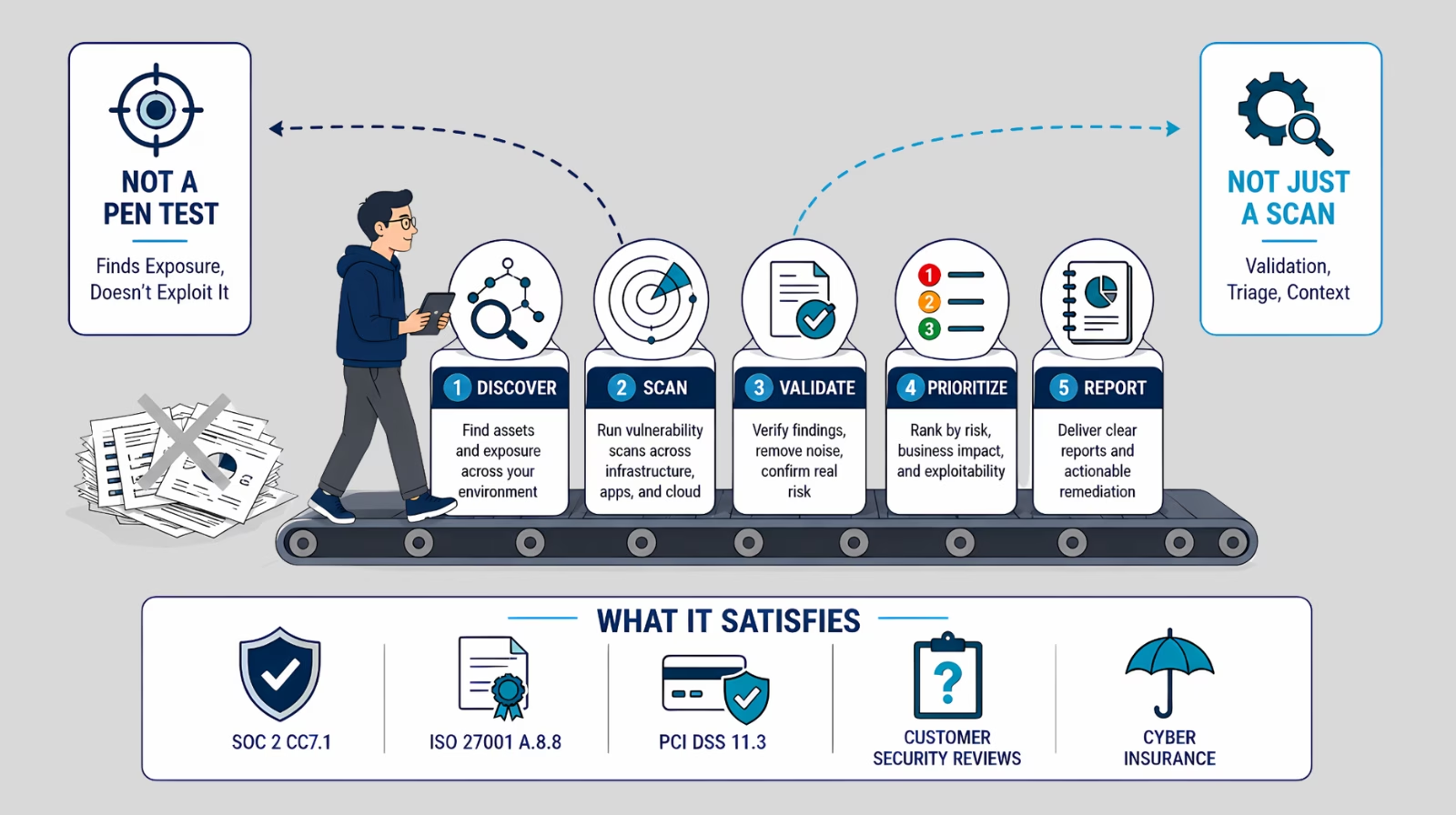
Vulnerability assessment services are engagements where a third party inventories an environment, scans it for known security weaknesses, validates and prioritizes the findings, and delivers a remediation plan with evidence suitable for auditors and customer security reviews. A good assessment answers three questions: what is exposed, which exposures matter, and in what order to fix them.
At a glance
- Deliverables to expect: validated findings report, risk-ranked remediation plan, executive summary, evidence package for audits
- Typical duration: one to four weeks depending on environment size
- Pricing drivers: asset count, environment complexity (cloud/on-prem/hybrid), authenticated vs. unauthenticated depth, re-test inclusion
- Commonly triggered by: SOC 2 or ISO 27001 audits, customer security questionnaires, PCI DSS 11.3, cyber insurance requirements
- Red flag: a raw scanner export delivered as the final report
What do vulnerability assessment services include?
A credible vulnerability assessment is a five-phase exercise, and the scan is only one phase.
- Scoping and asset discovery. The provider maps what exists before testing it: external footprint, internal networks, cloud accounts, web applications. Assessments that skip this phase inherit whatever the client's asset list gets wrong, and findings on unknown assets are the ones that hurt.
- Scanning. Automated detection across the agreed scope, ideally authenticated (credentialed) for accuracy. The guide to vulnerability scans explains the scan types and what each can and cannot see.
- Validation and triage. A human confirms which findings are real, removes duplicates and dead-asset ghosts, and kills the false positives. This phase separates an assessment from a scan export.
- Prioritization against context. Findings get ranked by actual exposure: a medium-severity flaw on an internet-facing system typically outranks a critical on an isolated internal host. Raw CVSS ordering without environmental context is a sign the provider skipped this work.
- Reporting and remediation planning. Deliverables split by audience: an executive summary with risk posture, a technical findings register with reproduction detail, and a sequenced remediation plan with realistic timelines.
Providers worth hiring also include a re-test window to confirm the fixes landed, and many offer to convert the one-time assessment into a recurring scanning program afterward.
Before commissioning any of this, it is worth ten seconds to see what an attacker sees first: Truvo's free domain scan grades your public mail, DNS, TLS and header configuration.
Vulnerability assessment vs. scan vs. penetration test
These three terms get used interchangeably by buyers, and the confusion produces reports auditors reject.
| Vulnerability scan | Vulnerability assessment | Penetration test | |
| What it is | Automated tool run | Scoped engagement: scan + validation + prioritization + plan | Human attacker simulating real exploitation |
| Human effort | Minimal | Triage, validation, contextual ranking | High: exploitation, chaining, logic testing |
| Output | Raw findings list | Validated, prioritized findings + remediation plan | Proven exploits with reproduction steps |
| Answers | What might be wrong? | What is wrong and what do we fix first? | What can an attacker really do? |
| Typical price | Tool subscription | Low-to-mid five figures, size-dependent | Mid five figures and up |
For a first security engagement, the assessment is usually the right entry point: it establishes the baseline, cleans up the obvious exposure, and produces the asset and finding data a later penetration test builds on. Commissioning a red-team-style exercise before basic vulnerability management exists produces a dramatic report and little operational improvement.
What compliance requirements does a vulnerability assessment satisfy?
Vulnerability assessment evidence maps directly to the requirements that trigger the purchase:
| Requirement | What it expects | What the assessment provides |
| SOC 2 CC7.1 | Procedures to detect vulnerabilities | Scan results, methodology, remediation records |
| ISO 27001 A.8.8 | Management of technical vulnerabilities | Findings register, treatment plan, re-test evidence |
| PCI DSS 11.3 | Quarterly internal and external scans | Scan reports meeting ASV requirements (external) |
| Customer security reviews | Proof vulnerabilities are found and fixed | Executive summary and evidence package |
| Cyber insurance | Demonstrated vulnerability management | Assessment report and remediation confirmation |
Watch out
A one-time assessment will not carry a Type 2 audit
A one-time vulnerability assessment satisfies a point-in-time question, but SOC 2 Type 2 and ISO 27001 surveillance audits examine whether vulnerability management operates continuously. Buyers whose real driver is an upcoming Type 2 audit need the recurring capability, and should tell providers that upfront so the engagement hands off into an operating cadence rather than ending at a PDF.
How to evaluate a vulnerability assessment provider
Six questions separate providers who run a program from providers who run a tool:
- Walk me through your validation process. If the answer is a tool name, the deliverable will be a scanner export. The right answer describes human triage, false-positive elimination, and dead-asset reconciliation.
- How do you prioritize findings? Look for environmental context (exposure, asset criticality, exploit availability) rather than plain CVSS sorting.
- What does the remediation plan look like? Ask for a sanitized sample report. It should sequence fixes with realistic timelines, not paste vendor advisories.
- Do you scope authenticated scanning? Credentialed scans find what patch level a system is really at; unauthenticated-only assessments of internal environments are shallow.
- Is a re-test included? Fixes that were never verified have a way of not existing when the auditor checks.
- What happens after the assessment? Providers who can define scanning tiers, remediation SLAs, and an evidence cadence turn the one-time purchase into a working capability. A defensible SLA baseline to expect in that conversation: critical and high findings on internet-facing assets remediated within 24 to 48 hours (7 to 14 days for internal systems), medium within 30 days, low within 90, with documented risk acceptance and compensating controls for anything that cannot meet the timeline.
Mixed and on-premises environments deserve one extra check: ask how the provider handles assets that cannot take an agent or survive aggressive scanning (switches, storage arrays, legacy appliances). Experienced firms tier the approach, with weekly automated coverage on internet-facing systems and documented manual verification on low-risk devices, rather than pretending one scanner setting fits a 15-year-old environment. The SOC 2 vulnerability scanning guide for on-prem environments shows what that tiering looks like in practice.
What do vulnerability assessment services cost?
Vulnerability assessment pricing scales with scope, and four variables drive most of the spread:
- Asset count and diversity. Fifty cloud servers assess faster than fifty branch-office networks with appliances and OT gear.
- Depth. Authenticated scanning, web application coverage, and cloud configuration review each add effort and value.
- Environment access. On-prem and hybrid environments need more setup than cloud-native ones.
- Re-testing and handoff. Verification passes and program-buildout support extend the engagement.
Small, cloud-native environments land at the low end of five figures; large hybrid estates with application and cloud coverage run considerably higher. Treat quotes dramatically below market as a signal the assessment is an unvalidated scan.
When a vulnerability assessment is the wrong purchase
An honest provider will say this in scoping, so it belongs in a buyer's guide: some situations call for a different engagement.
A customer contract demands a penetration test by name
A vulnerability assessment will not satisfy it; the auditor or customer will read the report and ask where the exploitation evidence is.
The environment has never had basic patching
If nothing has been updated in years, the findings list is predictable; the budget is better spent on remediation first and assessment after.
The real gap is the whole program
Companies facing their first SOC 2 often need the surrounding capabilities (asset inventory, access control, policies, evidence collection) as much as the vulnerability data. A capability assessment across the program identifies whether vulnerability management is the binding constraint or one gap among many.
Size the Assessment for Your Environment
A scoping call maps the engagement to an effective security program, with compliance as the byproduct.
Frequently Asked Questions
How long does a vulnerability assessment take?
One to four weeks for most environments. Scoping and access setup take the first few days, scanning runs hours to days, and validation plus reporting fills the remainder. Large hybrid environments or ones requiring physical access run longer.
How often should a vulnerability assessment be repeated?
Annually as a floor, with continuous or monthly scanning in between. Frameworks differ: PCI DSS requires quarterly scans, while SOC 2 and ISO 27001 expect vulnerability management to operate continuously. A common model is an annual third-party assessment on top of an internal scanning cadence.
Is a vulnerability assessment required for SOC 2?
SOC 2 does not name the service, but CC7.1 requires procedures to detect and act on vulnerabilities, and auditors expect scan evidence and remediation records. An assessment is a fast way to establish that evidence; a recurring scanning program is what sustains it through a Type 2 audit period.
Can a vulnerability assessment be done in-house instead?
Yes, with a scanner license and dedicated triage time. The trade is effort and objectivity: customer reviews and some auditors weight third-party results higher, and internal teams often lack time to validate and drive remediation. Many companies use a third-party assessment to set the baseline, then run scanning internally.
What is the difference between external and internal vulnerability assessments?
An external assessment tests what is reachable from the internet: the attack surface an outside attacker sees. An internal assessment tests from inside the network, modeling an attacker who has gotten in or a malicious insider. Compliance frameworks like PCI DSS require both.
Ready to Start Your Compliance Journey?
Get a clear, actionable roadmap with our readiness assessment.
Contact Us
Free Report: The CPCSC Compliance Playbook
Join the waitlist for a free copy when it’s released.
About the Author

Former security architect for Bank of Canada and Payments Canada. 20+ years building compliance programs for critical infrastructure.