

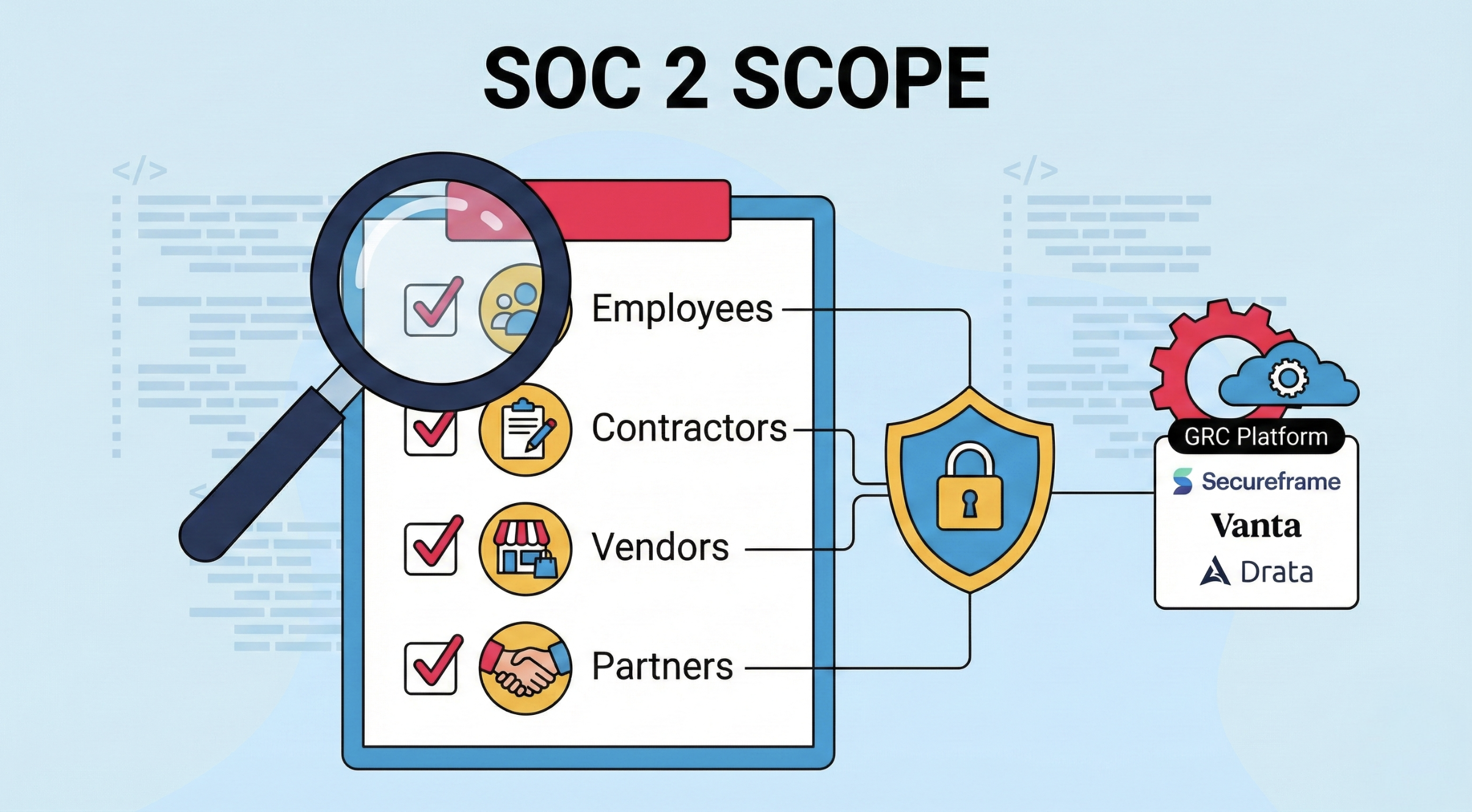
Short answer: a person is in SOC 2 scope when their role or access affects the system's ability to meet the Trust Services Criteria commitments.
- Always in scope: developers, IT ops, and anyone with production access
- Everyone: in scope for security awareness (CC1.1)
- Grey area: customer support, HR, and finance, depending on data access
- Contractors and vendors: need policy acknowledgment (CC1.1, CC1.4, CC8.1) to extend the control environment
Scope depends on company size and on which teams and systems support the service:
- SaaS companies under 50 people: everyone on staff is usually in scope.
- Larger companies: only the teams that support the service. In a 200-person company where 60 people (30%) work in a separate consulting practice with no access to the SaaS product or customer data, those 60 are out of scope for system controls and the other 140 are in.
- Development servers: out of scope for patching reviews. The repositories and CI/CD pipelines that connect development servers to production are in scope, because the code in those repositories ends up in production. Repositories for applications outside the in-scope service are out.
What does SOC 2 scope cover?
SOC 2 scope covers three areas:
- Systems: infrastructure, software, and data flows
- People: employees, contractors, and vendors
- Processes: the policies, procedures, and controls that govern operations
The AICPA defines a system as infrastructure, software, procedures, and data operated by people, so people scoping affects every other part of the scope. Teams often underestimate people scope, which reaches past engineering into support, HR, and outside contractors.
For a SaaS product, systems scope is production plus the CI/CD pipeline. People scope is usually all staff plus any contractor with access to production or customer data. Process scope is the change management, access review, and offboarding procedures those people follow.
SOC 2 scoping guides by area. The SOC 2 scope guide to systems, people, and processes covers the system boundary and process scope. The hybrid and on-prem scoping guide covers boundaries that span cloud and company-owned hardware. When production runs entirely on company-owned servers, SOC 2 readiness on bare metal starts with a scoped system inventory and tiered asset classification.
The impact test: who needs to be in SOC 2 scope?
The test: does the person's role or access affect the company's ability to meet service commitments to customers? People scope goes beyond employees to include contractors, vendors, and business partners whose activities directly or indirectly affect the controls behind the Trust Services Criteria. Teams often work with Canadian SOC 2 consultants to map scope to the real organization chart and vendor list from the start.
Who is always in scope through system access?
Anyone with logical or physical access to protected information assets or systems that support the service is in scope:
- Production access: developers, SREs, and DevOps engineers who can push code or change configuration
- Development and staging: engineers, QA, and architects preparing changes for production. Code written today runs in production tomorrow.
- Infrastructure operations: DBAs, network engineers, and IT ops managing databases, servers, and network configuration. A DBA on the customer database directly affects processing integrity and confidentiality.
Is everyone in scope for security awareness?
CC1.1 (Commitment to Integrity and Ethical Values) and CC1.4 (Competent Individuals) bring everyone into scope for security awareness, regardless of technical access:
- All employees for security and privacy awareness training: recognizing phishing, following acceptable use, and reporting incidents.
- Senior management for oversight. Setting the control environment and expectations is a core audit focus.
Are support functions in SOC 2 scope?
Support roles outside production can still affect the control environment, depending on the data and systems each role can reach.

Typically out of scope (for core system controls, still in scope for security awareness):
- Office maintenance staff with no system or data access
- External accountants handling only company financial records
- Marketing limited to analytics and public-facing tools with no customer data access

Are contractors and vendors in SOC 2 scope?
Yes. The AICPA explicitly includes contractors, vendors, and business partners. For outsourced functions, the company uses one of two methods:
- Inclusive method: the vendor's controls become part of the company's system description
- Carve-out method (more common): the vendor's services are identified, the vendor's controls are excluded, and the company's monitoring controls are included
Either way, vendor personnel who interact with the system need to be scoped. Ongoing SOC 2 vendor management falls under CC9.2.
An internal team is treated differently from a separate company, as the guide to SOC 2 scope for internal teams and dev servers explains.
What must contractors and vendors acknowledge?
The Trust Services Criteria require that outsourced personnel understand the company's standards of conduct (CC1.1) and that the company has assessed their competency (CC1.4).
At minimum, contractors and vendor personnel acknowledge:
- Standards of conduct covering ethical behavior, security practices, and incident reporting
- Security policy covering access, acceptable use, and incident response
- Change management policies (CC8.1) if they perform development or maintenance work
The signed acknowledgment is only the starting record. The auditor tests ongoing oversight: periodic adherence checks, such as reviewing vendor SOC 2 reports or running vendor security assessments, and how deviations get addressed.
How do GRC platforms track people scope?
Manual tracking stops working as headcount and vendor count grow. Secureframe, Vanta, and Drata integrate with the HRIS and identity provider to:
- Identify in-scope personnel
- Track onboarding and offboarding
- Monitor access permissions
- Collect training and policy acknowledgment evidence
Auditors get one source of truth, and gaps surface well before the audit. The same single-source approach applies to risk management when scope spans cloud and on-prem, where the risk register has to cover both cloud and on-prem, including the on-prem side that is harder to instrument.
How do you scope people for SOC 2, step by step?
Six Steps to Get People Scoping Right
- Inventory all personnel. List everyone who interacts with the system or affects the control environment: employees, contractors, vendors, business partners.
- Apply the impact test. Test each person against the Trust Services Criteria commitments and document the rationale.
- Map access and training. Verify MFA and least privilege, and confirm security awareness training for all in-scope personnel (CC1.1).
- Formalize vendor relationships. Contracts, standards of conduct, and policy acknowledgments (CC1.1, CC1.4, CC8.1). Review vendor SOC 2 reports where available.
- Automate with a GRC platform. Track personnel, access reviews, training, and acknowledgments in one place.
- Review regularly. At least annually, and after technical hires, new vendors, or architecture changes.

Not sure who's in scope?
Our fractional security team reviews your team structure, vendor relationships, and access patterns, then maps them to an effective security program where scoping is clear and defensible.
Frequently Asked Questions
What determines whether a person is in scope for SOC 2?
Whether the person's role or access directly or indirectly affects the system's ability to meet the Trust Services Criteria commitments. Anyone with access to production, customer data, or critical infrastructure is in scope. All employees are in scope for security awareness training (CC1.1).
Are contractors and vendors included in SOC 2 people scope?
Yes. The AICPA explicitly includes contractors, vendors, and business partners. Under the inclusive or the carve-out method, vendor personnel who interact with the system must acknowledge your security policies.
What is the difference between the inclusive and carve-out method?
The inclusive method puts a vendor's controls into your SOC 2 system description and audit scope. The carve-out method identifies the vendor's services but excludes the vendor's controls, and tests your controls for monitoring that vendor. Carve-out is more common because the audit scope stays manageable.
Which roles are typically out of scope for SOC 2?
Roles with no access to customer-facing systems or sensitive data are usually out of scope for core system controls: office maintenance staff, external accountants handling only company financial records, and marketing limited to non-production tools. All employees stay in scope for security awareness training under CC1.1.
How often should SOC 2 people scope be reviewed?
At least annually, and after significant changes: new hires in technical roles, new vendor relationships, system architecture changes, or acquisitions.
