


SOC 2 CSOCs (Complementary Subservice Organization Controls) are vendor controls your system depends on but does not operate. A SOC 2 report handles them with one of two methods:
- Carve-out (the standard approach): your report references the vendor's own SOC 2 report, and your auditor does not test the vendor's controls
- Inclusive: your auditor tests the vendor's controls directly
For a company in a colocation data center, the auditor asks for the data center's own SOC 2 report and tests only the parts the company runs itself (Truvo Cyber, 2026).
Getting the method wrong creates audit problems and confuses the enterprise buyers who read your SOC 2 report.
What is a subservice organization, and what are CSOCs?
CSOCs (Complementary Subservice Organization Controls) are controls operated by a third-party vendor, a subservice organization, that your system depends on to meet the Trust Services Criteria commitments. Your organization assumes the controls are in place but does not operate them.
Controls running the other way, which a vendor assumes customers operate, are covered in the guide to complementary user entity controls in SOC 2.
The most common example: a SaaS company in a colocation facility relies on the data center provider for physical security, environmental controls (power, cooling, fire suppression), and physical access management. The SaaS company needs those controls to meet SOC 2 security requirements, but the data center runs them. We document this dependency in the system description, with an annual review of the provider's SOC 2 report, for clients in our SOC 2 for colocation and data centers engagements.
Almost every service organization depends on other organizations. Your SOC 2 report has to name those dependencies and explain how you manage them, either by bringing the subservice organization's controls into scope or by carving them out and referencing the subservice organization's own SOC 2 report.
How do you identify your subservice organizations?
Before deciding on carve-out vs inclusive, you need to know which vendors qualify as subservice organizations. Not every vendor is one. A subservice organization is a third party whose services are part of your system, meaning they directly affect your ability to meet your Trust Services Criteria commitments.
In a recent engagement, we helped a company identify three subservice organizations for the SOC 2 scope:
Each vendor operates controls the company's system depends on: the data center runs physical security, the endpoint vendor runs malware detection, and Microsoft runs email and identity infrastructure.
Vendors that do not touch your system or data, such as your office cleaning service, your accountant, or your marketing tools, are not subservice organizations. The test is the same impact test used for people scoping: does this vendor's service directly or indirectly affect your ability to meet your Trust Services Criteria commitments?
What is the carve-out method?
The carve-out method excludes the subservice organization's controls from your audit scope. Your system description names the subservice organization and describes the services, but your auditor does not test the subservice organization's controls. The report states that those controls are carved out.
How carve-out works in practice:
The company running in a colocation facility carves out physical security controls. The system description says something like: Physical security controls, including facility access, environmental controls, and physical monitoring, are the responsibility of [data center provider]. These controls are excluded from the scope of this examination. [Data center provider] issues its own SOC 2 report, which is reviewed annually by management.
The company then runs complementary controls:
- Reviewing the data center's SOC 2 report every year
- Monitoring bridge letter gaps
- Documenting each review
Enterprise customers can request the data center's SOC 2 report separately for more assurance.
When to use carve-out:
- The vendor has an independent SOC 2 report (most major data centers, cloud providers, and SaaS vendors do)
- The vendor's controls are mature and independently audited
- You want a manageable, lower-cost audit scope
- Customers are comfortable reading the vendor's SOC 2 report separately
Carve-out is the standard approach for colocation facilities, major cloud providers (AWS, GCP, Azure), and established SaaS vendors. In our experience, auditors accept carve-out when the subservice organization is well known and has a current SOC 2 report.
What do enterprise customers expect to see in a carve-out?
Scoping subservice organizations is the first decision in a SOC 2 engagement.
Book a SOC 2 Scoping CallSophisticated reviewers look for three things:
- The subservice organization is named and the services are clearly described
- Your company reviews the subservice organization's SOC 2 report annually
- Any change of subservice organization triggers notifications, with a notice period
Free · Google Sheet
SOC 2 Common Criteria CC1 to CC9, Mapped to ISO 27001 (Spreadsheet)
Every Common Criteria point with the ISO 27001:2022 Annex A controls it maps to and the SOC 2 evidence that carries over, plus two sample control sets, kept current in a shared Google Sheet. Enter your email to open it.
What is the inclusive method?
The inclusive method brings the subservice organization's controls into your audit scope. Your auditor tests those controls, and the results appear in your SOC 2 report next to your own.
How inclusive works in practice:
The system description includes the subservice organization's infrastructure, people, processes, and data relevant to the service. The subservice organization provides a formal assertion and a representation letter covering the subservice controls, which your auditor then tests.
When to use inclusive:
- The vendor has no independent SOC 2 report
- You want to give customers one consolidated report
- The subservice organization's controls are deeply intertwined with your own (hard to separate cleanly)
- Customers explicitly require the inclusive method
Cost consideration: The inclusive method significantly expands the audit scope, increases cost, and requires the subservice organization's active cooperation (providing assertions, making personnel available for testing, granting auditor access). Most subservice organizations with their own SOC 2 reports prefer that customers use the carve-out method.
| Carve-Out | Inclusive | |
| Subservice controls tested? | No, referenced only | Yes, by your auditor |
| Audit scope | Narrower, lower cost | Expanded, higher cost |
| Subservice cooperation needed? | SOC 2 report sharing only | Assertions, representation letter, auditor access |
| Best when | Subservice org has an independent SOC 2 | No independent SOC 2 available, or customer requires it |
| How common? | Standard practice | Less common |
The diagram below compares the two methods: which controls are inside your audit scope, who tests them, and when each method fits.
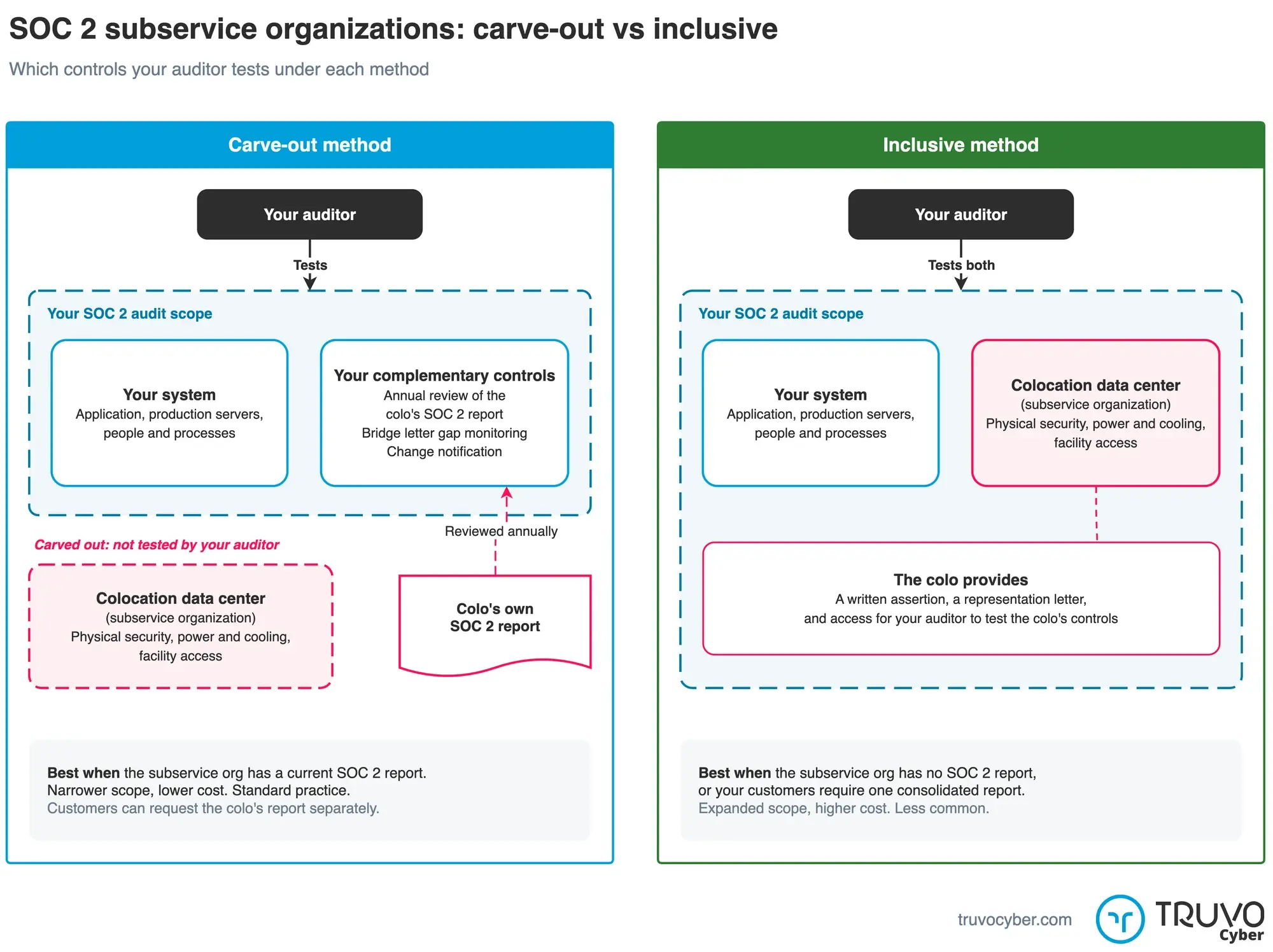
Carve-out keeps the subservice organization outside your audit scope. Inclusive brings the subservice organization's controls in for your auditor to test. Click to enlarge.
Why do enterprise buyers care how CSOCs are handled?
Enterprise buyers read your SOC 2 report to judge your whole service delivery chain, not just the parts you operate.
A data custodian for regulated industries (insurance, financial services, healthcare) needs a report that clearly shows how the company manages critical vendors. A documented carve-out with annual SOC 2 report review builds confidence. A vague mention of third-party services, with no named subservice organizations or oversight process, raises questions.
Companies that do well treat subservice organization management as an ongoing function: annual SOC 2 report reviews, documented in the vendor risk management program, with change notification procedures for critical subservice organizations. Companies that struggle treat subservice management as a one-time task during audit prep.
Not sure how to scope your subservice organizations?
Our fractional security team designs effective security programs where CSOCs, vendor management, and audit scope are scoped from the start, not patched together before the auditor arrives.
Book Your Strategy CallFrequently Asked Questions
What does CSOCs stand for in SOC 2?
Complementary Subservice Organization Controls: controls a third-party vendor (a subservice organization) operates and your system depends on to meet the Trust Services Criteria commitments. Examples include physical security at a colocation data center, infrastructure controls at AWS or Azure, and endpoint protection from a security vendor.
What is the difference between the carve-out and inclusive method in SOC 2?
Carve-out excludes the subservice organization's controls from your audit scope: the report names the vendor and services, but your auditor does not test the vendor's controls. Inclusive brings the controls into scope, so your auditor tests them and the results appear in your report. Carve-out is far more common because the scope stays manageable and the vendor's own SOC 2 report covers the controls.
When should a company use the inclusive method instead of the carve-out method?
When the subservice organization has no independent SOC 2 report for your report to reference. Inclusive also fits when customers require one consolidated report, or when the vendor's controls are too intertwined with yours to separate. Expect a larger scope, higher cost, and active vendor cooperation: a formal assertion, a representation letter, and auditor access to vendor personnel.
What is a CSOCs example in a SOC 2 report?
A SaaS company hosts production servers in a colocation facility, and the data center provider manages physical security, facility access, power, cooling, and fire suppression. The SOC 2 report names the data center as a subservice organization and usually carves out those controls, with an annual review of the data center's SOC 2 report.
How do I identify subservice organizations for my SOC 2 audit?
A subservice organization is a vendor whose services are part of your system and directly affect your Trust Services Criteria commitments, such as colocation or cloud providers, endpoint protection vendors, identity providers, and business productivity platforms. Vendors that do not touch your system or data (office supplies, marketing tools, cleaning) are not subservice organizations.
Do enterprise customers care about how CSOCs are handled?
Yes, especially in financial services, insurance, and healthcare. Buyers check that subservice organizations are named, that you review their SOC 2 reports every year, and that you have change notification procedures. Some contracts require 6 months' notice or more, with a right of refusal, before you change a critical subservice organization such as a data center.
How do you review a colocation provider's SOC 2 report?
Get the current report every year and check:
- The report covers the facility you use and the services you buy
- The report period overlaps your observation period, with a bridge letter for any gap
- The opinion type, and whether any exception touches a control you rely on
- Which complementary user entity controls the report lists, and which ones your team operates
Record the review with a date, the reviewer, the findings and any follow-up. The dated review record is the evidence the auditor samples. The data center vendor management guide covers how to read each section of the report.
