


A vCISO engagement gives your company a named senior security lead who owns the security program part time, with a team behind that lead for the hands-on work. At Truvo, the first 90 days follow a set sequence: assess your environment in the first month, build the program and the Security Program Manual in the second, and have a working rhythm by the third. After that, the vCISO holds weekly checkpoints, a monthly leadership review and quarterly roadmap planning. If you want to see what the manual looks like before you hire anyone, download the sample at the end of this post.
At a glance
- What happens in the first 30 days?: Architecture review, data flow diagrams, system inventory, staff interviews
- What happens by day 60?: Threat model, capability scores, a prioritized roadmap, the Security Program Manual drafted
- What do you hold by day 90?: A named owner, the manual, policies and controls in your GRC platform, a working cadence
- What's the monthly cadence?: Weekly checkpoints, a monthly leadership review, quarterly roadmap planning
- Who does the hands-on work?: Truvo's analysts and security engineers, in five-day blocks when needed
- What does a Truvo vCISO cost?: From USD $2,500 a month, depending on scope
Services spotlight: what a Truvo vCISO engagement includes
| Truvo service | What it covers |
| vCISO services | A named senior lead who owns security decisions and answers to your board, auditors and customers |
| Security capability assessment | The scoring of about 19 security capabilities that sets the roadmap |
| Security engineers on demand | Engineers who build the controls in your systems, sold in five-day blocks |
| Managed Vanta or Managed Drata | Your GRC platform operated day to day inside the same engagement |
| Security questionnaire services | Customer questionnaires and DDQs answered with the full submission package |
What happens in the first 30 days of a vCISO engagement?
The first month is about learning how your company works before anyone writes a policy. Policies come later, once we know how your company operates day to day. We start with the systems.
In the first 30 days, your vCISO:
- Reviews your security architecture. How your product is built, where the data lives, how people and services log in, and where the trust boundaries are.
- Draws data flow and network diagrams. How customer data moves through your environment, including across borders. Auditors and enterprise buyers ask for both diagrams.
- Builds a system inventory. Every cloud account, SaaS tool, code repository and laptop group, including systems with no GRC platform integration.
- Interviews your people. Engineering, IT, operations and whoever handles HR and legal, to compare the documented process with what happens on a normal Tuesday.
The architecture work usually covers the opening four to six weeks, so the first month ends with a clear picture of your environment and the first capability scores.
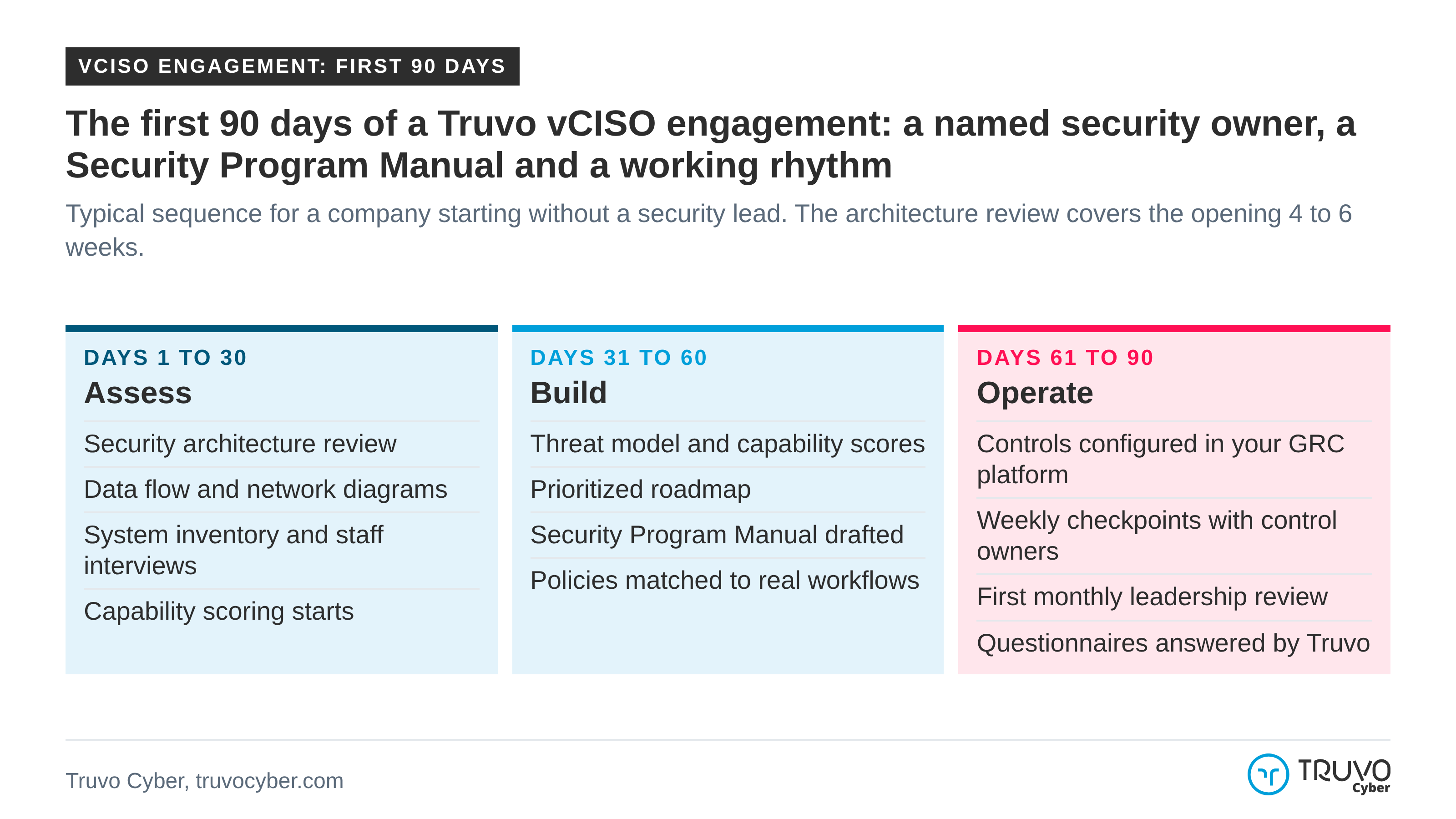
Figure: The first 90 days of a Truvo vCISO engagement: a named security owner, a Security Program Manual and a working rhythm. Days 1 to 30, Assess: security architecture review, data flow and network diagrams, system inventory and staff interviews, and capability scoring starts. Days 31 to 60, Build: threat model and capability scores, a prioritized roadmap, the Security Program Manual drafted and policies matched to real workflows. Days 61 to 90, Operate: controls configured in your GRC platform, weekly checkpoints with control owners, the first monthly leadership review and questionnaires answered by Truvo. The architecture review covers the opening 4 to 6 weeks. Click to enlarge.
What happens between day 30 and day 60 of a vCISO engagement?
The second month turns the picture into a plan and starts the build. Security capabilities are the building blocks of an effective security program, and an effective program has about 19 of them: access management, vulnerability management, logging and monitoring, vendor risk, incident response and so on. Your vCISO scores each capability on a simple scale: not in place, in place but not effective, effective but not provable, or effective and provable.
Together with a lightweight threat model, the scores give you a prioritized roadmap. High-impact fixes that close several gaps at once go first. Then the vCISO starts the Security Program Manual and the policies.
The Security Program Manual is the document I'd point to if you asked what you get from a vCISO. For each capability, the manual records five things: the scope (which systems), the technology (which tools), the evidence (which records you keep), the process (what happens, how often) and the people (who owns the work, who approves). We build the manual with your team in short workshops, one capability at a time. Policies come after the manual, matched to the workflows the manual describes. The policy vs procedure guide explains why the two are separate documents.
What does a vCISO deliver by day 90?
By the end of the first quarter, the program has an owner, a manual and a rhythm. Your engineers go back to the roadmap. In the third month:
- Controls get configured in your GRC platform. Vanta, Drata or whichever platform you own starts holding real evidence, mapped to the frameworks you need.
- The cadence starts. Weekly checkpoints with control owners, and the first monthly leadership review.
- Questionnaires come to us. Customer security questionnaires and DDQs go to the team, with the full submission package, instead of back to engineering.
- The roadmap gets dated. Each remaining gap has an owner, a fix and a date.
Here's the set of deliverables you keep from the first quarter. Every one is built from your systems, and every one stays with you if we ever part ways:
| Deliverable | What it is for |
| Security Program Manual | How each security capability works: scope, tools, evidence, process, owners |
| Security Posture Report | A summary for buyers, partners and the board |
| Security architecture review | How the product is built and where the risks are |
| Data flow and network diagrams | How data moves, for auditors and buyers |
| Threat model and remediation roadmap | What to fix, in what order |
| Capability assessment scores | Where each of about 19 capabilities stands |
| Policies and control set | Matched to real workflows, approved by leadership |
| Evidence pipelines in your GRC platform | Evidence collected on a schedule |
| Questionnaire answer library | Approved answers, reused deal to deal |
| Vendor risk register | Every in-scope vendor with a risk rating |
What is the monthly cadence of a vCISO engagement after the first 90 days?
After the first quarter, the engagement becomes an operating rhythm. Security programs work on rhythm, and the rhythm keeps the program from drifting back into somebody's spare time.
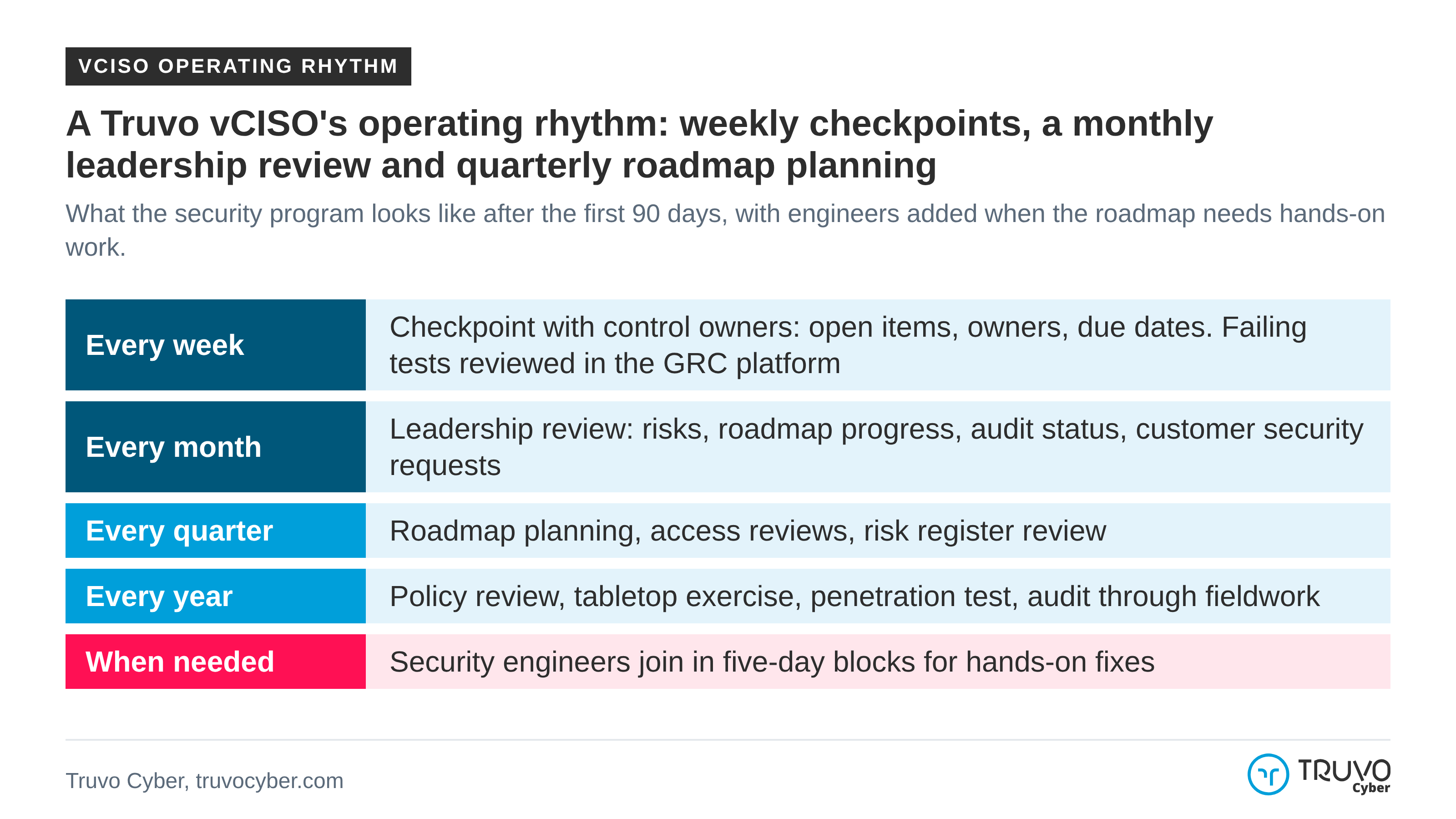
Figure: A Truvo vCISO's operating rhythm: weekly checkpoints, a monthly leadership review and quarterly roadmap planning. Every week: a checkpoint with control owners on open items, owners and due dates, and failing tests reviewed in the GRC platform. Every month: a leadership review of risks, roadmap progress, audit status and customer security requests. Every quarter: roadmap planning, access reviews and a risk register review. Every year: policy review, tabletop exercise, penetration test and the audit through fieldwork. When needed: security engineers join in five-day blocks for hands-on fixes. Click to enlarge.
The monthly leadership review is the meeting your CEO and CTO should always attend. In 30 minutes, the vCISO covers the risks that changed, roadmap progress, audit status and any customer security requests in the pipeline. Decisions get made and recorded: build a missing control, accept a risk with a written reason, or move a date. Our value is good security decisions, and the documents record those decisions.
Frameworks fit into the same rhythm. SOC 2 and ISO 27001 are frameworks you choose when customers ask for them. HIPAA, PIPEDA and Quebec Law 25 are laws that apply once the regulated data is in scope. Your vCISO maps all of them onto one program, so a second framework is mostly mapping work instead of a second project.
How does a vCISO pair with security engineers to get the work done?
A vCISO decides what the program needs. Someone still has to turn on MFA app by app, send logs to a SIEM, enroll laptops in device management and harden the cloud accounts. Buyers tell us they're tired of paying for advice with no hands, and I get it.
At Truvo, the vCISO and the engineers work as one team. When the roadmap calls for hands-on work, we add security engineers on demand in five-day blocks, under the same senior lead. The vCISO writes the requirement, the engineer builds the control in your systems, and the evidence goes into your GRC platform. Your own engineers stay on the product, and they're pulled in only for the application code and the decisions that belong to them.
How is a Truvo vCISO engagement priced and scoped?
A Truvo vCISO engagement is a monthly retainer, from USD $2,500 a month. The fee depends on the number of frameworks, the size of your environment, the systems in scope and how much of the operating work our team takes on. We set the scope and the fee in writing after a scoping call. The independent auditor bills the audit and the GRC vendor bills the platform licence, so both stay separate line items.
Every engagement is senior-led. The lead holds CISSP and CCSP credentials, and specialists in architecture, identity, detection engineering, incident response and privacy back the lead. When a company outgrows the fractional model and hires a full-time CISO, transition planning is part of the engagement, so the new CISO inherits a working program. The vCISO services page has the full scope, and the fractional CISO guide explains when fractional makes sense.
Get the sample Security Program Manual
The fastest way to judge a vCISO is to look at what they hand over. Our sample is an anonymized extract from a real client's Security Program Manual: three complete sections (change management, vulnerability and patch management, and incident management) mapped to SOC 2, plus the outline of the full manual, so you can see the level of detail a working program needs.
Download the SOC 2 security procedures sample
Truvo Cyber is a cybersecurity professional-services firm and a fractional security team. I spent years in security at Payments Canada, KPMG and Accenture before founding Truvo. Book a strategy call, and we'll walk through your environment and what the first 90 days would cover for you.
Where to start, depending on what you need:
- A senior owner for the whole program: vCISO services
- A clear picture of where you stand first: security capability assessment
- Hands on keyboard for the technical fixes: security engineers on demand
- Someone to operate the platform: Managed Vanta or Managed Drata
Plan your first 90 days with a vCISO
A senior Truvo vCISO owns your security program, builds the Security Program Manual and runs the monthly cadence.
Frequently asked questions
How does a vCISO engagement work?
A vCISO engagement puts a named senior security lead in charge of your security program part time, backed by a team. At Truvo the first 90 days follow Assess, Build, Operate: architecture review and inventory in the first month, capability scores, roadmap and the Security Program Manual in the second, and controls plus a working cadence in the third.
What does a vCISO do in the first 90 days?
Reviews the security architecture, draws data flow and network diagrams, builds the system inventory, interviews staff, scores about 19 security capabilities, writes the Security Program Manual and policies, configures controls in the GRC platform and starts weekly checkpoints and a monthly leadership review.
What deliverables should a vCISO engagement produce?
At Truvo, the first quarter produces a Security Program Manual, a Security Posture Report, an architecture review, data flow and network diagrams, a threat model and roadmap, capability scores, policies and controls, evidence pipelines in the GRC platform, a questionnaire answer library and a vendor risk register.
How often does a vCISO meet with the leadership team?
At Truvo, the vCISO holds weekly checkpoints with control owners, a monthly leadership review and quarterly roadmap planning. Urgent issues, such as a security incident or a deal-blocking questionnaire, get handled as they come in.
Does a vCISO do hands-on work?
A Truvo vCISO leads the program and makes the security decisions. Analysts operate the GRC platform, and security engineers build controls in your systems, added in five-day blocks when the roadmap needs them.
How much does a vCISO engagement cost?
Truvo's vCISO engagements start at USD $2,500 a month. The fee depends on frameworks, environment size, systems in scope and how much operating work the team takes on, and is set in writing after a scoping call.