

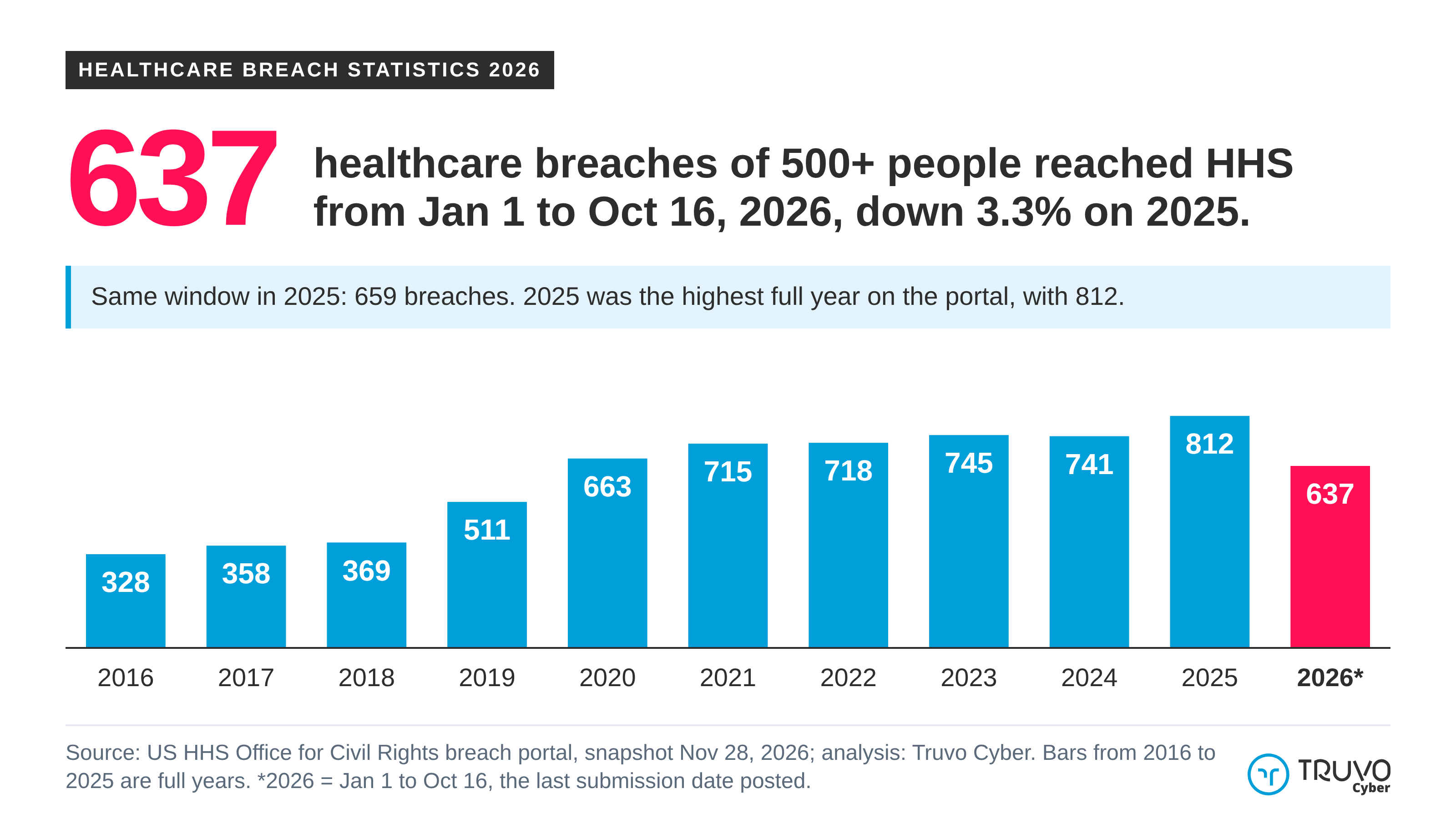
Healthcare organizations reported 637 breaches affecting 500 or more people to the US Department of Health and Human Services between January 1 and October 16, 2026, 3.3% fewer than the 659 reported over the same dates in 2025 (Truvo Cyber, 2026). Those 637 breaches list 90,622,199 affected individuals, down 33.7% from 136,776,249 a year earlier. Truvo Cyber counted every report on the HHS Office for Civil Rights (OCR) breach portal in a snapshot taken on November 28, 2026. October 16 is the latest submission date the portal had posted by then, so every 2026 figure below runs from January 1 to October 16. The method, definitions and limits are at the end of the post.
At a glance
- Breaches of 500+ records reported to HHS: 637 (659 over the same dates in 2025, down 3.3%)
- Individuals affected (sum of reported counts): 90,622,199 (136,776,249 over the same dates in 2025, down 33.7%)
- Share of breaches from hacking or IT incidents: 85.7% (546 of 637)
- Share of breaches involving a business associate: 35.0% (223 of 637)
- Breaches affecting 1 million or more people: 17
- Share of affected individuals in the 10 largest breaches: 65.6%, about two in every three
- Most common location of breached information: Network server, in 72.2% of breaches (460 of 637)
Percentage changes and shares are Truvo Cyber calculations from the counts on the portal.
How many healthcare data breaches were reported in 2026?
637 breaches of unsecured protected health information affecting 500 or more people reached HHS between January 1 and October 16, 2026. Over the same January 1 to October 16 window, earlier years had:
- 2021: 558
- 2022: 576
- 2023: 564
- 2024: 583
- 2025: 659
- 2026: 637
Full-year totals on the portal: 328 in 2016, 358 in 2017, 369 in 2018, 511 in 2019, 663 in 2020, 715 in 2021, 718 in 2022, 745 in 2023, 741 in 2024 and 812 in 2025. The 2025 total is the highest full-year count on the portal, which starts in late 2009. 2026 is running slightly behind 2025 and ahead of every earlier year over the same dates.
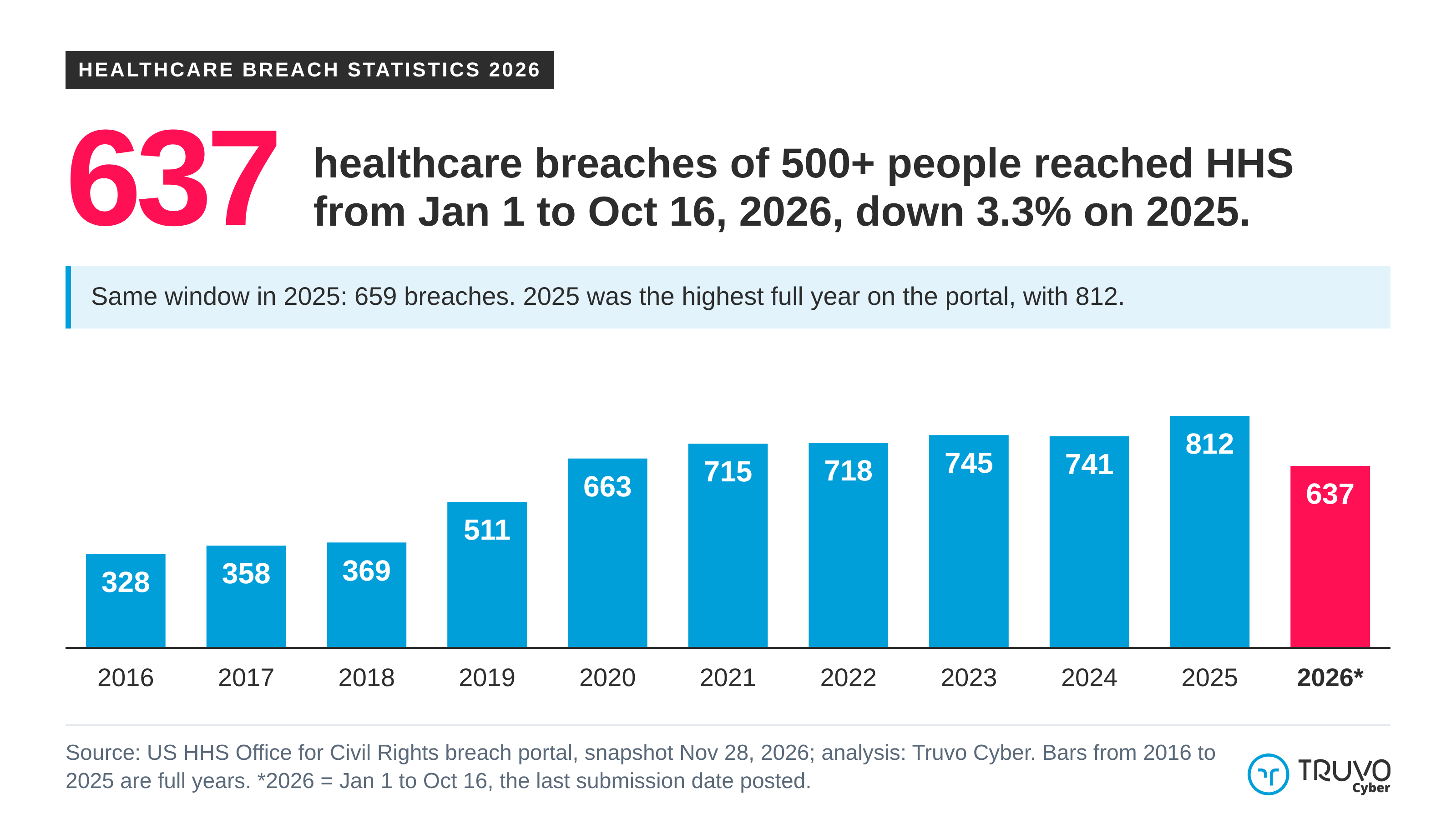
Figure: Healthcare data breaches reported to HHS per year, 2016 to 2026: 637 breaches from January 1 to October 16, 2026. Click to enlarge.
Source: Truvo Cyber analysis of the HHS OCR breach portal, snapshot of November 28, 2026. Bars from 2016 to 2025 are full years. Chart: Truvo Cyber.
How many people were affected by healthcare data breaches in 2026?
Breaches reported between January 1 and October 16, 2026 list 90,622,199 affected individuals, against 141,824,512 for all of 2025 and 291,433,347 for 2024. The sum counts people per breach, so a person caught in two breaches counts twice. The median 2026 breach affected 4,457 people, and 423 of the 637 breaches (66.4%) affected fewer than 10,000.
A few very large breaches drive the total. The 10 largest 2026 breaches account for 59,423,586 individuals, 65.6% of everyone affected this year. 17 breaches reported in 2026 affected 1 million or more people, and together they hold 71,841,156 individuals, or 79.3% of the 2026 total (Truvo Cyber calculation). 2024 had the same pattern at a larger scale: the Change Healthcare breach alone lists 192,700,000 individuals, the largest count on the portal.
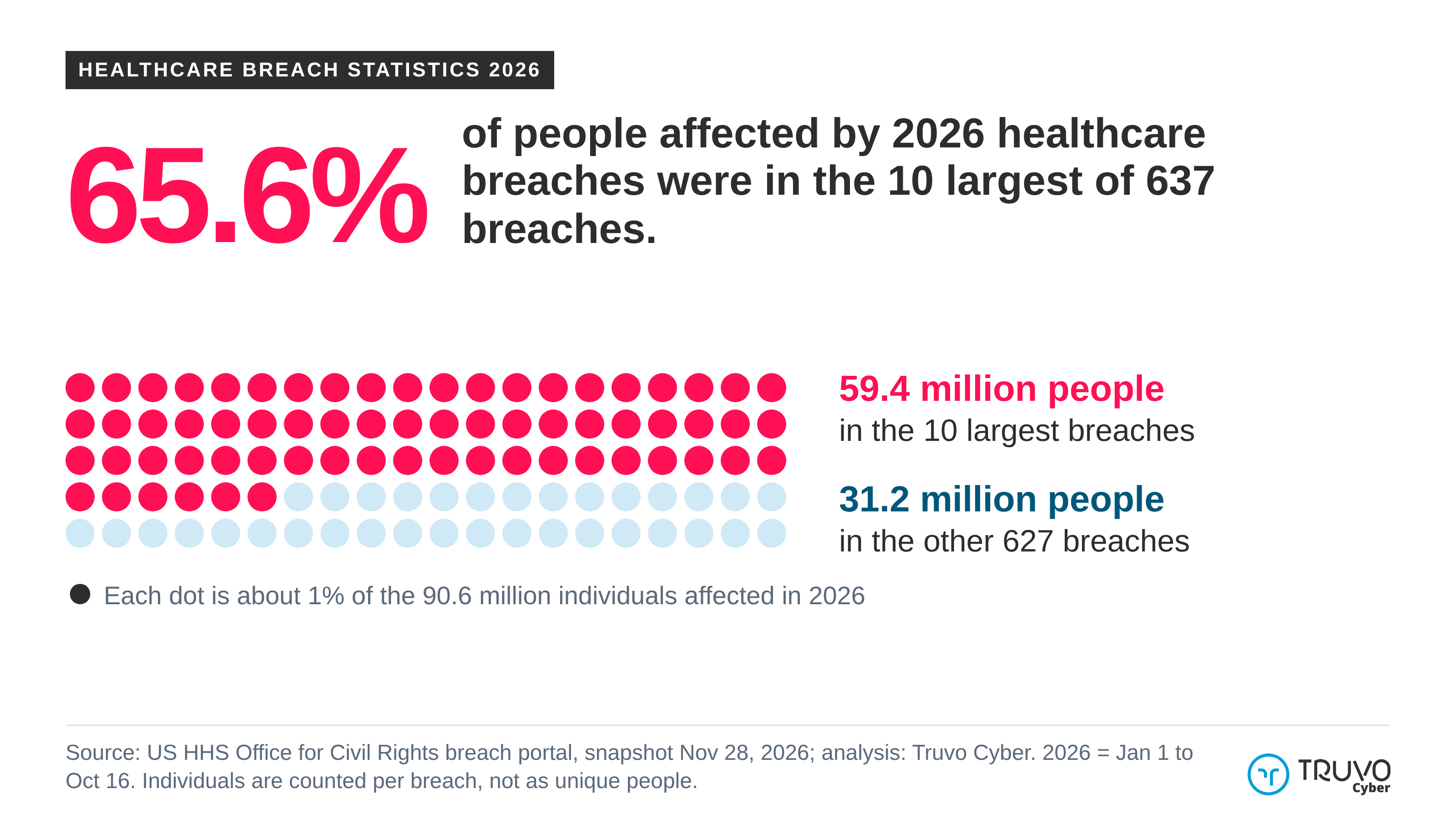
Figure: Dot pictogram: 65.6% of people affected by 2026 healthcare breaches were in the 10 largest of 637 breaches. Click to enlarge.
Source: Truvo Cyber analysis of the HHS OCR breach portal, snapshot of November 28, 2026. Each dot is about 1% of the 90,622,199 individuals affected from January 1 to October 16, 2026. Chart: Truvo Cyber.
What causes healthcare data breaches?
Hacking and IT incidents caused 85.7% of 2026 breaches (546 of 637) and 97.7% of affected individuals. The hacking share has grown every few years: 34.8% of breaches in 2016, 61.4% in 2019, 76.4% in 2021 and 80.9% in 2025. Theft, loss and improper disposal, the physical categories that made up 25.6% of breaches in 2016, account for 5 of the 637 breaches in 2026.
| Healthcare breaches by type | Share of 2026 breaches | Share of 2026 individuals | Share of 2021 breaches |
| Hacking/IT incident | 85.7% (546) | 97.7% | 76.4% (546) |
| Unauthorized access/disclosure | 13.5% (86) | 2.3% | 18.2% (130) |
| Theft | 0.3% (2) | under 0.1% | 3.4% (24) |
| Loss | 0.2% (1) | under 0.1% | 1.4% (10) |
| Improper disposal | 0.3% (2) | under 0.1% | 0.7% (5) |
Every report from 2016 onward lists a single breach type, so the shares add up to 100% after rounding.
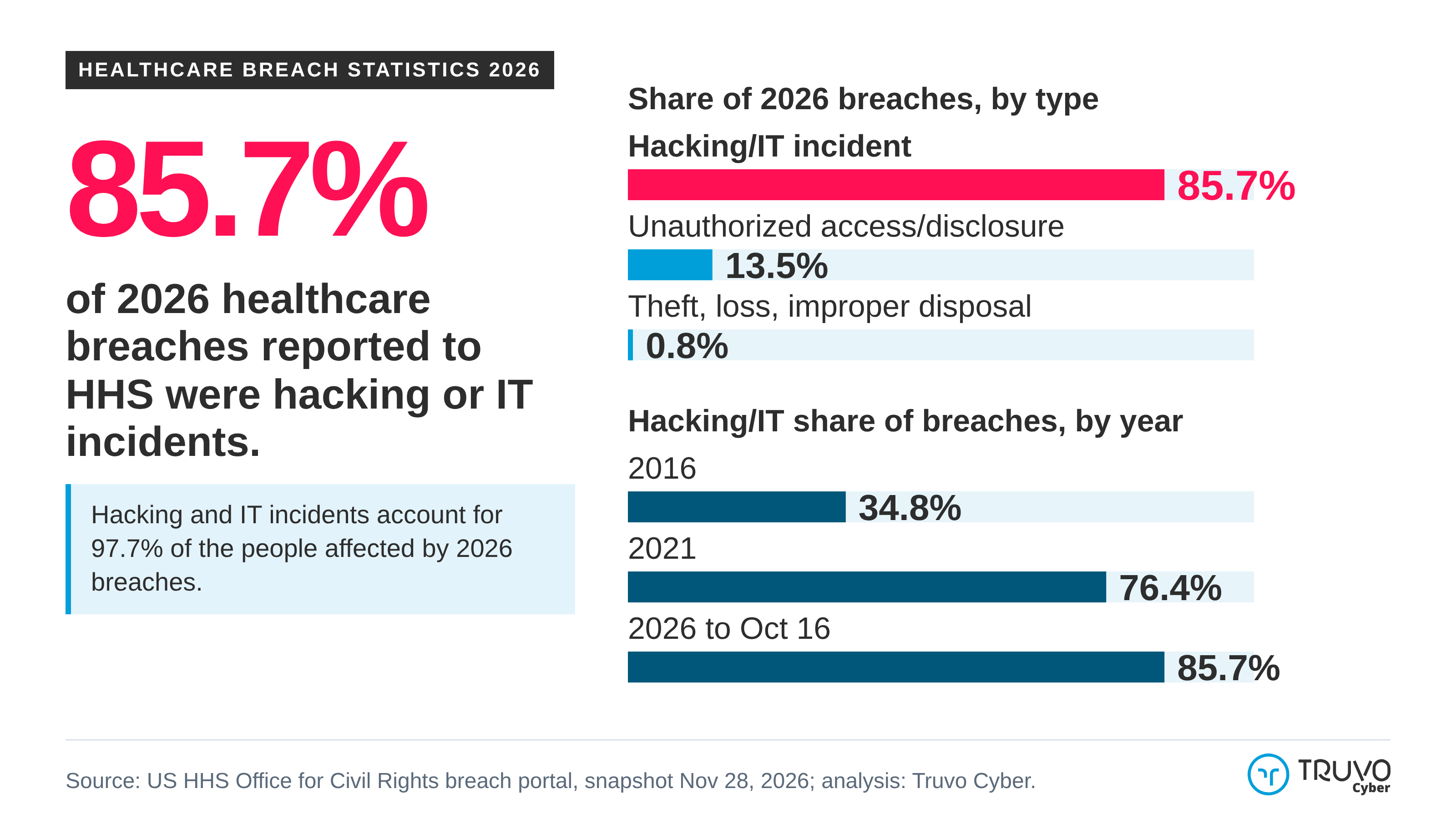
Figure: Healthcare data breaches by type: hacking and IT incidents caused 85.7% of 2026 breaches, up from 34.8% in 2016. Click to enlarge.
Source: Truvo Cyber analysis of the HHS OCR breach portal, snapshot of November 28, 2026. Chart: Truvo Cyber.
Which healthcare organizations report the most breaches?
Healthcare providers filed 73.6% of 2026 breach reports (469), business associates 15.1% (96) and health plans 11.3% (72). A business associate is a vendor that handles protected health information on behalf of a covered entity, such as a billing, IT or claims processing company.
Business associates file far fewer reports than providers, but their breaches run larger. In 2026 business associates filed 15.1% of reports and 36.0% of affected individuals. In 2025 the gap was wider: 17.4% of reports and 62.4% of individuals, with the Conduent Business Services breach (62,224,658 individuals) accounting for most of the difference.
How many healthcare data breaches involve a business associate?
35.0% of 2026 breaches (223 of 637) list a business associate as present, covering 38.5% of affected individuals. The 223 breaches include the 96 reports business associates filed themselves and 127 reports filed by providers and health plans. The share has held between 30.0% and 37.2% in every year since 2021: 35.4% in 2021, 35.4% in 2022, 37.2% in 2023, 30.0% in 2024 and 35.1% in 2025. Health plans list a business associate most often: 38 of the 72 health plan reports in 2026.
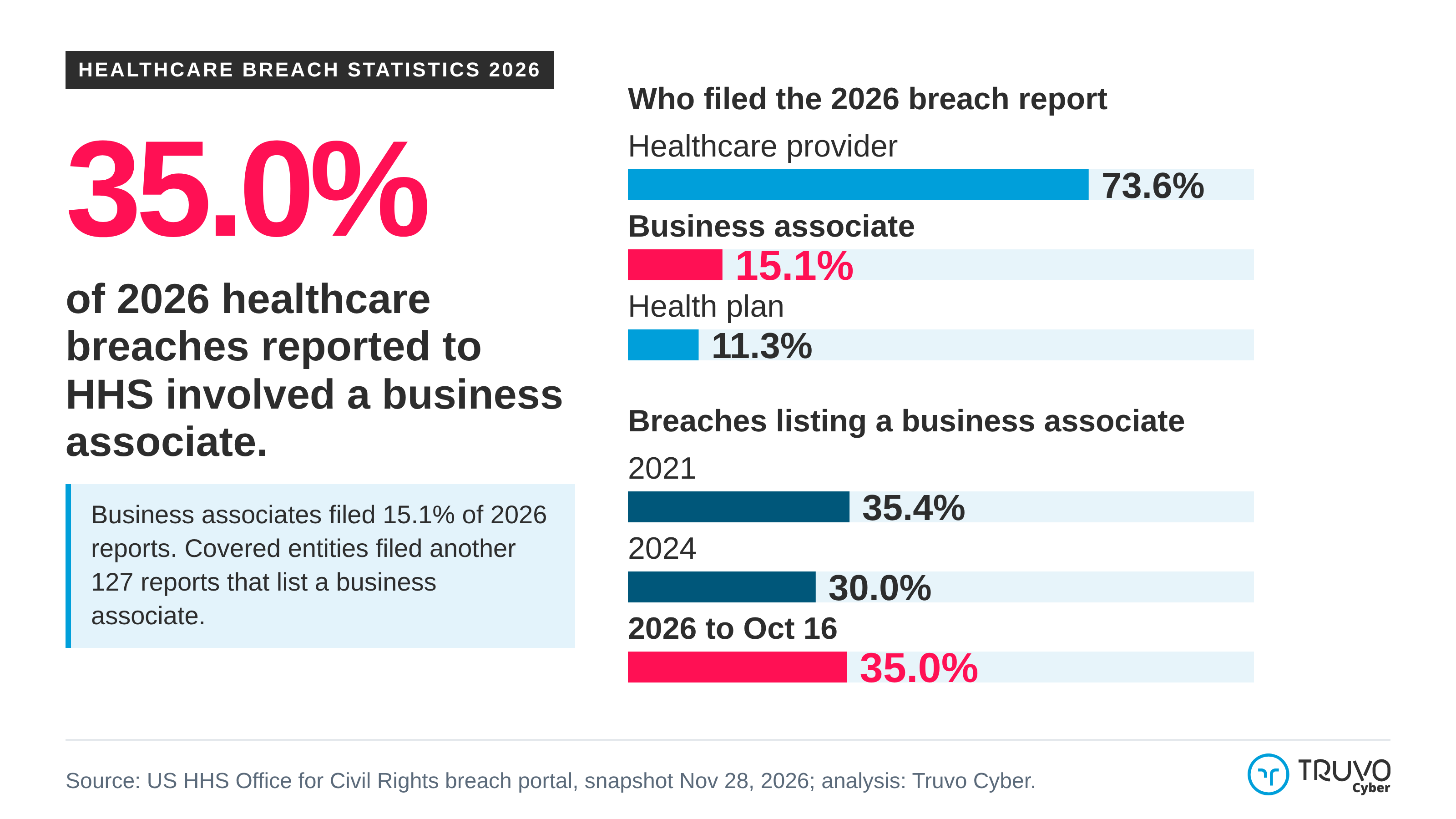
Figure: Healthcare data breaches by entity type: 35.0% of 2026 breaches involved a business associate. Click to enlarge.
Source: Truvo Cyber analysis of the HHS OCR breach portal, snapshot of November 28, 2026. Chart: Truvo Cyber.
Where was breached health information stored?
Network servers were the location of 72.2% of 2026 breaches (460) and 97.3% of affected individuals, followed by email at 20.3% (129). In 2021 the split was 56.5% network server and 28.7% email. HHS does not define "network server" on the portal, so the category covers anything from an on-premises file server to a cloud database. A breach can list more than one location, so location shares add up to more than 100%.
| Location of breached information | Share of 2026 breaches | Share of 2021 breaches |
| Network server | 72.2% (460) | 56.5% (404) |
| 20.3% (129) | 28.7% (205) | |
| Electronic medical record | 5.7% (36) | 5.5% (39) |
| Other | 5.7% (36) | 2.2% (16) |
| Paper/films | 4.1% (26) | 7.1% (51) |
| Desktop computer | 1.6% (10) | 1.8% (13) |
| Laptop | 0.9% (6) | 1.4% (10) |
What were the largest healthcare data breaches of 2026?
| Largest healthcare data breaches reported to HHS in 2026 | Entity type | Individuals affected | Breach type | Submitted |
| DentaQuest, LLC (MA) | Health plan | 15,000,000 | Hacking/IT incident | Jul 16, 2026 |
| Aesto, LLC (AL) | Business associate | 9,540,683 | Hacking/IT incident | Jul 31, 2026 |
| iRhythm Technologies, Inc. (CA) | Healthcare provider | 8,179,772 | Hacking/IT incident | Oct 3, 2026 |
| Lumexa Imaging (NC) | Healthcare provider | 5,830,949 | Hacking/IT incident | May 15, 2026 |
| AdaptHealth, LLC (PA) | Healthcare provider | 4,115,802 | Hacking/IT incident | Aug 14, 2026 |
| Unlimited Technology Systems, LLC (OH) | Business associate | 3,803,750 | Hacking/IT incident | Jul 21, 2026 |
| CareCloud, Inc. (NJ) | Business associate | 3,756,469 | Hacking/IT incident | Jul 24, 2026 |
| TriZetto Provider Solutions (MO) | Business associate | 3,433,965 | Hacking/IT incident | Feb 6, 2026 |
| QualDerm Partners, LLC (TN) | Healthcare provider | 2,951,318 | Hacking/IT incident | Feb 22, 2026 |
| Baylor Genetics (TX) | Healthcare provider | 2,810,878 | Hacking/IT incident | Aug 14, 2026 |
All 10 are hacking or IT incidents involving a network server, and four were filed by business associates. HHS posts the count each entity filed. Entities often revise counts after the first report, so later snapshots can differ. Across all years, DentaQuest's breach is the fourth-largest count on the portal, after Change Healthcare (192,700,000, 2024), Anthem (78,800,000, 2015) and Conduent Business Services (62,224,658, 2025).
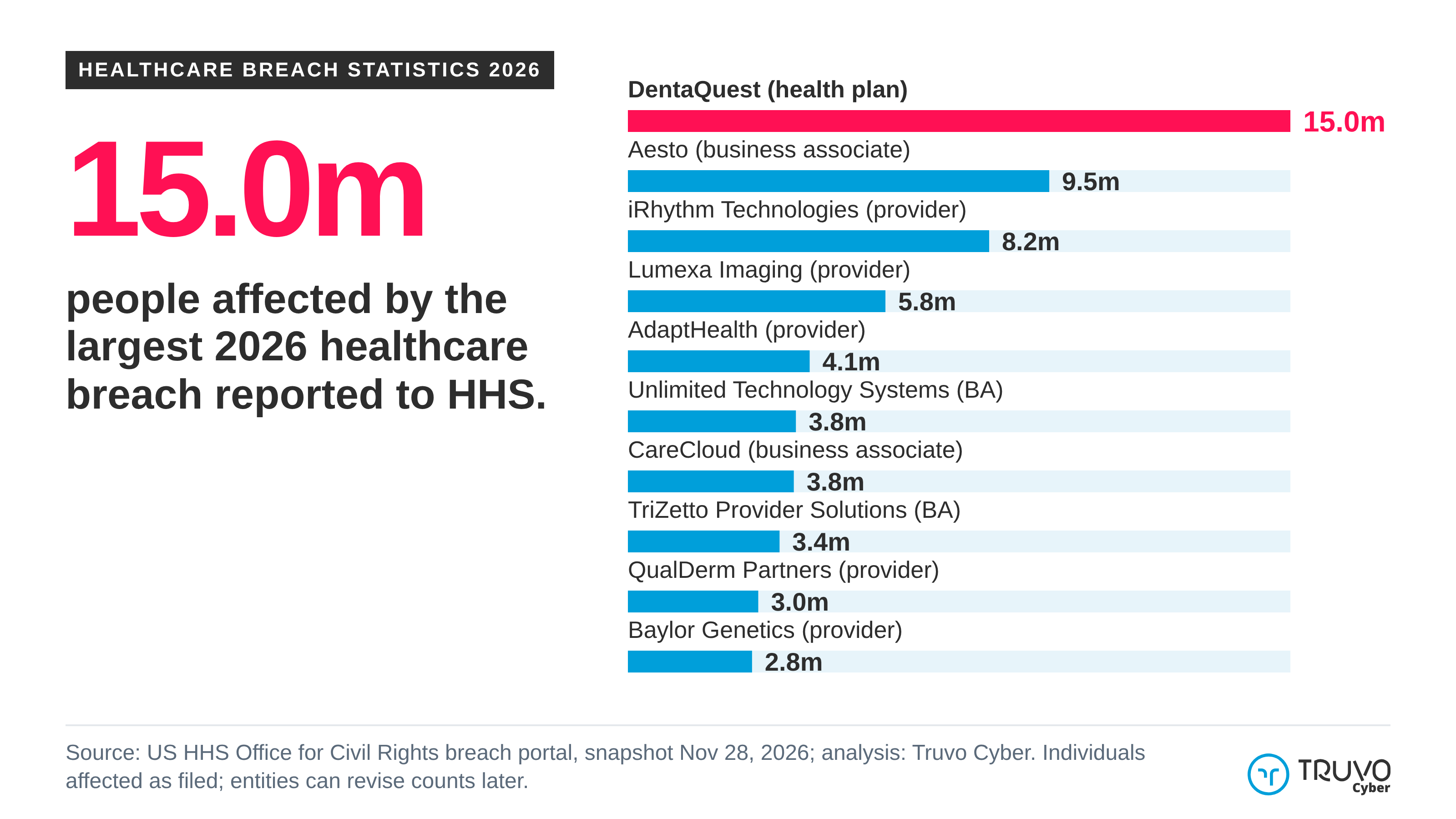
Figure: Largest healthcare data breaches reported to HHS in 2026: DentaQuest, 15.0 million people affected. Click to enlarge.
Source: Truvo Cyber analysis of the HHS OCR breach portal, snapshot of November 28, 2026. Chart: Truvo Cyber.
Which states report the most healthcare data breaches?
Organizations in Texas reported 66 breaches between January 1 and October 16, 2026, followed by California (60), Florida (42), New York (35) and Illinois (26). The state on the portal is the state of the reporting entity, which can differ from where the affected patients live.
What 2026 healthcare breach statistics mean for providers, health plans and their vendors
Key insight
The breach count is flat, and the cause is not.
637 breaches by October 16 is close to the 2025 pace, and 85.7% of those breaches were hacking or IT incidents. Stolen laptops and misplaced paper records, a quarter of reports in 2016, account for 5 reports in 2026. The work that prevents a 2026 healthcare breach is identity, patching, network segmentation, backup and detection on the systems that hold patient data, the same security capabilities an effective program builds before any compliance work begins.
Key insight
Network servers and email are where the records are.
97.3% of 2026 affected individuals were in breaches that list a network server. Email appears in 20.3% of breaches but 1.8% of individuals, so email breaches tend to be frequent and small, and server breaches tend to be fewer and very large. A HIPAA Security Rule risk analysis that inventories the servers, databases and cloud storage holding protected health information covers most of the records at stake.
Key insight
Vendors are a third of the problem, every year.
A business associate was present in 35.0% of 2026 breaches, and the share has stayed between 30.0% and 37.2% since 2021. For a software company selling into healthcare, the number decides how buyers treat the security review: a health plan that sees a vendor in roughly one breach in three will ask for evidence of the vendor's security program, and the vendor that can produce the evidence quickly closes the contract sooner.
Key insight
A handful of breaches carry most of the harm.
The 10 largest 2026 breaches hold 65.6% of affected individuals, and the median breach affected 4,457 people. Totals of affected individuals swing with one or two events, so the breach count and the hacking share are the steadier year-to-year measures.
HIPAA is a law, not a framework a company chooses. The HIPAA Breach Notification Rule applies to every covered entity and business associate holding unsecured protected health information, and a SOC 2 report does not satisfy the rule on its own.
How healthcare organizations and their vendors can reduce breach risk in 2027
- Assess security capabilities against the HIPAA Security Rule. A capability assessment across the roughly 19 security capabilities, then a Security Program Manual, then policies, controls and evidence. The HIPAA compliance service covers the risk analysis the Security Rule requires and the program behind the analysis.
- Treat network servers and email as the first controls to verify. Network servers appear in 72.2% of 2026 breaches and email in 20.3%. Confirm multi-factor authentication on email and remote access, patching and segmentation on servers that store patient data, and backups an attacker cannot reach.
- Hold business associates to evidence. Business associate agreements set obligations. A SOC 2 report or ISO 27001 certificate shows whether the vendor meets them. The SOC 2 vs HIPAA guide covers how the two fit together.
- Run the GRC platform for HIPAA as well as SOC 2. Vanta managed services and Drata managed services cover HIPAA alongside other frameworks in one program.
- Rehearse breach notification. The 60-day clock for breaches of 500 or more starts at discovery.
How did Truvo Cyber count these healthcare data breaches?
Truvo Cyber exported every record on the HHS OCR breach portal, both the "Under Investigation" list and the "Archive", on November 28, 2026, and counted them in BigQuery. The two lists do not overlap, so each breach appears once.
What the portal contains
- The portal lists breaches of unsecured protected health information affecting 500 or more individuals. Covered entities must report those breaches to HHS without unreasonable delay and no later than 60 days after discovery, and HHS posts them publicly (HHS, breach reporting).
- Breaches affecting fewer than 500 individuals go to HHS in an annual log, no later than 60 days after the end of the calendar year, and do not appear on the portal (45 CFR 164.408).
- A breach affecting more than 500 residents of a state or jurisdiction also requires notice to prominent media outlets serving that area (HHS, Breach Notification Rule).
- "Under Investigation" holds reports OCR has open. Closed cases move to the "Archive". A case's list says nothing about the breach itself, and some 2026 reports have already moved to the Archive.
Definitions
- Year: the year of the breach submission date, the date the report reached OCR. The breach itself often happened earlier.
- Individuals affected: the count each entity filed. The sum counts people per breach, not unique people.
- Breach type and location: a report can list several locations. Location shares count each listed category, so location shares can add up to more than 100%. Since 2016 every report lists one breach type.
- Same-window comparisons: January 1 to October 16 in each year, the latest submission date posted at snapshot time, unless a figure is labelled "full year".
- Median: the exact median of individuals affected per breach.
Key insight
Data:
8,093 records in total, 7,421 in the Archive and 672 under investigation, with submission dates from October 21, 2009 to October 16, 2026. The records list 1,111,251,198 affected individuals in total. One 2013 record has no individual count. Compact CSV extracts of every figure in this post are kept for the public dataset, and the full method and queries will be published in the dataset repo.
What are the limits of this healthcare breach analysis?
- The portal covers large breaches only. Breaches under 500 people go to HHS in annual logs that are not public.
- The portal posts reports with a delay. The November 28 snapshot holds no submissions after October 16, 2026, so 2026 figures stop at October 16 and every year is compared over the same dates. Over October 17 to December 31, 2025, HHS posted 153 reports, so the full-year 2026 count will rise once later reports are posted.
- Counts change after posting. Entities revise individual counts, and late reports for earlier years arrive during the year. Truvo Cyber keeps monthly snapshots to measure those revisions.
- Submission date is not breach date. A breach submitted in 2026 can have started in 2025 or earlier.
- Individuals are not unique people. The same person can appear in several breaches.
- HHS categories are broad. "Network server" and "hacking/IT incident" cover very different events.
- Records are counted as filed. A few entities appear more than once with the same date and count, for example a business associate filing for several clients. Truvo Cyber keeps every record as posted.
How to cite these healthcare data breach statistics
Truvo Cyber. (2026, November 28). Healthcare Data Breach Statistics 2026: 637 Breaches Reported to HHS So Far. https://truvocyber.com/blog/healthcare-data-breach-statistics-2026
HIPAA Programs That Hold Up When a Breach Happens
The 2026 numbers point to the same place as the five years before them: attackers reach patient records through servers and email, a vendor is involved in about a third of breaches, and the largest events affect millions of people at once. A HIPAA program that holds up starts with the security capabilities behind those numbers, then documents them in the risk analysis and policies the Security Rule requires, and extends the same expectations to every business associate.
Truvo Cyber is a fractional security team that builds HIPAA security programs for healthcare providers, health plans and the software companies that serve them, from the Security Rule risk analysis to breach response. If your team wants a second opinion on HIPAA readiness, book a strategy call.
Build a HIPAA program that holds up under a breach
Truvo builds the security capabilities behind HIPAA compliance, including vendor and business associate oversight.
Frequently Asked Questions
How many healthcare data breaches were there in 2026?
637 breaches affecting 500 or more people were reported to HHS between January 1 and October 16, 2026, according to Truvo Cyber's count of the HHS OCR breach portal (snapshot of November 28, 2026). Over the same dates in 2025 there were 659, and 812 were reported in all of 2025, the highest full-year count on the portal.
How many people were affected by healthcare data breaches in 2026?
Breaches reported to HHS between January 1 and October 16, 2026 list 90,622,199 affected individuals, down 33.7% from 136,776,249 over the same dates in 2025. The 10 largest breaches account for 65.6% of the total, and the count includes people affected by more than one breach.
What causes most healthcare data breaches?
Hacking and IT incidents caused 85.7% of healthcare breaches reported to HHS in 2026 (546 of 637) and 97.7% of affected individuals. Network servers were the location of breached information in 72.2% of 2026 breaches and email in 20.3%.
What percentage of healthcare breaches involve a business associate?
35.0% of healthcare breaches reported to HHS in 2026 (223 of 637) list a business associate as present, covering 38.5% of affected individuals. The share has stayed between 30.0% and 37.2% every year since 2021. Business associates filed 15.1% of 2026 reports themselves.
What was the largest healthcare data breach of 2026?
The largest healthcare data breach reported to HHS in 2026 is DentaQuest, LLC, a health plan, with 15,000,000 individuals affected in a hacking incident submitted on July 16, 2026. The largest on the portal across all years is Change Healthcare, with 192,700,000 individuals, submitted in 2024.
What is the HHS breach portal?
The HHS OCR breach portal is the public list of breaches of unsecured protected health information affecting 500 or more individuals, which covered entities must report to HHS within 60 days of discovery under the HIPAA Breach Notification Rule. Smaller breaches go to HHS in an annual log and are not posted.
Does HIPAA apply to software companies?
HIPAA applies to a software company that creates, receives, maintains or transmits protected health information on behalf of a covered entity. That company is a business associate, bound by a business associate agreement and directly liable under the HIPAA Security Rule and Breach Notification Rule.