

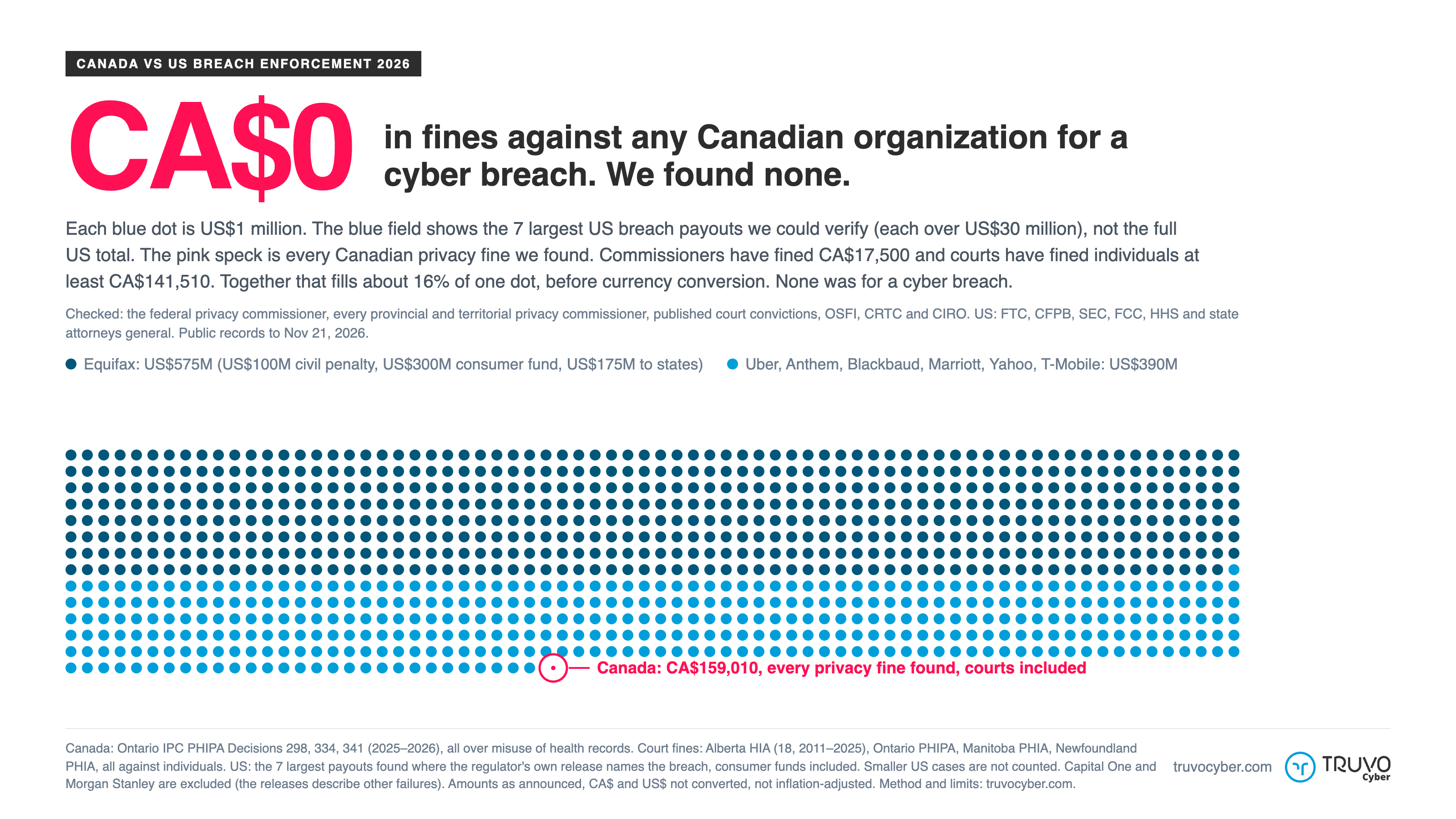
Truvo Cyber found no fine against any Canadian organization for a cyber breach, in public records up to November 21, 2026 (Truvo Cyber, 2026). Canada's privacy commissioners have issued four administrative fines in three decisions, CA$17,500 in total, all in Ontario over misuse of health records. Between 2018 and 2024, US regulators secured about US$965 million after seven large data breaches.
At a glance
- Fines against Canadian organizations for a cyber breach: None found
- Administrative fines by Canadian privacy commissioners, all time: CA$17,500 (4 fines in 3 Ontario decisions, 2025 to 2026)
- Court fines in Canadian privacy prosecutions found: At least CA$141,510, all against individuals
- Breach reports under PIPEDA to the federal Privacy Commissioner, 2019-20 to 2025-26: 4,861 reports, roughly 106 million accounts
- Federal Privacy Commissioner's power to fine: None under PIPEDA
- Equifax 2017 breach, amount per person affected: US$3.91 in the US, CA$0 in Canada
- 7 largest US breach payouts verified: About US$965 million (2018 to 2024)
- Federal bill that would allow fines up to 3% of global revenue: Bill C-36, first reading June 15, 2026, no second reading yet
The full table behind these numbers is available as a CSV download.
Has any Canadian organization been fined for a data breach?
Truvo Cyber found no fine against a Canadian organization for a cyber breach in any public record checked, up to November 21, 2026. The search covered the federal Privacy Commissioner, every provincial and territorial privacy commissioner, published court convictions, and the federal regulators most likely to act on a breach: the Office of the Superintendent of Financial Institutions (OSFI), the Canadian Radio-television and Telecommunications Commission (CRTC) and the Canadian Investment Regulatory Organization (CIRO).
The closest cases fall short of a breach fine:
- The CRTC fined two companies CA$250,000 in 2018 for helping install malware, and the CRTC set both penalties aside in 2022.
- CIRO fines individual advisors for sharing client information, for example CA$40,000 in 2023. CIRO fined the advisor, and no firm was fined for losing data in an attack.
- Ontario fined one clinic CA$7,500 in 2025, for failing basic duties under Ontario's health privacy law after a doctor misused patient records. No attack was involved.
How much have Canadian privacy commissioners fined, in total?
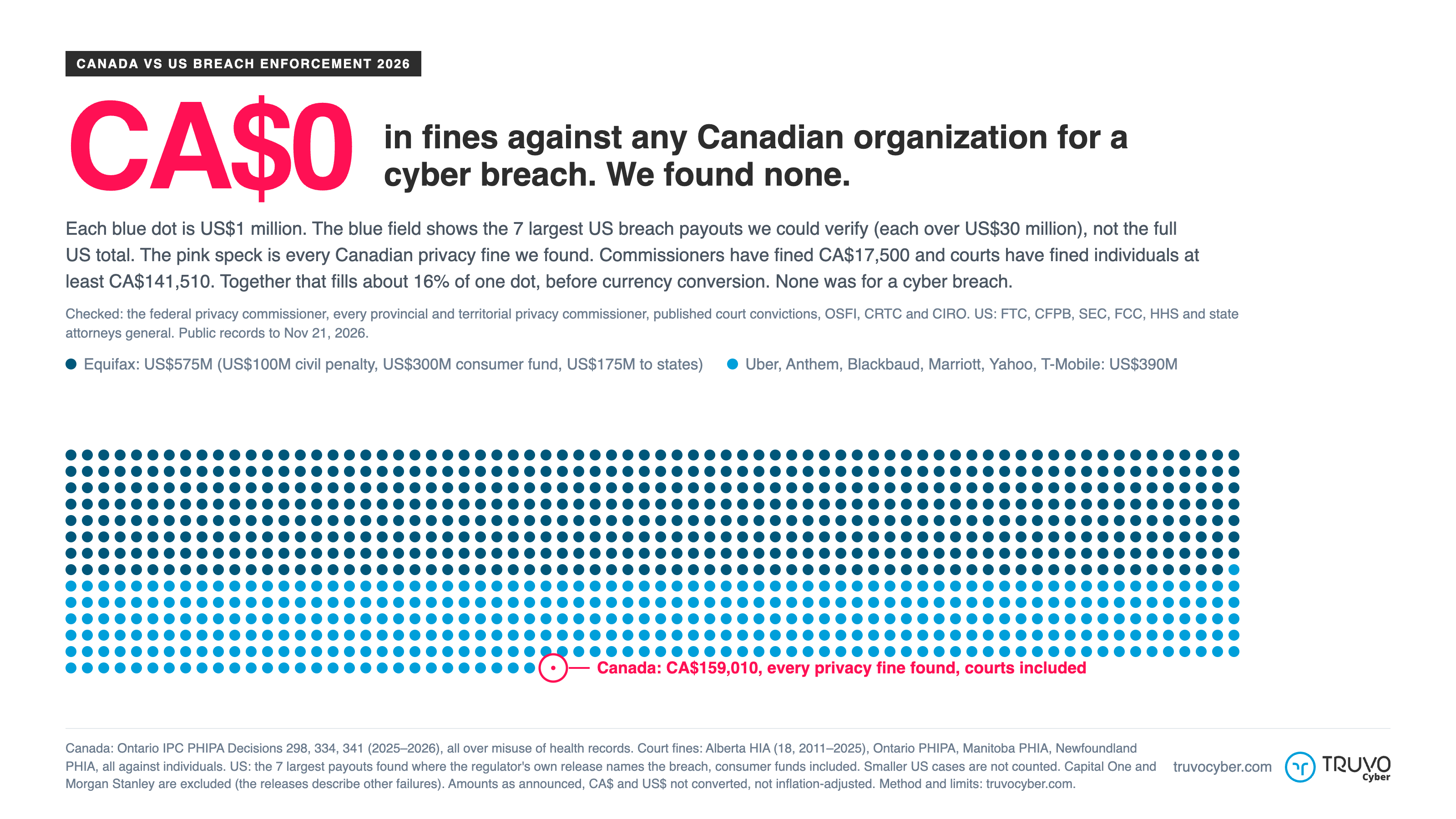
Canadian privacy commissioners have issued CA$17,500 in administrative fines in total, four fines across three decisions, all from Ontario's Information and Privacy Commissioner (IPC) under the Personal Health Information Protection Act (PHIPA). An administrative fine is one a commissioner issues directly, with no court case.
| Ontario PHIPA administrative fines | Date | Who was fined | Amount | Reason |
| Decision 298 | August 27, 2025 | A physician | CA$5,000 | Used patients' hospital records for personal financial gain |
| Decision 298 | August 27, 2025 | The physician's clinic | CA$7,500 | Failed basic PHIPA obligations |
| Decision 334 | April 23, 2026 | A hospital clerk | CA$2,000 | Accessed 436 patient records without authorization |
| Decision 341 | July 16, 2026 | A hospital clerk | CA$3,000 | Accessed 675 patient records without authorization |
Ontario's IPC has held the power since January 1, 2024, with maximums of CA$50,000 for a person and CA$500,000 for an organization. Quebec's Commission d'accès à l'information (CAI) has held a larger power since September 2023, up to CA$10 million or 2% of worldwide turnover, whichever is greater, under Law 25.
In answers to the National Assembly's 2026-2027 budget review, the CAI reported no administrative penalty and no penal fine for 2025-26, and no penal fine collected over five years. The CAI received 526 incident notices from April 2025 to February 2026, and 514 in 2024-25 according to the CAI's 2024-25 annual report.
Which Canadian privacy laws allow fines for a data breach today?
Two Canadian privacy laws let a commissioner fine directly today: Quebec's Law 25 and Ontario's PHIPA for health information. The federal private-sector law, the Personal Information Protection and Electronic Documents Act (PIPEDA), gives the federal Privacy Commissioner no power to fine.
Under PIPEDA, the Office of the Privacy Commissioner (OPC) states that the office does not prosecute offences or issue fines. A company that knowingly fails to report a breach or keep breach records commits an offence under PIPEDA section 28, punishable by a court fine of up to CA$10,000 on summary conviction or CA$100,000 on indictment. The OPC can only refer a case to the Attorney General of Canada, and federal prosecutors decide whether to charge. Truvo Cyber found no reported conviction under section 28.
Court fines do exist under provincial health privacy laws. Truvo Cyber found at least CA$141,510 in court fines across at least 26 convictions:
- Alberta, Health Information Act: CA$87,000 across 18 fined cases from 2011 to 2025, from the Alberta OIPC's conviction notices. The largest found was CA$15,000 in 2011.
- Ontario, PHIPA prosecutions: CA$35,010 across four convictions in 2016 and 2017, including a CA$20,000 fine for a social work student.
- Manitoba, Personal Health Information Act: CA$12,500 across two cases, including a former police officer who looked up his daughter's records.
- Newfoundland and Labrador, Personal Health Information Act: CA$7,000 across three cases, including a nurse fined CA$1,000.
Every conviction found punished an individual employee, in most cases for looking at health records without a work reason.
What happened to Equifax in Canada and the US after the 2017 breach?
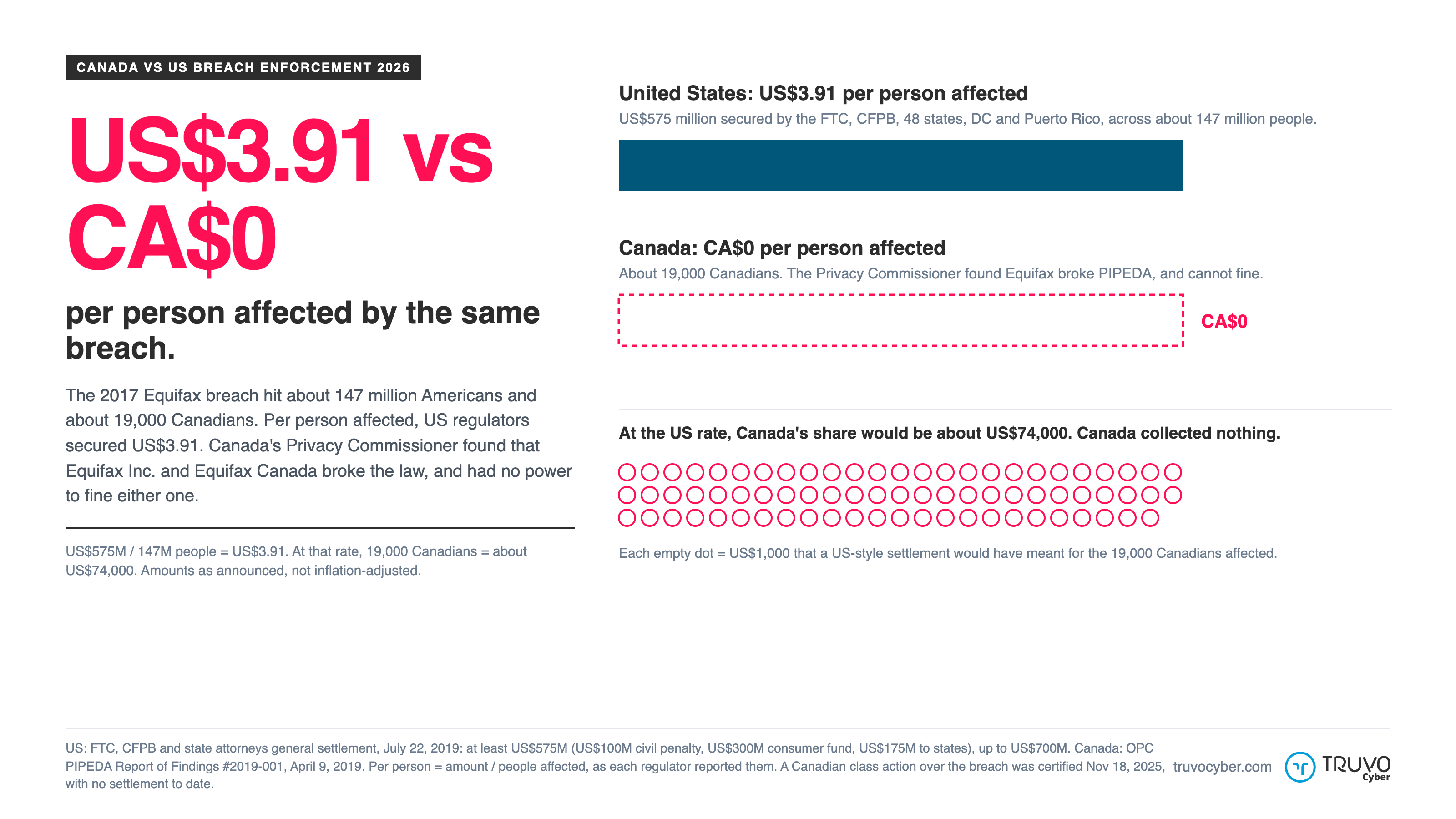
The 2017 Equifax breach affected about 147 million people in the US and about 19,000 in Canada. US regulators secured at least US$575 million, or US$3.91 per person affected. Canada's federal Privacy Commissioner found that both Equifax Inc. and Equifax Canada broke PIPEDA, and had no power to fine either company.
In the US, the FTC, the Consumer Financial Protection Bureau (CFPB), 48 states, the District of Columbia and Puerto Rico settled with Equifax in July 2019 for at least US$575 million and up to US$700 million. The US$575 million splits into three parts:
- US$100 million civil penalty to the CFPB
- US$300 million consumer fund
- US$175 million to 48 states, the District of Columbia and Puerto Rico
In Canada, OPC Report of Findings 2019-001 concluded in April 2019 that both companies contravened PIPEDA. At the US rate of US$3.91 per person, the 19,000 Canadians affected would come to about US$74,000. Canada collected nothing, and a Canadian class action over the breach was certified on November 18, 2025, with no settlement to date.
How many data breaches do Canadian businesses report each year?
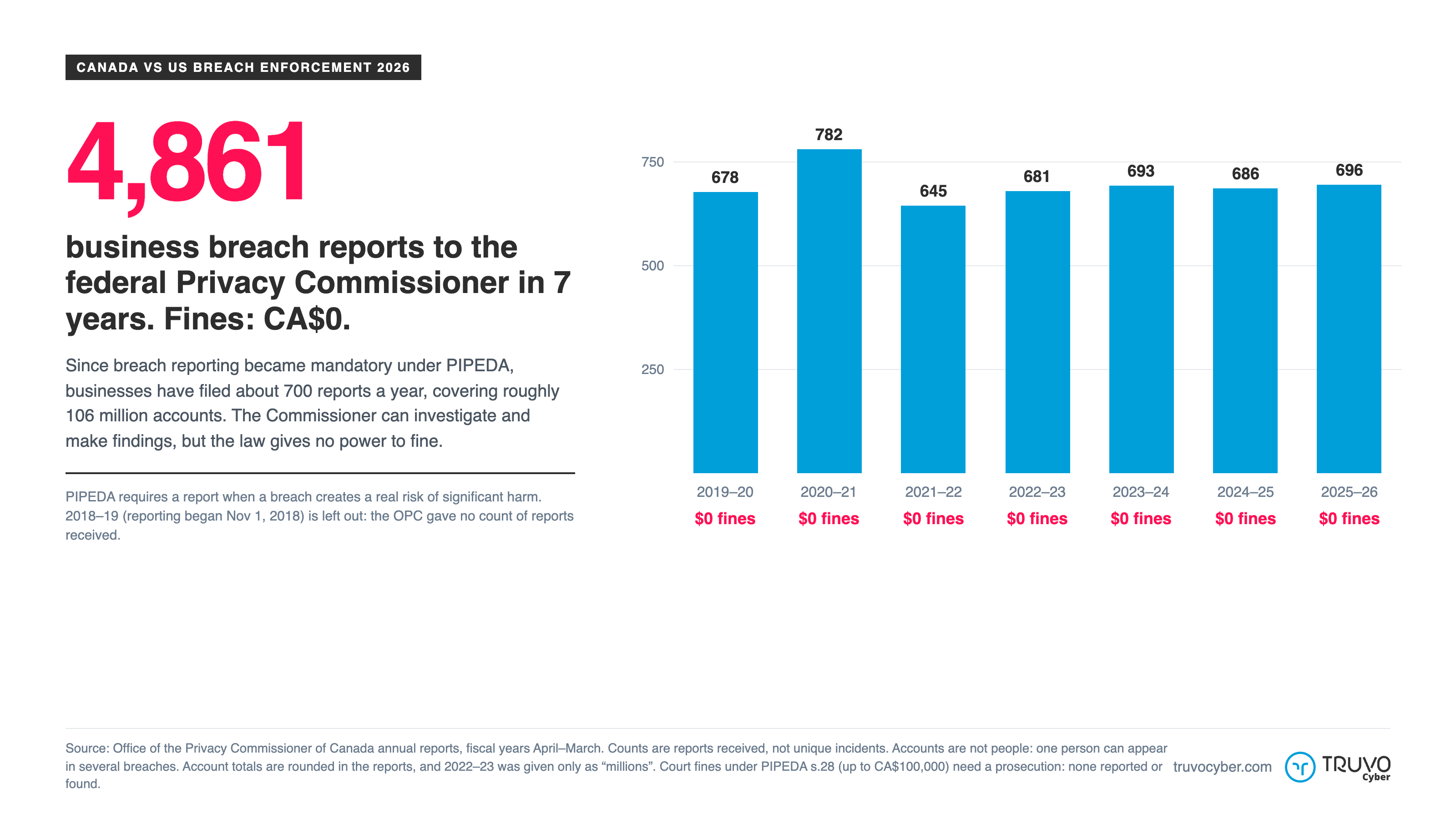
Businesses covered by PIPEDA filed 4,861 breach reports with the federal Privacy Commissioner from 2019-20 to 2025-26, about 700 a year, covering roughly 106 million accounts. PIPEDA requires a report when a breach creates a real risk of significant harm, and mandatory reporting began on November 1, 2018.
| Fiscal year (April to March) | PIPEDA breach reports | Accounts affected (as reported by the OPC) |
| 2019-20 | 678 | About 30 million |
| 2020-21 | 782 | At least 9 million |
| 2021-22 | 645 | At least 1.9 million |
| 2022-23 | 681 | Millions |
| 2023-24 | 693 | About 25 million |
| 2024-25 | 686 | About 20 million |
| 2025-26 | 696 | 20,328,495 |
In the OPC's 2025-26 annual report, the OPC counts 696 breach reports from businesses and 451 breach reports from federal institutions under the Privacy Act. A federal breach report can cover many individual breaches, so the 451 reports and the 36,130 breaches in the Treasury Board data measure different things.
Why did federal government privacy breaches jump to 36,130 in 2024-25?
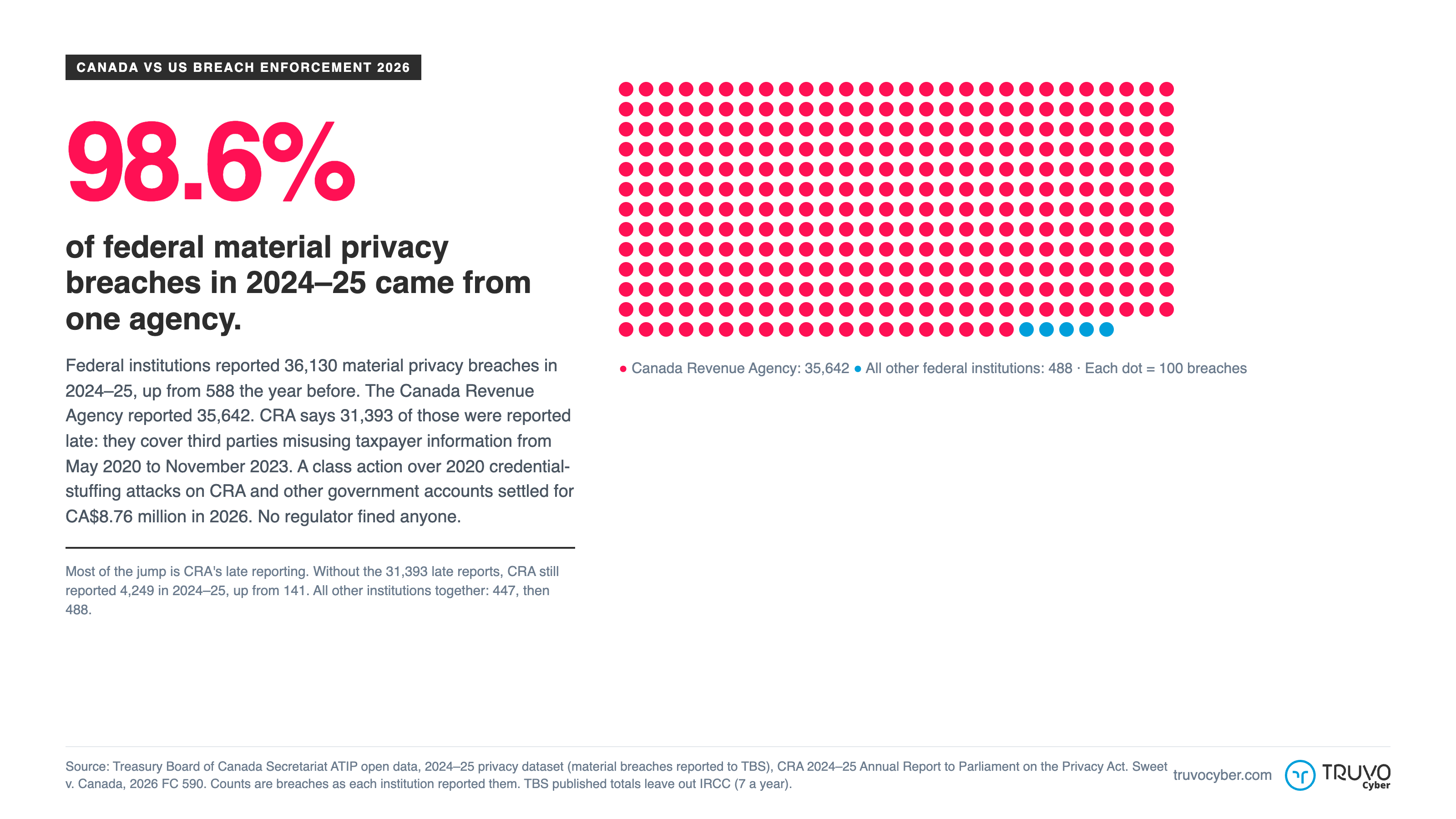
Federal institutions reported 36,130 material privacy breaches in 2024-25, up from 588 the year before, and the Canada Revenue Agency (CRA) reported 35,642 of them, or 98.6%. In the CRA's 2024-25 Privacy Act report, the CRA states that 31,393 of those breaches were reported late. The late reports cover third parties misusing taxpayer information between May 2020 and November 2023.
| Federal material privacy breaches | 2019-20 | 2020-21 | 2021-22 | 2022-23 | 2023-24 | 2024-25 |
| All federal institutions | 326 | 250 | 434 | 312 | 588 | 36,130 |
| Canada Revenue Agency | 6 | 5 | 7 | 58 | 141 | 35,642 |
| All other institutions | 320 | 245 | 427 | 254 | 447 | 488 |
Most of the jump comes from the CRA's late reporting. Without the 31,393 late reports, the CRA still reported 4,249 material breaches in 2024-25, up from 141 the year before. A class action over the 2020 credential-stuffing attacks on CRA and other government accounts, Sweet v. Canada, ended with a CA$8,760,500.90 settlement that the Federal Court approved on May 5, 2026. The CRA data breach post covers the Privacy Commissioner's 2026 findings on the CRA and the settlement claims process.
How much have US regulators secured after major data breaches?
US regulators secured about US$965 million after seven large data breaches between 2018 and 2024, counting only payments the regulator's own release ties to the named breach. The figure covers the seven largest payouts Truvo Cyber could verify, each over US$30 million. Every smaller US case is left out.
| US breach | Regulators | Amount (US$ millions) |
| Equifax (2017 breach) | FTC, CFPB, 48 states, DC and Puerto Rico | 575 |
| Uber (2016 breach and cover-up) | 51 attorneys general | 148 |
| Anthem (2014 breach) | HHS OCR (16), multistate attorneys general (39.5), California (8.69) | 64.19 |
| Blackbaud (2020 breach) | Multistate attorneys general (49.5), SEC (3), California (6.75) | 59.25 |
| Marriott (Starwood breach) | 50 attorneys general | 52 |
| Yahoo (2014 breach) | SEC | 35 |
| T-Mobile (2021 to 2023 breaches) | FCC (15.75 civil penalty, 15.75 required security spending) | 31.5 |
US amounts include consumer funds and required security spending where the settlement included them, so the US$965 million covers more than civil penalties. Three large US penalties are left out on purpose. The OCC's release on the US$80 million penalty against Capital One describes cloud risk management failures. The OCC's US$60 million penalty and the SEC's US$35 million penalty against Morgan Stanley concern hardware disposal failures, with no attack described.
Who pays when a Canadian organization has a data breach?
In Canada, the large payments after a data breach come from class actions, settled in court and paid to the people affected. Truvo Cyber found three Canadian breach settlements of more than CA$8 million:
- Desjardins (2019 insider breach): up to CA$200,852,500, approved June 14, 2022.
- LifeLabs (2019 cyberattack): up to CA$9.8 million, approved October 25, 2023.
- Government of Canada, CRA and GCKey accounts (2020 credential stuffing): CA$8,760,500.90, approved May 5, 2026 (Sweet v. Canada, 2026 FC 590).
A settlement differs from a fine. A company can settle without admitting fault, and the money goes to the people in the class and their lawyers, not to a regulator. Canadian breach costs also include incident response, recovery and lost business, which the cost of a data breach in Canada breaks down.
What would Bill C-36 change about privacy fines in Canada?
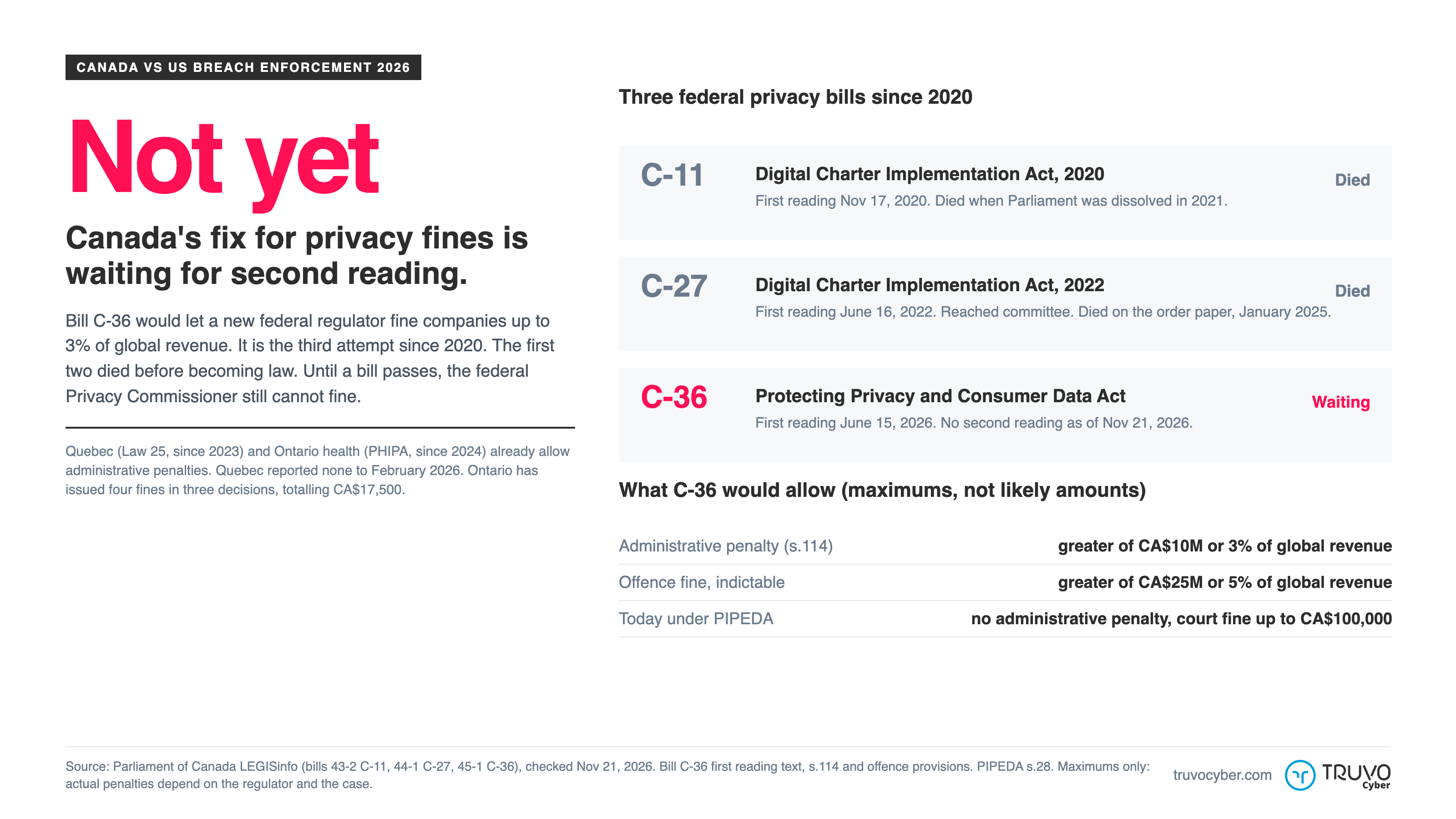
Bill C-36, the Protecting Privacy and Consumer Data Act, would let a new Privacy and Consumer Data Commissioner, part of a new Digital Safety and Data Protection Commission, fine companies up to the greater of CA$10 million or 3% of gross global revenue. Bill C-36 had a first reading on June 15, 2026, and LEGISinfo showed no second reading as of November 21, 2026.
| Federal privacy penalty | Today under PIPEDA | Under Bill C-36 as tabled |
| Administrative penalty | None | Greater of CA$10 million or 3% of gross global revenue (section 114) |
| Fine for an indictable offence | Up to CA$100,000 | Greater of CA$25 million or 5% of gross global revenue (section 145) |
| Fine on summary conviction | Up to CA$10,000 | Greater of CA$20 million or 4% of gross global revenue |
Bill C-36 is the third federal attempt since 2020. Bill C-11 (first reading November 17, 2020) died when Parliament was dissolved in 2021, and Bill C-27 (first reading June 16, 2022) died on the order paper in January 2025. The earlier history of the federal reform is in the post on Canadian privacy costs after Bill C-27. The maximums in the Bill C-36 table are ceilings, and the amount of any penalty would depend on the regulator and the case.
What should Canadian security and privacy leads do with these numbers?
Canadian security and privacy leads should plan around the cost of a breach itself and around the laws that already carry fines, since federal fines are close to absent today.
In Truvo Cyber's view, the low level of fines helps explain why many Canadian companies treat privacy as paperwork, and the data in this study shows the low fines, not the cause.
Four steps follow from the numbers:
- Map which laws already carry fines for the data held. Quebec's Law 25 applies to personal information of people in Quebec, Ontario's PHIPA applies to personal health information, and US customers bring US state and federal rules. The Law 25 compliance checklist and the post on HIPAA for Canadian companies cover two of those obligations.
- Price the breach itself. Class actions, incident response, recovery and lost contracts make up the cost of a Canadian breach today. The cyber insurance requirements in Canada post covers the controls insurers ask for before they pay.
- Keep breach records ready for a future regulator. PIPEDA already requires a record of every breach of security safeguards, reportable or not, and knowingly failing to keep one is an offence. Bill C-36 would raise the maximum fine for that offence from CA$100,000 to the greater of CA$25 million or 5% of gross global revenue (section 145).
- Build security for the attack. A report to the Privacy Commissioner is the floor. Access control, logging, vendor review and a tested incident response plan reduce both the chance of a breach and the size of the class action that follows.
How did Truvo Cyber build this data breach study?
Truvo Cyber built the figures in this post from public records checked between November 19 and November 21, 2026, and checked each figure against a primary source where one was available. A second review checked each claim against the cited source and searched for counterexamples, and the corrections from that review are in the figures in this post. A few figures rest on secondary reports where the primary page could not be read, and the Limits section names them.
Canadian sources
- Commissioner fines: decisions and announcements of every federal, provincial and territorial privacy commissioner. Ontario PHIPA Decisions 298, 334 and 341 are the only administrative fines found.
- Quebec: CAI letter AI-2526-238 (January 9, 2026) and the CAI's 2026-2027 budget review answers (questions P-15 and G-47).
- Court fines: conviction notices from the Alberta OIPC and the Ontario IPC, and news reports for Manitoba and Newfoundland and Labrador.
- Breach reports: OPC annual reports to Parliament, fiscal years 2019-20 to 2025-26.
- Federal institutions: the Treasury Board's access to information and privacy open data, privacy datasets 2019-20 to 2024-25, column material privacy breaches reported to TBS, and the CRA's 2024-25 Privacy Act report.
- Bills: LEGISinfo records for bills 43-2 C-11, 44-1 C-27 and 45-1 C-36, and the first reading text of Bill C-36.
US sources
- Press releases and orders from the FTC, CFPB, SEC, FCC, OCC, HHS OCR and state attorneys general, linked in the US table of this post.
- Selection rule: a US case counts when the regulator's own release names the breach. The seven cases are the largest found under that rule, each over US$30 million.
Definitions
- Administrative fine: a monetary penalty a privacy commissioner issues directly, with no court case.
- Court fine: a fine a court imposes after a prosecution under a privacy statute.
- Cyber breach: unauthorized access to personal information by an outside attacker, as opposed to an employee looking at records without a work reason.
- Per person affected: the amount divided by the number of people each regulator reported as affected.
The CSV dataset and charts are public on GitHub under CC BY 4.0.
What are the limits of this Canada and US enforcement study?
Six limits apply to the numbers in this study:
- None found depends on public records. A fine that no commissioner, court or news outlet published would be missing. Truvo Cyber will correct the figures if a reader sends a source.
- The US side is a sample and the Canadian side covers every case found. The seven US cases are the largest found, and every smaller US case is left out. The comparison favours Canada, and the gap stays large.
- US amounts mix penalties and settlements. Consumer funds and required security spending are included where the settlement included them. Strict civil penalties are a smaller part of the US$965 million.
- Currencies and years differ. Canadian figures are in Canadian dollars and US figures in US dollars, as announced, with no conversion and no inflation adjustment. Converting to one currency would widen the gap.
- Court fine totals are a minimum. The Alberta list has gaps (one release calls a CA$12,000 fine the third largest, so at least one larger fine is missing), and Ontario IPC Decisions 334 and 341 were checked through IPC announcements and legal summaries.
- Counts are reports. Breach reports and accounts affected come from each organization's own filing. One person can appear in several breaches, and one attack can produce many reports.
Truvo Cyber will refresh these figures when Bill C-36 moves forward or when a Canadian commissioner issues a new fine.
Who carries the cost of a Canadian data breach today?
The company and the people affected carry the cost of a Canadian data breach today, through class actions, recovery work and lost trust, since regulators fine very little and Bill C-36 has had no second reading. In our experience, companies that build security programs around real risks, with privacy compliance as a byproduct, are better placed to limit that cost under today's rules and under the penalties Bill C-36 would bring.
Truvo Cyber builds privacy and security programs for Canadian companies, from the breach register and incident response plan to Law 25 and PHIPA obligations, through the Truvo Cyber privacy program and data breach response services. If your team wants a second opinion on breach readiness before Bill C-36 passes, book a strategy call.
Get breach-ready before Bill C-36 passes
Truvo builds the security and privacy program behind the breach register, the incident response plan and Law 25 and PHIPA obligations.
Frequently Asked Questions
Has any company in Canada been fined for a data breach?
Truvo Cyber found no fine against any Canadian organization for a cyber breach in public records up to November 21, 2026. Canada's privacy commissioners have issued four administrative fines in three decisions, CA$17,500 in total, all in Ontario over misuse of health records. Courts have fined individual health workers at least CA$141,510 across at least 26 convictions.
Can the Privacy Commissioner of Canada issue fines under PIPEDA?
The Privacy Commissioner of Canada has no power to fine under PIPEDA. The Commissioner investigates complaints and breaches, makes findings and recommendations, and can go to Federal Court. A company that knowingly fails to report a breach commits an offence punishable by a court fine of up to CA$100,000 on indictment, and only federal prosecutors can bring the charge.
What are the fines under Quebec's Law 25?
Quebec's Law 25 lets the Commission d'accès à l'information impose administrative penalties of up to CA$10 million or 2% of worldwide turnover, whichever is greater, and courts can impose penal fines of up to CA$25 million or 4% of worldwide turnover, whichever is greater. The CAI reported no administrative penalty and no penal fine for 2025-26 in the CAI's 2026-2027 budget review answers.
How many data breaches are reported in Canada each year?
Businesses covered by PIPEDA filed 696 breach reports with the federal Privacy Commissioner in 2025-26, covering 20,328,495 accounts, and about 700 a year since 2019-20. Federal institutions filed 451 breach reports with the Commissioner in 2025-26, and one federal report can cover many breaches. Quebec's CAI received 526 incident notices from April 2025 to February 2026.
What happened to Equifax in Canada?
The Privacy Commissioner of Canada found in April 2019 that Equifax Inc. and Equifax Canada contravened PIPEDA in the 2017 breach, which affected about 19,000 Canadians. No fine followed, because PIPEDA gives the Commissioner no fining power. A Canadian class action was certified in November 2025, with no settlement to date.
What is Bill C-36?
Bill C-36, the Protecting Privacy and Consumer Data Act, is the federal bill that would replace the privacy part of PIPEDA. As tabled on June 15, 2026, the bill would allow administrative penalties of up to CA$10 million or 3% of gross global revenue. The bill had no second reading as of November 21, 2026.
Why did CRA report so many privacy breaches in 2024-25?
The Canada Revenue Agency reported 35,642 material privacy breaches in 2024-25, and 31,393 of them were reported late. The late reports cover third parties misusing taxpayer information between May 2020 and November 2023. Without the late reports, the CRA reported 4,249 breaches in 2024-25, up from 141 the year before.
How do Canadian privacy fines compare with US fines?
Canadian privacy commissioners have issued CA$17,500 in administrative fines in total. After the seven largest verified US data breach cases, US regulators secured about US$965 million between 2018 and 2024. For the same Equifax breach, US regulators secured US$3.91 per person affected and Canada secured nothing.
