

The Canada Revenue Agency (CRA) confirmed 42,755 individual privacy breaches from May 2020 to September 2025, in which attackers used taxpayer information to get into or change CRA accounts. The Privacy Commissioner of Canada found in May 2026 that the CRA broke the Privacy Act, and no fine followed. A class action over the 2020 attacks settled for CA$8,760,500.90, and claims close on February 3, 2027.
At a glance
- Confirmed individual breaches, May 2020 to September 2025: 42,755 (OPC special report)
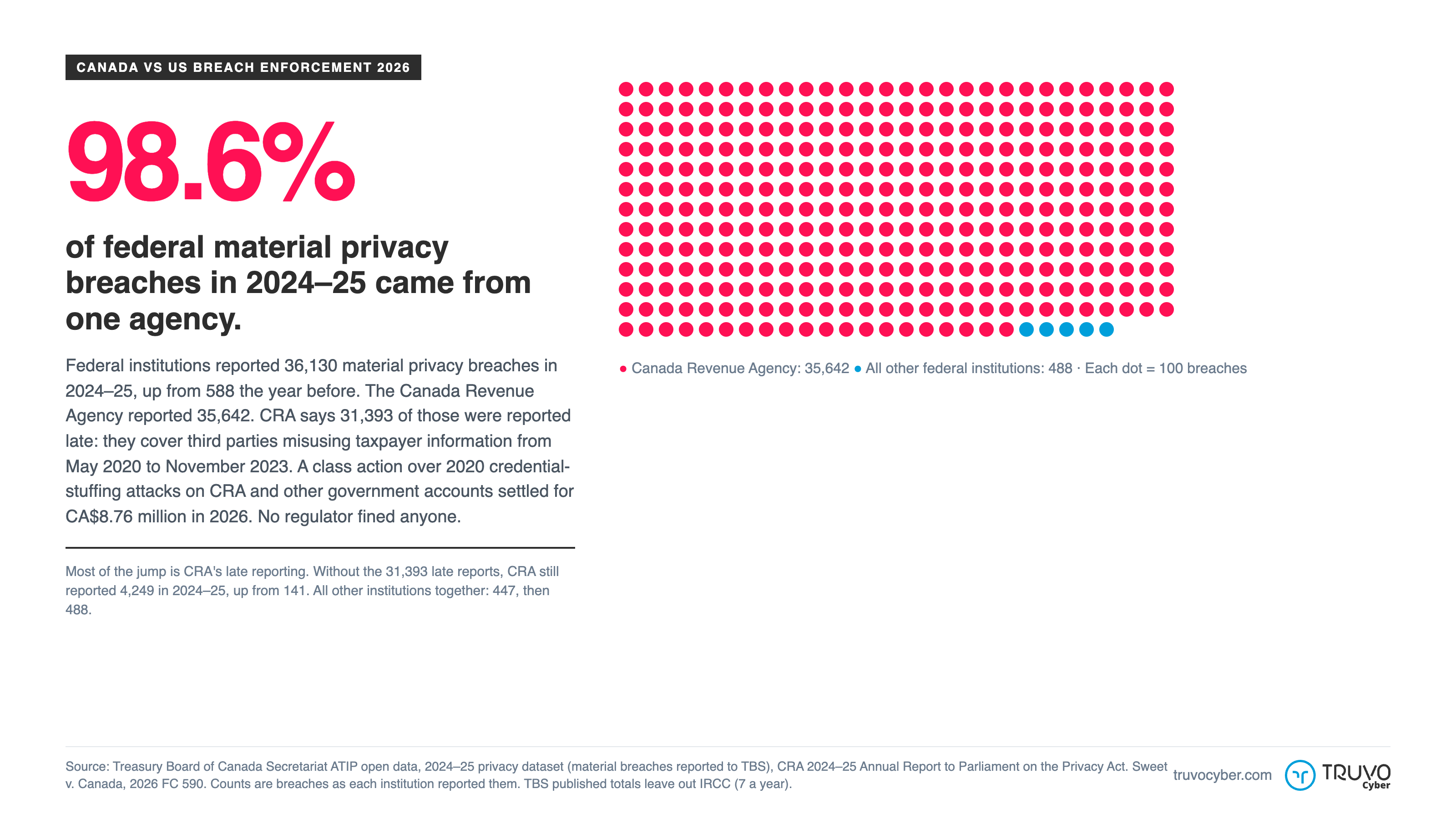
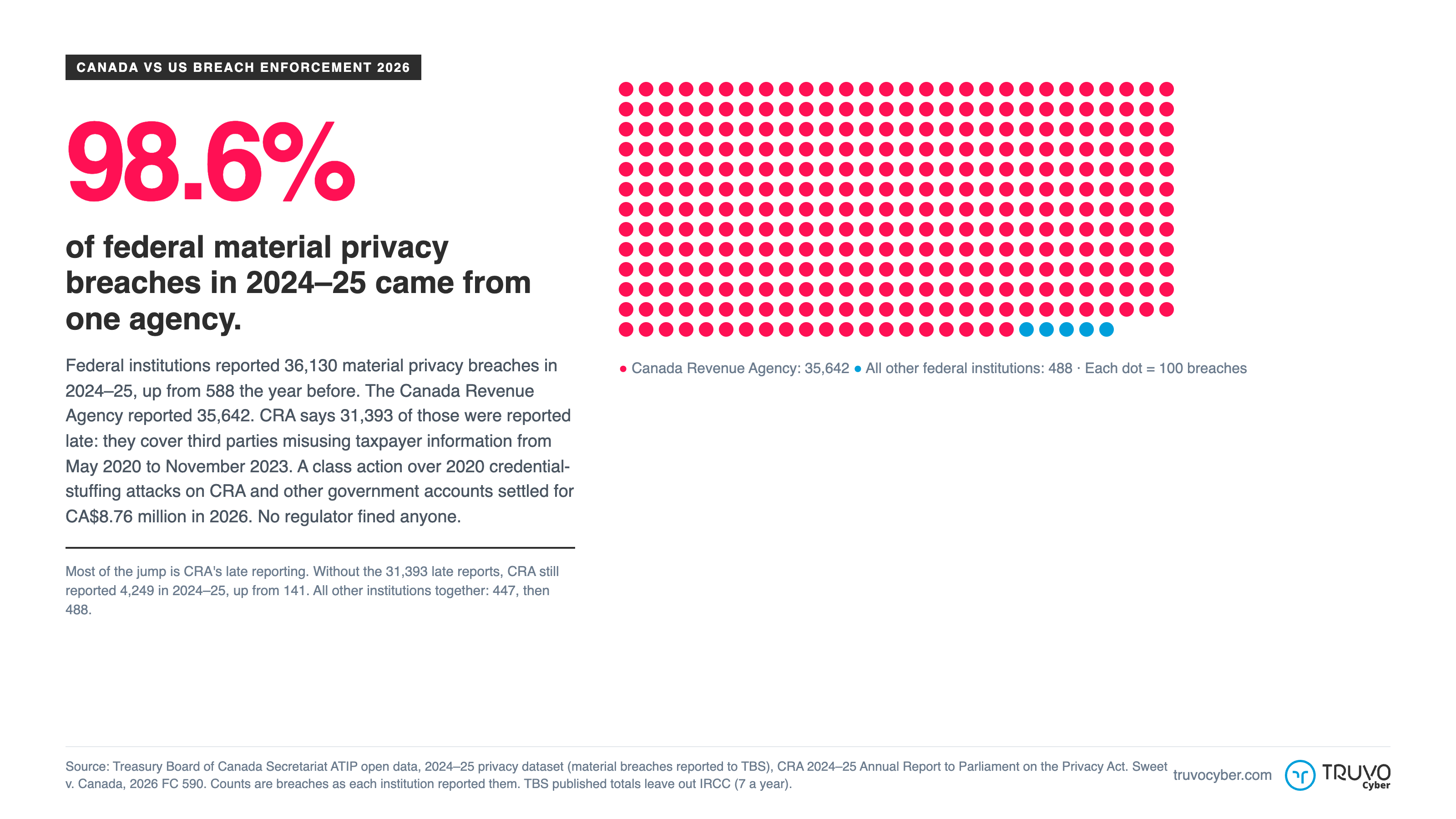
- CRA share of all federal material privacy breaches, 2024-25: 98.6% (35,642 of 36,130, Truvo Cyber analysis)
- Breaches the CRA reported late, covering May 2020 to November 2023: 31,393
- Privacy Commissioner finding, May 7, 2026: CRA contravened the Privacy Act, complaint well-founded and conditionally resolved
- Fine: None. The federal Privacy Commissioner has no power to fine
- Class action settlement (Sweet v. Canada): CA$8,760,500.90, claims due February 3, 2027
What happened in the CRA data breach?
The CRA data breach is a series of attacks since 2020 in which outsiders used stolen or leaked credentials and personal details to get into taxpayer accounts, change banking or contact information, or file returns for refunds. The Privacy Commissioner's special report calls each case an Unauthorized Use of Taxpayer Information by a Third Party (UUTP), which results in unauthorized access to, or modification of, taxpayers' personal information by bad actors with the objective of financial gain.
The best-known wave came in summer 2020, when attackers used credentials stolen in breaches at other organizations to log in to CRA My Account and other Government of Canada accounts, a method called credential stuffing. Many of the attacks aimed at pandemic benefits: the official settlement notice gives fraudulent CERB, CESB or EI applications and diverted benefits as examples of fraud.
How many CRA privacy breaches have there been since 2020?
The CRA has confirmed 42,755 individual breaches across six quarterly reports, covering cases confirmed from May 11, 2020 to September 30, 2025, according to the Privacy Commissioner's special report. The dates mark when the CRA confirmed each breach, and the CRA does not track when each breach happened.
| CRA breaches confirmed, by reporting period | Breaches |
| May 11, 2020 to November 9, 2023 (reported late, in May 2024) | 31,393 |
| November 10, 2023 to September 30, 2024 | 3,232 |
| October to December 2024 | 805 |
| January to March 2025 | 1,438 |
| April to June 2025 | 3,062 |
| July to September 2025 | 2,825 |
| Total | 42,755 |
The CRA counts dominate federal breach statistics. In the Treasury Board's open data for 2024-25, the CRA reported 35,642 of the 36,130 material privacy breaches across all federal institutions, or 98.6%, up from 141 of 588 the year before. The CRA's 2024-25 Privacy Act report states that 35,571 of the CRA's 35,642 involved unauthorized use of taxpayer information by a third party. The full federal comparison is in the Canada vs US data breach fines study.
How did attackers get into CRA accounts?
Attackers often got into CRA accounts with stolen or leaked credentials from external sources, according to the Privacy Commissioner's special report. The Commissioner adds that most cases relied on credentials and information that may have come from phishing or social engineering aimed at taxpayers. The investigation examined five entry points: sign-in through financial institutions, My Account, general enquiry phone calls, tax returns, and Represent a Client.
The Commissioner's findings include three weaknesses in the CRA's defences:
- Multi-factor authentication came late. The CRA made multi-factor authentication mandatory in October 2021, which the report says may have been a contributing factor to the breaches before that date. The news release adds that once multi-factor authentication was in place, the CRA did not consistently rely on the strongest methods.
- Breach tracking started in 2022. The CRA began tracking individual breaches only in 2022, and at the time of the report the CRA had no single central repository for tracking them.
- Most cases were found by taxpayers. The report states that the majority of UUTPs remained self-reported, meaning taxpayers spotted the misuse before the CRA did.
The CRA could not explain in every case how attackers got past the authentication checks, according to the news release.
What did the Privacy Commissioner find about the CRA breaches?
The Privacy Commissioner of Canada found that the CRA contravened subsections 6(2) and 8(2) of the Privacy Act, on the accuracy and disclosure of personal information, and rated the complaint well-founded and conditionally resolved. The special report was tabled in Parliament on May 7, 2026. The investigation opened in October 2024 after a complaint, on October 29, 2024 according to the CRA's 2024-25 Privacy Act report.
The Commissioner made nine recommendations. The CRA accepted eight in full and one in part. The Commissioner also credits significant efforts by the CRA over the last five years and rates the CRA's containment and mitigation as satisfactory. The Commissioner also refers to an earlier OPC investigation into the 2020 credential-stuffing attacks, in which stolen credentials obtained from previous breaches at other organizations are used to access existing online accounts.
Was the CRA fined for the data breach?
The CRA was not fined for the data breach. The Privacy Act gives the federal Privacy Commissioner no power to fine a government institution, and the private-sector law, PIPEDA, gives the Commissioner no power to fine a business either. Under the Privacy Act, the Commissioner's tools are findings, recommendations and reports to Parliament.
The money that followed the 2020 attacks came from a class action, Sweet v. Canada. The Federal Court approved a settlement of CA$8,760,500.90 on May 5, 2026. Across Canada, privacy commissioners have issued CA$17,500 in administrative fines in total, all in Ontario health cases, and federal Bill C-36 would let a new commissioner fine businesses up to the greater of CA$10 million or 3% of gross global revenue if passed. The data breach fines study compares those numbers with US enforcement.
Who can claim from the CRA data breach settlement?
People can claim from the CRA data breach settlement if third parties got into their Government of Canada online account during the 2020 attacks covered by the settlement, and claims must reach KPMG by February 3, 2027. The class covers people whose information in a CRA account, My Service Canada account or GCKey account was disclosed without authorization between March 1 and December 31, 2020.
The settlement pays only two groups within that class, according to the official notice:
- People whose accounts were accessed during the credential-stuffing attacks between June 26 and August 18, 2020
- People whose accounts were accessed through a Represent a Client account between October 8 and November 25, 2020
| CRA settlement payment category | Maximum |
| Access claim: time and inconvenience, CA$20 an hour up to 4 hours | CA$80 |
| Fraud claim: fraudulent applications or diverted benefits, CA$20 an hour up to 10 hours | CA$200 |
| Special Compensation Fund: documented out-of-pocket losses, such as unreimbursed fraud losses or identity theft fees | CA$5,000 |
Payments may be reduced depending on the number of approved claims. Claims are filed at breachsettlementcanada.kpmg.ca, where class members can also check eligibility. Breaches outside the two 2020 windows receive no payment under the settlement.
What should CRA account holders check now?
CRA account holders should turn on the strongest multi-factor authentication option available and check the account for changes they did not make. In the CRA's 2024-25 Privacy Act report, the CRA lists the warning signs: unexpected changes to contact or banking information, changes of representative or directors, and tax returns filed on the person's behalf with refunds.
Three steps follow from the Commissioner's findings:
- Use a unique password for the CRA account. Credential stuffing works when a password from another breached site also opens the CRA account.
- Choose the strongest multi-factor option the CRA account offers. The Commissioner criticized the CRA's reliance on weaker methods, and a code sent by text message is among the weaker options.
- Review account activity and mail. The CRA notifies people when a breach is confirmed and offers credit protection when required, and most cases in the period the Commissioner investigated were reported by taxpayers themselves.
What should organizations learn from the CRA data breach?
Organizations should treat credential stuffing as a certainty for any account system open to the public, and the CRA case shows the cost of late multi-factor authentication and weak breach tracking. The weaknesses the Commissioner found point to three controls for any company with a customer login: phishing-resistant authentication, a central breach register, and detection that finds misuse before customers do.
Under PIPEDA, every organization the law covers must keep a record of every breach of security safeguards involving personal information under the organization's control, reportable or not, and Bill C-36 would attach penalties to privacy failures. A breach register kept from day one is cheaper than one rebuilt during an investigation. The CRA began tracking individual breaches in 2022 and reported 31,393 breaches late, in May 2024.
How did Truvo Cyber gather the CRA data breach facts in this post?
Truvo Cyber took the breach counts, findings and recommendations from the Privacy Commissioner's special report of May 7, 2026 and the matching news release, and the settlement terms from the official Government of Canada notice, all read on November 21, 2026. The 98.6% share comes from Truvo Cyber's analysis of the Treasury Board's access to information and privacy open data for 2024-25. The settlement total and approval date come from Canadian Lawyer's case report, because the official notice gives neither.
Two limits apply. The CRA counts breaches by the date of confirmation, so the quarterly figures show when the CRA confirmed cases, and the dates of the attacks are unknown. The CRA's quarterly counts to the Privacy Commissioner and the Treasury Board's fiscal-year counts cover different periods, so the 42,755 and 35,642 figures measure different things and cannot be added together.
How can Canadian companies stop credential stuffing before a breach?
The CRA breaches came from a known attack, credential reuse, against accounts that lacked strong multi-factor authentication. The same weaknesses appear in customer portals, partner logins and admin consoles across Canadian companies, and the fix is a security program with phishing-resistant authentication, detection and a breach register in place before the first incident.
Truvo Cyber builds identity security and breach response programs for Canadian companies, through the Truvo Cyber data breach response and privacy program services. If your team wants a review of login security or breach readiness, book a strategy call.
Close the credential-stuffing gap
Truvo reviews login security, multi-factor authentication and breach readiness for Canadian companies, then builds the program to fix the gaps.
Frequently Asked Questions
Was there a CRA data breach?
Yes. The Canada Revenue Agency confirmed 42,755 individual privacy breaches from May 2020 to September 2025, in which attackers used stolen credentials or personal details to get into or change taxpayer accounts. The Privacy Commissioner of Canada found in May 2026 that the CRA contravened the Privacy Act.
How many people were affected by the CRA data breach?
Truvo Cyber found no official count of people affected in the Privacy Commissioner's report or the CRA's report, which both count breaches. The Privacy Commissioner's special report gives 42,755 confirmed individual breaches from May 2020 to September 2025.
Was the CRA fined for the data breach?
The CRA was not fined. The federal Privacy Commissioner has no power to fine under the Privacy Act. The Commissioner made nine recommendations, and the CRA accepted eight in full and one in part.
How much is the CRA data breach settlement?
The Sweet v. Canada settlement is CA$8,760,500.90, approved by the Federal Court on May 5, 2026. Individual payments go up to CA$80 for access claims, CA$200 for fraud claims and CA$5,000 in documented losses, and payments may be reduced depending on the number of approved claims.
What is the deadline to claim from the CRA settlement?
Claims must be submitted by February 3, 2027, at breachsettlementcanada.kpmg.ca. The claims period opened on August 4, 2026.
Who is eligible for the CRA data breach settlement?
People whose Government of Canada online account was accessed by third parties during the credential-stuffing attacks between June 26 and August 18, 2020, or through a Represent a Client account between October 8 and November 25, 2020, can receive payments. Eligibility can be checked on the KPMG settlement site.
