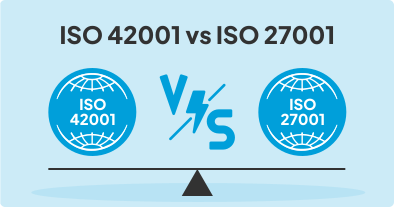
ISO 27001 protects information through an Information Security Management System (ISMS). ISO 42001 governs AI systems through an Artificial Intelligence Management System (AIMS), with controls for AI risks such as model drift, bias and explainability. Both standards share the same management-system clauses, so a company with ISO 27001 already has roughly 60 to 70% of the ISO 42001 work done (Truvo Cyber estimate). The remaining work is AI-specific governance.
- Scope: ISO 27001 covers information assets. ISO 42001 covers AI systems: models, training data and inference pipelines
- Annex A: ISO 27001:2022 has 93 controls in 4 themes. ISO 42001 has 38 controls in 9 control objectives (A.2 to A.10)
- Shared: Clauses 4 to 10 (the ISO Harmonized Structure), risk methodology, internal audit and management review
- Certification: both run on a 3-year cycle with annual surveillance audits
- Order: ISO 27001 first, or both together. Adding ISO 42001 to an existing ISO 27001 program typically takes 10 to 16 weeks
Should you get ISO 27001 before ISO 42001?
ISO 27001 is the base for ISO 42001. The AIMS relies on information security controls that ISO 42001 does not define in full: access management, encryption, change management, incident response, vendor risk, business continuity and asset management. ISO 42001 adds the AI controls: impact assessments, data for AI systems, AI system life cycle, information for interested parties and responsible use.
In our engagements, companies rarely pursue ISO 42001 without ISO 27001. A company that certifies ISO 42001 alone typically ends up rebuilding the ISO 27001 security controls under a different name. The path depends on where you start:
- No certification yet: run ISO 27001 and ISO 42001 as one program. The overlap is large enough that one engagement is faster than two in sequence
- Already ISO 27001 certified: treat ISO 42001 as an extension of the existing ISMS. Expect 10 to 16 weeks of AI-specific work
- Interested in ISO 42001 but without ISO 27001: keep ISO 27001 in the plan. Enterprise buyers ask for ISO 27001 regardless of AI governance maturity, and the AIMS depends on those security controls
Dual certification against one shared program saves on audit fees, evidence work and policy writing, because the overlapping requirements are tested and documented once. Truvo's ISO 42001 consulting services start with an ISO 42001 gap analysis that shows how much of your ISO 27001 program carries over.
I already have ISO 27001. How much additional work is required to add ISO 42001?
A company with a working ISO 27001 ISMS typically needs 10 to 16 weeks of AI-specific work to add ISO 42001, because the management-system clauses, risk method, internal audit and management review carry over. Truvo Cyber, a Canadian cybersecurity consulting firm serving clients globally, scopes the add-on as an extension of the existing ISMS as a fixed-scope project, with ongoing operation of the AIMS after certification if the company wants it, led by a senior CISSP in the US or Canada.
What carries over from an ISO/IEC 27001:2022 ISMS:
- Management-system clauses 4 to 10: context, leadership, planning, support, operation, performance evaluation and improvement, extended to name the AI systems in scope
- Risk method and risk register: the same scoring and treatment process, with AI risk categories added
- Security controls the AIMS relies on: access management, encryption, change management, incident response, supplier management and business continuity
- Internal audit and management review: one audit programme and one review meeting for both management systems
What is new under ISO/IEC 42001:2023:
- AI policy (Annex A.2) approved by top management
- AI risk assessment and AI risk treatment for bias, drift, explainability and misuse, run through the same Clause 6.1 process as security risks
- AI system impact assessment (Clauses 6.1.4 and 8.4) for effects on individuals, groups and society
- Annex A AI controls for data, the AI system life cycle and a statement of applicability against the 38 controls
The full list of AI controls is in the section "What does ISO 42001 add beyond ISO 27001?" further down this page.
The ISO 42001 certification cost breakdown covers platform, audit, consulting and ongoing costs.
Where do ISO 27001 and ISO 42001 overlap?
Both standards follow the ISO Harmonized Structure (formerly Annex SL). Clauses 4 to 10 cover the same management-system requirements: context of the organization, leadership, planning, support, operation, performance evaluation and improvement. A team that runs an ISMS already knows this structure.
Information security controls carry over as the base the AIMS relies on: access management, encryption, incident response, change management, vendor risk and business continuity. The ISO 27001 controls stay in place and extend to AI assets such as models, training data and inference pipelines.
ISO 42001 also fits with other ISO standards, including ISO 9001 (quality), ISO 27701 (privacy) and the ISO 31000 risk management guidelines. Companies already running one of these get further overlap in governance, risk method and documentation.
| Area |
ISO 27001 |
ISO 42001 |
Overlap |
| Scope |
Information assets (data, systems, infrastructure) |
AI systems (models, training data, inference pipelines) |
Both require formal scope definition and context analysis |
| Risk assessment |
CIA triad: confidentiality, integrity, availability |
AI-specific: bias, drift, explainability, ethical use, societal impact |
Risk methodology is reusable. Risk categories differ |
| Controls (Annex A) |
93 controls across 4 themes (organizational, people, physical, technological) |
38 controls across 9 control objectives (A.2 to A.10), plus Annexes B (implementation guidance), C (AI objectives and risk sources) and D (use across domains) |
ISO 27001 security controls are the base the AIMS relies on |
| Core deliverable |
ISMS |
AIMS |
Both require documented management systems with continuous improvement |
| Audit cycle |
3-year certification, annual surveillance |
3-year certification, annual surveillance |
Identical cycle structure |
Where does your AI governance stand?
Take the ISO 42001 Readiness Scorecard. Fifteen questions, five minutes. You get a snapshot of your current AI governance maturity, and we get enough context to make a strategy call useful.
Take the Scorecard
How do the frameworks map to each other?
We built the Framework Explorer (FEX) to show how SOC 2, ISO 27001, ISO 42001, and other frameworks map to each other control by control. FEX is in beta and ready to use: pick a framework and see where the controls overlap with other frameworks.
Free · Google Sheet
ISO 27001 vs SOC 2 Control Mapping Spreadsheet
Every SOC 2 Common Criterion mapped to ISO 27001:2022 Annex A, all 93 Annex A controls mapped back to SOC 2 with what a SOC 2 holder still has to build, and two sample control sets, kept current in a shared Google Sheet. Enter your email to open it.
What does ISO 42001 add beyond ISO 27001?
ISO 42001 adds three areas of work that ISO 27001 does not cover. IBM's 2025 Cost of a Data Breach Report found 63% of breached organizations had no AI governance policy or were still writing one, and heavy shadow AI use added an average of USD 670,000 to breach costs.
AI system impact assessment. ISO 42001 requires an assessment of the potential consequences of each AI system for individuals, groups and society (Clauses 6.1.4 and 8.4). The assessment covers bias, fairness, transparency and the effects of automated decisions, and documents each system's intended purpose and operating limits.
Continuous AI risk monitoring. Model drift, training data quality, shifts in feature distributions and new adversarial techniques change faster than an annual ISMS review cycle. AI risks need ongoing monitoring between formal reviews.
Annex A AI controls. ISO 42001 Annex A lists 38 controls under 9 control objectives:
- A.2 Policies related to AI
- A.3 Internal organization
- A.4 Resources for AI systems
- A.5 Assessing impacts of AI systems
- A.6 AI system life cycle
- A.7 Data for AI systems
- A.8 Information for interested parties of AI systems
- A.9 Use of AI systems
- A.10 Third-party and customer relationships
Three informative annexes have no ISO 27001 equivalent: Annex B (implementation guidance for each control), Annex C (AI-related organizational objectives and risk sources) and Annex D (use of the AIMS across domains and sectors). Auditors expect documented evidence for each control, and strong technical practices with no documentation often fail third-party reviews.
The guide to AI-specific risks under ISO 42001 maps these controls to MLOps workflows.
How do you run one program for both frameworks?
Build one security program and map both frameworks onto that program, the same approach as stacking SOC 2 and ISO 27001. The controls stay the same, and each framework is a different view of one program.
- Start with a gap analysis. If you are already ISO 27001 certified, the gap analysis covers which AI systems are in scope, which AI risks exist and which Annex A controls need new work
- Extend the existing risk register. Add AI risk categories (bias, drift, explainability, societal impact) to the register you already have, so AI risks get the same governance as security risks
- Use cross-mapping in your GRC platform. GRC platforms such as Vanta, Drata and Secureframe map one control, such as an access review, to requirements in both standards
- Map to the NIST AI RMF where US buyers ask for it. The NIST AI Resource Center hosts a Microsoft-authored crosswalk from the AI RMF functions (Govern, Map, Measure, Manage) to ISO 42001, and the ISO 42001, NIST AI RMF and EU AI Act crosswalk lays the three side by side
Should I hire the same firm for ISO 42001 and my existing SOC 2 or ISO 27001?
Hiring the consulting firm that built the existing SOC 2 or ISO 27001 program typically shortens the ISO 42001 work, because the same team already knows the controls, the evidence and the risk register. Truvo Cyber builds ISO 42001 on top of the SOC 2 or ISO 27001 program a company already runs, and the audit stays with a separate accredited certification body. The certification body is the one firm that has to stay separate: ISO/IEC 17021-1 clause 5.2.5 bars a certification body, and any part of the same legal entity, from providing management system consultancy.
- Same consulting firm for the build: one team maps ISO 42001 onto the program the company already runs, and one risk register and one evidence set serve every framework
- Separate certification body for the audit: the firm that builds the AIMS and the firm that certifies the AIMS are two different firms
- Internal audit: ISO/IEC 17021-1 clause 5.2.6 bars the certification body from running internal audits for the clients the body certifies. Clause 9.2 of ISO/IEC 42001 requires internal auditors selected for objectivity and impartiality, in practice an auditor who did not build the controls. See ISO internal audit services
- SOC 2: an independent CPA firm issues the SOC 2 report, separate from the firm that builds the program
Which certification bodies offer combined ISO 27001 and ISO 42001 assessments?
Accredited certification bodies can offer an integrated audit that covers ISO 27001 and ISO 42001 in one visit, with shared management-system clauses tested once. Ask each certification body whether the body holds accreditation for ISO 42001 specifically, and check the answer in the accreditation body's public directory. ISO/IEC 42006, published in 2025, sets the AI-specific requirements for bodies that certify against ISO 42001.
A SOC 2 examination and an ISO 42001 certification audit follow two different sets of standards, AICPA attestation standards and ISO/IEC 17021-1. A company can schedule both in the same year and reuse one evidence set across both audits.
When do you need ISO 27001, ISO 42001 or both?
What your company builds, and what customers, regulators and partners ask for, decide which standard you need. AI use is now common among the buyers who already ask for ISO 27001: Stanford's 2025 AI Index found 78% of surveyed organizations reported using AI in 2024, up from 55% a year earlier.
ISO 27001 ALONE
Enough when the company handles sensitive data but does not develop, deploy or operate AI systems. ISO 27001 alone fits many traditional SaaS, financial services and data processing companies.
ISO 42001 ALONE
Possible for AI-focused companies whose customers do not ask for ISO 27001, which is rare in our experience. The EU AI Act entered into force on August 1, 2024, and obligations phase in through 2028. Under the Digital Omnibus amendment, in force since July 27, 2026, Annex III high-risk obligations apply from December 2, 2027.
Companies selling AI products into the EU already get AI governance questions from buyers, and the same buyers usually ask for ISO 27001 too. See ISO 42001 and the EU AI Act.
BOTH STANDARDS
The common case for companies that build AI-powered products for customers who expect formal information security governance. Enterprise buyers who already require ISO 27001 now ask about AI governance, and ISO 42001 is the usual reference point for that question.
For certification cost benchmarks and platform support, see the ISO 42001 implementation guide and the compliance software review.
ISO 42001 Certification-Ready in 12 Weeks
Our ISO 42001 Accelerator covers AI risk assessment, AIMS implementation, GRC platform setup, and certification body coordination. Fixed price, no scope creep.
Not ready to talk yet? Take the readiness scorecard first.
Frequently Asked Questions
What percentage of ISO 27001 carries over to ISO 42001?
In Truvo Cyber engagements, an ISO 27001 program covers roughly 60 to 70% of the ISO 42001 work: the shared management-system clauses (4 to 10) plus the security controls the AIMS relies on, such as access management, encryption, incident response, change management, vendor risk and business continuity. The remaining work is AI-specific: impact assessments, data governance for AI systems, AI system life cycle controls and information for interested parties.
Can ISO 42001 stand alone, or do you need ISO 27001 too?
ISO 42001 can be certified without ISO 27001, but the AIMS relies on information security controls that ISO 42001 does not define in full. In our engagements, companies with neither certification run both as one program against a shared security foundation. Adding ISO 42001 to an existing ISO 27001 program typically takes 10 to 16 weeks of AI-specific work. Adding ISO 27001 after ISO 42001 means close to a full ISO 27001 implementation.
Can I pursue both certifications in a single audit cycle?
Yes. Both standards follow a 3-year certification cycle with annual surveillance audits. Many certification bodies offer integrated audits that assess both management systems together, which lowers audit fees and preparation time.
Do I need a separate team for ISO 42001?
The governance structure of an existing ISMS extends to cover the AIMS. Data science and ML engineering teams join the management system and contribute to risk assessments, control design and evidence collection for the AI requirements. The security team leads the management system, and the AI team owns the technical AI controls.
How does ISO 42001 relate to the EU AI Act?
ISO 42001 gives a management system for AI governance that supports EU AI Act requirements for high-risk AI systems, such as risk management, documentation, transparency and human oversight. ISO 42001 certification alone does not prove EU AI Act compliance, but the certification shows systematic AI governance to regulators and buyers.
How long does it take to add ISO 42001 if I already have ISO 27001?
With a mature ISO 27001 program, expect 10 to 16 weeks: gap analysis, AI risk and impact assessments, AI control implementation, Annex A mapping, and preparation for the Stage 1 and Stage 2 audits. The timeline depends on how many AI systems are in scope and how well the existing AI development work is documented.
Is ISO 42001 required or voluntary?
ISO 42001 is a voluntary standard. We see buyers asking for ISO 42001, especially customers subject to the EU AI Act and enterprises with AI governance requirements in their vendor reviews.
Further Reading