

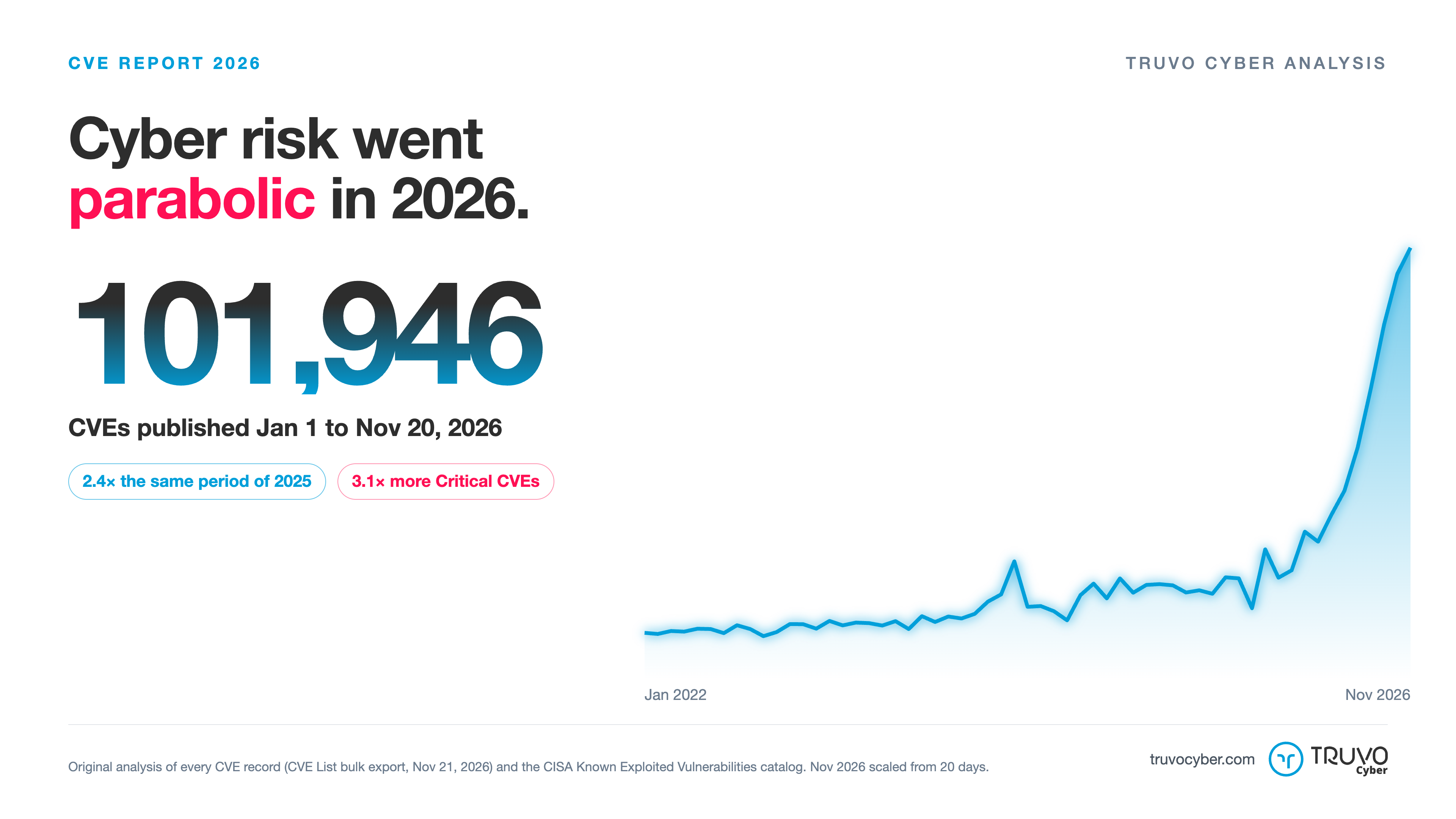
The CVE Program published 101,946 CVEs between January 1 and November 20, 2026, more than 2024 and 2025 combined (Truvo Cyber, 2026). Critical CVEs rose 3.1 times over the same period of 2025. Of the 2026 CVEs, 226 are in the CISA Known Exploited Vulnerabilities (KEV) catalog so far, 1 in 451.
Truvo Cyber counted every record in the CVE List and matched each KEV entry to the CVE record behind the entry. Every figure below comes from that analysis, and the method, definitions and limits are at the end of the post.
At a glance
- CVEs published: 101,946 (2.4x the same period of 2025)
- CVEs rated Critical: 11,244 (3.1x the same period of 2025)
- High or Critical share of scored CVEs: 56% (48% in 2025)
- CVEs added to CISA KEV in 2026: 306 (245 in all of 2025)
- 2026 CVEs confirmed exploited so far: 226, or 1 in 451
- KEV additions listed within 30 days of the CVE: 60% (51% in 2025)
- CVEs in 2027 if the 2026 curve stays parabolic: about 597,000, one every 53 seconds (211,000 if volume plateaus)
The yearly table behind these numbers is available as a CSV download.
How many CVEs were published in 2026?
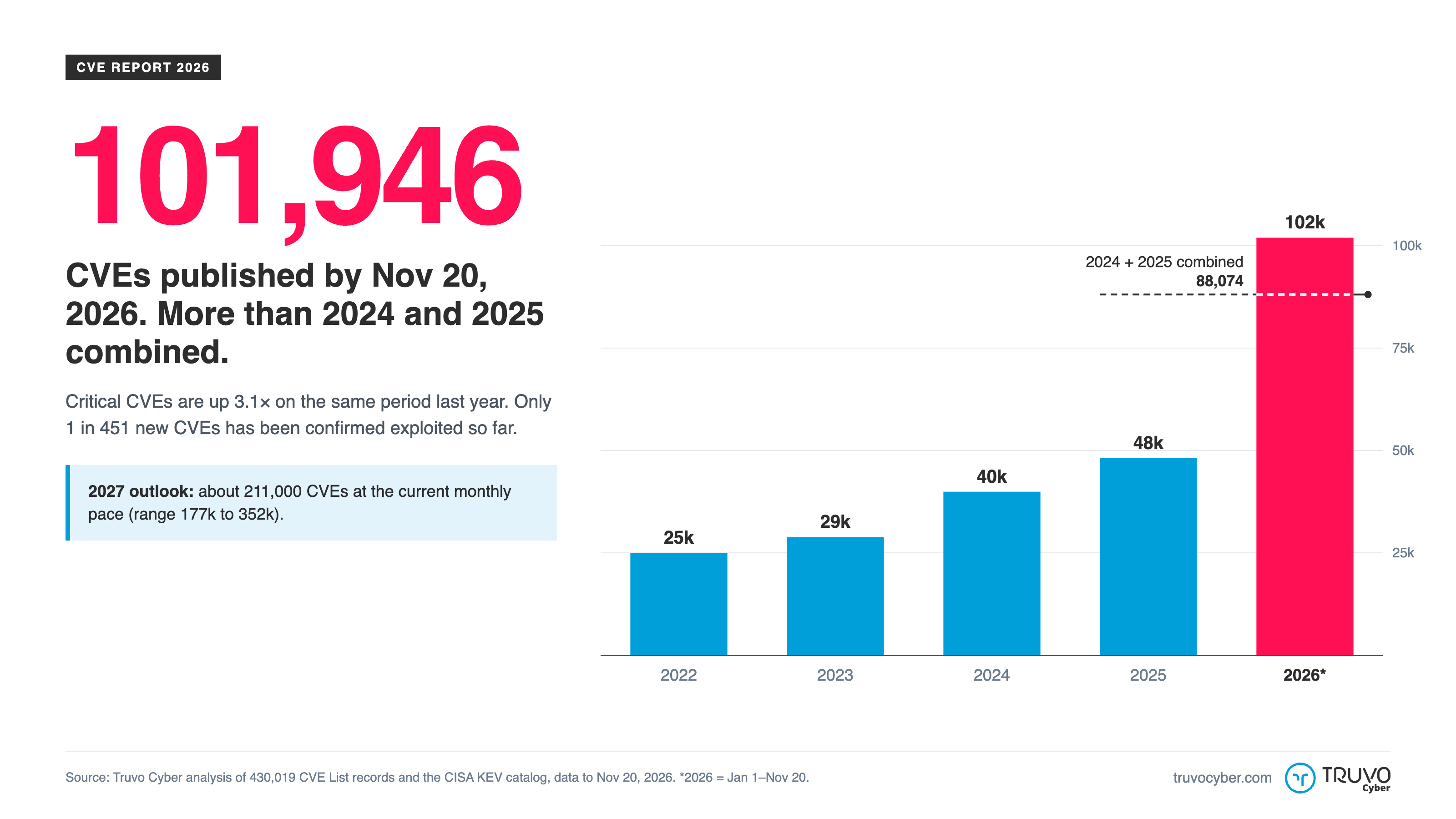
The CVE Program published 101,946 CVEs from January 1 to November 20, 2026. The full year of 2025 had 48,150, and 2024 had 39,924. The 2026 count already exceeds those two years together (88,074) with six weeks of the year left.
Over the same January-to-November-20 window, the five-year count is:
- 2022: 22,080
- 2023: 25,446
- 2024: 35,418
- 2025: 41,987
- 2026: 101,946
Annual growth sat between 15% and 40% from 2022 to 2025. In 2026 the count rose 143%. A widely shared chart from Andreessen Horowitz, based on Epoch AI data for 21 large software vendors, described the rise as parabolic. The full CVE List, covering every vendor and open-source project with a CVE, shows the same rise.
The chart below compares each full year with 2026 to date. The dashed line marks 2024 and 2025 combined.
How fast did monthly CVE counts grow in 2026?
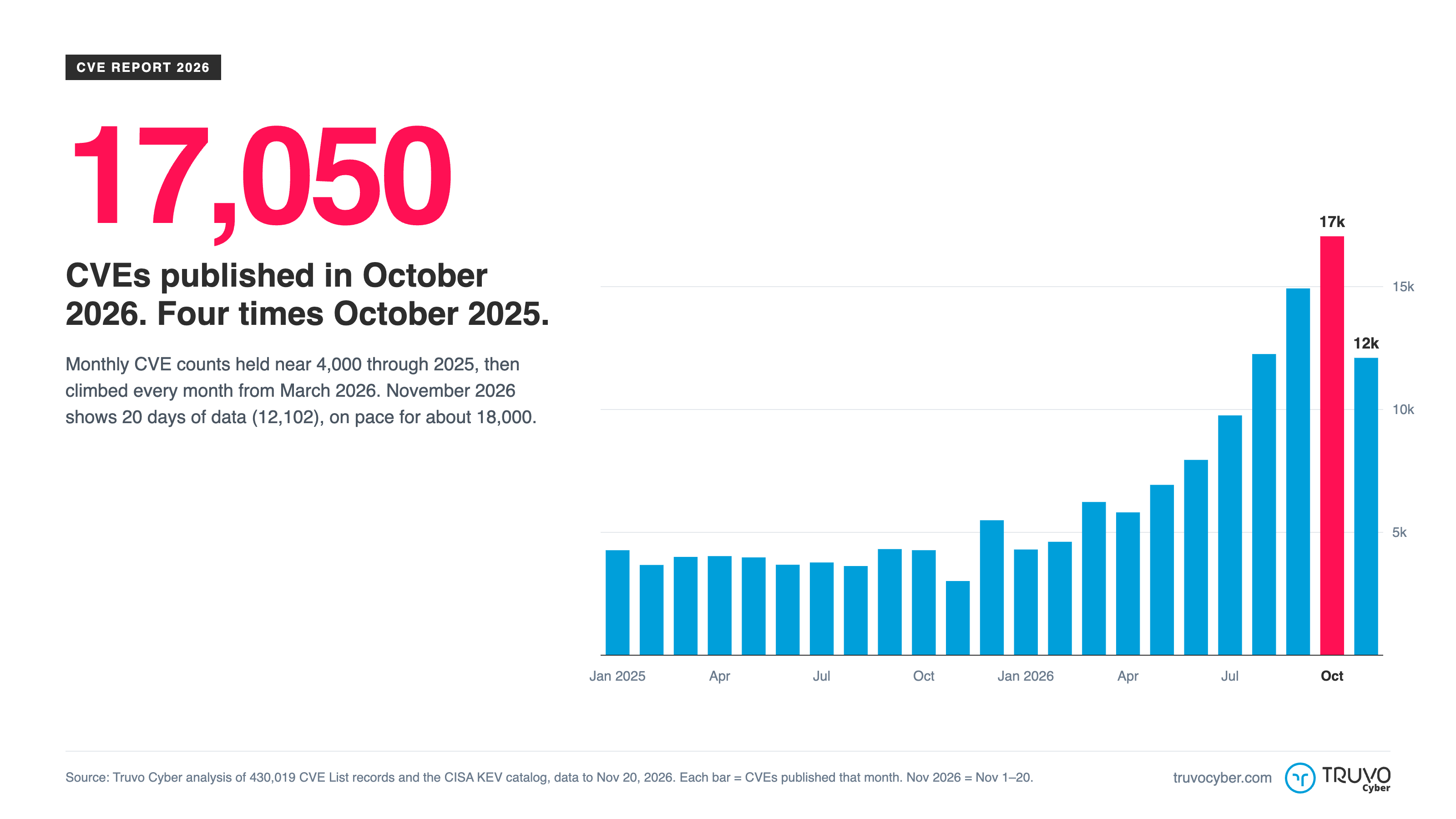
Monthly CVE counts stayed between about 3,000 and 5,500 through 2025, then rose every month from March 2026. October 2026 had 17,050 CVEs, four times October 2025 (4,274). The first 20 days of November 2026 had 12,102 CVEs, a pace of about 18,000 for the month.
The rise has two parts:
- January to February 2026: about 4,300 to 4,600 CVEs a month, close to the 2025 level
- March to October 2026: growth in almost every month, from 6,236 in March to 17,050 in October
The chart shows each month from January 2025 to November 20, 2026.
How many Critical CVEs were published in 2026?
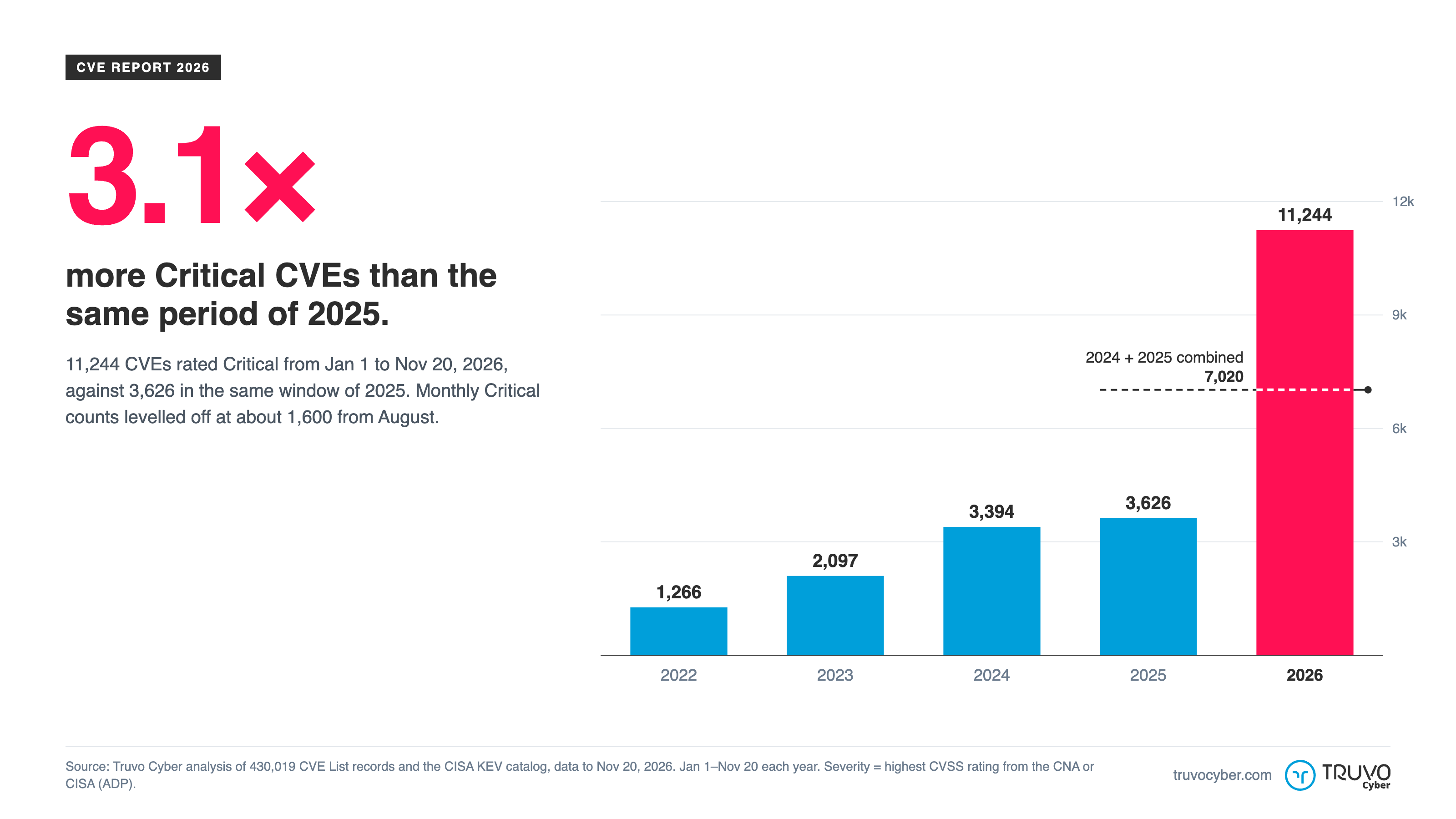
CVE issuers and CISA rated 11,244 CVEs as Critical between January 1 and November 20, 2026. The same window had 3,626 Critical CVEs in 2025 and 1,266 in 2022. The 2026 count is 3.1 times 2025 and 8.9 times 2022.
Monthly Critical counts peaked at 1,831 in August 2026 and then held at about 1,600 a month through November. The total CVE count kept growing over the same months, so the Critical count has levelled off while lower-severity CVEs continue to rise.
Did the severity of CVEs change in 2026?
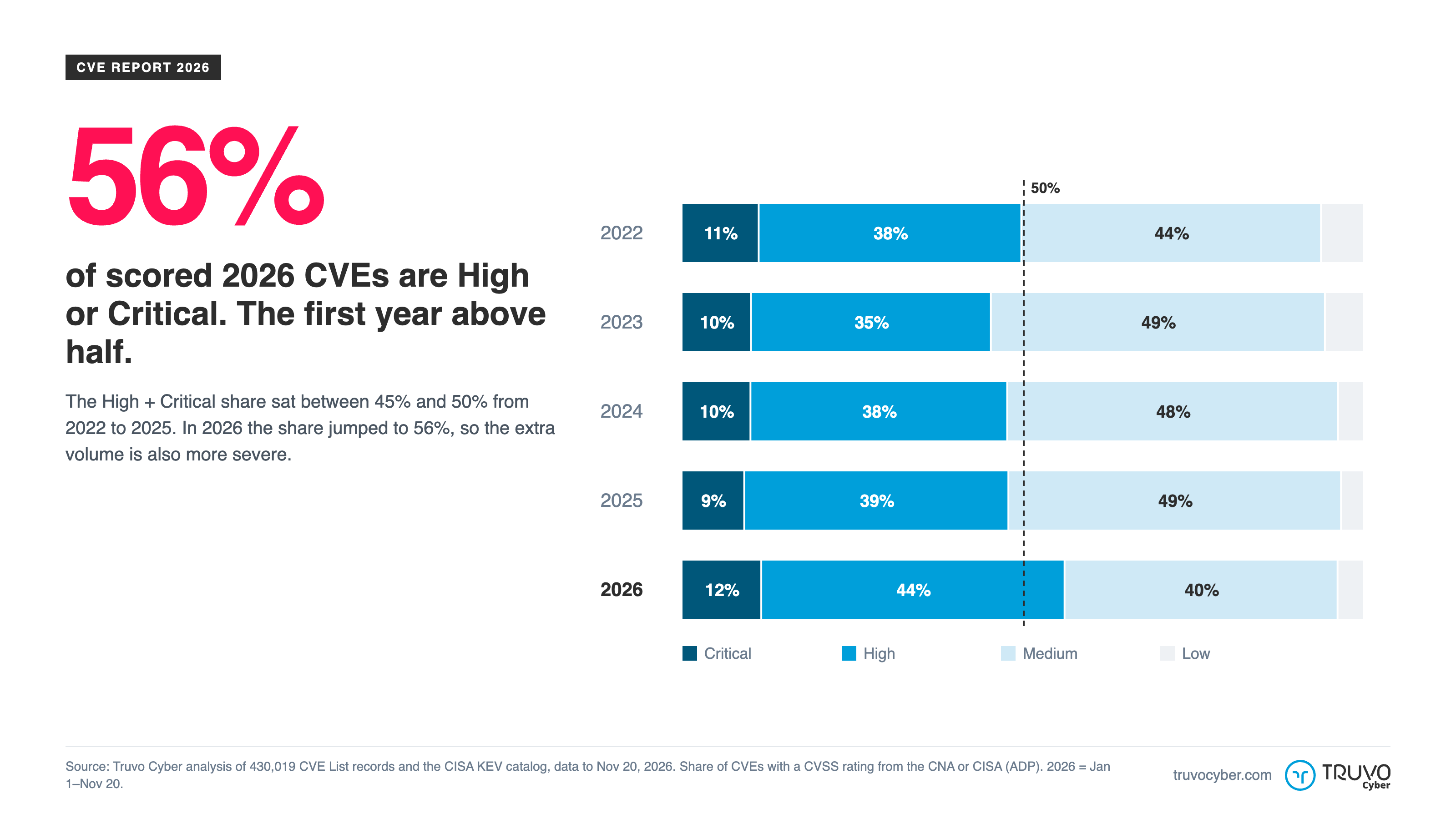
Yes. 56% of scored 2026 CVEs are rated High or Critical, the first year above half. The High-plus-Critical share was 50% in 2022, 45% in 2023, 48% in 2024 and 48% in 2025.
| CVE severity mix by year (share of scored CVEs) | Critical | High | High + Critical |
| 2022 | 11% | 38% | 50% |
| 2023 | 10% | 35% | 45% |
| 2024 | 10% | 38% | 48% |
| 2025 | 9% | 39% | 48% |
| 2026 (to Nov 20) | 12% | 44% | 56% |
Two changes in scoring practice are part of the picture. About 28% of 2026 CVEs carry a CVSS v4.0 score as the highest rating, against almost none in 2023. CISA's own scores, added through the CISA Authorized Data Publisher (ADP) container, are the only rating on 15% of 2026 CVEs. Both changes affect how many CVEs reach High or Critical, so the severity shift reflects scoring practice as well as the bugs themselves.
Which organizations published the most new CVEs in 2026?
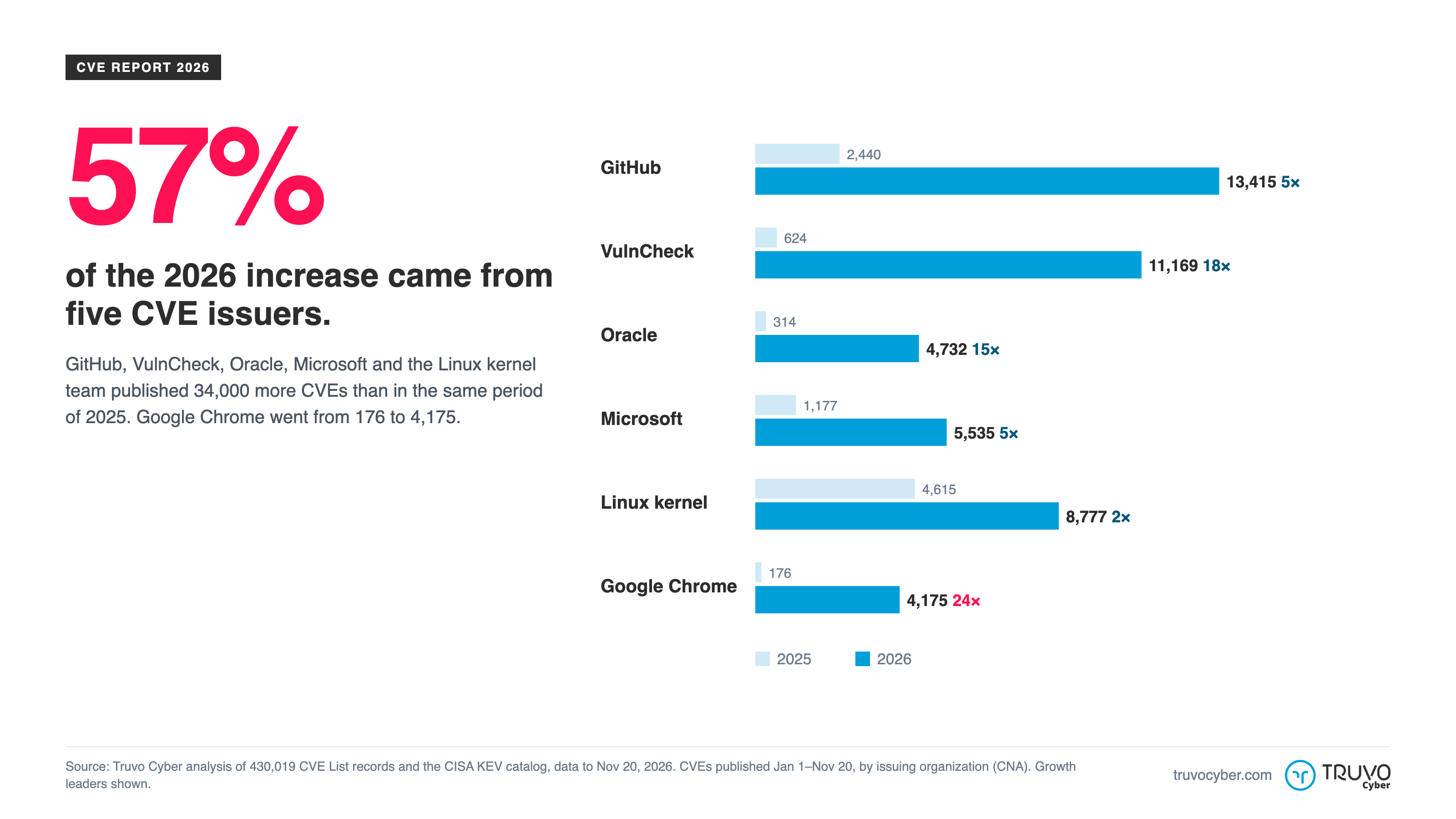
Five CVE Numbering Authorities (CNAs) account for 57% of the growth in 2026: GitHub, VulnCheck, Oracle, Microsoft and the Linux kernel team. Together they published about 34,500 more CVEs than in the same period of 2025.
| CNA | CVEs, Jan 1 to Nov 20, 2025 | CVEs, Jan 1 to Nov 20, 2026 | Change |
| GitHub | 2,440 | 13,415 | 5.5x |
| VulnCheck | 624 | 11,169 | 17.9x |
| Oracle | 314 | 4,732 | 15.1x |
| Microsoft | 1,177 | 5,535 | 4.7x |
| Linux kernel | 4,615 | 8,777 | 1.9x |
| Google Chrome | 176 | 4,175 | 23.7x |
GitHub and VulnCheck publish CVEs for open-source projects and for researchers who report to them. Oracle, Microsoft and Google Chrome publish CVEs for their own products. Growth in both groups means more vulnerability discovery and reporting across the industry, and more CVEs per vendor patch release.
The CVE records state who published each CVE. The records do not state how each bug was found, so this analysis cannot measure how much AI-assisted discovery adds to the count. Google's threat intelligence team has reported an AI agent turning a security patch into a working exploit. Attackers use the same kind of tools.
How many 2026 CVEs are in the CISA KEV catalog?
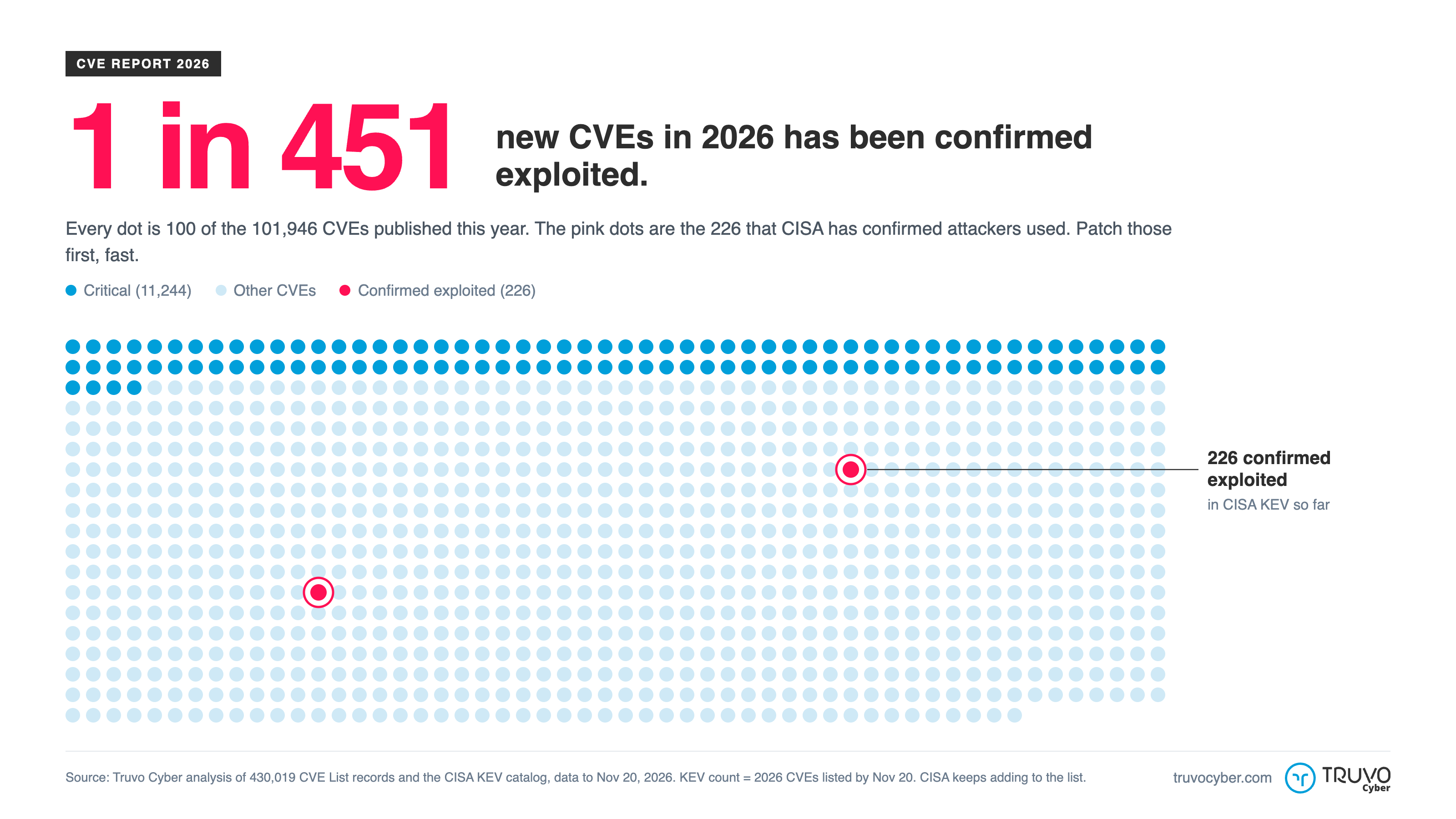
226 CVEs published in 2026 are in the CISA Known Exploited Vulnerabilities catalog as of November 20, 2026, or 1 in 451 of the 101,946 CVEs published this year. CISA lists a CVE in KEV only after confirming exploitation in the wild. Under Binding Operational Directive 26-04, issued June 10, 2026, a KEV listing starts the remediation clock for US federal civilian agencies. BOD 26-04 replaced BOD 22-01 and sets the deadline by four factors: whether the asset is publicly exposed, KEV status, whether exploitation can be automated, and the technical impact. Agencies must meet the new timelines within 180 days of issuance, by early December 2026. The full deadline table, and how all 2026 CVEs map to each deadline, are in the post on CISA BOD 26-04 remediation timelines.
The chart below gives one dot to every 100 CVEs published in 2026. The blue dots are Critical CVEs. The two pink dots are the KEV entries.
The share of CVEs that reach KEV is falling as volume grows. CVEs published in 2022 and 2023 reached KEV at about 5 to 6 per 1,000. CVEs published in 2024 and 2025 reached KEV at about 4 per 1,000. The 2026 rate is 2.2 per 1,000 so far, and will rise as CISA adds more 2026 CVEs over the coming months.
The count of KEV additions is rising in absolute terms:
- 2023: 187 KEV entries added
- 2024: 186
- 2025: 245
- 2026 (to November 20): 306, on pace for about 345
How fast are newly published CVEs being exploited?
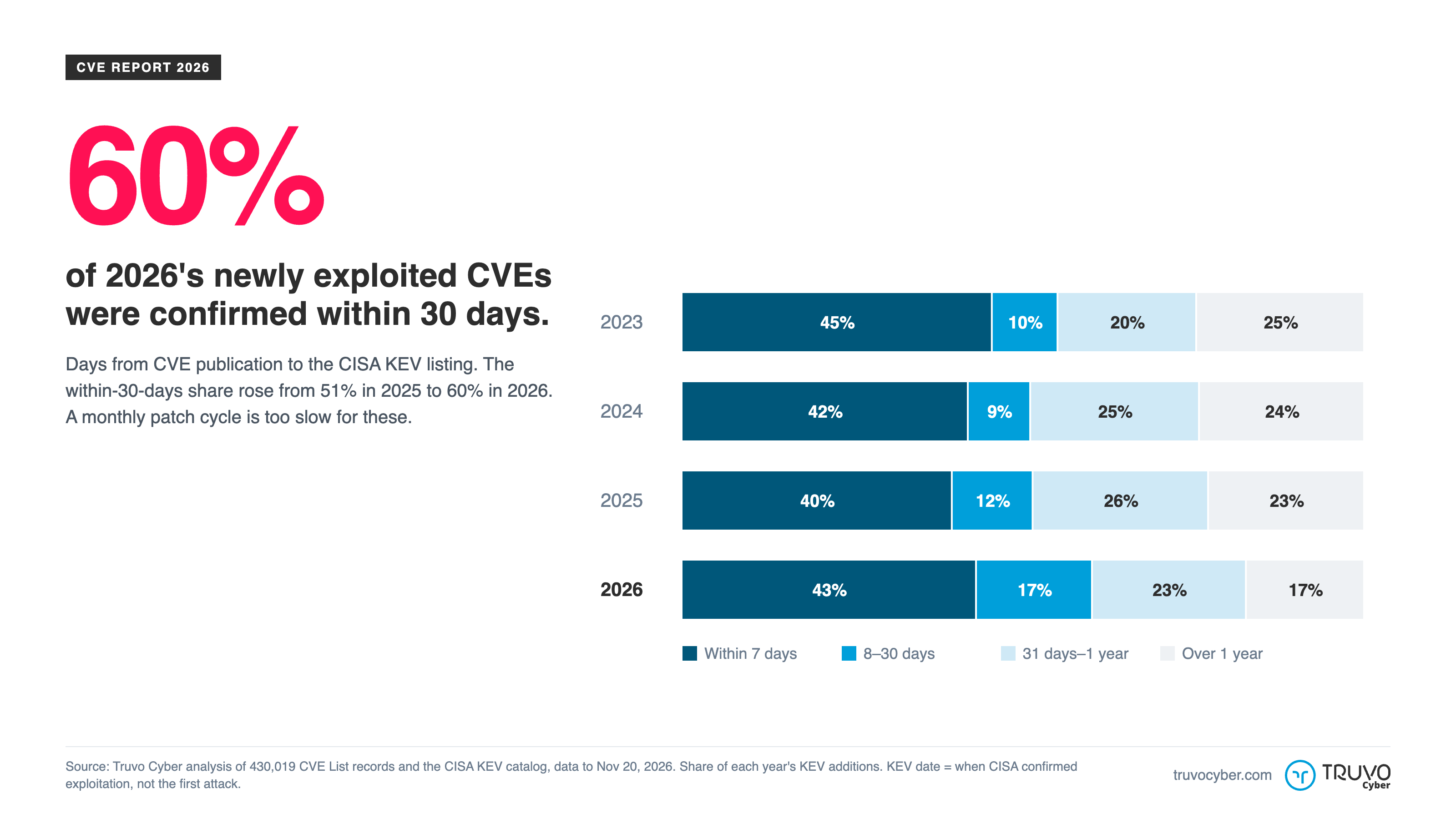
60% of the CVEs CISA added to KEV in 2026 were listed within 30 days of the CVE being published, up from 51% in 2025 (Truvo Cyber, 2026). 43% were listed within 7 days. The within-7-days share has stayed between 40% and 45% since 2023, so the change in 2026 is in the 8-to-30-day range.
| KEV additions by days from CVE publication to KEV listing | Within 7 days | 8 to 30 days | 31 days to 1 year | Over 1 year |
| 2023 | 45% | 10% | 20% | 25% |
| 2024 | 42% | 9% | 25% | 24% |
| 2025 | 40% | 12% | 26% | 23% |
| 2026 (to Nov 20) | 43% | 17% | 23% | 17% |
Recent CVEs also make up a larger share of KEV. Between January 1 and November 20 of each year, CISA added this many CVEs published in the same or the previous year:
- 2022: 139
- 2023: 132
- 2024: 129
- 2025: 174
- 2026: 260
The 2026 figure is about double the 2022-to-2024 level. A KEV listing date marks the day CISA confirmed exploitation. Attacks often start earlier, so these figures show the latest date by which a patch was needed.
What will CVE volume mean for security teams in 2027?
If the 2026 curve stays parabolic, 2027 brings about 597,000 CVEs, one new CVE every 53 seconds (Truvo Cyber projection, 2026). The parabolic case is the upper scenario. Monthly growth slowed from 26% in August 2026 to about 7% in November 2026. Even if volume stops growing at the October and November 2026 level, 2027 still brings about 211,000 CVEs, 580 a day.
| 2027 scenario | CVEs in 2027 | CVEs a day | One new CVE every | Critical CVEs a day |
| 2025 (for scale) | 48,150 | 132 | 11 minutes | 15 |
| Plateau: late-2026 pace holds | 211,000 | 580 | 2.5 minutes | 64 |
| Trend: 2026 monthly growth continues in a straight line | 352,000 | 960 | 90 seconds | 106 |
| Parabolic: the 2026 curve holds | 597,000 | 1,640 | 53 seconds | 180 |
The impact on a security team in the parabolic case:
- Triage volume: about 1,640 new CVEs a day, against 132 a day in 2025. Any process that has a person read every new CVE stops working long before that volume.
- Critical CVEs: about 180 a day if 11% of CVEs stay Critical, the 2026 share. A policy of fix every Critical within 30 days means about 5,400 new Critical CVEs to assess every month across the industry.
- Confirmed exploited CVEs: about 10 new CISA KEV entries a week if KEV additions grow 49% again, about 2 every working day. Based on the 2026 timing, about 4 of those each week would be confirmed exploited within 7 days of disclosure.
- The prioritisation gap: about 316,000 High or Critical CVEs against about 514 confirmed exploited CVEs in one year. Patching by severity means working through about 600 High or Critical CVEs for every confirmed exploited one.
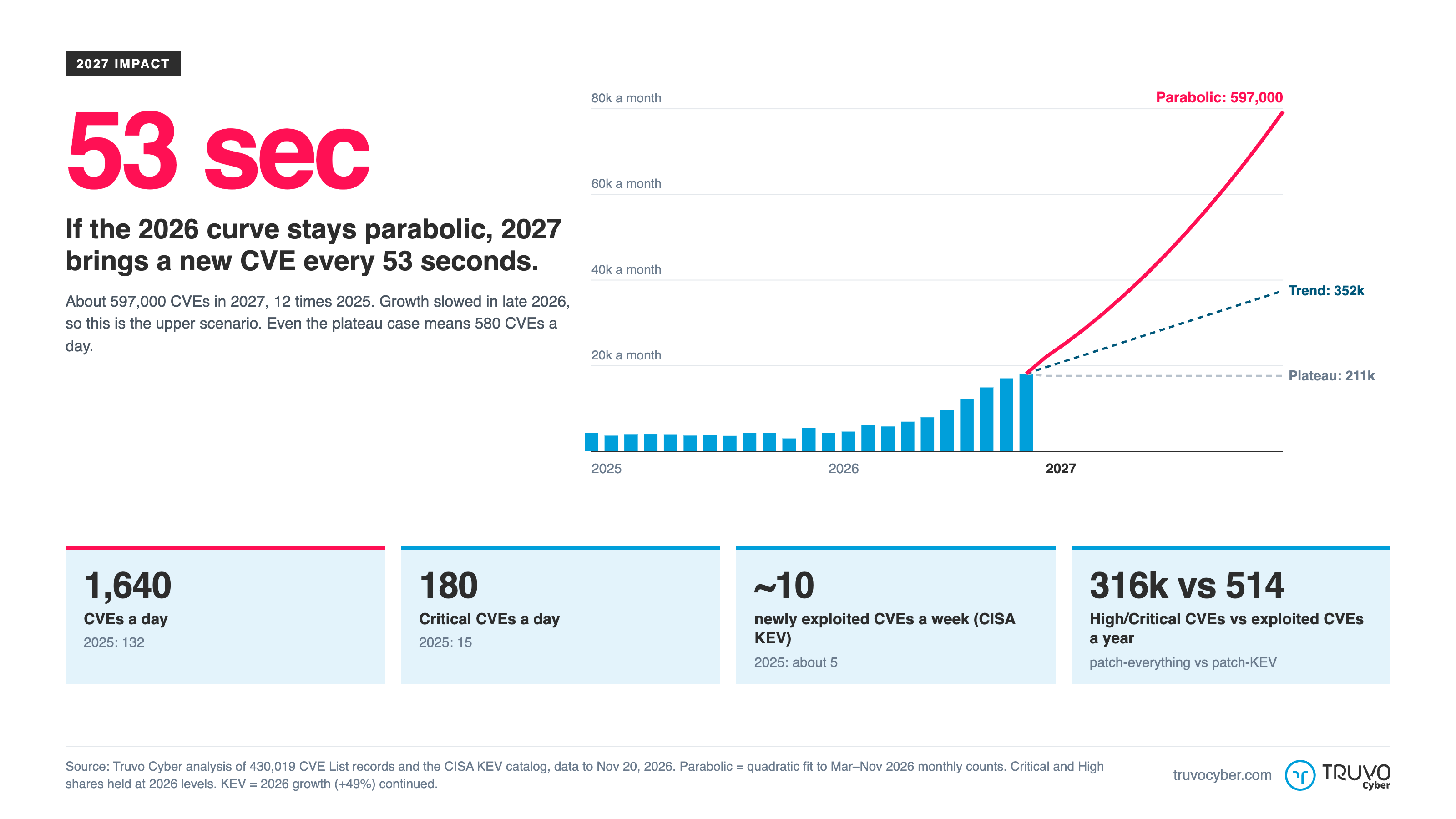
The scenarios use these assumptions:
- Plateau: the October-to-November 2026 monthly pace held for 12 months
- Trend: the March-to-November 2026 monthly increase (about 1,500 more CVEs each month) continues through 2027
- Parabolic: a quadratic curve fitted to the March-to-November 2026 monthly counts, extended through December 2027
- Critical and High CVEs: held at the 2026 shares, 11% Critical and 53% High or Critical of all CVEs
- CISA KEV: 2027 additions grow 49% over the 2026 pace, the 2026 growth in recent exploited CVEs
What should security teams change about patching in 2027?
Security teams should patch by confirmed exploitation first and by CVSS score second. At 200,000 CVEs a year, a policy of patch every High and Critical within 30 days means more than 100,000 fixes a year across the industry, most of which no attacker will use. A KEV-first policy focuses the fast track on a few hundred CVEs a year.
Four steps put the numbers above to work:
- Put CISA KEV entries on a fast service level. Patch or mitigate KEV entries that affect the environment within days. Keep everything else on the normal cycle. The risk-based vulnerability management post shows how one team triaged 28 Critical findings with KEV, EPSS and exposure.
- Add exploit likelihood to the queue. EPSS scores estimate the chance of exploitation in the next 30 days. EPSS covers CVEs that CISA has not confirmed yet.
- Keep an inventory the team can check in minutes. The question to answer for every new KEV entry is do we run this?. A new KEV entry is only useful if the team can match the entry against the software and devices in production. Network edge devices (VPNs, firewalls, remote access gateways) appear in KEV often: vendors of these devices, including Cisco, Fortinet, Ivanti, Citrix, Palo Alto Networks and Check Point, account for about 20% of 2026 KEV additions.
- Record the decisions. SOC 2 auditors test vulnerability management under CC7.1, and ISO 27001 certification bodies test Annex A control 8.8. Both look for a written policy, defined timelines and evidence that the team met them. A vulnerability management policy template with a KEV clause covers the policy. Risk acceptance records cover the CVEs the team chose to defer.
How did Truvo Cyber calculate these CVE and KEV statistics?
Truvo Cyber built the figures in this post from two public sources, downloaded on November 20 and 21, 2026.
Data sources
- CVE List: the CVE Program's bulk export (cvelistV5), release dated November 21, 2026 at 03:00 UTC. The export holds 430,019 CVE records: 410,823 published and 19,196 rejected. The analysis counts published records only.
- CISA KEV catalog: the KEV JSON feed, catalog version 2026.11.20, with 1,790 entries. Truvo Cyber matched every KEV entry to the CVE record of the same ID.
Definitions
- CVE published date: the
datePublishedfield in the CVE record. - Severity: the highest CVSS base severity in the CVE record, taken from the CNA container (CVSS v4.0, v3.1 or v3.0) or, where the CNA gave none, from the CISA ADP container. A CVE with no CVSS rating in either container counts as unscored. Severity shares use scored CVEs only (96,413 of the 101,946 CVEs in 2026).
- Time to KEV listing: the KEV
dateAddedminus the CVE published date, in days. - Recent CVE: a CVE published in the same calendar year as the KEV listing or in the year before.
- CNA: the organization in the CVE record's
assignerShortNamefield.
Comparisons
- Year-over-year figures compare the same window, January 1 to November 20, in each year, unless a figure is labelled full year.
- KEV trend figures start in 2023. CISA launched the catalog in November 2021 and loaded several hundred older CVEs in 2021 and 2022, so those years overstate new exploitation.
- November 2026 contains 20 days of data. Monthly pace figures scale the 20 days to a 30-day month.
Why the NVD severity filter was not used
The National Vulnerability Database API returns a severity filter, but in a test the filter returned 153 Critical CVEs for September 2026, out of 15,074 published that month. NVD enrichment has not kept pace with 2026 volume, and the filter misses most CNA-supplied and CVSS v4.0 scores. The CVE records themselves hold those scores, so this analysis reads severity from the CVE List directly.
Projection method
The 2027 scenarios extend 2026 monthly counts forward under three assumptions (plateau, trend and parabolic), listed in the 2027 section above. The parabolic case is a least-squares quadratic fit to the nine monthly counts from March to November 2026 (November scaled from 20 days to 30), extended 13 months forward. The projection describes what happens if 2026 trends continue. A change in CNA policy, a CVE Program funding change or a change in vendor disclosure practice could move the 2027 number outside the range.
What are the limits of this CVE and KEV analysis?
Five limits apply to the numbers above:
- A KEV date marks confirmation, not the first attack. Exploitation often starts before CISA lists a CVE, so time-to-KEV figures are an upper bound on how fast attackers moved.
- The 2026 KEV count will grow. CISA adds older CVEs to KEV every month. The 1-in-451 figure is a floor for 2026 and will change as more 2026 CVEs are confirmed.
- KEV is a confirmed subset of exploitation. CISA lists a CVE when CISA has reliable evidence of exploitation. Vendors and threat intelligence firms track further exploited CVEs that never reach KEV.
- Severity depends on who scored the CVE. CNAs and CISA score independently, and the move to CVSS v4.0 changes some ratings. The severity shift in 2026 reflects scoring practice as well as the vulnerabilities.
- CVE counts measure disclosure, not total risk. One vendor can publish dozens of CVEs for one product release. A CVE count is a measure of disclosed vulnerabilities, and the count depends on CNA reporting policy.
Truvo Cyber will refresh these figures with full-year 2026 data in January 2027. The analysis scripts, CSV datasets and charts are public on GitHub under CC BY 4.0.
Patch the Exploited CVEs First
CVE volume more than doubled in 2026, and the share of confirmed exploited CVEs fell to 1 in 451. Both numbers point to the same policy: a fast, written service level for KEV entries, a normal cycle for the rest, and records that prove the team followed the policy. Teams that already run SOC 2 or ISO 27001 can add a KEV clause to the existing vulnerability management policy and keep the audit evidence they already collect.
Truvo Cyber builds risk-based vulnerability management programs for SaaS and infrastructure teams, from scanner setup to the KEV service level and the audit evidence behind the program. If your team wants a second opinion on patch timelines before the next audit, book a strategy call.
Patch the CVEs Attackers Use
Build an effective security program with a KEV-first patch SLA your auditor can verify.
Frequently Asked Questions
What is the CISA KEV catalog?
The CISA Known Exploited Vulnerabilities (KEV) catalog is a list of CVEs that the US Cybersecurity and Infrastructure Security Agency has confirmed attackers exploited in the wild. The catalog had 1,790 entries on November 20, 2026. Under Binding Operational Directive 26-04 (June 10, 2026), a KEV listing starts the remediation clock for US federal civilian agencies, with the deadline set by asset exposure, exploit automation and technical impact. Many private companies use KEV to set patching priorities.
How many CVEs were published in 2026?
The CVE Program published 101,946 CVEs between January 1 and November 20, 2026, according to Truvo Cyber's count of the CVE List. The full year of 2025 had 48,150 CVEs. The full-year 2026 total will be between about 115,000 (the 2026 average pace) and 126,000 (the October and November pace).
How many CVEs were added to CISA KEV in 2026?
CISA added 306 entries to the KEV catalog between January 1 and November 20, 2026, against 245 in all of 2025. Of those 306, 260 were CVEs published in 2025 or 2026.
What percentage of CVEs are exploited?
About 0.2% of CVEs published in 2026 are in CISA KEV so far, or 1 in 451. For CVEs published from 2022 to 2025, between 0.4% and 0.6% reached KEV. The 2026 share will rise as CISA confirms more 2026 CVEs.
How fast are vulnerabilities exploited after disclosure in 2026?
43% of the CVEs CISA added to KEV in 2026 were listed within 7 days of CVE publication, and 60% within 30 days. A KEV listing marks confirmation, so exploitation often started earlier.
Why did the number of CVEs double in 2026?
Five CVE Numbering Authorities account for 57% of the 2026 increase: GitHub, VulnCheck, Oracle, Microsoft and the Linux kernel team. Google Chrome CVEs grew from 176 to 4,175 over the same period. The CVE records do not say how each bug was found, so the share of the increase that comes from AI-assisted discovery is not measurable from CVE data alone.
How many CVEs will there be in 2027?
If the 2026 curve stays parabolic, Truvo Cyber projects about 597,000 CVEs in 2027, one every 53 seconds. If monthly volume stops growing at the late-2026 level, 2027 still brings about 211,000 CVEs. A straight-line continuation of the 2026 monthly increase gives about 352,000. Monthly growth slowed in late 2026, so the parabolic figure is the upper scenario.
Should companies patch every Critical CVE within 30 days?
Patching every Critical CVE within 30 days is hard to sustain at 2026 volume, with more than 11,000 Critical CVEs published in under 11 months. A KEV-first policy puts confirmed exploited CVEs on a fast service level, adds EPSS for exploit likelihood, and keeps other Critical CVEs on a defined but longer timeline. SOC 2 and ISO 27001 auditors accept risk-based timelines when the policy is written down and the team follows the policy.
