

CISA Binding Operational Directive 26-04, Prioritizing Security Updates Based on Risk, sets remediation deadlines for US federal civilian agencies from four factors: whether the asset is publicly exposed, whether the CVE is in the CISA Known Exploited Vulnerabilities (KEV) catalog, whether an attacker can automate the exploit, and how much control the exploit gives. Deadlines range from 3 days (with forensic triage) to fix on system upgrade. CISA issued BOD 26-04 on June 10, 2026, and agencies must meet the new timelines within 180 days, by early December 2026.
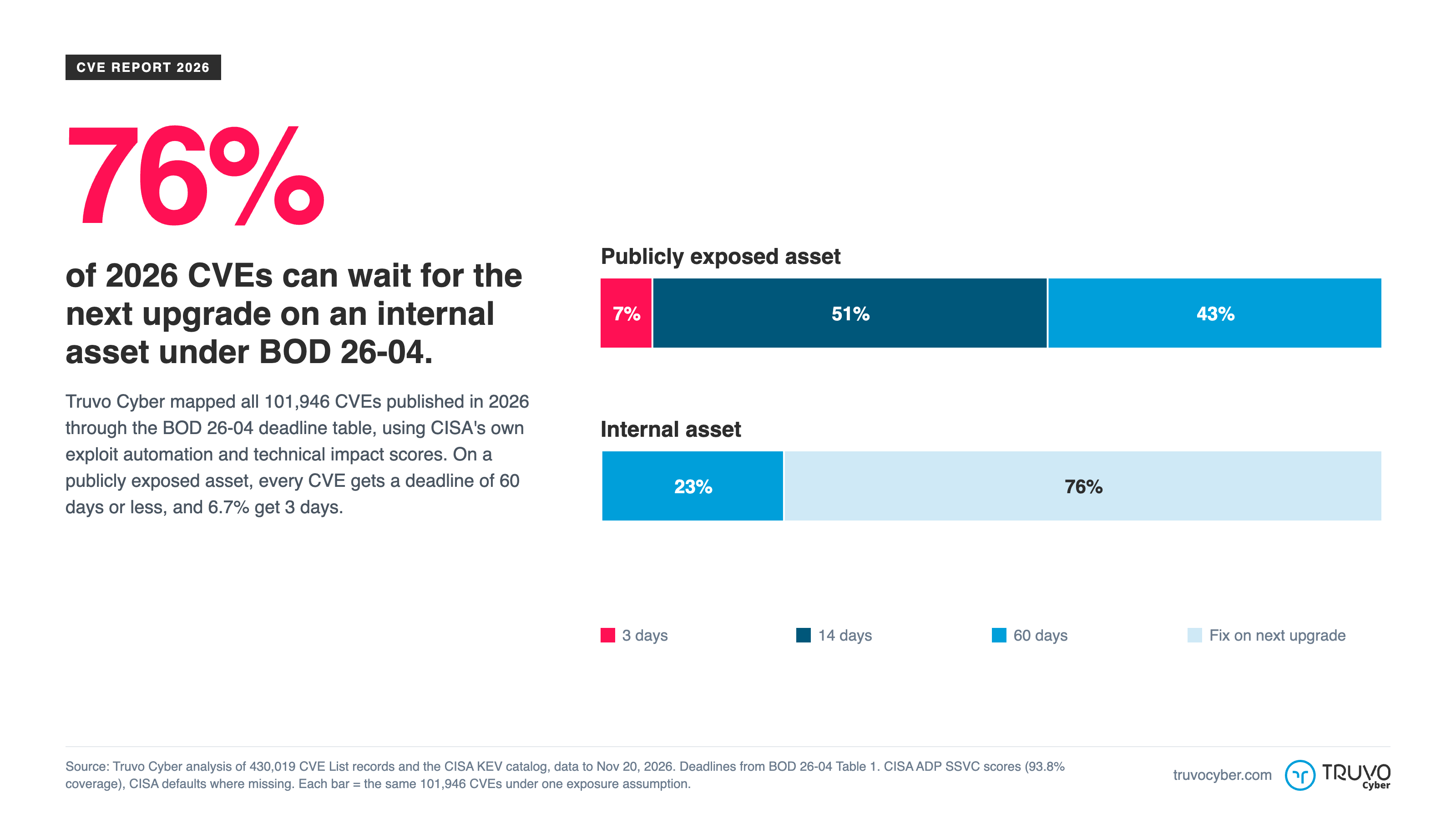
Truvo Cyber mapped all 101,946 CVEs published in 2026 through the BOD 26-04 deadline table. On an internal asset, 76% of 2026 CVEs can wait for the next system upgrade. On a publicly exposed asset, every 2026 CVE has a deadline of 60 days or less (Truvo Cyber, 2026).
At a glance
- Full name: Binding Operational Directive 26-04: Prioritizing Security Updates Based on Risk
- Issued: June 10, 2026
- Replaces: BOD 22-01 (KEV, 2021) and BOD 19-02 (internet-accessible systems, 2019), both revoked
- Applies to: US Federal Civilian Executive Branch (FCEB) agencies, and contractors only where the contract says so
- Deadline factors: public exposure, KEV status, exploit automation, technical impact
- Shortest deadline: 3 calendar days, plus forensic triage
- Longest deadline: fix at the next scheduled major upgrade or rebuild
- Full compliance: within 180 days of issuance (early December 2026)
What is CISA BOD 26-04?
BOD 26-04 is the CISA directive that tells US federal civilian agencies how fast to fix vulnerabilities, based on risk. CISA issued the directive on June 10, 2026. In the directive's words, BOD 26-04 supersedes and hereby revokes BOD 19-02 and BOD 22-01, the directive that created the KEV catalog in 2021.
The directive text and the implementation guidance are on cisa.gov. Three points carry over from the earlier rules:
- CISA still maintains the KEV catalog. The criteria for adding a CVE to KEV remain unchanged.
- A KEV listing still starts a remediation clock. The clock starts when CISA adds the CVE to KEV or when the agency finds the CVE on an asset, whichever comes first.
- Agencies may move faster. The guidance describes the BOD timelines as the maximum duration.
What are the BOD 26-04 remediation timelines?
CISA sets 16 deadlines in Table 1 of BOD 26-04, one for each combination of the four risk factors. The table below reproduces Table 1 from the directive.
| BOD 26-04 Table 1 row | Publicly exposed? | In KEV? | Automatable? | Technical impact | Remediation deadline (calendar days) |
| 1 | Yes | Yes | Yes | Total control | 3 days and forensic triage |
| 2 | Yes | Yes | Yes | Partial control | 3 days |
| 3 | Yes | Yes | No | Total control | 3 days and forensic triage |
| 4 | Yes | Yes | No | Partial control | 14 days |
| 5 | Yes | No | Yes | Total control | 3 days |
| 6 | Yes | No | Yes | Partial control | 14 days |
| 7 | Yes | No | No | Total control | 14 days |
| 8 | Yes | No | No | Partial control | 60 days |
| 9 | No | Yes | Yes | Total control | 3 days and forensic triage |
| 10 | No | Yes | Yes | Partial control | 14 days |
| 11 | No | Yes | No | Total control | 14 days |
| 12 | No | Yes | No | Partial control | 14 days |
| 13 | No | No | Yes | Total control | 60 days |
| 14 | No | No | Yes | Partial control | 60 days |
| 15 | No | No | No | Total control | Fix on system upgrade |
| 16 | No | No | No | Partial control | Fix on system upgrade |
Two labels in the table have specific meanings:
- 3 days and forensic triage: the agency remediates or mitigates within 3 days and also checks the asset for signs of compromise.
- Fix on system upgrade: the agency fixes the vulnerability the next time the asset receives a scheduled major upgrade or rebuild. The guidance says agencies do not need to prioritize these vulnerabilities.
The timelines are dynamic. Taking an asset off the internet changes the publicly exposed answer to no, and the deadline moves to the matching row.
What are the four BOD 26-04 risk factors?
The four BOD 26-04 risk factors are asset exposure, KEV status, exploit automation and technical impact. CISA publishes three of the four for every scored CVE, through the CISA Vulnrichment program. The agency supplies the fourth, exposure, from the agency's own asset inventory.
| BOD 26-04 risk factor | Question CISA asks | Where the answer comes from |
| Asset exposure | Is the vulnerable asset publicly exposed? | the agency's asset inventory |
| KEV status | Is the CVE in the KEV catalog? | CISA KEV catalog |
| Exploit automation | Is an adversary able to automate all the steps necessary to exploit the vulnerability? | CISA Vulnrichment (SSVC Automatable) |
| Technical impact | Does the attacker gain partial or total control of the asset? | CISA Vulnrichment (SSVC Technical Impact) |
The definitions come from the directive and the SSVC model maintained by CERT/CC:
- Publicly exposed: accessible to unauthenticated or untrusted entities via public networks, such as the internet, regardless of its physical or logical location.
- Total control: total control over the behavior of the software, including if the exploit reliably reveals log-in credentials.
- Partial control: limited control over the software or the information exposed. Denial of service is the directive's example.
- Automatable: the guidance gives a public proof of concept that achieves reliable remote code execution as an example of an automatable exploit.
When CISA has not scored a CVE yet, and the CVE is not in KEV, the guidance treats the CVE as not automatable with total technical impact until the scores arrive.
How is BOD 26-04 different from BOD 22-01?
BOD 26-04 covers every CVE on an agency asset, while BOD 22-01 covered KEV entries only. Under BOD 22-01, every KEV entry got the same clock: two weeks for CVEs assigned from 2021 onwards and six months for older CVEs.
| Comparison | BOD 22-01 (2021, revoked) | BOD 26-04 (2026) |
| Vulnerabilities covered | KEV entries | all vulnerabilities, ranked by four factors |
| Deadline basis | one fixed clock for every KEV entry | 16 combinations of exposure, KEV, automation and impact |
| Fastest deadline | 2 weeks | 3 days, plus forensic triage |
| Internet exposure | not a factor | first factor in the table |
| Low-risk internal vulnerabilities | outside the directive | fix at the next scheduled upgrade |
The practical change is speed at the top and relief at the bottom. A KEV entry on an exposed asset that gives total control now has 3 days. An unexploited, non-automatable CVE on an internal asset waits for the next rebuild.
How many 2026 CVEs fall into each BOD 26-04 deadline?
Exposure decides most BOD 26-04 deadlines. Truvo Cyber applied Table 1 to all 101,946 CVEs published between January 1 and November 20, 2026, twice: once as if every CVE ran on a publicly exposed asset, and once as if every CVE ran on an internal asset.
| 2026 CVEs by BOD 26-04 deadline | On a publicly exposed asset | On an internal asset |
| 3 days (with or without forensic triage) | 6,866 (6.7%) | 104 (0.1%) |
| 14 days | 51,488 (50.5%) | 122 (0.1%) |
| 60 days | 43,592 (42.8%) | 23,774 (23.3%) |
| Fix on next system upgrade | 0 | 77,946 (76.5%) |
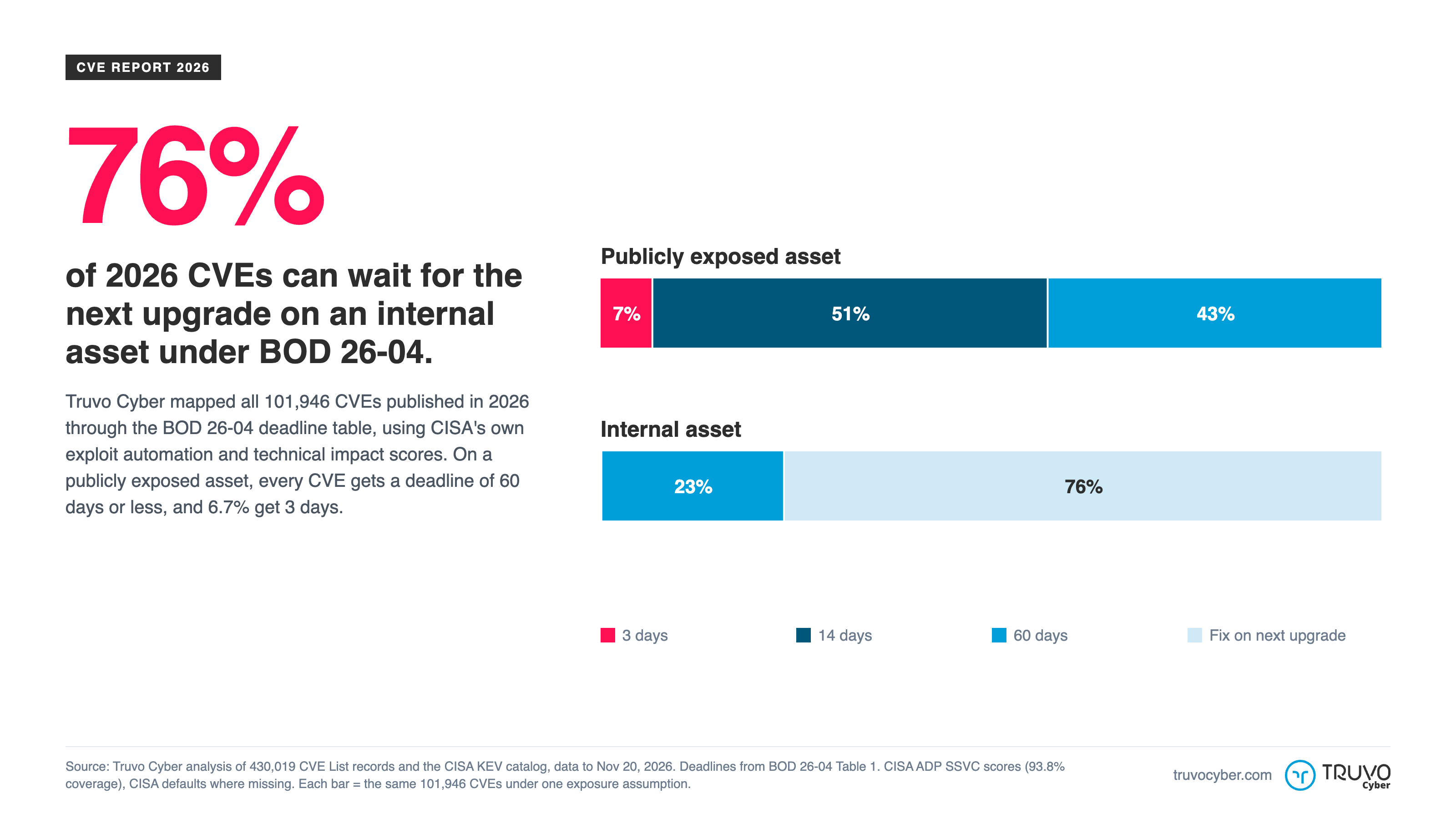
Three findings come out of the mapping:
- CISA scored 93.8% of 2026 CVEs for automation and technical impact through Vulnrichment, so the four-factor model works on almost every new CVE from day one.
- 7.1% of scored 2026 CVEs are both automatable and give total control (6,760 CVEs). The 6,760 CVEs get a 3-day deadline on any exposed asset, whether or not CISA lists the CVE in KEV.
- The same CVE can carry a 3-day deadline or no deadline at all. Exposure is the factor the agency controls. Taking a service off the internet, or putting an authentication gateway in front of the service, moves most CVEs from a 14-day or 60-day deadline to the next upgrade.
The pillar post on CVE and CISA KEV statistics for 2026 has the volume figures behind these counts: 101,946 CVEs by November 20, Critical CVEs up 3.1 times on 2025, and 1 in 451 confirmed exploited so far.
Does BOD 26-04 apply to SaaS providers and federal contractors?
BOD 26-04 binds US federal civilian agencies. The directive applies to contractors only where the procurement contract says so, and CISA tells agencies to review their contracts with the contracting officer. For SaaS and cloud providers that sell to agencies, three points from the guidance apply:
- FedRAMP-authorized services: agencies work through the FedRAMP Program Management Office, and FedRAMP-authorized providers are told to coordinate with their agency customers. The guidance states that FedRAMP will require adoption of new vulnerability rules (named VDR and VER in the guidance) by December 7, 2026.
- Commercial services outside FedRAMP: agencies work directly with the cloud service provider, and a commercial provider reports the status of outstanding vulnerabilities to the agency receiving the service.
- Contracts and SLAs: CISA strongly recommends that agencies put remediation timelines in the service level agreement or contract.
A SaaS company with federal customers should expect BOD 26-04 deadlines to appear in contract renewals and security questionnaires. A company with no federal customers has no obligation under BOD 26-04, but the four-factor model and the CISA data behind the model are free to use.
How should a SOC 2 or ISO 27001 company use the BOD 26-04 timelines?
A SOC 2 or ISO 27001 company can adopt the BOD 26-04 table as the remediation SLA in the vulnerability management policy. SOC 2 auditors test remediation timelines under CC7.1, and ISO 27001 certification bodies test Annex A control 8.8. Both look for a written timeline and evidence that the team met the timeline. A timeline taken from a federal directive is easy to justify to an auditor and to an enterprise customer.
Five steps put BOD 26-04 into an existing program:
- Tag every asset as publicly exposed or internal. Exposure is the factor that moves most deadlines, and the only one CISA cannot supply. A cloud asset inventory with an internet-facing tag covers most of the work.
- Pull KEV, Automatable and Technical Impact for each finding. The KEV feed and the Vulnrichment data are public. Many scanners already show KEV status.
- Compare the BOD 26-04 deadlines with the current policy. The Truvo vulnerability management policy template uses a 48-hour Emergency tier for internet-facing Critical or High vulnerabilities that are in KEV or have a public exploit. The 48-hour Emergency tier and the 7-day Critical tier both meet the matching BOD 26-04 rows. Two rows are faster under BOD 26-04: an exposed, automatable CVE with partial impact gets 14 days (the template gives a High finding 30 days), and every CVE on an exposed asset gets 60 days or less (the template gives Medium and Low findings 90 days). Teams adopting BOD 26-04 shorten those two tiers for internet-facing assets.
- Record the four factors on every ticket. Exposure, KEV status, automation and impact on each ticket let an auditor recompute every due date. The risk-based vulnerability management post shows a full triage with these inputs.
- Write down the fix on system upgrade decisions. Internal, non-KEV, non-automatable CVEs can wait for the next rebuild under BOD 26-04. Record those decisions as risk acceptances with the next rebuild date, so the auditor sees a decision and not a missed deadline.
How Truvo Cyber mapped 2026 CVEs to BOD 26-04 deadlines
Truvo Cyber used three public sources, downloaded on November 20 and 21, 2026:
- CVE records: the CVE List bulk export (cvelistV5), release dated November 21, 2026. The analysis counts the 101,946 published CVEs with a
datePublishedbetween January 1 and November 20, 2026. - Automation and technical impact: the SSVC Automatable and Technical Impact values in the CISA ADP container of each CVE record, the data CISA publishes through Vulnrichment. 95,663 of the 101,946 CVEs (93.8%) carry both values.
- KEV status: the CISA KEV catalog, version 2026.11.20. 226 CVEs published in 2026 were in KEV on November 20.
Each CVE was placed in a Table 1 row twice, once with publicly exposed set to yes and once set to no. CVEs without CISA scores were placed by the guidance default: not automatable, total technical impact. The two exposure cases are the extremes. A real environment holds a mix of exposed and internal assets, so a real deadline mix is somewhere between the two columns. The scripts and the tier counts are public on GitHub.
Patch the CVEs Attackers Use
Build an effective security program with a KEV-first patch SLA your auditor can verify.
Frequently Asked Questions
What is BOD 26-04?
BOD 26-04, Prioritizing Security Updates Based on Risk, is a CISA Binding Operational Directive issued on June 10, 2026. BOD 26-04 sets remediation deadlines for US federal civilian agencies from four factors: public exposure, KEV status, exploit automation and technical impact. BOD 26-04 revoked BOD 22-01 and BOD 19-02.
Does BOD 26-04 replace BOD 22-01?
Yes. CISA states that BOD 26-04 supersedes and hereby revokes BOD 22-01. CISA still maintains the KEV catalog created by BOD 22-01, with unchanged criteria, and a KEV listing still starts a remediation clock under BOD 26-04.
What is the BOD 26-04 deadline for a KEV vulnerability?
A KEV vulnerability gets 3 days or 14 days under BOD 26-04. A KEV vulnerability gets 3 days, plus forensic triage, when the exploit gives total control and the asset is publicly exposed or the exploit is automatable. Every other KEV combination gets 3 or 14 days, as listed in Table 1.
When must agencies comply with BOD 26-04?
Agencies had to update vulnerability management policy immediately on issuance, update processes within 60 days, and remediate within the Table 1 timelines within 180 days of June 10, 2026 (early December 2026).
Does BOD 26-04 apply to private companies?
BOD 26-04 binds US federal civilian agencies only. Contractors are covered only where the procurement contract says so, and agencies are told to work with cloud providers through FedRAMP or directly. Private companies can adopt the BOD 26-04 table voluntarily as a risk-based remediation SLA.
How many CVEs get a 3-day deadline under BOD 26-04?
On a publicly exposed asset, 6.7% of CVEs published in 2026 (6,866 of 101,946) would carry a 3-day deadline under BOD 26-04, according to Truvo Cyber's mapping. On an internal asset, 0.1% would (104 CVEs, all in KEV).
Where does CISA publish the BOD 26-04 risk factors?
CISA publishes KEV status in the KEV catalog, and the Automatable and Technical Impact values through the Vulnrichment program on GitHub. Vulnrichment adds the values to CVE records. The agency supplies the fourth factor, public exposure, from the agency's own asset inventory.
Can a SOC 2 company use BOD 26-04 as the patch SLA?
Yes. A SOC 2 or ISO 27001 company can adopt the BOD 26-04 Table 1 deadlines, or faster ones, as the written remediation SLA. Auditors test that the policy states a timeline and that the team met the timeline, and recording the four factors on each ticket gives the auditor the evidence to check every due date.
