
.svg)
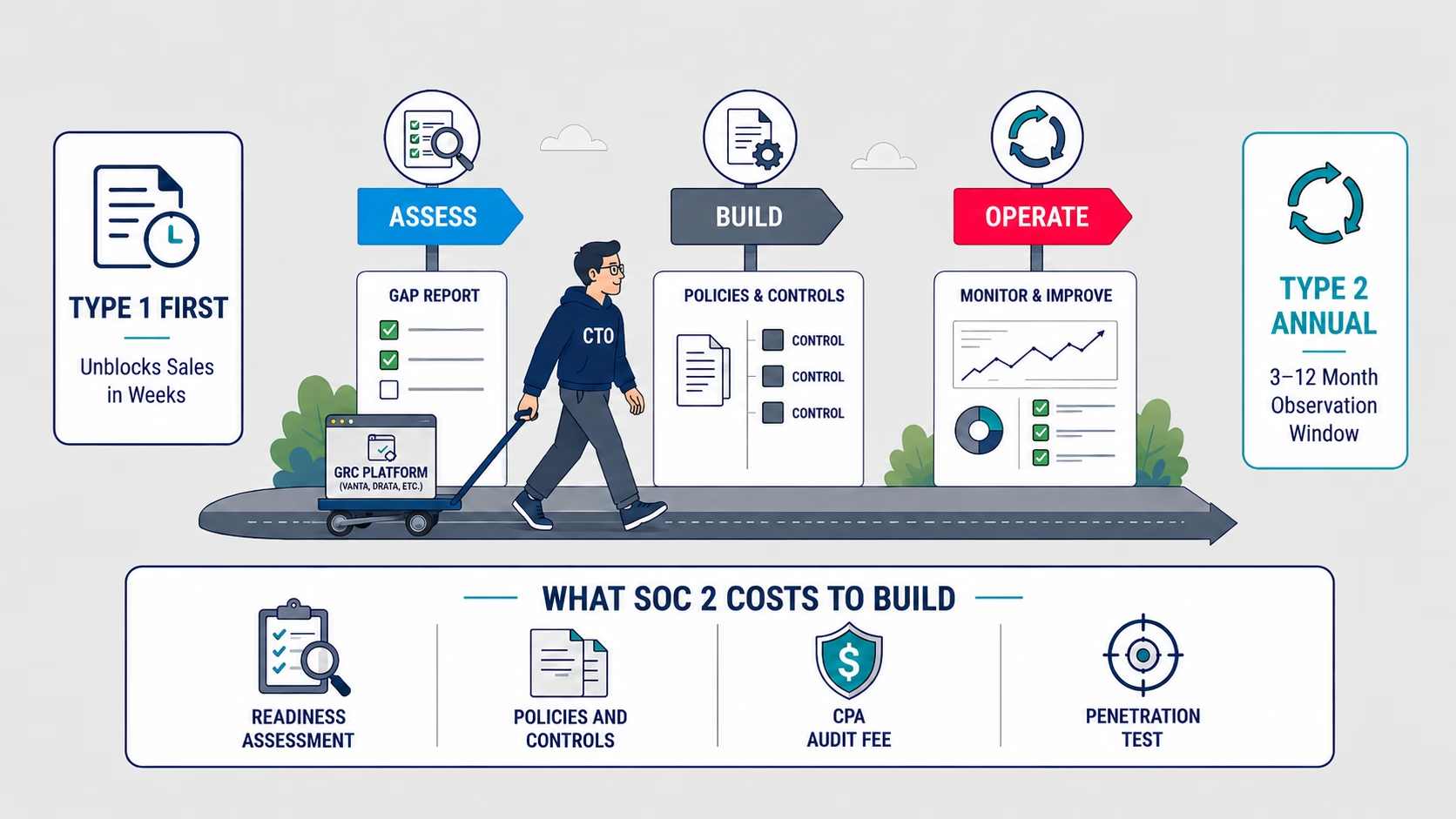
TL;DR: SOC 2 compliance for a B2B SaaS company is a sales requirement before it is a security exercise: enterprise buyers use the report to clear vendors through procurement, and not having one stalls deals. The efficient path is a capability assessment, a build phase that produces real policies and evidence, a Type 1 report to unblock sales, then a Type 2 report as the annual standard. Automation platforms compress the evidence work, but they do not build the program.
SOC 2 was created by the AICPA as an attestation framework: an independent CPA firm examines your security program and reports on whether your controls meet the Trust Services Criteria. Unlike HIPAA or PCI DSS, no law requires it. The market does. Once a SaaS company starts selling to mid-market and enterprise buyers, the security review shows up in every deal, and a clean SOC 2 report is the standard way through it.
SOC 2 is a revenue gate, not a legal mandate
Enterprise buyers are accountable for their supply chain, and a third-party attestation is how they evaluate vendors at scale. The question is rarely whether you will need SOC 2, only whether you will have it before or after it costs you a deal.
What a SOC 2 report covers
Every SOC 2 report is structured around five Trust Services Criteria: Security, Availability, Processing Integrity, Confidentiality, and Privacy. Security, also called the Common Criteria, is mandatory in every report. The other four are optional, and each one added expands the controls the auditor tests and the evidence your team has to produce.
A Security-only report is the common starting point for a first audit. Availability is the most frequent addition for SaaS, since uptime commitments already live in most contracts and the underlying controls (monitoring, backups, disaster recovery) usually exist. Privacy tends to be the heaviest lift and is worth deferring unless customers are asking for it by name.
SOC 2 Type 1 vs Type 2: the first-year game plan
A Type 1 report attests that your controls were suitably designed at a single point in time. A Type 2 report attests that those controls operated effectively over an observation period, typically 3 to 12 months, with the auditor sampling evidence across the window. The Type 2 report is what enterprise buyers expect you to maintain annually.
| Type 1 | Type 2 | |
| What it attests | Control design at a point in time | Operating effectiveness over a period |
| How fast you can get it | As soon as controls are built | After a 3-12 month observation window |
| What the auditor examines | Policies, procedures, configurations | Sampled evidence that controls ran as designed |
| Role in your program | First-year milestone that unblocks sales | The annual standard buyers expect |
The difference shows up in how the auditor works. For a Type 1, they confirm a security training policy exists and applies to new hires. For a Type 2, they pull the list of everyone hired during the observation period, select a sample, and ask for proof those specific people completed training. If the record does not exist, the control failed, regardless of whether the training happened.
The sequence that fits a first-time program: build the controls, take a Type 1 to get a report into buyers' hands quickly, then run a 6-12 month observation period into your first Type 2. After that, Type 2 becomes the annual rhythm and the Type 1 retires. The case for this order is laid out in why Type 1 comes first.
How long SOC 2 compliance takes for SaaS, and what it costs
For a cloud-native SaaS team, readiness work typically takes 2 to 4 months from kickoff to Type 1 audit, with the timeline driven by how much remediation the assessment turns up rather than by the framework itself. The first Type 2 then follows the observation window. First-year all-in cost is commonly between US$20,000 and US$100,000 across three separate invoices: readiness and consulting work, the independent CPA audit fee, and a penetration test.
The full breakdown of what moves that number, framework scope, infrastructure, report type, and maturity, is in what SOC 2 costs and the 4 factors that drive it, and the step-by-step sequence is in the SOC 2 timeline, cost, and steps walkthrough. The short version for planning: the most expensive SOC 2 programs are the ones started under deal pressure, because the same work gets compressed and parallelized at premium rates.
The path: assess, build, operate
An effective security program is made of roughly 19 security capabilities: access control, change management, vulnerability management, logging and monitoring, incident response, vendor management, and so on. SOC 2 is a lens on those capabilities, not a separate thing you bolt on. That framing turns the compliance project into a buildable sequence.
Assess: score the capabilities
The starting point is a capability assessment: score each of the ~19 capabilities against where SOC 2 expects them to be. Even a small team has controls in place; the assessment finds what is missing and what exists but leaves no auditable trace. The output is a gap report that becomes the build plan. A readiness assessment also settles scope early, which systems, people, and data flows are in the audit boundary, before you over-invest in controls for systems that were never in scope.
Truvo's security capability assessment is that first step: current state review, capability scoring, findings rated by consequence, and a remediation plan sequenced by dependency.
Build: manual, policies, controls, evidence
The build phase follows a fixed order: the Security Program Manual that defines how the program operates, then the policies, then the controls and the evidence they generate. The recurring finding in first-time programs is undocumented security: the team runs vulnerability scans, but no record ties scans to findings to remediation, so the work is invisible to an auditor. The working rule: if it is not documented, it did not happen.
The gap is usually evidence, not security
Teams often already do the work SOC 2 asks for. What they lack is the record. Building controls that generate their own evidence, like pull request approvals logged in version control, closes the gap without adding process overhead.
Operate: the steady state the Type 2 examines
Once the controls exist, the program shifts into a maintenance rhythm: quarterly access reviews, annual policy reviews, security training, and a risk assessment, plus continuous monitoring and change management. This steady state is exactly what the Type 2 auditor samples. A program that runs all year makes the annual audit a validation exercise; a program that wakes up two months before the audit makes it an archaeology project.
What automation covers, and what it does not
GRC automation platforms like Vanta, Drata, and Secureframe connect to your cloud provider, identity provider, and code repository through APIs and collect a large share of the technical evidence automatically. For an early-stage team, that removes real work: screenshots, exports, and spreadsheet tracking that would otherwise land on engineers. We deploy these platforms with clients and consider them essential.
What they do not do is build the program. The platform cannot scope your audit, write policies that match how your company operates, decide which capabilities need remediation first, or manage the auditor relationship. A dashboard full of green checks shows that evidence collection works; it says nothing about whether a program exists behind it. The difference is detailed in what Vanta and Drata can't automate. The tool is essential, but without program design and ongoing operations behind it, it is an expensive dashboard.
The pairing that works in practice: a platform for evidence automation, plus a fractional security team or vCISO for scoping, control design, and auditor management. That combination keeps your senior engineers building product instead of becoming accidental compliance managers, which is the failure mode that stalls roadmaps.
Get SOC 2 Without Stalling Your Roadmap
We build the effective security program behind the report so your engineers stay on product work.
Turning the report into revenue
The return on a SOC 2 program shows up in the sales cycle. On the cost side, the report replaces much of the security questionnaire grind: instead of a senior engineer filling in a 300-row spreadsheet per prospect, sales hands over the report and answers the remainder from documented controls. On the revenue side, the report is the ticket into procurement at companies that will not evaluate an unattested vendor at all. The SOC 2 enterprise sales primer covers how to run this play deal by deal.
A trust center compounds the effect: a public page with your compliance status, a program overview, and an NDA-gated path to the full report. Buyers doing early diligence self-serve the answers, and your security posture starts working as a differentiator before sales ever gets on a call. Whether the whole exercise pays for itself is a fair question, and is SOC 2 a waste of money takes it head on.
The post-audit mistake that creates audit fatigue
A common and costly pattern after a first successful audit: the team exhales, returns to the roadmap, and does not think about compliance again until two months before the next audit. Reconstructing evidence for an incident from eleven months ago is far harder than recording it when it happened, and the annual scramble that results is how teams come to resent their own program.
The fix is to keep the operate phase running: evidence collected continuously by the platform, recurring tasks scheduled and owned, and someone accountable for keeping the program current as the company changes. Run that way, the audit validates work already done, the report renews on schedule, and the security program behind it keeps getting stronger. That is the outcome buyers were asking about in the first place.
Frequently Asked Questions
Is SOC 2 compliance mandatory for SaaS companies?
No law requires SOC 2. It is a market requirement: mid-market and enterprise buyers routinely require a SOC 2 report before signing, so for B2B SaaS it functions as a condition of selling upmarket rather than a legal obligation.
Should a SaaS company get SOC 2 Type 1 or Type 2 first?
Type 1 first in most cases. It can be issued as soon as controls are built, which gets a report into buyers' hands quickly. The first Type 2 follows after a 3-12 month observation period and then becomes the annual standard.
How long does SOC 2 compliance take for a SaaS company?
A cloud-native team typically needs 2 to 4 months of readiness work to reach a Type 1 audit, depending on how much remediation the capability assessment finds. The first Type 2 report follows the chosen observation window, commonly 6 to 12 months.
How much does SOC 2 compliance cost?
First-year all-in cost commonly runs US$20,000 to US$100,000, split across three invoices: readiness and consulting work, the independent CPA audit fee, and a penetration test. Scope, infrastructure, report type, and existing maturity move the number.
Can Vanta, Drata, or Secureframe get you SOC 2 compliant on their own?
They automate a large share of evidence collection, which is real and valuable work. They do not scope the audit, write policies that fit your operations, design controls, or manage the auditor. Teams without in-house compliance expertise pair the platform with a fractional security team or vCISO.
Which Trust Services Criteria should a first SOC 2 report include?
Security (the Common Criteria) is mandatory and is the usual starting point. Availability is the most common addition for SaaS since the controls often already exist. Privacy and Processing Integrity add significant work and are best deferred until customers ask for them.
Ready to Start Your Compliance Journey?
Get a clear, actionable roadmap with our readiness assessment.
Contact Us
Sample SOC 2 Control List
Input your email to download the list
About the Author

Former security architect for Bank of Canada and Payments Canada. 20+ years building compliance programs for critical infrastructure.