
.svg)
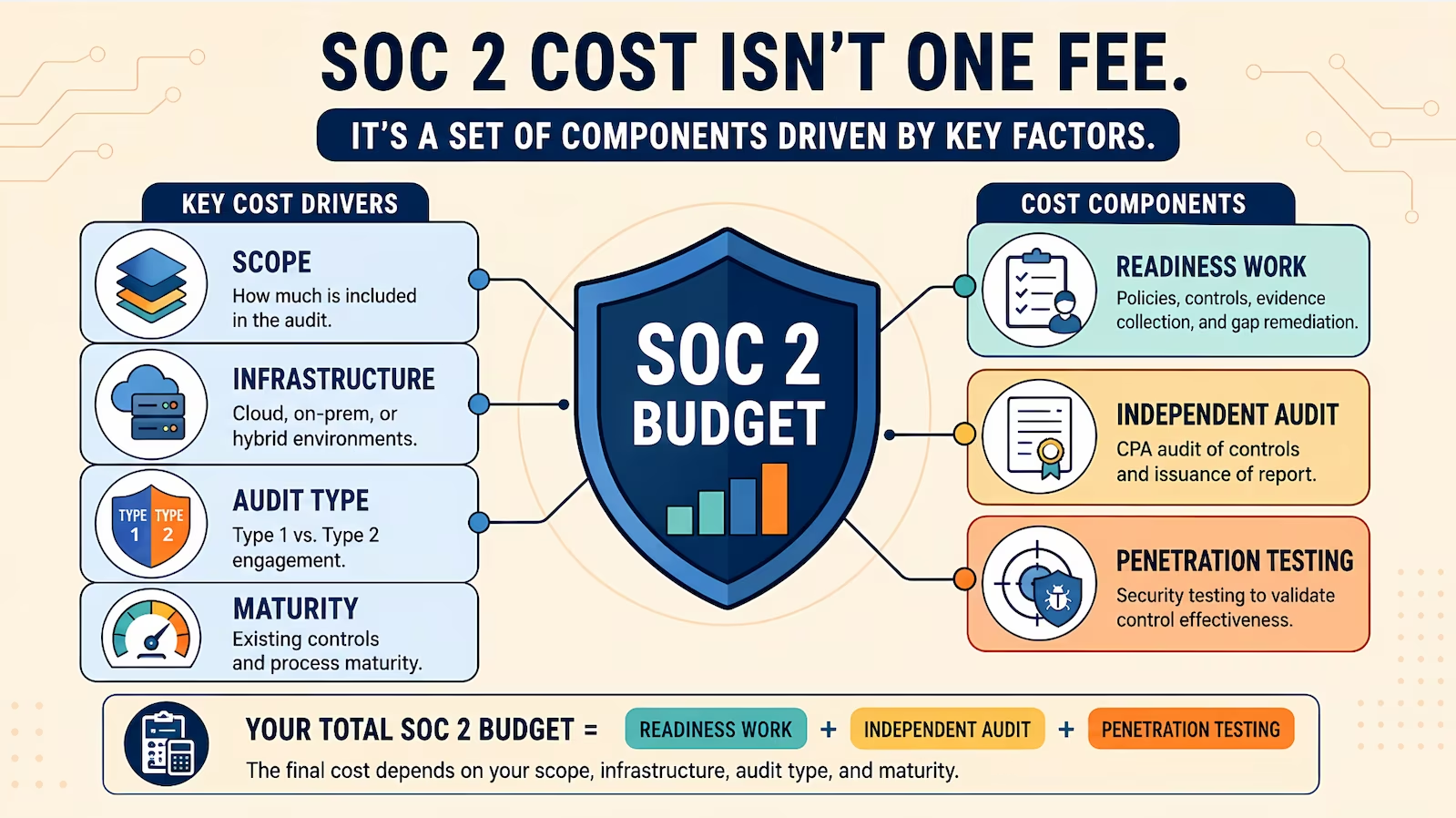
TL;DR: All-in SOC 2 cost for a growth-stage SaaS company typically runs between US$20,000 and US$100,000 in the first year, with most SMBs in the US$30,000-$50,000 range. That number splits across three separate buckets: readiness and consulting work (roughly $10,000-$15,000 for an assessment, $30,000-$50,000 for full implementation), the independent CPA audit fee (a median of $10,000-$25,000 for a Type 2), and penetration testing as a separate line item ($5,000-$30,000). What moves your number up or down comes down to four factors: framework scope, infrastructure (on-prem vs cloud), audit type, and your organization's size and existing security maturity.
The headline SOC 2 cost figures can be misleading, because they bundle together costs that are billed by different parties and quoted as a single price.
The number is three invoices, not one
A single quoted SOC 2 price almost always hides three separate bills: readiness and consulting work, the independent CPA audit fee, and a penetration test. They come from different parties and arrive at different times.
How much does a SOC 2 audit cost?
The audit itself is one line item, and it is worth isolating because it is the part most people misunderstand. A SOC 2 audit is performed by an independent licensed CPA firm, and that firm's fee is separate from any readiness or consulting work you do to prepare. The CPA cannot also build your program; independence rules forbid auditing work they performed themselves. So the audit fee is a standalone cost.
For a growth-stage SaaS company, the median SOC 2 Type 2 audit fee runs between US$25,000 and US$45,000. A SOC 2 Type 1 audit, which is a point-in-time snapshot rather than a period of operation, costs less, often in the $10,000-$20,000 range. These are the auditor's fees only. They do not include the work of getting ready for the audit, and they do not include penetration testing, which auditors expect to see evidence of but do not perform themselves.
This separation matters. A company that sees $25,000 quoted as a SOC 2 cost and assumes that covers everything is going to be surprised when the readiness work, the GRC platform license, and the pentest arrive as distinct invoices. The total is the sum of the parts, and the parts come from different places.
The 4 factors that move your SOC 2 cost
Factor 1: Framework scope and which Trust Services Criteria you include
SOC 2 is built on five Trust Services Criteria: Security (the required baseline, also called the Common Criteria), Availability, Processing Integrity, Confidentiality, and Privacy. Every SOC 2 report includes Security. The other four are optional, and each one you add expands the control set the auditor has to test and the evidence you have to produce.
A Security-only report is the most common starting point and the least expensive. Adding Availability is straightforward for most cloud-native teams because the underlying controls (monitoring, uptime, disaster recovery) often already exist.
Privacy and Processing Integrity tend to be the heaviest lift, because it brings data handling, consent, and retention controls into scope that frequently require new processes rather than documentation of existing ones. The more criteria in scope, the higher both your readiness cost and your audit fee, because both scale with the number of controls in play.
Factor 2: Infrastructure - cloud vs hybrid vs on-prem
A SOC 2 program on modern cloud infrastructure is materially cheaper to build and audit than the same program running on hybrid or on-premises infrastructure, and the gap is widening.
On a cloud-native stack, a large share of the technical controls SOC 2 expects (audit logging, encryption at rest and in transit, multi-factor authentication, least-privilege access) are already available in AWS, GCP, or Azure. The work is configuration and documentation, not construction. GRC platforms integrate directly with these providers and pull evidence automatically, which compresses both the readiness timeline and the volume of manual evidence collection.
On-premises and bare-metal environments scope higher. Physical security controls come into play, evidence has to be gathered by hand because automated integrations are rare, and the auditor has more scope to test.
Hybrid environments sit in between and carry their own complication: the risk register and evidence trail have to cover both halves of the environment consistently, not just whichever side is easier to instrument. We cover this in more depth in our breakdown of GRC and compliance for on-prem and hybrid environments. The practical effect on cost is that an on-prem or hybrid SOC 2 can run noticeably more in both readiness effort and audit fees than a comparable cloud-native one.
Infrastructure is the cost lever
Cloud-native stacks supply most required technical controls out of the box, and GRC platforms automate the evidence. On-prem and hybrid add physical controls, manual evidence, and more audit surface, which raises both readiness effort and audit fees.
Factor 3: Type 1 vs Type 2, and which engagement phase you are in
SOC 2 comes in two report types, and the difference drives both cost and timeline. A Type 1 report attests that your controls were designed appropriately at a single point in time.
A Type 2 report attests that those controls operated effectively over a period, usually three to twelve months. Type 2 is what enterprise buyers almost always want, and it costs more because the auditor is testing operation over time rather than design at a moment.
The engagement phase also shapes cost. We organize SOC 2 work into three phases: Assess, Build, and Operate. Assess is the gap analysis that maps where you stand against what SOC 2 requires.
Build is where policies get written, controls get configured, and the GRC platform gets stood up. Operate is the ongoing phase where the program runs and accumulates the evidence a Type 2 audit needs. Companies pay for these phases differently depending on how much they do in-house versus with a partner, which is the next factor.
| Phase | What it covers | Typical engagement model |
| Assess | Gap analysis against the Trust Services Criteria; scoping; prioritized remediation plan | Fixed-fee readiness assessment, usually 1-2 weeks |
| Build | Policy authoring, control configuration, GRC platform setup, risk assessment, vendor inventory | Fixed-fee implementation project, 8-12 weeks |
| Operate | Continuous evidence collection, access reviews, ongoing program management toward the audit | Monthly retainer (fractional security team) |
Factor 4: Organization size and existing security maturity
The final factor is where you are starting from. A 15-person company with strong engineering hygiene but no formal program will spend less than a 200-person company with sprawling access, legacy systems, and undocumented processes. Headcount drives cost in two direct ways: GRC platform licenses scale with employee count, and more people means more access to review and more training to track.
Existing maturity matters as much as size. A team that already enforces MFA, runs least-privilege access, and keeps reasonable logs is closer to audit-ready than its size would suggest, and its readiness cost reflects that. A team that has been deferring all of this until a deal forced the question has more remediation to fund. The most expensive SOC 2 programs are the ones started under deal pressure with no foundation in place, because the work gets compressed and parallelized at premium rates.
Deal pressure is the most expensive starting point
The priciest SOC 2 programs are the ones started under deal pressure with no foundation in place. The work gets compressed and parallelized at premium rates. Starting before a deal forces the question is the single biggest cost saver.
DIY vs consultant vs platform-only: what each approach costs
There are three common ways to get to SOC 2, and they trade money against time and risk differently.
| Approach | What you get | Cost profile | Best fit |
| DIY (platform only) | A GRC platform license and templates; you do all the work | Lowest cash cost, highest time and rework risk | Teams with in-house compliance expertise and spare bandwidth |
| Platform + consultant | Platform plus a partner who designs the program and runs it with you | Higher upfront, lower risk of failed or delayed audit | Teams without dedicated compliance staff who need to move predictably |
| Big-firm consulting | Full-service engagement at enterprise rates | Highest cost | Large organizations with complex scope and budget to match |
The platform-only route looks cheapest on paper, and for a team with genuine in-house expertise it can be. The hidden cost is the program design work that the platform does not do. A green dashboard is not the same as an audit-ready program, a gap we have written about at length in why a green GRC platform doesn't mean you're audit-ready. When the dashboard says compliant but the auditor finds the evidence thin, the rework happens under time pressure, which is the most expensive way to do it.
Where Truvo fits
We price for transparency because the bundled-quote model is part of what makes SOC 2 cost so confusing. Our SMB engagement start at US$5,000 for Assess and US$25,000 for Build, with ongoing Operate (our Assess-Build-Operate model) at US$2,500 per month. Our Enterprise engagement start at US$10,000 for Assess and US$50,000 for Build, with Operate at US$5,000 per month. Full pricing is on our pricing page, and the scope of the work is detailed on our SOC 2 compliance service page. Prices are in USD; Canadian clients can be billed in CAD and we account for the exchange rate so the number you see is the number you plan around.
The positioning we hold is enterprise rigor at a growth-stage budget. The audit fee and pentest still come from independent parties, as they must, but the program work that determines whether those engagements go smoothly is where a partner earns its cost.
Scope Your SOC 2 Number First
We map your infrastructure, scope, and maturity to a realistic budget and an effective security program built to clear the audit.
If you want to know which factors apply to your environment before you commit to a budget, the fastest starting point is a scoping conversation. Book a scope call and we will map your infrastructure, scope, and maturity to a realistic number. If you would rather get a read on where you stand first, our free SOC 2 scorecard gives you a prioritized view of your gaps in under five minutes.
SOC 2 cost is predictable once you know your inputs
The reason SOC 2 cost feels opaque is that the single number people quote hides three separate invoices and four underlying variables. Once you separate the readiness work from the CPA audit fee from the pentest, and once you know your framework scope, your infrastructure, your report type, and your maturity, the range collapses into something you can plan around.
Compliance done this way stops being a surprise expense and becomes what it should be: a predictable cost of clearing the security reviews that gate your enterprise deals. For the operational sequence behind the budget, see our walkthrough of SOC 2 timeline, cost, and first steps.
Frequently Asked Questions
How much does SOC 2 cost in total for a small company?
For a growth-stage SMB, total first-year SOC 2 cost typically runs between US$30,000 and US$50,000. That figure combines readiness or implementation work, the independent CPA audit fee, and a penetration test. Cloud-native teams with existing security hygiene sit at the lower end; teams starting from scratch or running hybrid infrastructure sit higher.
Is the SOC 2 audit fee separate from consulting costs?
Yes. The audit is performed by an independent licensed CPA firm, and independence rules forbid that firm from also building the program it audits. The audit fee, typically US$25,000-$45,000 for a Type 2, is therefore a standalone cost, separate from any readiness assessment, implementation work, or GRC platform license you pay for to prepare.
Why is a penetration test priced separately?
Auditors expect evidence of vulnerability management, including periodic penetration testing, but they do not perform the test themselves. A pentest is a specialized engagement priced on its own, usually between US$8,000 and US$30,000 depending on scope. A focused test on a single cloud application sits at the low end; a full-scope enterprise test sits at the high end.
How much cheaper is SOC 2 on cloud versus on-prem?
Cloud-native SOC 2 is materially cheaper because providers like AWS, GCP, and Azure already supply most required technical controls, and GRC platforms automate evidence collection from them. On-premises environments add physical security controls, manual evidence gathering, and more audit surface, which raises both readiness effort and audit fees. The gap commonly runs to several thousand dollars or more.
Does adding Trust Services Criteria increase the cost?
Yes. Every SOC 2 report includes the Security criterion. Adding Availability, Processing Integrity, Confidentiality, or Privacy expands the control set the auditor must test and the evidence you must produce. Each added criterion raises both readiness cost and audit fees. Privacy is usually the most expensive to add because it introduces data handling controls that often require new processes.
Ready to Start Your Compliance Journey?
Get a clear, actionable roadmap with our readiness assessment.
Contact Us
Sample SOC 2 Control List
Input your email to download the list
About the Author

Former security architect for Bank of Canada and Payments Canada. 20+ years building compliance programs for critical infrastructure.