
.svg)
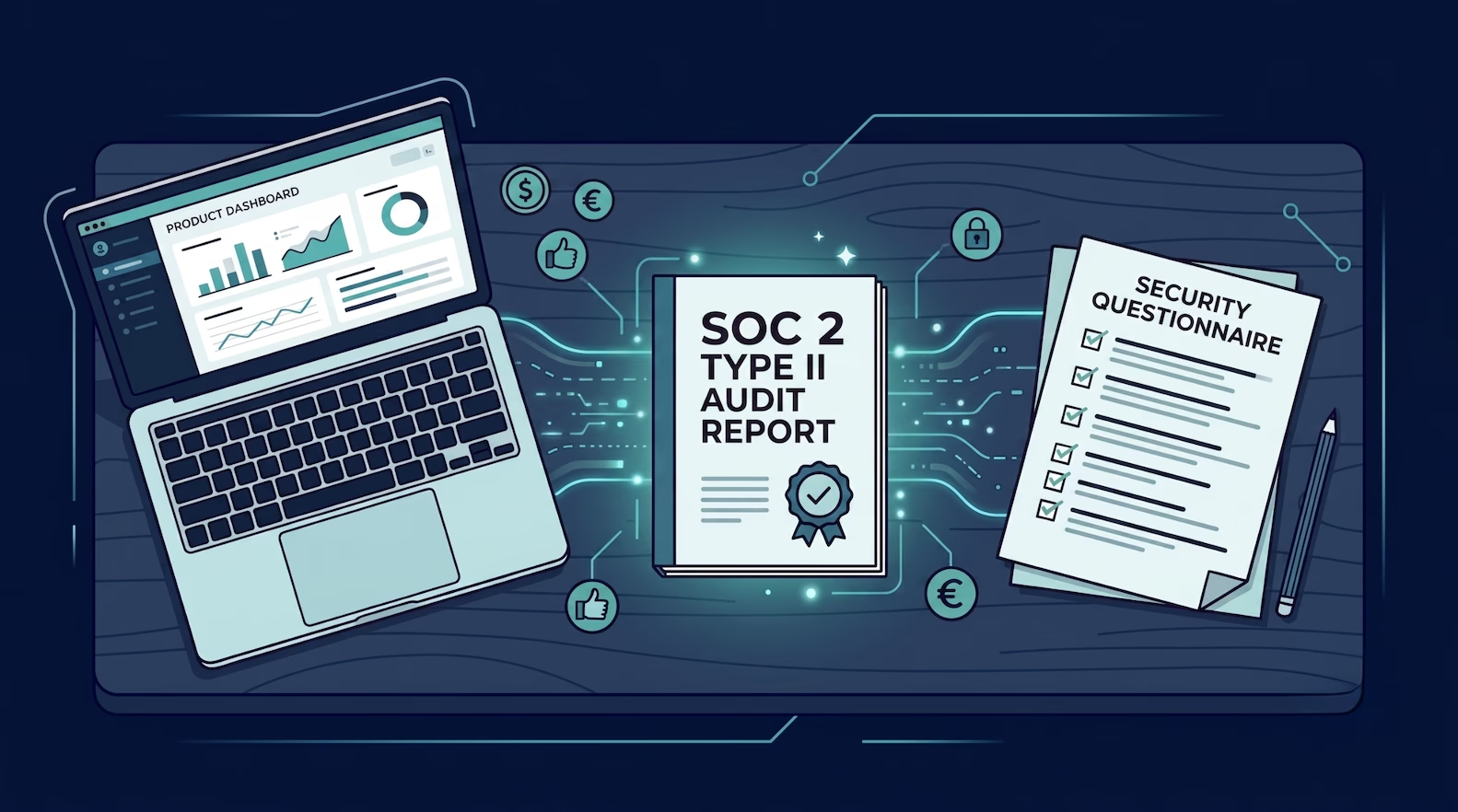
An enterprise prospect sends over a security questionnaire. Or procurement asks whether you have a SOC 2 report. Or a deal stalls because the security review team is waiting on documentation you don't have.
For many B2B software teams, this is the first time SOC 2 becomes a real, urgent thing: a gate standing between them and a signed contract.
This post covers what SOC 2 is, what it requires, and the Type 1 vs. Type 2 distinction that matters most in a sales context. For the how-to (phases, timeline, cost, and first steps), see How to Get SOC 2: Timeline, Cost, and First Steps.
SOC 2 Is a Sales Gate
Enterprise procurement teams use SOC 2 to evaluate dozens of vendors without auditing each one directly. When you have a report, deals move. When you don't, security review becomes an indefinite hold. In North America, SOC 2 has become the entry credential for B2B software selling into enterprise accounts.
SOC 2 Is a Sales Requirement Disguised as a Compliance Framework
In North America, SOC 2 has become the de facto standard for B2B software vendors that touch enterprise systems or handle sensitive data. It tells customers that a security program has been independently verified against a set of controls defined by the American Institute of Certified Public Accountants (AICPA).
SOC 2 is audited by accounting firms, specifically CPAs. It has an unusual history that placed it in the hands of the accounting profession rather than the security industry. The practical effect is that auditors in the SOC 2 world are not penetration testers or red teams. They are structured, evidence-driven reviewers who examine documentation, controls, and operating history.
In Europe, the equivalent is ISO 27001:2022. Companies selling to enterprises on both sides of the Atlantic will eventually need both. The foundation they share is significant, so building one makes the other substantially easier.
The reason enterprises require it is straightforward: they need a way to evaluate dozens of vendors' security postures without auditing each one themselves. A SOC 2 report is their shortcut. When a vendor has one, the procurement process moves. When they don't, it stalls.
The Surprise
We often see that people new to SOC 2 assume it is primarily a technical exercise: encryption in transit, encryption at rest, access controls, logging. Get the infrastructure right and you are done.
The technical part is real and it matters, but it accounts for roughly 30 percent of what SOC 2 requires. The other 70 percent is management and process.
The 70/30 Rule
Technical controls (encryption, access control, logging) account for roughly 30 percent of SOC 2. The remaining 70 percent is policies, risk management, vendor oversight, incident response procedures, and security training. Teams that treat SOC 2 as a technical checklist routinely underestimate the scope and miss their timelines.
What falls into that 70 percent:
Risk management. A documented, repeatable risk assessment process that identifies risks, assigns owners, and tracks remediation. Auditors look for evidence that this runs on a schedule, not a one-time spreadsheet.
Policies. Every control area needs a documented policy: information security, acceptable use, data classification, incident response, business continuity. Policies must be version-controlled, reviewed annually, and acknowledged by employees.
Vendor management. Every third-party vendor that touches systems or data needs to be assessed. If a vendor has their own SOC 2 report, that simplifies things considerably. Their report can be referenced rather than conducting a full assessment.
Incident response. A documented plan covering detection, escalation, containment, and communication, with evidence of testing.
Security awareness training. Annual training for all employees, with completion tracked and recorded.
Access reviews. Periodic reviews of who has access to what, documented with timestamps showing what was reviewed and what changed.
None of this is unreasonable. But teams that expect a technical checklist often underestimate the documentation and process work required. That is where timelines slip.
Type 1 vs. Type 2
There are two types of SOC 2 reports:
A SOC 2 Type 1 report is a point-in-time assessment. An auditor reviews policies and a sample of controls, verifies that everything is in place as of a specific date, and issues a report. It establishes that the program exists and that controls are designed correctly. Once a company finishes building its program, a Type 1 audit typically takes three to four weeks.
A SOC 2 Type 2 report requires an observation period (typically three, six, or twelve months) during which the program operates and evidence is collected. The auditor then reviews that evidence and issues a report covering the full period. Type 2 is the gold standard. It tells enterprise procurement teams not just that a program was built, but that it has been running. Most mature enterprise procurement processes ultimately require Type 2.
| SOC 2 Type 1 | SOC 2 Type 2 | |
| What it assesses | Controls designed correctly at a point in time | Controls operating effectively over 3-12 months |
| Audit duration | 3-4 weeks once program is built | 3-12 month observation period + audit |
| Use in sales | Satisfies near-term procurement requirements | Required by mature enterprise procurement |
| When to pursue | After program build is complete | Immediately after Type 1, run concurrently with sales |
The sequencing that works well: build the program, get Type 1 quickly to satisfy near-term procurement requirements, then begin the Type 2 observation period immediately. By the time serious enterprise deals are closing, the company is often in a position to commit to Type 2 delivery within a defined timeframe.
You Don't Have to Wait to Sell
The moment a security program is underway, it is legitimate to tell prospects exactly that: the program is in progress, the timeline is set, and here is where things stand. Most enterprise security reviewers understand this. What they are evaluating is whether security is being taken seriously and whether the roadmap is credible.
For deals where a compliance requirement is firm, there is another option: contractually commit to delivering a Type 2 report within twelve months of signing. This structure is accepted in most procurement contexts. The customer gets a binding commitment; the vendor gets the deal.
Waiting for a completed report before engaging enterprise buyers is the wrong sequencing. The program and the sales motion should run in parallel.
The Contractual Commitment Option
If an enterprise deal requires SOC 2 Type 2 and your observation period is still running, a contractual commitment to deliver the report within 12 months of signing is widely accepted in B2B procurement. The customer gets a binding obligation; you get the contract. Start the conversation before the report is complete.
If a compliance requirement is already in front of you and you need a clear picture of where your program stands, a focused readiness review can deliver that in about two weeks. No engagement required to start the conversation. Reach out here.
SOC 2 Blocking Your Next Deal?
Build an effective security program that satisfies enterprise procurement and moves deals forward.
Frequently Asked Questions
What is SOC 2?
SOC 2 is an auditing standard for service organizations developed by the AICPA. It verifies that a company's security controls meet the Trust Services Criteria covering security, availability, processing integrity, confidentiality, and privacy. In practice, it has become the entry requirement for selling software to enterprise buyers in North America.
Who needs SOC 2?
Any B2B software company that handles customer data, accesses customer systems, or sells to enterprises will eventually be asked for a SOC 2 report. It is most common in SaaS, infrastructure, fintech, and healthcare technology.
Is SOC 2 only about technical security?
No. Technical controls account for roughly 30 percent of what SOC 2 requires. The rest is policies, risk management, vendor oversight, incident response planning, and security training: the management part of a security program.
What is the difference between SOC 2 Type 1 and Type 2?
Type 1 is a snapshot: it confirms controls are designed correctly as of a specific date. Type 2 requires an observation period (typically 3-12 months) to confirm controls have been operating effectively over time. Enterprise buyers generally require Type 2 for long-term vendor relationships.
Can we talk to enterprise prospects before we have a SOC 2 report?
Yes. Having a program underway with a committed timeline is a legitimate answer to a procurement security review. Many vendors contractually commit to delivering Type 2 within twelve months of a contract signing.
Next: How to Get SOC 2: Timeline, Cost, and First Steps covers the three phases, what GRC platforms do, what it costs, and how to start.
Ready to Start Your Compliance Journey?
Get a clear, actionable roadmap with our readiness assessment.
Contact Us
Free Report: The CPCSC Compliance Playbook
Join the waitlist for a free copy when it's released.
About the Author

Former security architect for Bank of Canada and Payments Canada. 20+ years building compliance programs for critical infrastructure.