
.svg)
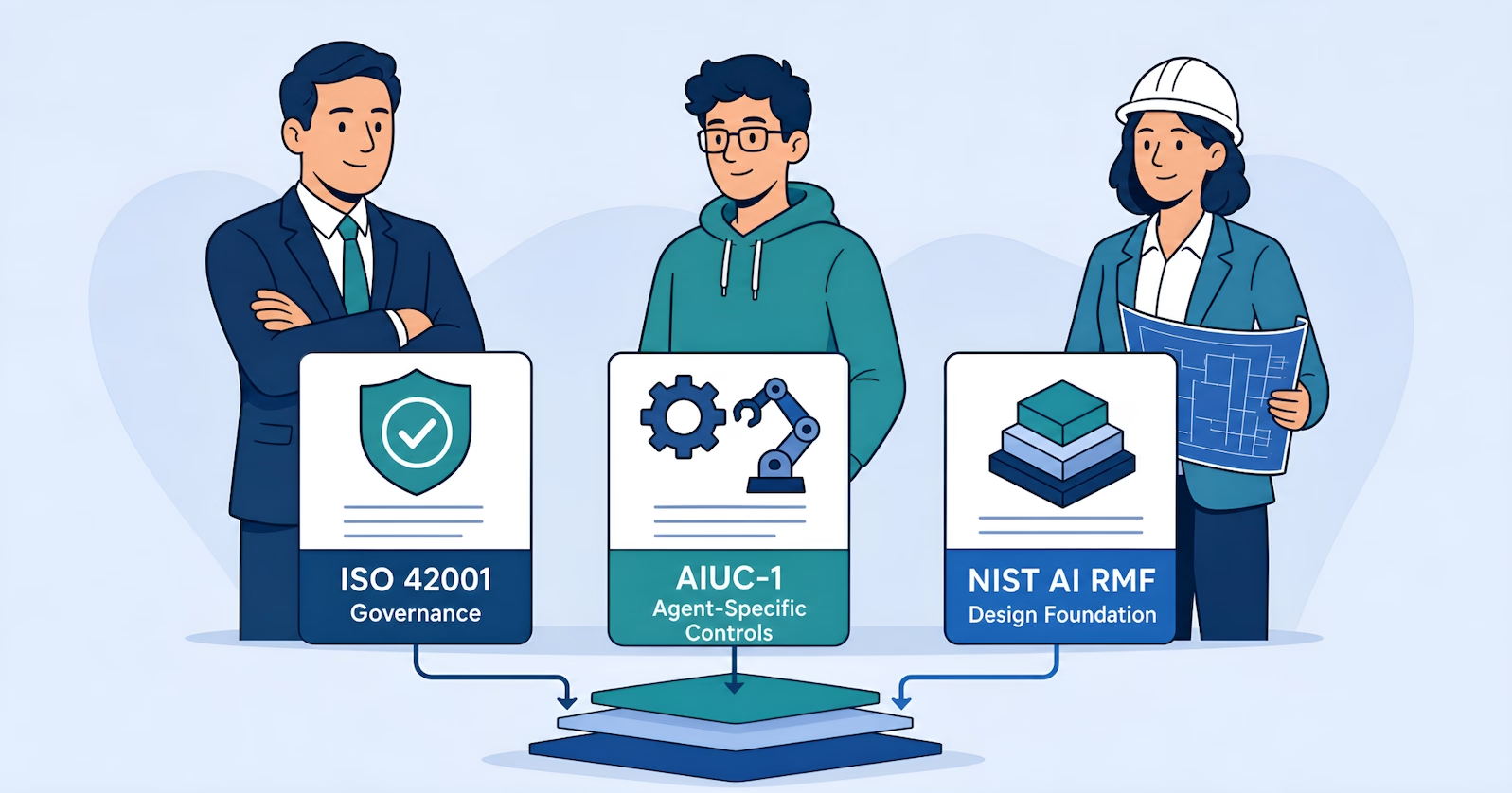
Three AI governance frameworks are fighting for procurement-team attention in 2026, and most of the comparison content treats them as competitors in a single race. They are not. ISO 42001, AIUC-1, and NIST AI RMF are built for different buyers, different products, and different stages of organizational maturity. Treating them as alternatives leads to the wrong selection. Treating them as a stack, built deliberately, is closer to how the market is actually settling out.
The cleanest framing came out of a recent conversation with Mike Kim, co-founder and CEO of Mycroft.io, an AI governance consultancy that has been working through these standards with operators on both sides of the border.
Mike Kim, Mycroft.io
ISO 42001 is the CEO's AI certification. AIUC-1 is the CTO's. That's the cleanest way to describe what's actually happening in the market right now.
That single distinction reframes the comparison. The question is not which framework wins. The question is which buyer at the customer's table a company needs to satisfy, and at what stage of that product's maturity. The rest of this post unpacks each framework, where they overlap, where they diverge, and what the procurement reality looks like in 2026.
The three frameworks at a glance
| Framework | Built for | Certifiable? | Primary buyer driver | 2026 maturity |
| ISO 42001 | Organizations operationalizing AI as a management system | Yes, by accredited certification bodies | Procurement teams, board-level AI governance | Showing up in TPRM questionnaires now; small number of active certification bodies in Canada |
| AIUC-1 | AI-agent product companies | Yes, by AIUC (certifier also offers insurance) | CTO and security engineering teams shipping agents | Open standard, venture-backed; not yet on most TPRM questionnaires |
| NIST AI RMF | Security architects designing AI risk programs | No, voluntary framework | North American procurement teams asking for AI risk management | Foundational; widely referenced, especially in US federal-adjacent supply chains |
Each framework is doing useful work. None of them does all of it.
What each framework actually is
ISO 42001: the certifiable governance standard
ISO 42001 is the first international management-system standard for artificial intelligence. It defines what an AI Management System (AIMS) looks like, similar in shape to ISO 27001's Information Security Management System but pointed at a different problem. Where ISO 27001 governs how an organization protects information, ISO 42001 governs how an organization develops, deploys, and oversees AI systems across their lifecycle.
The structural important detail: ISO 42001 is about AI usage, not data protection. It assumes ISO 27001-grade information security is already a solved problem at the organization. It then adds: AI inventory, impact assessments, supplier management for AI components, monitoring of AI behavior in production, and human oversight controls. We covered the mechanics of this in our companion piece on ISO 42001 vs ISO 27001.
What makes ISO 42001 distinctive in this comparison is that it is certifiable by an accredited third-party body, which makes it the cleanest answer when a buyer's procurement form asks whether a vendor is certified to a recognized AI governance standard. That single property is why it has shown up in TPRM questionnaires faster than the alternatives.
AIUC-1: the operator-focused, agent-aware standard
AIUC-1 is published by the AI Underwriting Company, an entity that was funded by venture capital with an explicit thesis: AI agents need their own assurance regime, and the same firm that certifies an AI product can also underwrite insurance against its failures. AIUC-1 is the resulting open standard.
The framework is organized around six control families:
- Data and privacy
- Security and safety
- Reliability
- Accountability
- Traceability
- Society impact
Several of those families contain controls that ISO 42001 does not address directly at the same level of granularity. Tool-call safety, for example, is meaningful for an AI agent that can take real-world actions through API calls, and AIUC-1 spells that out. Traceability requirements are also more operator-focused, written for the engineers building the system rather than the executives overseeing it.
Mike Kim, Mycroft.io
AIUC-1 is the framework you adopt when your product is an agent and the people evaluating you are technical. It is open source as a standard, but the certifier and the insurer are the same entity. That is something every buyer should understand before they commit.
That is not necessarily a flaw. Underwriting and certification have always been linked in adjacent markets, with cyber insurance and SOC 2 attestations often coming from related ecosystems. It is, however, an unusual structure for a compliance framework, and worth knowing about before adoption.
NIST AI RMF: the open foundation
The NIST AI Risk Management Framework is voluntary, US-origin, and prescriptive in the way NIST publications usually are. It defines four functions, Govern, Map, Measure, Manage, and offers a structured playbook for designing an AI risk program. There is no certification body. There is no audit trail. It is a reference architecture.
For a security architect who wants a recipe rather than a certificate, NIST AI RMF is the cleanest design starting point. It also pairs naturally with the rest of the NIST family, including NIST CSF 2.0, which itself added a Govern function in its 2024 revision for similar reasons.
The procurement signal is regional. North American buyers, particularly those in US federal supply chains or working with US enterprises, are increasingly asking suppliers about NIST AI RMF alignment. European buyers ask about the EU AI Act. That regional split matters when deciding where to invest first.
Who each framework is actually built for
The CEO-vs-CTO framing is the easiest way to remember the audience split.
ISO 42001 is the CEO's framework
Written in management-system language. It satisfies a board that wants to know AI risk is being governed. It produces a certificate that goes on a procurement form, in an investor deck, and on a website. It maps cleanly to the EU AI Act, which means a CEO can frame ISO 42001 certification as anticipatory regulatory compliance in front of a board.
AIUC-1 is the CTO's framework
Written in operator language. It satisfies a security engineering counterpart on the customer side who wants to know that an AI agent is observable, accountable, and won't take a destructive action against their environment. The controls describe behavior, not just policy.
NIST AI RMF is the architect's framework
The recipe a security or AI engineering team uses when designing the program in the first place. It is upstream of the other two. A team that builds against NIST AI RMF tends to have a clean glide path to ISO 42001 certification later, because the underlying program is already there.
This is the same dynamic that played out with ISO 27001 and SOC 2. Programs built on a reference architecture certify faster than programs built only against an audit checklist. We touched on this pattern in SOC 2 vs ISO 27001.
Where the controls overlap
The good news for anyone worried about duplicating work: a significant portion of the underlying controls overlaps across all three frameworks.
- Risk assessment is present in all three. The vocabulary differs; the substance is similar.
- Data governance, particularly around training data lineage and consent, is shared territory.
- Monitoring and human oversight are present across the board.
- Supplier and third-party AI management appears in ISO 42001 and AIUC-1 and is implied by NIST AI RMF's Map function.
This is where the audit-once-comply-many concept applies. A single set of well-designed controls, evidenced once, can satisfy requirements across multiple frameworks if the program is built deliberately. That is the design principle behind an effective security program, and we wrote about it in detail in Effective Security First, which lays out the pattern we apply to multi-framework environments.
Where they diverge
The divergence is where the selection decision actually lives.
ISO 42001 has stronger requirements around organizational governance, top-management commitment, internal audit, and management review. Those are management-system mechanics that NIST AI RMF largely leaves to the implementer.
AIUC-1 goes deeper than ISO 42001 on agent-specific concerns. Tool-call safety, autonomous action boundaries, traceability of agent decisions, and society-impact controls are written with the assumption that the AI in question is taking real actions, not just generating outputs.
NIST AI RMF is the most prescriptive on the design side and the least prescriptive on the evidence side. There is no auditor walking through the controls at the end.
Conflict-of-interest worth knowing about
Per Mike Kim: AIUC-1 is the only compliance framework I'm aware of where the certifier also sells you the insurance. That is the part of the story buyers should understand before they adopt it.
The procurement reality in 2026
Theoretical fit is one question. What actually shows up on customer questionnaires is another, and it is the question that drives most framework decisions in practice.
Across the AI-vendor conversations we have been part of over the last six months, the pattern is consistent:
- ISO 42001 is the framework procurement teams are starting to ask about by name. It is showing up in TPRM questionnaires, particularly from European customers and from North American enterprises with a forward-leaning compliance function.
- NIST AI RMF is the framework North American buyers reference when they have not yet specified ISO 42001. It functions as the catch-all show me you have an AI risk management program requirement.
- EU AI Act references are appearing in European procurement questions with increasing frequency, and ISO 42001 is the cleanest answer because the standard was deliberately designed to map to it. Our EU AI Act overview covers that mapping in more depth.
- AIUC-1 has not yet hit mainstream TPRM questionnaires. That is not a knock on the standard. It is a maturity observation. The framework was published recently, and procurement vocabulary moves slowly.
For an AI-agent product company selling to technical buyers who care about agent-specific assurance, AIUC-1 may still be the right investment, because the engineering audience the framework was written for is the same audience evaluating the product. For an AI-enabled SaaS company selling to mainstream enterprises through procurement, ISO 42001 is the framework that gets through the gate. Most companies will eventually want both, in sequence.
A useful Canadian-specific consideration: there are currently only a small number of accredited bodies in Canada certifying ISO 42001, which affects timelines and pricing. We wrote about that in ISO 42001 auditors in Canada.
PICK THE RIGHT AI FRAMEWORK FOR YOUR BUYERS
We help you choose the AI governance framework that satisfies the buyer at your table and lays the foundation for an effective security program.
The pragmatic stack
If we strip the question down to a single design recommendation, the answer is a stack rather than a selection.
- NIST AI RMF as the design foundation. Build the program against a reference architecture. Govern, Map, Measure, Manage. Get the controls right before chasing any certificate.
- ISO 42001 as the certifiable governance standard. When the program is operating, add a management system on top and pursue accredited certification. This is the artifact procurement teams are increasingly asking for.
- AIUC-1 as a product-specific overlay for companies shipping an AI agent. If the product takes autonomous action and the buyers are technical, AIUC-1's agent-specific controls and the associated insurance product may matter. Adopt it after the foundation is in place, not instead of it.
That sequence is not the only valid path, but it is the one that minimizes rework. It treats the frameworks as complementary parts rather than competing options, which matches how the market is actually settling.
For organizations that want a quick read on which framework to start with, we built the ISO 42001 Scorecard as a 10-minute self-assessment.
Frequently asked questions
Can I be certified for AIUC-1?
Yes. AIUC-1 is an open standard published by the AI Underwriting Company, which also acts as the certifier. The same entity offers insurance against AI product failures, so buyers should understand that the certification body and the underwriter share a corporate parent before adopting it.
Is NIST AI RMF mandatory in the US?
No. NIST AI RMF is voluntary. There is no audit body and no certificate. It is increasingly referenced in US federal procurement guidance and in enterprise TPRM questionnaires asking suppliers to demonstrate an AI risk management program, but it is a reference architecture, not a legal requirement.
Which AI framework do enterprise procurement teams ask about most in 2026?
Procurement teams ask about AI governance broadly, often by name: ISO 42001, NIST AI RMF, or EU AI Act alignment. ISO 42001 is the one showing up most often as a specific named requirement, because it is certifiable. AIUC-1 has not yet hit mainstream TPRM questionnaires.
Does ISO 42001 cover AI agents specifically?
Not at the operational level. ISO 42001 governs the AI Management System: inventory, impact assessments, oversight, supplier management. AIUC-1 reaches further into agent specifics such as tool-call safety and traceability of autonomous actions. For agent products, the two are complementary, not interchangeable.
How does ISO 42001 relate to the EU AI Act?
ISO 42001 is a certifiable governance standard deliberately aligned with the direction of the EU AI Act. They are different instruments: the EU AI Act is legislation, ISO 42001 is a voluntary management-system certification. ISO 42001 certification is the cleanest way to demonstrate anticipatory alignment.
The frameworks are not racing each other. They are stacking. The CEOs sign off on ISO 42001, the CTOs sign off on AIUC-1, and the architects design against NIST AI RMF at the base of both. Pick the framework that matches the buyer at your table, then build the next one.
Ready to Start Your Compliance Journey?
Get a clear, actionable roadmap with our readiness assessment.
Contact Us
Free Report: The CPCSC Compliance Playbook
Join the waitlist for a free copy when it’s released.
About the Author

Former security architect for Bank of Canada and Payments Canada. 20+ years building compliance programs for critical infrastructure.