
.svg)
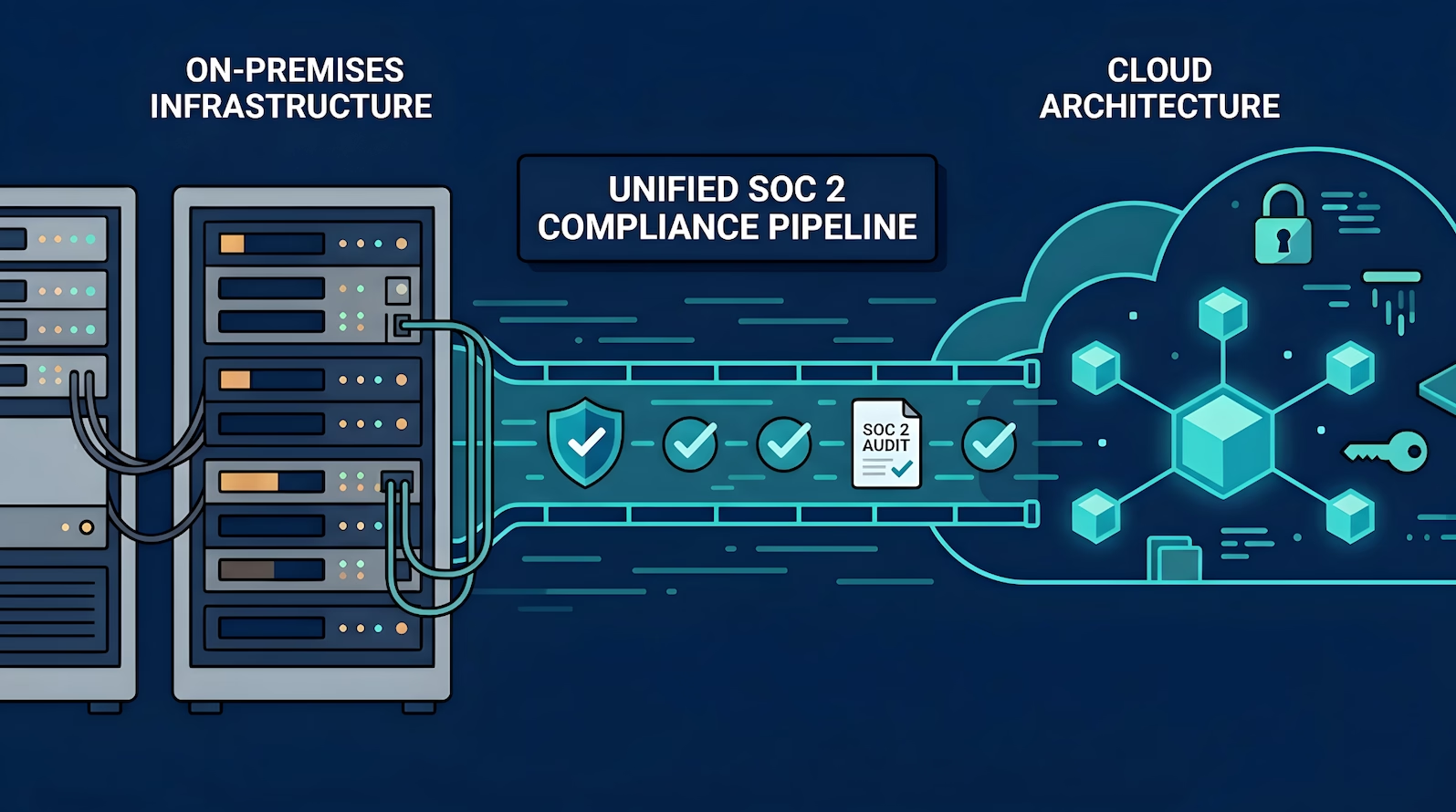
GRC platforms automate compliance evidence collection for cloud-native infrastructure. Connect your AWS account, hook in your identity provider, link your CI/CD pipeline, and the platform starts pulling configuration data, access logs, and vulnerability scan results automatically. For a company running entirely in the cloud, this works well. A large portion of SOC 2 controls become continuously monitored, and the audit preparation workload drops substantially.
For companies running bare metal servers, co-location racks, or legacy on-prem systems alongside cloud infrastructure, the experience is different. The integrations connect. The dashboard populates. And then a significant portion of the environment simply does not appear anywhere in the compliance program.
The GRC platform's integration model is designed around cloud provider APIs, SaaS connectors, and modern infrastructure tooling. On-premises infrastructure sits entirely outside that model. No API to query, no agent pre-configured, no built-in test library that maps to bare metal. The platform is not failing to cover on-prem; it was never designed to.
The Compliance Gap This Creates
The audit scope includes the on-prem systems, but the compliance tooling does not. Evidence collection for those systems falls to manual processes, and the automated testing that makes continuous compliance possible in cloud-native environments simply does not exist, until it is built.
GRC engineering is how companies close this. Not by working around the platform, but by extending the compliance program beyond what the platform covers, starting with a full environment inventory, mapping controls to the actual scope, and building the automated tests that generate evidence across everything, including the systems the platform cannot reach.
Why On-Prem Is Different
The reason GRC platforms do not cover on-prem infrastructure is not a product oversight. It is a consequence of how the platforms are built.
Modern GRC platforms work through integrations: authenticated connections to cloud providers (AWS, Azure, GCP), identity platforms (Okta, Azure AD), endpoint management tools (Jamf, Intune), CI/CD systems, and SaaS applications. Each integration exposes an API that the platform queries to pull configuration state, access records, and security settings. The platform tests those values against expected control states and generates evidence automatically.
Bare metal servers do not have cloud provider APIs. Co-location racks do not connect to identity platform integrations. Legacy systems running on-premises do not expose the kind of structured API endpoints that GRC integrations are built around.
For the platform to test an on-prem system, it would need an agent, a custom integration, or a mechanism for ingesting evidence from systems it cannot directly query, none of which come pre-built for most on-prem environments.
The practical effect: when a company running hybrid infrastructure connects their GRC platform, the platform covers the cloud-native portion of the environment well, and the on-prem portion not at all.
This matters for audit scope. If SOC 2 or ISO 27001 audit scope includes the on-prem systems, and for most companies it does, then every control that applies to those systems needs evidence. The platform does not generate it. Someone has to.
What GRC Platforms Cover and What They Skip
In a standard cloud-native environment, a well-configured GRC platform automates evidence collection for roughly 40 to 50 percent of SOC 2 controls. This is a realistic estimate based on patterns observed across multiple compliance engagements. The integrations pull configuration state for access management, encryption settings, vulnerability scan results, and infrastructure security controls effectively. That is genuine value.
The remaining 50 to 60 percent requires manual effort regardless of environment type: policy acknowledgments, risk assessment documentation, vendor reviews, training records, change management approvals, and incident response evidence. These controls require human judgment and documentation that cannot be automated away.
For companies with on-premises infrastructure, the automation percentage drops further, closer to 30 percent in environments where a significant share of in-scope systems sit outside the platform's integration model. The gap is not abstract; it translates directly to the evidence collection workload heading into an audit.
The Test Reconciliation Problem
In one engagement, a company discovered 232 active tests in their GRC platform, roughly a third of which were failing. On review, many of those failures were not compliance deficiencies at all. Tests designed for Windows environments were failing on Mac-only infrastructure.
Tests checking for specific cloud configurations were running against systems that used a different architecture. The compliance posture was stronger than the dashboard suggested. The problem was reconciliation: identifying which tests applied to the actual environment, which should be disabled, and which should be replaced with tests that matched the infrastructure.
On-prem environments face this problem amplified. The platform enables tests it was built to run. If the environment the tests were designed for does not match the environment being assessed, the result is noise, and more importantly, the controls that do apply to the on-prem systems remain untested.
The Inventory-First Approach
GRC engineering starts from a different position: full environment inventory before controls. This is the foundation of what GRC engineering means as a discipline.
Before the GRC platform is configured, before controls are mapped, the first step is a complete inventory of everything in scope. Cloud infrastructure. SaaS applications. Endpoints. And the on-prem systems: bare metal servers, co-location racks, network appliances, legacy applications, physical infrastructure. All of it, documented with enough detail to answer the question: what controls apply to this system, and how will compliance be demonstrated?
This inventory serves two purposes.
First, it establishes the real audit scope. Auditors assess the systems that process, store, or transmit in-scope data. If on-prem systems do any of that, they are in scope, and the compliance program needs to cover them.
Second, it provides the foundation for test design. You cannot build an automated compliance test for a system you have not inventoried.
The inventory lists systems the GRC platform may never see. A database running on bare metal in a co-lo facility. An authentication service on a legacy server that predates the cloud migration. Network monitoring infrastructure that was never moved. Each of these systems carries compliance obligations that the GRC platform, left to its own integrations, will not surface.
For a breakdown of where the integration model ends and what falls through, see What Vanta and Drata Can't Automate.
Automated Compliance Testing for Bare Metal and Co-Lo
Once the on-prem systems are inventoried and their controls mapped, the next problem is evidence generation. Manual evidence collection, screenshots, configuration exports, hand-assembled logs, is reliable in the way that any manual process is reliable. It works until it does not, and it requires human time every time an audit approaches.
GRC engineering builds automated tests for on-prem systems using the same underlying logic as cloud-native tests: query the system state, compare it against the expected control state, generate timestamped evidence. The implementation is different because the interface is different.
| Infrastructure Type | Evidence Collection Method | Tools |
| Linux bare metal servers | Scripted configuration checks on a defined schedule | Ansible, Chef, custom scripts |
| Network infrastructure (co-lo) | Management interface queries parsed against control baselines | Firewall/switch APIs + CIS benchmarks |
| Legacy systems with limited APIs | Local agents export evidence to central collection point | Custom agents, centralized evidence store |
The Key Design Principle
The evidence generated needs to be auditor-readable. It is not enough to collect configuration data; the test output needs to demonstrate clearly that the control requirement was met. A script that pulls the list of privileged users on a bare metal server and compares it against the approved access list, with a timestamped record of the comparison, is directly useful to an auditor reviewing CC6.2. A raw configuration dump that requires interpretation is not.
Hybrid Environments: One Compliance Program, Two Infrastructure Models
The harder problem in hybrid environments is building a single compliance program that treats both as part of the same scope, with consistent evidence standards and a unified audit trail.
This matters because auditors assess the compliance program as a whole. If cloud infrastructure has continuous automated monitoring and on-prem systems have quarterly manual reviews, the program has two different evidence standards. Auditors notice. The controls covering on-prem systems will receive more scrutiny because the evidence pattern is different, and any gaps become visible against the backdrop of the tighter cloud coverage.
The goal is coverage parity: the same control tested the same way, with the same evidence quality, regardless of whether the underlying system is a cloud instance or a bare metal server. This requires that the automated tests for on-prem systems produce evidence in the same format and cadence as the GRC platform's cloud-native tests.
In practice, this means integrating the on-prem test results into the same evidence library the GRC platform manages for cloud controls. Most platforms support manual evidence uploads and custom test configurations that allow external evidence to be attached to specific controls. The on-prem automated tests output to this evidence library, and the auditor sees a unified compliance record, not two separate programs.
The GRC platform remains central to the program. It manages the control library, tracks test status, handles policy acknowledgment workflows, and generates the audit reports. GRC engineering extends its reach to the systems the platform cannot directly query. The two work together. For more on how the two fit together, see GRC Platform vs GRC Engineering: When You Need Both.
For deeper reference on how this plays out in SOC 2 scope design, SOC 2 Network Security for On-Prem Environments covers network controls specifically, and SOC 2 Access Control for On-Prem Infrastructure addresses how access management evidence is built for systems outside the cloud identity provider model.
What GRC Engineering Builds for On-Prem Systems
Four Deliverables the Platform Alone Cannot Provide
- A scoped environment inventory, including on-prem systems with enough technical detail to map controls accurately.
- A control-to-system mapping for on-prem scope, making explicit which controls have automated coverage and which require custom test builds.
- Automated test infrastructure for on-prem systems: scripts, agents, and collection pipelines that query system state on a continuous schedule and generate auditor-readable evidence.
- Integrated evidence in the GRC platform: on-prem test outputs flowing into the same evidence library as cloud-native test results, so the compliance record is unified and the audit trail covers the full scope.
The outcome is a compliance program that reflects the actual environment. When an auditor requests evidence for a control that applies to a bare metal server in a co-lo facility, the evidence exists, it is current, and it was generated by the same kind of automated process as the cloud controls. The on-prem systems are not handled separately or differently. They are part of the same program.
The Practical Starting Point
For engineering teams navigating this for the first time, the right starting point is not the GRC platform configuration. It is the inventory question: which systems are in scope, and which of those systems is the platform currently unable to reach?
That gap analysis, the distance between audit scope and platform coverage, defines the GRC engineering work. Some teams find the gap is small: a few legacy systems that can be covered with lightweight scripting. Others find the gap is substantial: a significant portion of the environment that has never had automated compliance coverage.
Either way, the gap does not close by itself. The platform will not expand to cover on-prem systems through additional integrations, because the integration model was not designed for that. Addressing it requires building the tests, building the evidence pipeline, and integrating the results into the program the platform manages.
That is the work GRC engineering does. Not replacing the platform, but extending the compliance program to cover the full scope the platform was not built to reach.
For a broader view of how GRC engineering operates across the compliance lifecycle, see GRC Engineering in Practice.
On-Prem Compliance Needs Engineering
An effective security program for hybrid infrastructure starts with inventory and ends with automated evidence, regardless of where the systems live.
Frequently Asked Questions
Why don't GRC platforms cover on-premises infrastructure?
GRC platforms are built around API integrations with cloud providers, identity systems, and SaaS tools. Bare metal servers, co-location racks, and legacy on-premises systems do not expose the kind of structured API endpoints those integrations require. The platform is not failing to cover on-prem infrastructure; the integration model was designed for cloud-native environments. Covering on-prem requires a different approach: custom scripts, scheduled agents, and evidence pipelines built specifically for systems outside the platform's integration surface.
How do you automate compliance testing for bare metal servers?
For Linux bare metal servers, scripted configuration checks using tools like Ansible or custom scripts query system state directly: user access lists, patch levels, service configurations, and audit log settings. The scripts run on a defined schedule, the results flow into a centralized evidence store, and the compliance record builds continuously rather than in a pre-audit sprint. The key requirement is that the output is auditor-readable, demonstrating clearly that the control requirement was met, not just a raw configuration dump.
What percentage of SOC 2 controls can a GRC platform automate for on-prem environments?
In a standard cloud-native environment, GRC platforms typically automate evidence collection for roughly 40 to 50 percent of SOC 2 controls. For companies with significant on-premises infrastructure, that percentage drops further, often to around 30 percent, because a larger share of in-scope systems sit outside the platform's integration model. The remaining controls, and the on-prem coverage gap, require manual or custom-automated evidence collection.
Can I use Vanta or Drata for hybrid environments?
Yes, GRC platforms like Vanta and Drata remain valuable for the cloud-native portion of a hybrid environment. They automate evidence collection for cloud providers, identity systems, and supported SaaS tools effectively. The limitation is that the on-premises portion of the environment falls outside their integration model. GRC engineering addresses this by building automated tests and evidence pipelines for the on-prem systems, with the results integrated into the same evidence library the GRC platform manages for cloud controls.
What is the first step toward on-prem compliance automation?
The first step is a complete inventory of in-scope systems, with particular attention to what falls outside the GRC platform's integration surface. This inventory establishes the real audit scope and identifies where automated testing needs to be built. Without this inventory, the compliance program is scoped to the integration catalog rather than to what the audit will actually examine, which is where most on-prem compliance gaps originate.
Ready to Start Your Compliance Journey?
Get a clear, actionable roadmap with our readiness assessment.
Contact Us
Free Report: The CPCSC Compliance Playbook
Join the waitlist for a free copy when it's released.
About the Author

Former security architect for Bank of Canada and Payments Canada. 20+ years building compliance programs for critical infrastructure.