.svg)

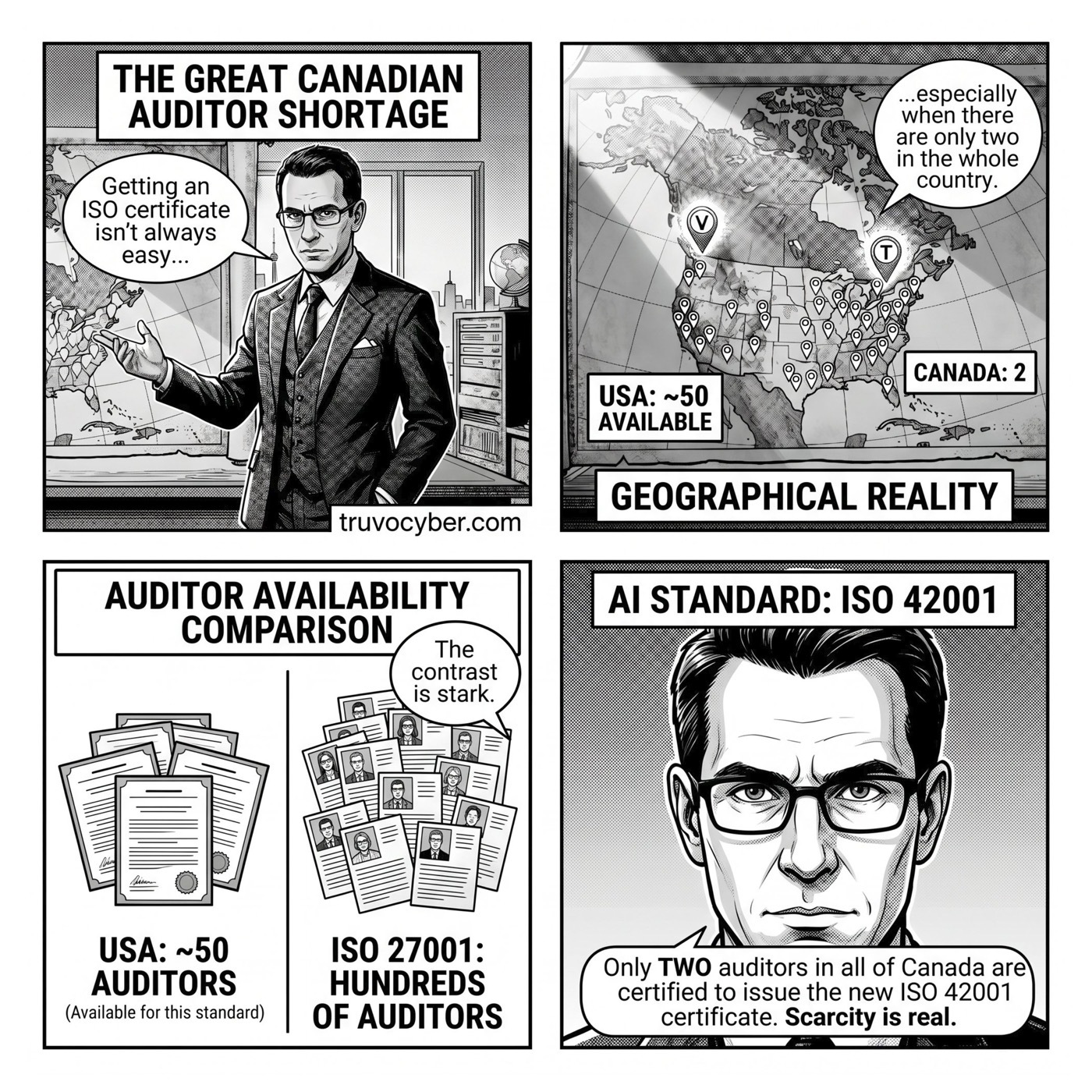
Some RFPs landing in 2026 include a clause most vendors miss on first read: certification must be issued by an SCC-accredited body. SCC is Canada's national accreditation body, and the pool of SCC-accredited certification bodies for ISO 42001 is approximately two. Not two dozen. Two.
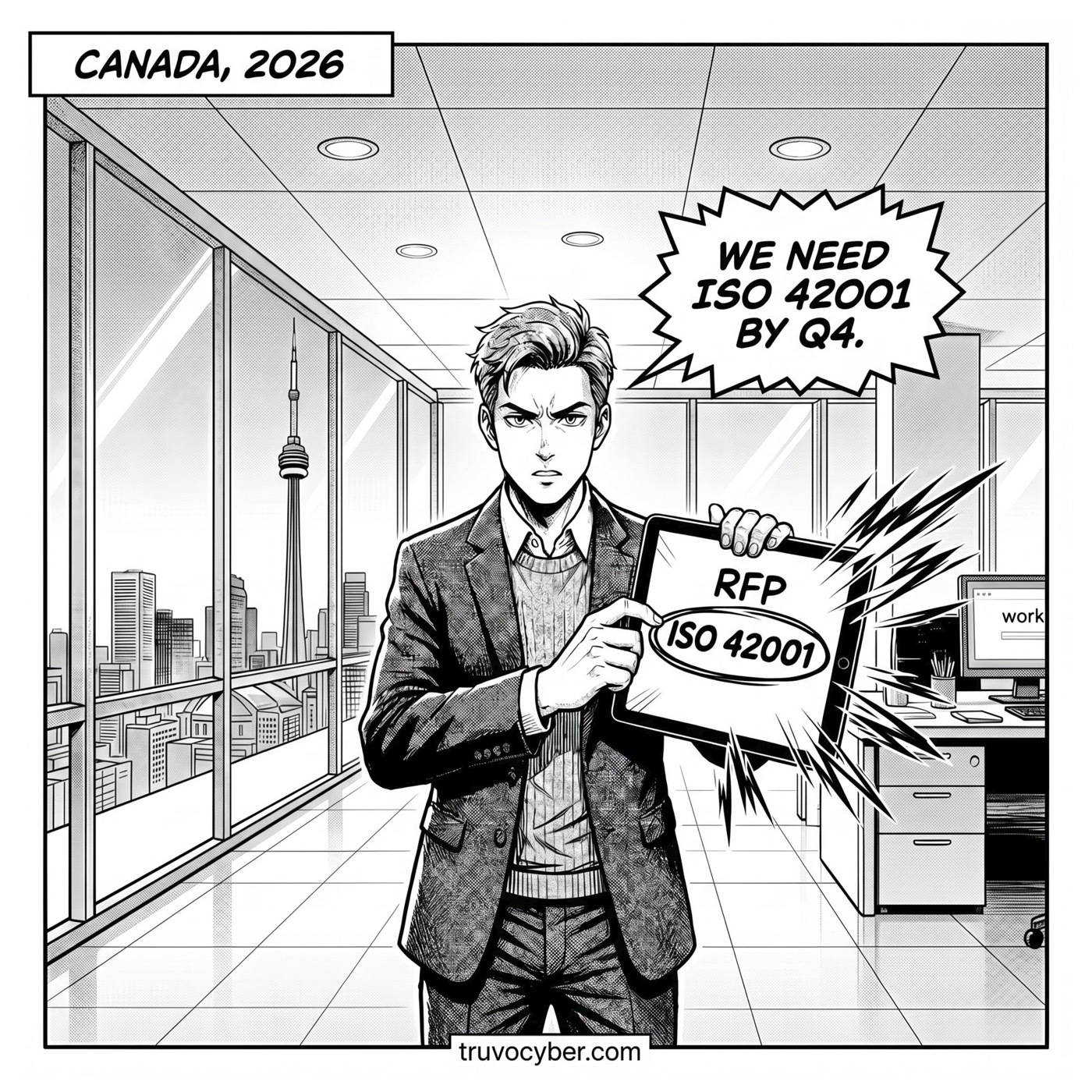
Canadian government and defense procurement has an established pattern of requiring SCC-accredited certification bodies for security management standards. ISO 27001 follows this pattern, and ISO 42001 runs through the same SCC accreditation infrastructure. Buyers applying that requirement to AI management systems will find approximately two Canadian options today. Understanding whether your buyers specify SCC accreditation should be the first question you answer, before engaging any certification body.
2
ISO 42001 certification bodies in Canada
Based on a 2026 market scan and practitioner conversations, including Mike Kim, co-founder of Mycroft.io. Registries are not always synchronized; the directional point holds even if the exact count moves.
The United States has roughly fifty certification bodies for this standard. ISO 27001 has hundreds globally. If you are planning to certify in 2026, that gap affects your timeline, your budget, and arguably your decision about whether to pursue ISO 42001 at all this year.
Why so few Canadian auditors?
The bottleneck is talent, not demand. ISO 42001 was published in December 2023. Certifying against it requires lead auditors who understand AI provenance, model bias, training-data lineage, and the role definitions baked into the standard. Most ISO 27001 lead auditors have not retooled for that yet, and the certification bodies that employ them are still building internal capability.
The role definitions are harder than they sound. ISO 42001 asks an organization to declare its role in the AI ecosystem: provider, producer, user, customer, or subject. A SaaS company that resells an OpenAI-powered feature is simultaneously a user of someone else's model and a provider to its own customers. Getting that wrong at the start of an engagement is one of the most common ways ISO 42001 projects stall, before a single auditor shows up. For a full breakdown of why ISO 42001 governs AI use rather than data classification, and what that means structurally, see our companion piece.
What this means for cost and timeline
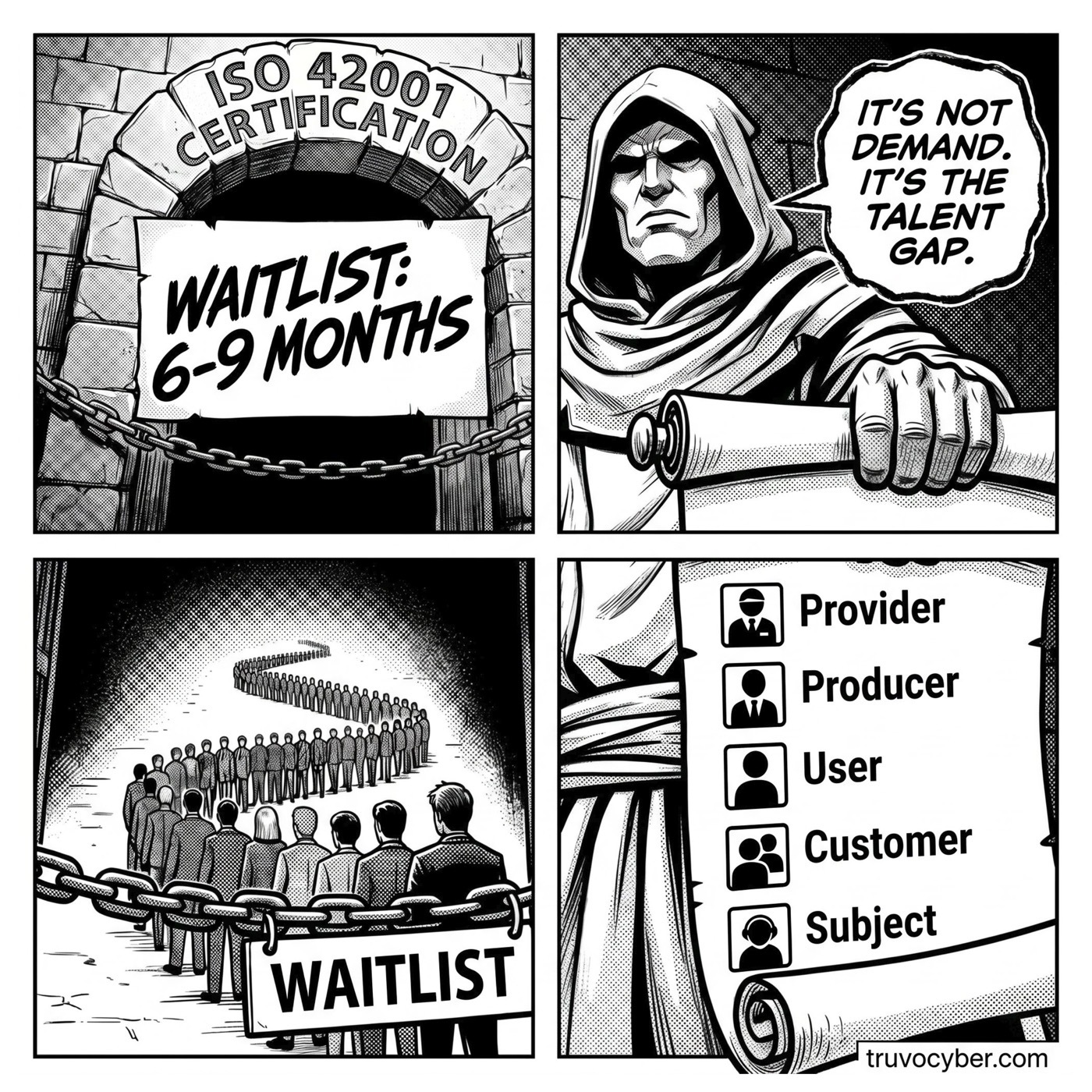
Expect waitlists: auditor availability, not your readiness, is the rate-limiter in 2026. Audit fees are running noticeably higher than ISO 27001 for equivalent scope. Scarcity pricing is real. Once you are in the audit cycle (Stage 1 documentation review, Stage 2 certification audit), the process resembles ISO 27001. Budget two to three months of internal preparation, then add queue time on top. A six-to-nine-month window from scoping to certificate is realistic.
The less visible constraint is scoping. ISO 27001 scoping is mature; ISO 42001 has none of that institutional memory yet. Which AI systems are in scope? Are you certifying every model you use, or only specific product lines? How do you handle a foundation model you do not control? A well-scoped Statement of Applicability, written before the certification body arrives, shortens the audit and reduces re-scope risk.
Should Canadian companies wait?
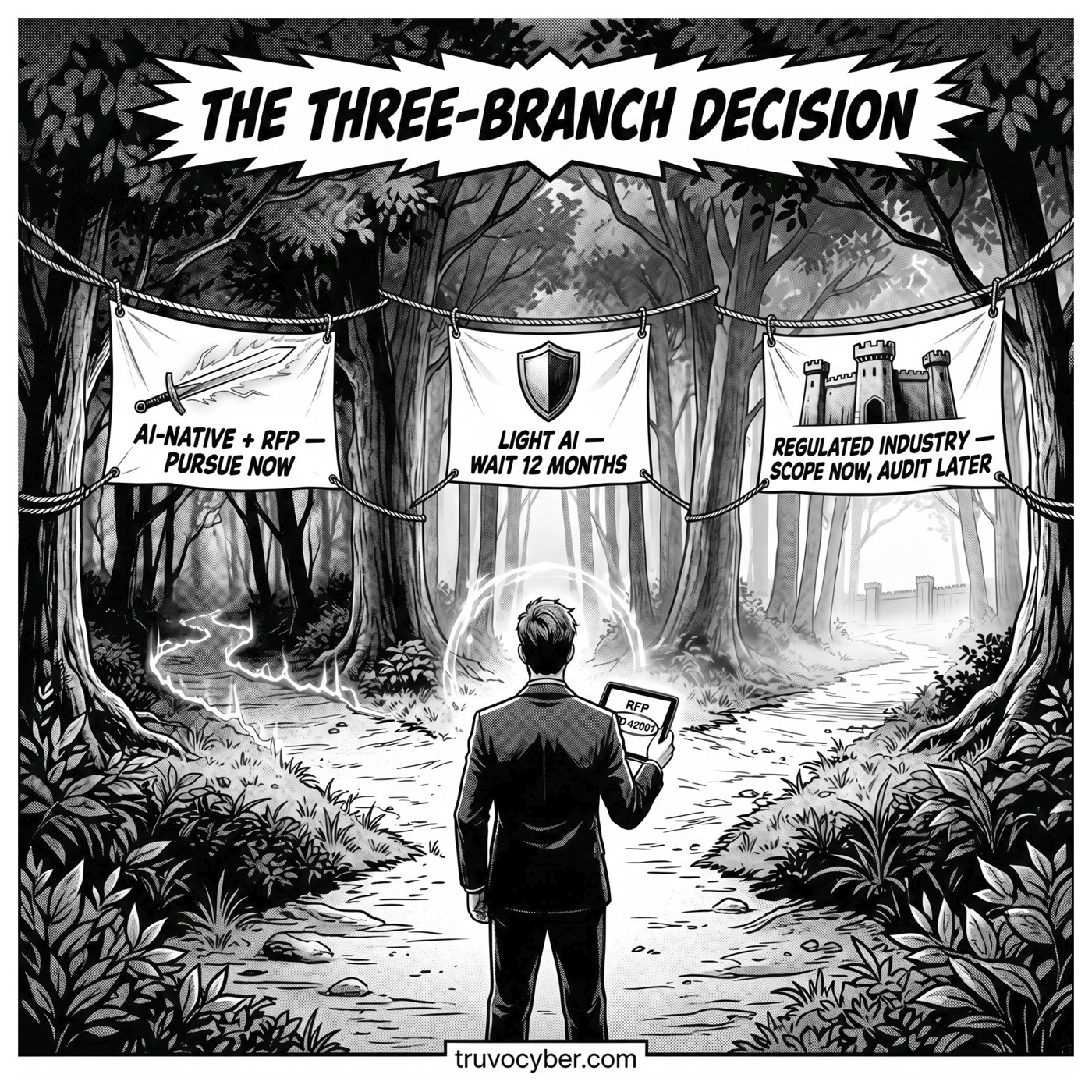
It depends on which scenario fits. Waiting for the RFP before starting is consistently the most expensive compliance plan. The math holds across every framework. But the calculus here is more nuanced than a simple "start now" recommendation.
Find out if you are two months or twelve months out from being ISO 42001 audit-ready.
Take the ISO 42001 Readiness Scorecard
What to look for in a Canadian certification body
Three things to verify before you sign: the CB's accreditation status for ISO/IEC 42001:2023 specifically, not just general ISO accreditation; the lead auditor's actual ISO 42001 engagement history; and their fluency on the provider versus downstream-user distinction, which is where the role definitions bite hardest. An answer of zero ISO 42001 audits completed is not a deal-breaker in 2026, but it should change the conversation about audit hours and expected findings.
The US Fallback: When It Does Not Apply
A Canadian company can be certified by a US-based certification body. An ISO/IEC 42001 certificate issued by any IAF MLA signatory (ANAB, SCC, UKAS) is generally accepted internationally. For most commercial enterprise buyers, this is sufficient.
The exception is regulated Canadian procurement. Canadian government and defense procurement has an established pattern of requiring SCC-accredited certification bodies for security management standards. ISO 27001 follows this pattern, and ISO 42001 runs through the same SCC accreditation infrastructure. If your buyers fall into this category, verify the exact certification body language in your RFP before proceeding. Discovering mid-certification that only an SCC-accredited body will satisfy the requirement means rejoining a Canadian waitlist from the start. For a related look at how auditor scarcity shapes certification timelines in another Canadian context, see the CPCSC Level 1 Readiness Scorecard.
What the bottleneck tells you

The interesting signal in the "only two auditors" figure is not the inconvenience. Inconvenience gets resolved by markets, and the Canadian pool will look different in 18 months. The signal is what the bottleneck reveals about market maturity.
AI governance as a discipline is roughly where data protection was in 2018: real, accelerating, and ahead of the supply of expertise needed to operationalize it. The companies that pursue ISO 42001 in 2026 are not just buying a certificate. They are buying a position on a curve that will only get more crowded. For teams still deciding which AI governance framework fits their situation, our comparison of ISO 42001 vs AIUC-1 vs NIST AI RMF covers the strategic trade-offs in detail.
The supply curve catches up to the demand curve, eventually. It always does. The question is whether you want to be on the certificate side of that curve when it does, or still on the waiting list.
FIND OUT IF YOU'RE AUDIT-READY FOR 2026
An effective security program is the foundation ISO 42001 assumes is already in place. We help Canadian teams scope, build, and prepare for it before the auditor queue moves.
Frequently asked questions
How many ISO 42001 certification bodies are accredited in Canada?
By our count, based on a 2026 market scan and practitioner conversations, two. Accreditation registries (ANAB, SCC, UKAS) are not always synchronized and new auditors can be added at any time, so the exact number can move. The directional point holds: the Canadian pool is roughly an order of magnitude smaller than the US pool.
Can a US-based certification body issue an ISO 42001 certificate for a Canadian company?
In most cases, yes, if the certification body is accredited by an IAF MLA signatory such as ANAB. An ISO/IEC 42001 certificate from an IAF-recognized US CB is generally accepted internationally. The exception is regulated sectors. Canadian government and defense procurement has an established pattern of requiring SCC-accredited bodies for security management standards, and ISO 42001 runs through the same SCC infrastructure. Verify before you commit.
How much does ISO 42001 certification cost in Canada?
We do not publish a fixed number because scope, headcount, and AI footprint move the figure significantly. As a directional anchor, ISO 42001 audit fees are running noticeably higher than ISO 27001 for an equivalent scope, typically in the tens of thousands of dollars. Scarcity pricing on the Canadian auditor side is real, so budget conservatively. See our full ISO 42001 cost breakdown for component-level ranges.
How long does ISO 42001 certification take from scoping to certificate?
Plan for two to three months of internal preparation once your management system and Statement of Applicability are in good shape, followed by Stage 1 and Stage 2 audits. In Canada the limiting factor is currently auditor queue time, not your readiness. A six-to-nine-month effective window from scoping to certificate is reasonable in 2026.
Do I need a Canadian auditor if my customers are in the EU?
Not necessarily. An ISO/IEC 42001 certificate issued by any certification body accredited under an IAF MLA signatory is generally recognized across markets, including the EU. The certificate itself is the recognized artifact, not the auditor country. Check with the specific buyer, particularly in regulated sectors, before you finalize the CB choice.