
.svg)
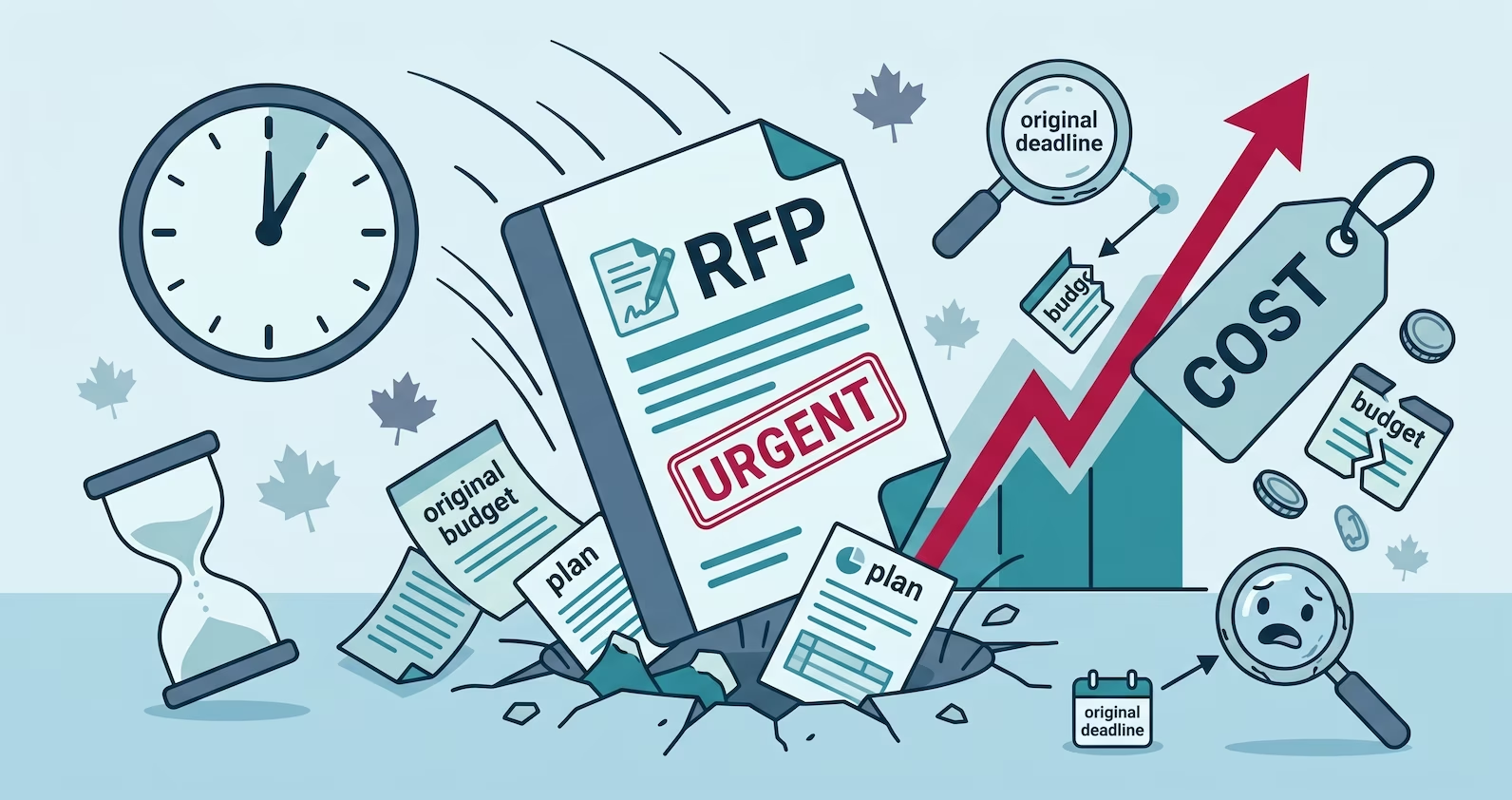
Most companies treat compliance as a procurement problem. Something to handle when a customer or a contract surfaces it. The logic is reasonable on the surface: do not spend money on a certification you do not yet need, and do not staff a function you cannot yet justify. So compliance sits on the "we will deal with it when it comes up" pile.
The trouble is that compliance is not a procurement problem. It is an engineering and operations problem, and engineering and operations problems compress badly under deadline pressure.
The core idea
Reactive compliance costs 1.5 to 3 times what the same work costs booked with normal lead time. That is before you factor in the deal you lose when the report does not land in time. Factor that in and the multiplier is not a multiplier anymore. It is the full annual contract value, repeated every year the customer would have renewed.
The four cost lines that move the wrong way
When the RFP arrives with a 60-day or 90-day clock, every cost line moves against you at once.
Consultant scarcity premium. Good compliance consultants are booked. Engagement calendars run six to twelve weeks ahead, sometimes longer in busy quarters. When a company calls with a tight deadline, the consultants who can actually start next week are either between engagements (which is informative) or willing to charge a premium to displace other work. In my experience, reactive engagements price 1.5 to 3 times higher than the same scope booked with normal lead time.
Auditor scarcity premium. Same dynamic on the audit side. SOC 2 auditors, ISO 27001 certification bodies, and CPCSC C3PAOs all work from booked calendars. A company that needs an audit report in eight weeks is asking for a slot that was not on the schedule. The audit firms that say yes either have a cancellation or run an expedited fee structure. The audit itself is not faster. It just costs more.
Internal overtime and opportunity cost. This one almost never makes it onto the budget. Compliance that compresses into a sprint pulls engineering, IT, security, legal, and HR away from the work they were hired to do. Product slips. Feature commitments to existing customers slip. The CTO spends six weeks in compliance meetings instead of architecture reviews. No invoice captures it, but in my experience the opportunity cost is usually larger than the consulting fee, and it lasts longer because product debt accumulated during the sprint has to be paid back later.
Rushed tool selection. GRC platforms, SIEM, MDR services, vulnerability scanners, IAM, endpoint security. Each is a multi-year commitment. Picking the wrong one under deadline pressure is expensive twice. First, the wrong tool usually still gets you across the audit line. Then it sits in your stack for the next three to five years, generating friction every quarter. Companies that pick a GRC platform in a panic often replatform within eighteen months.
The lost-deal cost nobody puts on the slide
The analysis above assumes the certification lands in time. Sometimes it does not. The prospect has a hard deadline, the audit cannot complete inside it, the contract goes to a competitor who already had the report.
This is the cost line that changes the entire calculation. When you compare proactive to reactive on the cost of getting certified, the difference might be 1.5 to 3 times. When you compare proactive to losing the contract entirely, the difference is the entire deal. A $500,000 ARR enterprise contract that goes to a competitor because you could not produce a SOC 2 Type 1 report in time is not a $30,000 problem versus a $90,000 problem. It is a $500,000 problem, repeated every year the contract would have renewed.
I see this pattern most clearly in two places. Canadian SaaS companies trying to break into US enterprise procurement hit SOC 2 walls during discovery, and the deals that stall in week three of the procurement cycle often would have closed if the report had been in hand. Canadian defence-adjacent suppliers waiting for federal RFPs hit the same wall on CPCSC and ITSP.10.171 readiness. The procurement calendar does not wait for your assessment timeline.
The full argument for an effective security program
Effective Security First is our field report on why the reactive path is structurally more expensive, and how teams that plan 12 to 18 months ahead close the cost gap. Download the PDF.
Why on-prem and hybrid make this worse
Cloud-native companies have a structural advantage in reactive scenarios. AWS, Azure, and GCP inherit a meaningful portion of the control surface, and the customer responsibility shrinks when the workload is fully managed. A reactive SOC 2 build on a clean cloud architecture is hard but tractable.
On-prem and hybrid is a different problem. You operate the physical security, the network boundary, the patching cadence on bare metal, the backup infrastructure, the asset inventory for hardware that does not announce itself in an API. Some of this cannot compress at all. Facility access logs, badge systems, and physical sanitization procedures need operating history before an auditor can sample them. CPCSC Level 1 has 13 controls. Several of them, including physical access control, media sanitization, and boundary protection, assume operating history that does not exist if you started six weeks before the contract award.
What "a little bit proactive" actually buys
Proactive compliance is not the same as expensive compliance. The framing matters. Most companies that defer compliance imagine the alternative is a full audit booked, a GRC platform purchased, a consultant on retainer, and a six-figure annual budget line. That is one version of proactive, and it is not the version that solves the reactive cost problem.
The version that solves the problem is more modest: foundational controls in place (MFA on all admin and remote access, documented offboarding, an asset inventory, a written information security policy, a basic vendor inventory, a tested backup process), a written sense of which framework the business is heading toward, and an established relationship with a consultant who has already done a scoping conversation and can mobilize quickly when the deadline arrives.
That work, done over six to twelve months as background activity, costs a fraction of a reactive sprint. It also collapses the timeline of the eventual sprint, because the foundation is already in place. The consultant is not starting from zero. The auditor is not looking at a six-week-old policy library. The internal team is not learning the framework for the first time on a deadline.
Signals you are closer to a real deadline than you think
Companies that get caught flat-footed almost always had earlier signals they did not act on.
- A board member or investor asks about SOC 2 readiness during a quarterly review. Rarely curiosity. Usually the board is hearing about it from peers or prospective acquirers.
- A prospect sends a security questionnaire you cannot answer in under a day. That is procurement telling you what will be required at contract.
- An industry peer announces a certification one or two segments above your typical deal size. Procurement teams notice and update their requirements.
- A regulator or government department publishes guidance. CPCSC is a recent example. Suppliers who read it as a signal had a year. Suppliers who waited for the contract award did not.
- A customer renewal adds a security clause that was not in the previous agreement. The cheapest signal, because the customer is telling you in writing.
When two or more appear in the same quarter, the deadline is no longer hypothetical.
Frequently Asked Questions
How long does it actually take to get certified?
For most SMBs with cloud-only infrastructure and reasonable engineering hygiene, SOC 2 Type 1 readiness runs 8 to 12 weeks, with Type 2 adding a 3 to 6 month observation period. ISO 27001 typically runs 4 to 9 months including the certification audit. CPCSC Level 1 is a self-assessment that can be completed quickly if the underlying controls already exist, but the underlying controls take months to implement if they are not. Hybrid and on-prem environments add time to all three.
Is it actually cheaper to wait until a customer asks?
No. Reactive engagements price 1.5 to 3 times higher than the same scope booked with normal lead time. Add the internal team's opportunity cost and the risk of a rushed tooling decision that costs more to unwind later, and the reactive path is materially more expensive even before factoring in lost deals.
What can we do proactively without spending a lot?
Implement the foundational controls every framework expects: MFA on all admin and remote access, a written information security policy, a documented offboarding process, an asset inventory, a vendor inventory, a tested backup process. Have a scoping conversation with a consultant so you understand what an engagement would look like when the deadline arrives. That work is inexpensive and shortens the eventual sprint substantially.
What is the cost of losing a deal because of compliance?
The full annual contract value, repeated for every renewal year you would have held the customer. For a five-year enterprise relationship at $200,000 ARR, the lost-deal cost is $1 million in revenue, plus the marketing and sales investment that produced the opportunity. This is the number that makes reactive compliance economically irrational even when the immediate consulting fees look manageable.
Ready to Start Your Compliance Journey?
Get a clear, actionable roadmap with our readiness assessment.
Contact Us
Free Report: The CPCSC Compliance Playbook
Join the waitlist for a free copy when it’s released.
About the Author

Former security architect for Bank of Canada and Payments Canada. 20+ years building compliance programs for critical infrastructure.