
.svg)
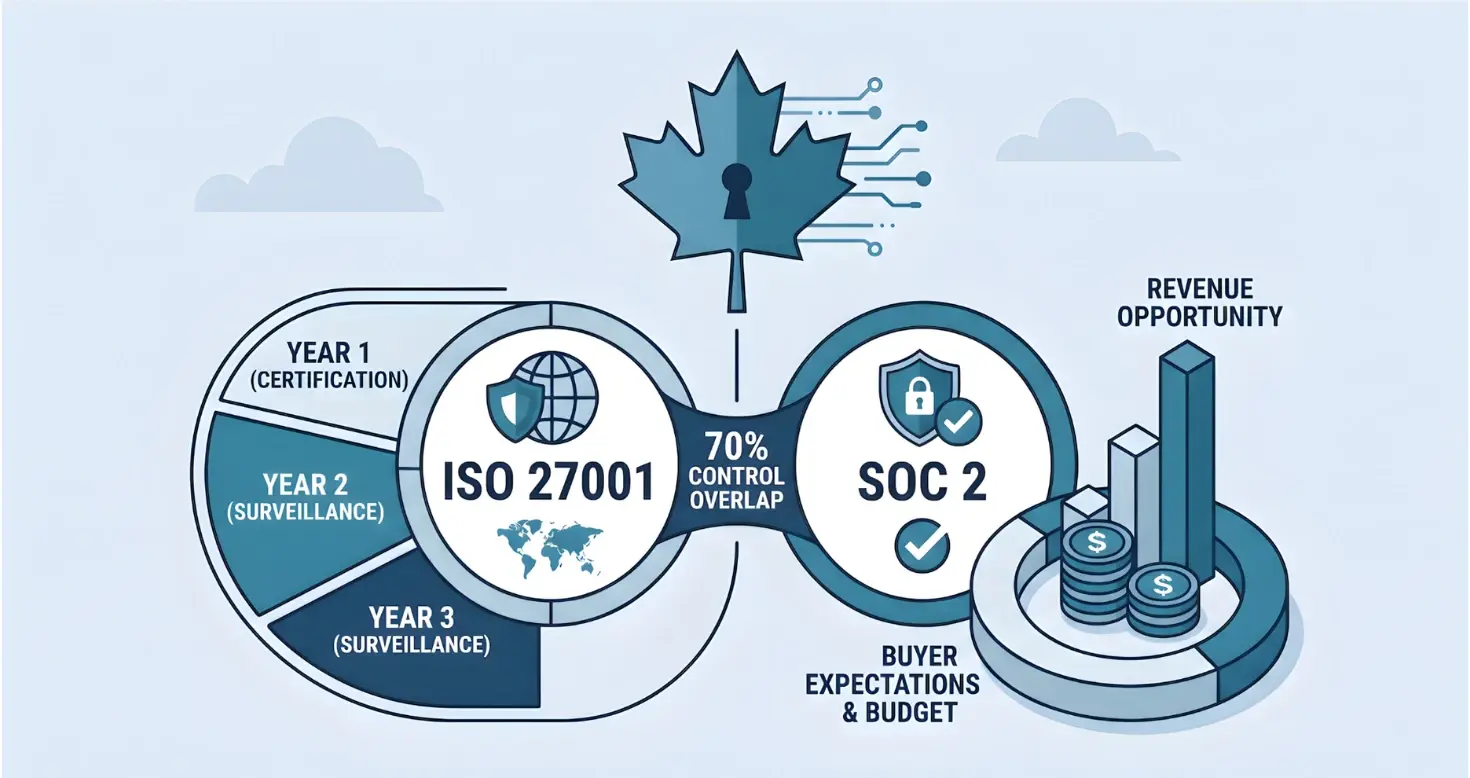
ISO 27001 certification gives you a one-to-two-page certificate. SOC 2 gives you a 40-to-50-page report describing every control, how it was tested, and what the auditor found. In North America, most enterprise buyers want the report, not the certificate. That single difference drives the majority of framework decisions we see across Canadian SaaS companies.
But ISO 27001 is not the wrong choice. In the right circumstances, it is the better one, and in many cases it belongs alongside SOC 2 rather than instead of it. The question is not which framework is superior. The question is which framework your buyers, regulators, and partners actually require, and whether you need one or both.
This guide covers when ISO 27001 consulting makes sense for a Canadian company, what the certification actually costs once you account for the full audit cycle, how the 70% control overlap with SOC 2 makes framework stacking practical, and what to look for when hiring an ISO 27001 consultant.
Key Difference
ISO 27001 produces a 1-2 page certificate confirming ISMS compliance. SOC 2 produces a 40-50 page report detailing every control, every test, and every finding. North American enterprise buyers expect the detail.
The Certificate vs. the Report
The most important thing to understand about ISO 27001 is what your buyer receives at the end.
An ISO 27001 certification produces a short certificate issued by an accredited certification body. It confirms that the company operates an Information Security Management System (ISMS) that meets the requirements of ISO/IEC 27001:2022. That certificate does not describe what controls exist, how they were tested, or what risks were identified. It says: this company passed.
A SOC 2 report is fundamentally different. It is a detailed narrative describing the company's control environment, the specific controls in place, the tests the auditor performed, and the results. An enterprise buyer reading a SOC 2 report can evaluate the company's security posture independently. They can see whether the controls are relevant to their risk profile, identify gaps, and make an informed procurement decision.
In North America, that level of detail is what closes deals. Security and procurement teams at enterprise buyers have been trained to review SOC 2 reports as part of vendor due diligence. When a company presents an ISO 27001 certificate instead, the typical response is a follow-up security questionnaire to get the detail the certificate does not provide.
This does not mean ISO 27001 lacks value. It means the value shows up in different contexts.
When ISO 27001 Makes Sense
ISO 27001 becomes the right framework, either alone or alongside SOC 2, in several common scenarios.
European customers or partners. ISO 27001 is the recognized standard in Europe and most international markets. European procurement teams expect it. GDPR compliance conversations often assume an ISO 27001 foundation. If a meaningful portion of revenue comes from, or is headed toward, European markets, ISO 27001 removes friction that SOC 2 alone cannot address.
Government and defence contracts. Several Canadian and international government procurement frameworks reference ISO 27001 directly. In regulated sectors where contract requirements specify ISO 27001 certification, no alternative satisfies the requirement. This is particularly relevant for companies working toward CPCSC compliance, where ISO 27001 provides a strong control foundation.
Multi-framework strategy. Companies that need both SOC 2 and ISO 27001, or anticipate needing additional frameworks like HIPAA, PCI DSS, or ISO 42001 for AI governance, benefit from building a single security program that maps to multiple standards simultaneously. The control overlap makes this practical, not just theoretical.
Board or investor requirements. Some institutional investors and board governance policies require ISO 27001 certification as a condition of investment or continued funding, particularly for companies with international operations.
The Cost Myth: Surveillance Audits Add Up
One of the most common misconceptions we encounter is that ISO 27001 is cheaper than SOC 2 because full recertification happens every three years instead of annually. This comparison breaks down once you account for the complete audit cycle.
Common Misconception
Comparing ISO 27001's Year 1 certification cost against three years of SOC 2 audits is not an honest comparison. ISO requires paid surveillance audits in Years 2 and 3. The three-year total is often comparable to, or higher than, SOC 2.
ISO 27001 operates on a three-year certification cycle, but it is not a one-and-done engagement followed by two years of nothing. The cycle works like this:
| Year | Audit Type | Typical Cost (CAD) |
| Year 1 | Full certification (Stage 1 + Stage 2) | $15,000 - $40,000 |
| Year 2 | Surveillance audit | $8,000 - $20,000 |
| Year 3 | Surveillance audit | $8,000 - $20,000 |
| Year 4 | Recertification audit (full scope) | $15,000 - $40,000 |
Over three years, a company pays for one full audit and two surveillance audits. The total is often comparable to three annual SOC 2 Type 2 audits, sometimes more once you factor in the overhead of maintaining the ISMS documentation that ISO specifically requires. For a direct comparison, see the SOC 2 cost and timeline breakdown.
Any competent ISO 27001 consultant should walk through the full three-year cost before a client commits to the framework.
The 70% Control Overlap: Why Framework Stacking Works
Roughly 70% of controls map directly between ISO 27001 Annex A and the SOC 2 Trust Services Criteria. When you line up ISO 27001:2022 Annex A controls against SOC 2 CC categories, the overlap in access control, change management, incident response, risk assessment, vendor management, and business continuity is significant.
What this means in practice: a company that has built an effective security program for SOC 2 is already 60 to 70% of the way toward ISO 27001 certification. The additional work falls into a few specific areas.
ISMS Documentation
ISO 27001 requires a formal Information Security Management System with a Statement of Applicability, risk treatment plan, and management review records. Building the ISMS wrapper around an existing SOC 2 program typically takes four to six weeks.
Formal Risk Assessment Methodology
ISO 27001 prescribes a more formal risk assessment process than SOC 2. The risk register, assessment methodology, and treatment plans need to follow the ISO 27001 structure even if the underlying risks are identical.
Internal Audit
ISO 27001 requires a formal internal audit of the ISMS. SOC 2 does not require this, though many mature programs run them voluntarily.
A GRC platform like Vanta, Drata, or Secureframe that already manages SOC 2 evidence can typically manage ISO 27001 controls in parallel. Companies pursuing both frameworks often find the incremental cost is 30 to 40% of what a standalone ISO 27001 engagement would have been.
What an ISO 27001 Consultant Actually Does
The word consultant in this context covers a wide range of engagements, from a lightweight gap assessment to a fully managed certification program. Understanding the scope matters because the quality of the consulting engagement determines whether certification succeeds on the first attempt and whether the ISMS is maintainable afterward.
Gap assessment. A qualified consultant reviews the current control environment against ISO 27001:2022 requirements and delivers a gap report, risk-ranked remediation roadmap, and realistic timeline to certification.
ISMS build. The implementation phase. This includes designing the ISMS scope, writing or adapting policies to meet Annex A requirements, building the risk assessment framework, establishing the internal audit process, and configuring evidence collection. For a SaaS company with an existing SOC 2 program, this phase is substantially shorter than a greenfield build.
Audit preparation and support. Selecting an accredited certification body, preparing for Stage 1 (documentation review) and Stage 2 (operational audit), running mock audits, and providing on-call support during the actual certification audit.
Ongoing ISMS management. After certification, the ISMS requires continuous operation: management reviews, internal audits, corrective actions, risk reassessments, and surveillance audit preparation. Companies without a dedicated security team often need ongoing consulting support to keep the ISMS running between audit cycles.
The Assess, Build, Operate Model for ISO 27001
The engagement model that works for SOC 2 consulting applies equally to ISO 27001.
Assess: Standalone gap assessment against ISO 27001:2022. Delivered as a prioritized roadmap with scope recommendations, timeline, and budget estimate. Useful for companies deciding between frameworks or needing a third-party opinion before committing.
Build: Fixed-scope implementation. Policies, ISMS documentation, risk assessment, control mapping, GRC platform configuration, auditor selection, and readiness review. At the end of the Build, the company is prepared for the Stage 1 audit.
Operate: Ongoing management of the ISMS. Weekly cadence, continuous evidence collection, surveillance audit preparation, management reviews, internal audits, and corrective action tracking. Operate is what prevents the ISMS from decaying between certification cycles.
ABO (Assess + Build + Operate): The annual subscription that bundles everything into a single line item. One team, one price, full accountability from gap assessment through certification and beyond.
Framework Stacking Advantage
Companies with an existing SOC 2 program can typically add ISO 27001 at 30-40% of the cost of a standalone certification, thanks to the 70% control overlap. The ABO model makes this particularly efficient because the same fractional security team manages both frameworks under one engagement.
How to Evaluate an ISO 27001 Consultant
Multi-framework experience. A consultant who has only done ISO 27001 may not understand how to build an ISMS that also satisfies SOC 2, which matters if both frameworks are on the roadmap. The same evaluation criteria for SOC 2 consultants apply here. Look for experience across multiple frameworks and the ability to design a program that maps to several standards simultaneously.
Certification body relationships. An experienced consultant knows which accredited certification bodies work well for SaaS companies, what their audit approach looks like, and how to avoid scope disagreements that delay certification. They should be able to recommend two or three options and explain the tradeoffs.
Program-first approach. If a consultant leads with documentation templates and policy libraries, they are selling paperwork, not a security program. The right approach builds an effective security program that addresses real risks, then maps ISO 27001 requirements onto that program. The certification should be a byproduct of good security, not the goal itself.
Post-certification support. Certification is not the finish line. Ask how the consultant supports surveillance audits, ISMS updates, and the three-year recertification cycle. A consultant who disappears after the Stage 2 audit is not thinking about whether the program will survive.
Making the Framework Decision
The decision between ISO 27001 and SOC 2, or the decision to pursue both, comes down to three factors.
Where are the buyers? North American enterprise buyers expect SOC 2 reports. European buyers expect ISO 27001 certificates. If the revenue is split, both frameworks may be necessary.
What do the contracts require? Some procurement requirements are non-negotiable. Read the actual contract language. An ambiguous reference to industry-standard security certification is different from a specific requirement for ISO 27001 certification from an accredited body.
What else is on the roadmap? If HIPAA, SOC 2, or ISO 42001 are coming in the next 12 to 18 months, building the security program with multi-framework stacking in mind from day one saves significant rework later.
The worst outcome is choosing a framework based on perceived cost savings and then discovering six months later that your largest prospect requires the other one. An honest consultant will walk through these scenarios before recommending a path.
Build Your ISO 27001 Program
We build effective security programs first, then map certifications onto them.
Frequently Asked Questions
How much does ISO 27001 certification cost in Canada?
The full certification audit (Stage 1 + Stage 2) typically costs $15,000 to $40,000 CAD for a SaaS company, depending on scope and company size. Add $8,000 to $20,000 CAD for each of the two annual surveillance audits that follow. Consulting fees for building the ISMS are separate and vary by the maturity of the existing security program.
Can a company pursue ISO 27001 and SOC 2 at the same time?
Yes. Roughly 70% of controls overlap between the two frameworks. Companies that build a single security program and map both frameworks onto it typically find the incremental cost of adding the second framework is 30 to 40% of a standalone engagement. A GRC platform that supports both frameworks makes the evidence collection significantly more efficient.
Is ISO 27001 accepted in North America instead of SOC 2?
In most cases, no. North American enterprise buyers expect a SOC 2 report because it provides 40 to 50 pages of control detail they can review independently. An ISO 27001 certificate confirms compliance but does not give the buyer that level of transparency. Companies with North American buyers typically need SOC 2 as the primary framework, with ISO 27001 added for European markets or specific contract requirements.
How long does it take to get ISO 27001 certified?
For a SaaS company building from scratch, typically 6 to 12 months from gap assessment to Stage 2 audit. Companies with an existing SOC 2 program can often compress this to 3 to 6 months because the majority of controls are already in place. The timeline depends on the maturity of the existing security program, the scope of the ISMS, and the availability of the certification body.
What is the difference between an ISO 27001 consultant and a certification body?
A consultant helps build and prepare the ISMS for certification. They design the program, write policies, configure evidence collection, and run mock audits. The certification body is the independent accredited organization that conducts the actual certification audit. The consultant and the certification body must be separate entities to maintain audit independence.
Do surveillance audits ever fail?
Yes. If the ISMS has not been maintained between certification cycles, or if significant nonconformities are found during a surveillance audit, the certification body can suspend or withdraw the certificate. This is the most common reason companies need ongoing consulting support after initial certification, as the ISMS requires continuous operation, not just an annual check-in.
Further Reading
Ready to Start Your Compliance Journey?
Get a clear, actionable roadmap with our readiness assessment.
Contact Us
ISO 27001 Checklist
Input your email to download the list.
About the Author

Former security architect for Bank of Canada and Payments Canada. 20+ years building compliance programs for critical infrastructure.