
.svg)
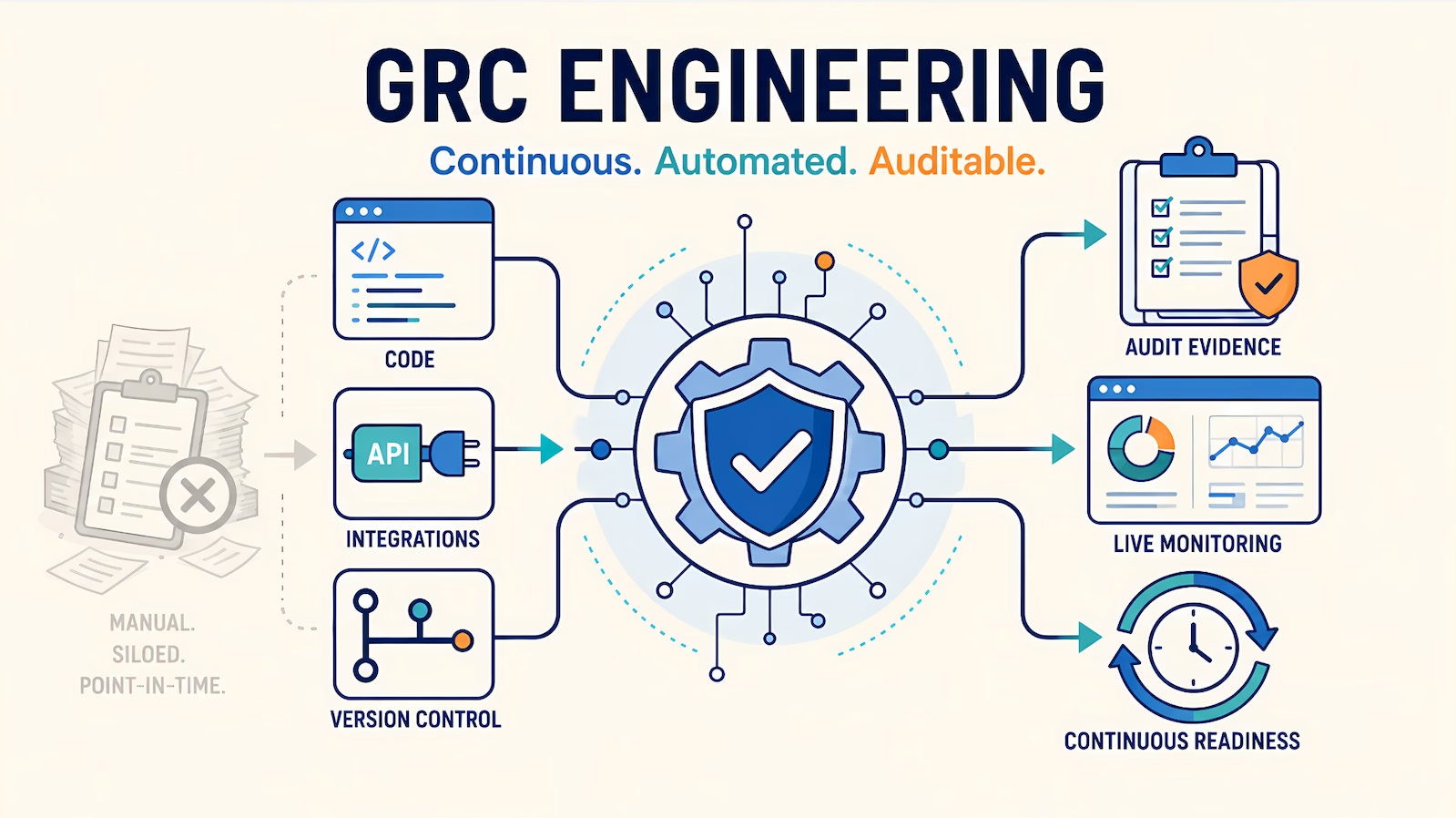
GRC engineering has been picking up momentum in the security community. It is in job postings, conference agendas, and strategy conversations at companies that take compliance seriously. Most explanations stay at the slogan level: treat compliance like an engineering problem. That is a useful frame, but it does not tell you what GRC engineering involves.
Starting with GRC
GRC stands for governance, risk, and compliance: how an organization makes decisions and sets accountability, identifies and responds to threats, and demonstrates adherence to the frameworks and regulations that apply to it. SOC 2, ISO 27001, HIPAA, PCI DSS, NIST CSF, and CIS Controls all fall under compliance.
For most organizations, GRC work has been fundamentally administrative: spreadsheets, manual evidence collection, and point-in-time assessments. Platforms like Vanta, Drata, and Secureframe have automated large parts of evidence collection, but the underlying approach has stayed largely the same.
GRC engineering is a different approach to that same work.
The Problem with Point-in-Time Compliance
Annual audits and manual evidence collection leave organizations running a compliance program that works at a single moment in time. GRC engineering replaces that cycle with a system that generates evidence continuously.
What GRC Engineering Means
GRC engineering applies software engineering practices to governance, risk, and compliance programs.
The practitioners at grc.engineering define it as a fundamental shift toward engineering mindset and systems thinking. The core idea: the same discipline that makes software reliable, version-controlled, auditable, and scalable can make compliance programs work the same way.
Evidence collection runs through APIs rather than manual screenshots. Audit workflows run as code. Compliance monitoring runs continuously rather than once a year before an audit. Documentation lives in version-controlled repositories, not in a folder called Risk_Assessment_v4_final_FINAL.docx.
The result is a compliance program that behaves like a well-run engineering system: predictable, auditable, and not dependent on individual heroics.
Engineering Principles Applied to Compliance
Infrastructure as code. Version control. Automated processes. Reproducible outputs. These are standard practices in software engineering. GRC engineering applies the same discipline to compliance infrastructure.
What a GRC Engineer Does
A GRC engineer sits at the intersection of security, compliance, and software development. The work clusters into a few consistent areas.
Evidence Collection via API
Scripts pull control health, policy coverage, and evidence status from GRC platforms. A single script surfaces what changed across multiple environments in seconds, without logging into dashboards manually.
Compliance Audits as Code
Cloud provider APIs expose configuration state across every service in an account. Audit scripts check IAM configurations, storage settings, and access permissions against a control baseline like CIS Controls Level 1. Every run is timestamped, versioned, and reproducible. An auditor who asks how the assessment was conducted gets a commit log.
Architecture Documentation from Code
Network diagrams and data flow documents generated using tools like Mermaid and draw.io XML, checked into version control. When the environment changes, the diagram changes with it.
Policy and Control Infrastructure in Version Control
Policies, control descriptions, and risk registers managed as files rather than Word documents. Changes are tracked, reviewable, and auditable.
Continuous Monitoring
Device compliance, stale account detection, access review cadence, vulnerability scanner outputs. When something changes, the diff is visible immediately rather than at the next audit prep cycle.
How This Differs From Traditional GRC Work
The traditional GRC model is project-based: controls get assessed, evidence gets collected, an audit happens, and the cycle repeats the following year. Between engagements, the program drifts.
GRC engineering reorients this toward systems rather than projects. A program built as a system generates evidence as a natural byproduct of the work, rather than requiring a manual sprint before each audit. SOC 2 Type 2, for example, requires demonstrating that controls operated effectively over a six to twelve month period. If monitoring and evidence collection are not continuous, there is nothing to show for the months before the audit preparation started.
GRC engineers do not replace platform tools. Vanta, Drata, and Secureframe do critical work no custom script can replicate. A GRC engineer builds on top of them: automated monitoring, custom audit coverage, and reproducible evidence collection.
Systems vs. Projects
A project-based compliance program requires a manual effort before every audit. A system-based program generates evidence continuously as a byproduct of how the work gets done. The difference compounds over time.
When Organizations End Up Here
GRC engineering tends to emerge in a few situations.
Scale
Managing programs across multiple clients, with overlapping frameworks and continuous evidence requirements, breaks the manual model quickly. Automation is not optional at that scale.
Engineering-Led Organizations
Companies where the CTO or a senior engineer owns the compliance program tend to apply the same instincts to GRC: version control the important stuff, automate the repetitive stuff, build systems that do not rely on someone remembering to do something.
Multi-Framework Programs
A company pursuing SOC 2 and ISO 27001 simultaneously, or managing SOC 2 alongside CPCSC or HIPAA, has overlapping control requirements that benefit from a consistent automated approach. Treating control infrastructure as code allows controls to be mapped, deduplicated, and monitored across frameworks without doubling the operational work.
Continuous Audit-Readiness
Organizations that treat audit preparation as a recurring sprint find that scramble cost compounds over time. Building monitoring and evidence infrastructure once, so audit readiness is a default condition rather than a periodic effort, is the engineering mindset applied to compliance.
The Organizational Question
GRC engineering does not require hiring a dedicated GRC engineer. Smaller organizations often get there through fractional support or by working with a consulting practice that operates this way natively.
What matters is that the compliance program generates evidence continuously, is monitored through automated systems, and produces an audit trail as a natural output of the work.
The question for most technical leaders is not whether to adopt GRC engineering principles. It is whether the compliance program currently in place is structured to operate that way.
For organizations evaluating ongoing GRC support, GRC managed services covers what that operational work looks like in practice.
Build a Compliance Program That Runs Itself
An effective security program generates evidence continuously, not in a sprint before each audit.
The compliance program that runs without heroics is an engineered one. If the current approach relies on someone remembering to collect evidence before each audit, or if the only record of a control operating is a JIRA ticket marked complete, the program is running on administrative effort rather than engineering discipline. That model works until it does not.
Reach out if the compliance program needs to be rebuilt for continuous operation rather than annual scramble.
Frequently Asked Questions
What is GRC engineering?
GRC engineering applies software engineering practices to governance, risk, and compliance programs. It treats compliance infrastructure the way software teams treat code: version-controlled, automated, continuously monitored, and auditable by design rather than by effort.
What does a GRC engineer do?
A GRC engineer automates evidence collection via API, writes audit scripts that check cloud configurations against control baselines, generates architecture documentation from code, manages policies in version control, and builds continuous monitoring for device compliance and access controls.
How is GRC engineering different from traditional compliance work?
Traditional GRC is project-based: evidence gets collected before an audit, the audit happens, and the cycle repeats annually. GRC engineering reorients this toward systems - the compliance program generates evidence continuously as a byproduct of how work gets done, so audit readiness is a default condition rather than a sprint.
Do I need to hire a full-time GRC engineer to adopt these practices?
No. Many organizations adopt GRC engineering principles through fractional support or by working with a consulting practice that operates this way natively. What matters is that the program is structured to generate evidence continuously, not that someone holds the title of GRC engineer.
When does GRC engineering make sense?
GRC engineering tends to emerge at scale, in engineering-led organizations where the CTO owns compliance, in multi-framework programs (SOC 2 plus ISO 27001, CPCSC, or HIPAA), and in any organization that wants audit readiness to be a continuous state rather than a recurring effort.
Does GRC engineering replace platforms like Vanta or Drata?
No. Platforms like Vanta, Drata, and Secureframe do critical work that no custom script can replicate. A GRC engineer builds on top of those platforms: automated monitoring, custom audit coverage, and reproducible evidence collection that extends what the platforms provide.
Ready to Start Your Compliance Journey?
Get a clear, actionable roadmap with our readiness assessment.
Contact Us
Free Report: The CPCSC Compliance Playbook
Join the waitlist for a free copy when it's released.
About the Author

Former security architect for Bank of Canada and Payments Canada. 20+ years building compliance programs for critical infrastructure.