
.svg)
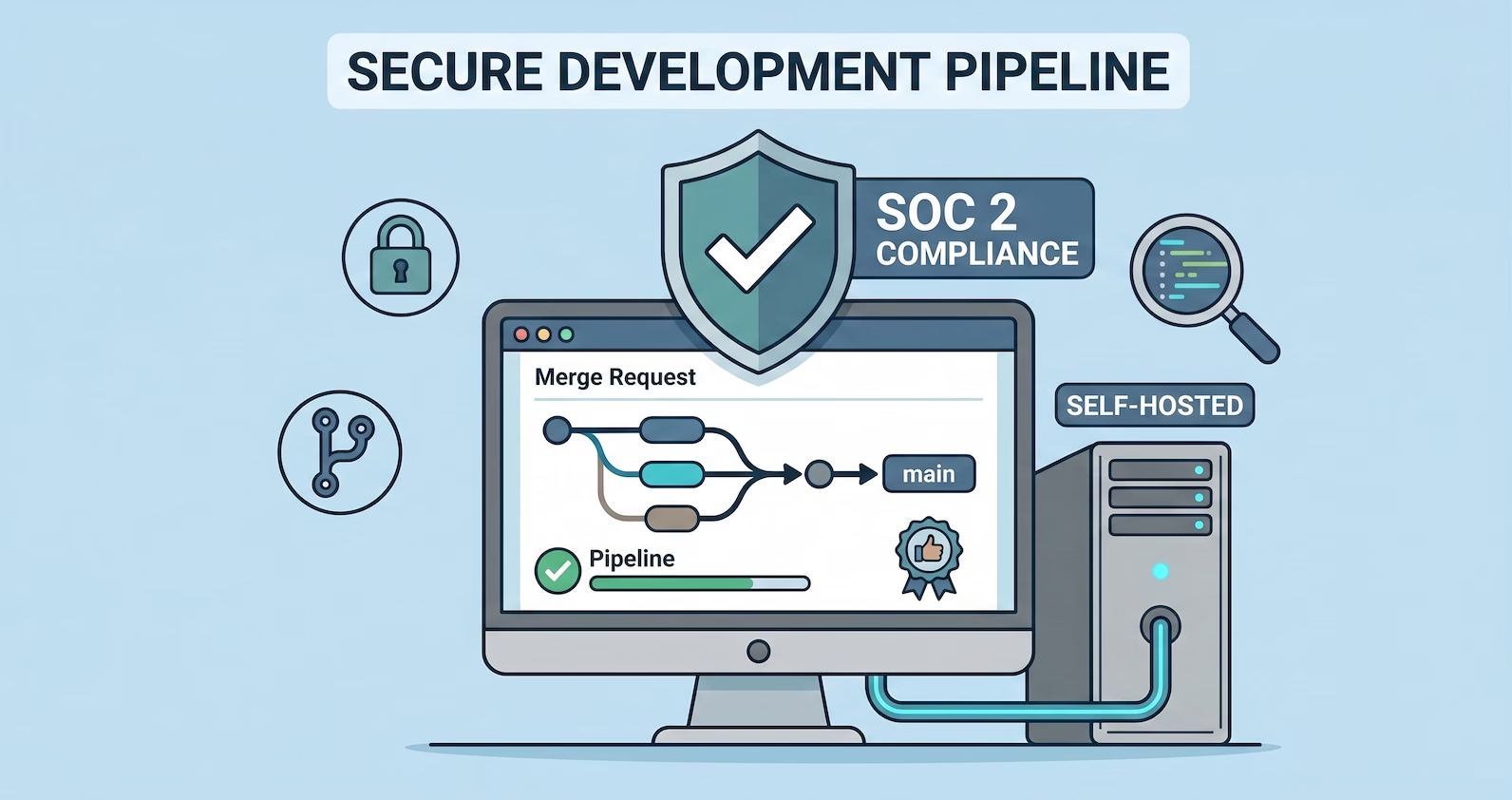
TL;DR
- The same Trust Services Criterion that governs infrastructure changes governs code changes: CC8.1, change management
- Self-hosted GitLab is the right answer when residency, sovereignty, regulatory, or contractual constraints rule out US-hosted source control (GitHub.com, GitLab.com, Bitbucket Cloud)
- Branch protection rules, merge request workflow, code review enforcement, dependency scanning (Snyk, Trivy, Semgrep), and secrets management (HashiCorp Vault) produce the SOC 2 evidence package
- The GitLab instance itself goes into SOC 2 scope alongside the code it manages and needs the same patching, backup, monitoring, and access discipline as production
- For changes that cross the application boundary (infrastructure, network, database), the merge request workflow links to the same ticket-driven change process described in SOC 2 change management with tickets
A growing number of Canadian and European customer contracts include a data residency clause: any system that stores or processes the customer's data, including the development environment that builds it, must run on infrastructure inside a specified jurisdiction. That single line in a procurement contract eliminates GitHub.com, GitLab.com, Bitbucket Cloud, and every other US-hosted source control platform from the architecture. What is left is self-hosted GitLab, running on infrastructure the team owns and operates, in a region the customer accepts.
One clause in a procurement contract changes the architecture
A data residency clause eliminates every US-hosted source control platform from the shortlist before the security conversation even starts. Self-hosting isn't nostalgia, it's the only option that satisfies the contract.
The same constraint shows up in defence supplier contracts, healthcare data sovereignty clauses, fintech supply chain risk decisions, and MSP customer mandates. Self-hosting source control is a deliberate choice driven by residency, sovereignty, regulatory, or contractual constraints, not nostalgia for on-prem. The SOC 2 auditor does not care about the motivation. They care that the development lifecycle authorizes, tests, approves, tracks, and documents every change that reaches production, and that the evidence trail is continuous. Self-hosted GitLab produces exactly that package. It just takes deliberate configuration, and it puts the GitLab instance itself into SOC 2 scope alongside the code it manages.
What SOC 2 Actually Requires of the SDLC
The Trust Services Criterion that governs secure development is CC8.1, change management. The same criterion that covers network, database, and infrastructure changes covers code and pipeline changes. The 2017 TSC (with revised Points of Focus, 2022) describes outcomes, not implementation patterns. A development lifecycle that satisfies CC8.1 has to show authorization before design, secure design and development, tracking across the lifecycle, testing proportional to risk, approval before deployment, segregation of duties, deployment with verification and rollback, and documentation that outlasts the implementer.
None of those outcomes say GitHub. None say GitLab either. What they say is that the lifecycle produces a durable, sampleable record of the discipline that went into each change. Self-hosted GitLab, configured against CC8.1 instead of against a generic template, produces that record as a byproduct of the merge request workflow.
Why Teams Self-Host
The decision is rarely about preference. Four drivers show up repeatedly: data residency, where hosting source control outside the country is a procurement blocker before it's a security conversation; sovereignty and contractual constraints, where a customer's MSA specifies that all code, build artifacts, and pipeline logs live on infrastructure under the vendor's direct control; supply chain control, where the risk committee concludes that a self-hosted instance with tight ingress, enforced MFA, and a small blast radius is a better trade than trusting a third party to patch on their timeline; and regulatory obligation, where defence contractors, critical infrastructure operators, and regulated healthcare companies live under frameworks that require or favour self-hosted source control for anything touching protected systems.
Self-hosting answers a real set of needs, but it adds operational burden. The team inherits the patching, backup, monitoring, and access review responsibilities for the GitLab instance itself. Those responsibilities are in scope for SOC 2 because GitLab is now production infrastructure, not a SaaS dependency.
The Merge Request Is the Change Record
A SOC 2-ready GitLab instance treats the merge request as the change record. Everything the auditor wants to see, from who asked for it, to what tests ran, to who approved it, to when it reached production, lives inside one merge request URL. The configuration that makes this possible has to be enforced at the group level so discipline doesn't depend on developer goodwill.
Protected branches are how CC8.1 authorization and segregation-of-duties outcomes get enforced in the tooling. The minimum ruleset for a production repository:
- Direct pushes to the default branch are blocked. Every change reaches the default branch through a merge request.
- Merge requires a passing pipeline. Testing before deployment becomes a tool-enforced gate rather than a process promise.
- Merge requires at least one approval from a user other than the author. Segregation of duties, expressed in GitLab's approval rules.
- Force pushes to protected branches are disabled. History is immutable, which is what makes the merge request a durable audit artifact.
- Approval rules are owned at the group level so a developer can't disable approvals on a repository they happen to maintain.
Branch protection rules are the evidence
Group-level protected branch settings, approval rules, and the immutable merge request history are the artifacts that demonstrate CC8.1 authorization and segregation-of-duties outcomes. Screenshots of the configuration plus a representative merge request sample produce the audit package.
For small teams where one person owns a whole service and there's no obvious second approver, a tagging convention flags material security-relevant merge requests and a structured quarterly retrospective review of tagged merges produces a written record auditors accept. It's the same compensating-control pattern described in SOC 2 change management with tickets instead of CI/CD for teams that can't enforce real-time segregation on every change.
When branch protection is configured correctly, the merge request carries every artifact CC8.1 expects. The description scopes the work, the linked issue captures the pre-coding authorization, the pipeline section records every job that ran (SAST, DAST, dependency scanning, secret detection), the approval section records who approved and when, and the merge commit links the change to the deployment. The whole record is immutable after merge and exportable for sampling.
Secrets Don't Live in Repositories
This is the one rule with no exceptions, and it's the first thing an experienced auditor looks for. Not in the default branch, not in a forgotten feature branch, not in a .env.example with the real values commented out, not in a test fixture, not in a Dockerfile.
Two patterns cover the realistic options. HashiCorp Vault running next to GitLab gives the team a single self-hosted source of truth for credentials, certificates, and API keys. GitLab CI jobs authenticate to Vault through short-lived tokens issued per pipeline run. Rotation, audit logging, and revocation all live inside Vault, which keeps secrets management, change management, and source control inside the same self-hosted footprint. The lighter-weight option is GitLab's built-in CI/CD variables, scoped to protected branches and protected environments only. Variables must be masked so they don't appear in pipeline logs, marked protected so they only expose to jobs running against protected branches, and scoped to the environment they belong to (staging secrets don't get injected into production jobs).
Vault keeps secrets management inside the self-hosted footprint
HashiCorp Vault running alongside GitLab gives the team one self-hosted source of truth for credentials, with short-lived tokens issued per pipeline run. Rotation, audit logging, and revocation all stay inside infrastructure the team owns, which matters when the reason for self-hosting was residency or sovereignty in the first place.
Either pattern produces the same auditor-facing outcome: secrets have an owner, a rotation cadence, an access log, and a clear separation between where the code lives and where the credentials live. Secret scanning runs on every push so the tool catches the mistake the policy was supposed to prevent. When a match fires, the remediation is to invalidate the secret at the source, not to rewrite git history and hope.
Dependency Scanning: Warning Icons Are Not Audit Failures
Every SOC 2 dependency scanning conversation eventually arrives at the same fear. A developer looks at the scanner output, sees warnings on transitive dependencies pulled in by a top-level package, and assumes the audit will fail because the warnings exist. That's a misread of what CC8.1 expects.
From real engagements: a team preparing for SOC 2 saw warning icons on several third-party dependencies that were no longer maintained. A single core dependency pulled in seven transitive dependencies, and two of those pulled in three more. Most of the flagged packages were on dependencies the team never directly chose. The developer assumed warnings meant automatic failure. The actual expectation was different: show that the team noticed, assessed whether each finding introduced real risk, and either remediated or formally accepted the exception with a documented reason and a review cadence.
Dependency scanning satisfies the SOC 2 outcome through three behaviours, not through a clean report. Scans run on every merge request so the output is part of the change record. Findings are triaged on a defined cadence (weekly for Tier 1 services, monthly for internal tooling) with outcomes recorded on the exception. Risk acceptances have an owner and an expiration date, because indefinite won't-fix is where audit findings start. GitLab's built-in dependency scanning is sufficient for most stacks; Snyk, Sonatype Lifecycle, and similar third-party scanners integrate via the pipeline; Trivy and Grype cover the container image layer. The more important question is whether scanner output feeds a triage cadence that produces continuous evidence, the same way the scan output described in on-prem vulnerability scanning feeds the remediation queue.
SAST on a Legacy Stack
Static analysis is where a lot of on-prem SaaS programs stall, and not because the team isn't committed. A typical scenario: the company runs on an older version of a major application framework. Every commercial SAST tool they evaluate only supports the newer framework versions because that's where the vendors have optimized. The team ends up considering a framework migration, an expensive and invasive project that has nothing to do with security, purely so they can run a SAST tool. That's the wrong trade.
CC8.1 expects static analysis as one element of a secure development process, but it doesn't specify the tool, and it doesn't require tools that only serve the latest framework version. Semgrep is the open-source option that actually covers legacy stacks, including older .NET, older Java, older Ruby, and older PHP. Rule sets are community-maintained or company-authored, rules can be developed in-house for the specific framework version, and the tool integrates directly into a GitLab pipeline with results posted to the merge request in the same format any other SAST output would use. For a small team on a legacy stack, Semgrep in GitLab CI with a curated ruleset satisfies the SAST outcome under CC8.1 as well as any enterprise platform would. DAST runs separately through GitLab's built-in DAST against a staging deployment or OWASP ZAP for teams running DAST outside GitLab, with results attached to the merge request.
The Pipeline as Continuous Evidence
The SOC 2 evidence model for scanning, patching, and access reviews follows a three-part continuous evidence pattern: configuration, execution history, representative samples. GitLab pipelines produce all three in one place.
| Evidence | GitLab Artifact | What It Proves |
| Configuration | .gitlab-ci.yml in the default branch plus group-level pipeline templates |
Which jobs run in what order, against which environments, inherited by every project |
| Execution history | GitLab pipeline list across the observation period | Every run, every status, every job, timestamped and immutable |
| Representative sample | One merge request picked at random | Description, linked issue, passing pipeline with every security scan job green or each finding triaged, non-author approval, merge commit, deployment |
Pipeline security architecture is not one decision. It's a choice between individually-assembled open-source tools, GitLab's built-in security features, or an all-in-one platform that posts standardized results back to the merge request. All three can satisfy CC8.1. The right choice depends on team size, technical capability, and whether non-developers need to interpret the results. The auditor doesn't care which path the team picks. They care about coverage, consistency, and whether the output shows up where the change is being approved.
When Code Changes Touch Infrastructure
Not every change is pure application code. Infrastructure-as-code merges (Terraform, Ansible), database migrations, and pipeline configuration changes land through the same merge request workflow but carry additional risk because the blast radius extends beyond a single service. The clean pattern is to treat those merges as high-risk changes that trigger a ticket in the change management system when they touch production infrastructure.
The merge request is still the source of truth for the code change itself. The ticket in JIRA or ServiceNow carries the CAB reference, the maintenance window, the rollback plan, and the post-implementation verification that a pure code change wouldn't need. The merge request description links to the ticket. The ticket closure links to the merge commit. The auditor sees the full chain when sampling either end. This is the cross-hand-off that connects the SDLC discipline here to the broader change management discipline in SOC 2 change management with tickets instead of CI/CD.
GitLab Itself Is In Scope
The GitLab instance itself goes into SOC 2 scope
Once GitLab is self-hosted, it's production infrastructure for the development lifecycle. It inherits the same patching, backup, access review, configuration baseline, and log-forwarding discipline as any other production system. Treating it as invisible infrastructure is what breaks otherwise-good SDLC programs at audit time.
The self-hosting trade-off the team chose at the beginning of the procurement conversation shows up again at audit time. The GitLab instance is now production infrastructure for the development lifecycle, which puts it in scope for the same controls as any other production system. Patching lands on a tiered SLA (GitLab publishes security releases on a regular cadence that slots directly into the tiered workflow in SOC 2 patch management for on-prem). The configuration is treated as a baseline and monitored for drift alongside every other system in SOC 2 configuration baselines for bare metal. Repository data, CI artifacts, and the GitLab database get routine, tested backups. Maintainer and owner access is reviewed on the standard cadence (stale maintainer permissions are the most common finding). GitLab's logs feed the central SIEM so an attack on the source control plane is visible in the same place as attacks on any other system.
Treating the GitLab instance as invisible infrastructure is the mistake that breaks otherwise-good SDLC programs at audit time. It's a production system. It's in scope.
Running Self-Hosted Source Control and Need SOC 2?
Truvo wires branch protection, pipeline evidence, and secrets discipline into existing GitLab instances as part of an effective security program.
How CC8.1 Points of Focus Show Up in the Merge Request Workflow
CC8.1 in the 2017 Trust Services Criteria (with revised Points of Focus, 2022) lists fourteen Points of Focus that describe the characteristics auditors evaluate when assessing whether change management is suitably designed and operating effectively. The merge request workflow described above maps to those characteristics directly.
Lifecycle coverage shows up as one GitLab instance and one workflow handling application code, infrastructure-as-code, database migrations, and pipeline configuration changes uniformly. Authorization before design shows up as the linked issue on every merge request, opened and prioritized by someone other than the implementer before coding starts. Secure design and development shows up as SAST, dependency scanning, secret detection, and DAST running in the merge request pipeline and surfacing security-relevant findings before review.
Documentation, tracking, and testing show up together: the description, linked issue, pipeline output, and review comments form a record someone who wasn't in the room can read six months later; GitLab's timeline captures every state transition, pipeline run, approval, and the merge commit; the pipeline runs unit, integration, and security tests on every merge request, with higher-risk merges attaching additional manual test evidence before approval. Software configuration control shows up as configuration parameters living alongside the code and flowing through the same merge request workflow.
Approval and segregation of duties at deployment show up as the non-author approval rule enforced at the group level, with separate environment-job approvals for infrastructure-touching changes and the tagged quarterly retrospective review for small teams. Impact identification and evaluation show up in the issue and merge request description fields and the post-merge verification. Incident-driven changes show up through the workflow link that turns an incident ticket into a merge request so the audit trail spans both processes. Baseline configurations for the SDLC itself are the .gitlab-ci.yml, group-level templates, and branch protection rules, each change-controlled under their own merge request.
Emergency change handling and patch management as a change type round out the PoF list: critical fixes bypass the standard cadence with post-hoc approval within 48 to 72 hours and review at the next retrospective, and patches to dependencies, base images, and the GitLab instance itself flow through the same merge request workflow with severity-driven SLA tiers.
Explore further in Framework Explorer: CC8.1, see the full requirement, all 14 Points of Focus, evidence types, and cross-framework mappings to ISO 27001 and beyond.
Source: AICPA TSP Section 100, 2017 Trust Services Criteria with Revised Points of Focus (2022). Point of Focus characteristics described in Truvo's words and mapped to a self-hosted GitLab merge request workflow. Consult the source document for the official AICPA text.
Where This Fits in an Effective Security Program
Teams that pass SOC 2 cleanly on a self-hosted GitLab footprint aren't the ones with the most elaborate pipelines. They're the ones whose merge request workflow matches how engineers actually build software, whose branch protection is enforced at the group level, whose secrets live outside the repository with an owner and a rotation cadence, whose scanning output feeds a triage queue that produces continuous evidence, and whose GitLab instance is treated as production infrastructure with the patching, backup, access review, and monitoring discipline that designation implies.
Build the program once. Map frameworks onto it without restart. The same merge request workflow satisfies the CC8.1 outcomes in SOC 2, the change management outcomes in ISO 27001 Annex A, and the software development lifecycle requirements in CPCSC and ITSP.10.171. Self-hosting is a constraint, not an excuse for weaker discipline.
Running Self-Hosted Source Control and Need SOC 2?
Truvo is a Canadian cybersecurity consultancy building effective security programs for on-prem, hybrid, and sovereignty-constrained infrastructure. Our fractional security team designs secure development workflows that match how the engineering team actually builds software, with branch protection, pipeline evidence, and secrets discipline wired into existing GitLab instances rather than imposed on top. See how we structure SOC 2 on-prem consulting engagements, or book a strategy call.
Further Reading
- SOC 2 Change Management with Tickets Instead of CI/CD: the sibling post covering ticket-driven change control for infrastructure changes that sit alongside the merge request workflow
- SOC 2 Patch Management for On-Prem Servers and Network Devices: the tiered patching workflow that the GitLab instance itself slots into
- SOC 2 Vulnerability Scanning for On-Prem: how scan output feeds the remediation queue alongside dependency scanning
- SOC 2 Configuration Baselines for Bare Metal: how baseline discipline applies to the GitLab instance and the pipeline configuration
- SOC 2 Readiness for Bare Metal SaaS: cluster overview and what an on-prem engagement actually looks like
Frequently Asked Questions
Does SOC 2 require GitHub or a hosted source control platform?
No. CC8.1 describes outcomes, not tooling. A self-hosted GitLab instance with branch protection, merge request approvals, pipeline-based testing, and continuous pipeline evidence satisfies the same change management outcomes as a hosted equivalent. The platform is a choice driven by residency, sovereignty, contractual, or risk-appetite factors.
What GitLab configuration satisfies SOC 2 CC8.1 for secure development?
At minimum: protected branches that block direct pushes to the default branch, merge approval rules that require at least one non-author approver, merge gating on passing pipelines, disabled force pushes, group-level enforcement so individual repositories can't opt out, and a pipeline that runs SAST, dependency scanning, secret detection, and DAST on every merge request. Secrets live in HashiCorp Vault or in GitLab's protected variables, never in the repository.
How should dependency scanning findings be handled for SOC 2?
Scanner findings on their own are not an audit failure. The CC8.1 expectation is that the team noticed each finding, assessed whether it introduces real risk, and either remediated or documented a risk acceptance with an owner, a compensating control, and a review cadence. A team with scanner findings and a triage log is stronger than a team with a clean report and no visible process.
Is self-hosted GitLab itself in scope for SOC 2?
Yes. Once GitLab is self-hosted, the instance is production infrastructure for the development lifecycle and inherits the same SOC 2 scope as any other production system. That means patching on a tiered SLA, tested backups, access reviews for maintainer and owner roles, configuration baselines, and log forwarding to the central SIEM.
What SAST tool works for legacy .NET or legacy Java codebases?
Semgrep is the open-source option that covers older .NET, older Java, older Ruby, and older PHP stacks that commercial SAST vendors typically no longer support. Rule sets are community-maintained or company-authored, and the tool integrates directly into GitLab CI with results posted back to the merge request. For a small team on a legacy stack, Semgrep in a GitLab pipeline satisfies the SOC 2 SAST outcome without forcing a framework migration or a dedicated scanning server.
Ready to Start Your Compliance Journey?
Get a clear, actionable roadmap with our readiness assessment.
Contact Us
Sample SOC 2 Control List
Input your email to download the list.
About the Author

Former security architect for Bank of Canada and Payments Canada. 20+ years building compliance programs for critical infrastructure.