
.svg)
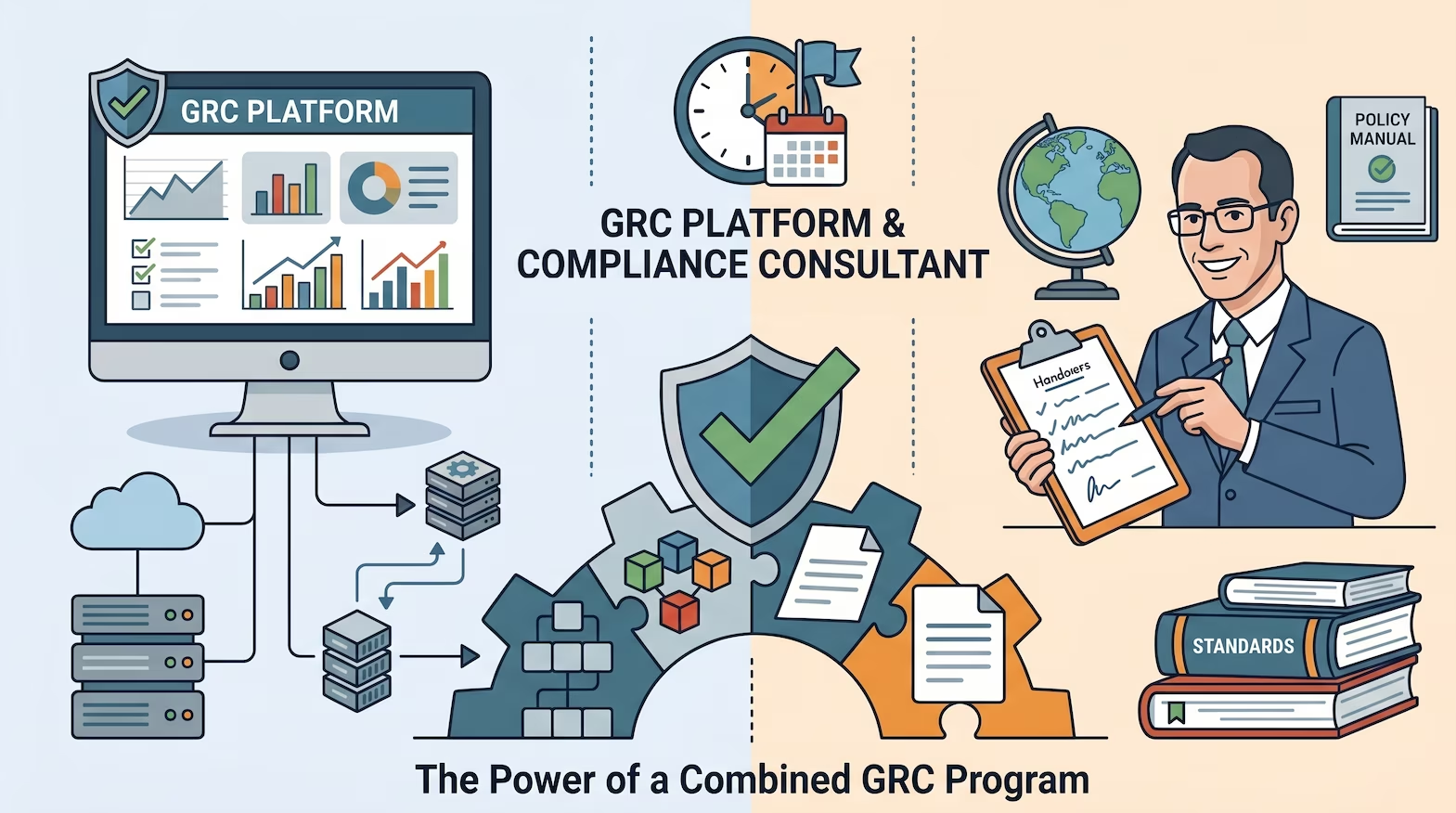
The question surfaces early in most compliance conversations: do we need a consultant, or can we just use the platform?
It is a reasonable question. GRC platforms like Vanta, Drata, Secureframe, and Scrut market a self-service path to compliance. Subscribe, connect integrations, follow the control library, collect evidence, engage an auditor. The platforms are good at what they do. For a specific subset of companies, the self-service path works.
But the question sets up a false choice. The platform automates evidence collection. The consultant designs the program. These are different functions, and neither replaces the other. Companies that skip the platform end up with a good program buried under manual evidence that decays between audits. Companies that skip the consultant end up with a dashboard that looks healthy but a program that does not hold up under scrutiny.
This is The Program Gap: the space between having a compliance tool and having an effective security program.
What the Platform Does Well
GRC platforms solve a real problem. Before automation, SOC 2 evidence collection meant screenshots, spreadsheets, and manual checks across every in-scope system. For a cloud-native company with ten or fifteen integrations, that manual approach consumes hundreds of hours annually and introduces the risk of gaps.
What Automation Handles
API-driven evidence collection from cloud providers, identity providers, and endpoint tools. Real-time control monitoring with stale-evidence alerts. Questionnaire automation and trust center management. Structured evidence packaging for auditor access. For a cloud-native SaaS company, the platform handles 60 to 70 percent of the compliance workload through automation alone.
That is substantial, and it is why skipping the platform to save money is almost always a false economy. A fintech startup was once advised by a competing vendor that a GRC platform was optional, that they could manage SOC 2 compliance manually with spreadsheets and screenshots. Technically true. Practically dangerous. SOC 2 involves 70 to 80 controls, each requiring four or five pieces of evidence, some renewed quarterly, some annually. Manually tracking all of that is not just inefficient, it is a compliance risk because evidence gaps become inevitable when collection depends on human memory.
What the Platform Cannot Do
Here is where the gap opens.
Scope definition. SOC 2 is principles-based. The AICPA never published a checklist of controls. Every control inside a GRC platform is one vendor's interpretation of how a hypothetical company might satisfy the SOC 2 Trust Services Criteria. The platform ships with a default control library written for a default tenant, usually a SaaS company on AWS or Azure. When a company's actual operations do not match that default, the platform's controls are scoring the wrong things.
A professional services firm recently started SOC 2 because an enterprise client required it. They subscribed to a leading GRC platform and started working through controls. Three weeks in, the platform showed 69% compliant. But the team could not tell how much of that score reflected their reality. The controls were written for a company with infrastructure, an application, and a board. The firm had none of those. The score was real, but it was scoring the wrong thing.
The Score Trap
A GRC platform compliance score reflects how well the company matches the platform's default control library. It does not reflect how ready the company is for an audit. For non-SaaS organizations especially, the gap between platform score and audit readiness can be significant.
Control design and customization. Template controls describe a generic company. CC1 (Control Environment) and CC6 (Logical and Physical Access) in particular are written assuming the entity owns systems, runs workloads, and provisions identities. A services firm whose work happens inside client-owned environments has to translate those criteria into its own context and bring the auditor along.
Policy customization. Adopting template policies as-is creates a specific risk: the policies describe what the platform thinks the company does, not what the company actually does. Auditors ask questions. If the policy says one thing and the company does another, that is a finding.
Compensating controls and auditor communication. When a standard control does not apply, someone needs to design a compensating control, document why the standard approach does not fit, and communicate the rationale in terms the auditor will accept. This is judgment-heavy work.
Program design. The platform provides a framework for tracking compliance activities. It does not answer questions like: what is our risk tolerance? How do we handle exceptions? What level of access review is appropriate for our size and complexity?
The Platform-Only Outcome
Companies that subscribe to a GRC platform without engaging a consultant tend to follow a predictable path:
- Connect integrations and start working through the default control library
- Make rapid early progress as the low-hanging fruit gets automated
- Hit a wall when controls require customization, scoping decisions, or policy work
- Spend weeks trying to figure out what the auditor actually needs
- Enter the audit with gaps that could have been identified and closed months earlier
- Receive findings that require remediation and a follow-up review
The platform score climbs steadily during stages one and two. It plateaus during stage three. The company interprets the plateau as almost done when it actually means the hard part starts now. The hard part, scoping, policy customization, compensating controls, and auditor communication, is exactly where a consultant adds value.
The Real Cost
The cost of the platform-only path is not the subscription fee. It is the CTO hours spent figuring out what a consultant already knows, the audit delays from scope misalignment, and the enterprise deals that close with a competitor while the team is still resolving findings.
The Consultant-Only Outcome
The opposite approach runs into a different problem. The consultant designs a sound program. Policies are customized. Controls are well-scoped. The auditor engagement goes smoothly. But evidence collection is manual.
This works for the first audit. Six months later, the evidence starts to decay. The quarterly access review gets pushed because the team is busy with a product launch. New employees are onboarded without enrollment in security training. A cloud configuration changes during a deployment and nobody notices because there is no continuous monitoring.
The consultant-only path produces a program that is well-designed on paper but fragile in practice. The program decays between audits because nobody automated the evidence that keeps it alive.
The Right Answer: Both, Working Together
The platform and the consultant serve different functions in the same program:
| Function | The Consultant Provides | The Platform Provides |
| Scoping | Judgment on what belongs in scope | Framework for tracking scoped systems |
| Controls | Design and customization | Monitoring and evidence collection |
| Policies | Customization to match real operations | Version tracking and review scheduling |
| Evidence | Defines what evidence is needed | Automates collection and storage |
| Auditor | Communication and negotiation | Structured evidence package |
| Operations | Program design and cadence definition | Continuous monitoring and alerting |
When both are in place, scoping is done correctly from the start so the platform monitors the right things. Controls are customized to match real operations so the platform score reflects reality. Evidence collection is automated so the program stays healthy between audits. Auditor communication is handled by someone who speaks the auditor's language. The CTO's time goes back to product work.
How to Structure the Engagement
For companies approaching compliance for the first time, the typical engagement model follows three phases:
Phase 1: Assess. The consultant evaluates the company's current state, defines scope, identifies gaps, and recommends the appropriate GRC platform based on the tech stack and compliance requirements.
Phase 2: Build. The consultant configures the platform, customizes controls, writes policies, implements technical controls, and prepares the environment for the auditor. The platform is operational by the end of this phase.
Phase 3: Operate. The consultant or the internal team runs the ongoing compliance cadences: evidence reviews, access review orchestration, integration monitoring, vendor risk updates, and audit preparation. The platform automates the evidence. The operator ensures the program behind the evidence is real.
Where nobody internal can hold that phase, the operator role is what our fractional security team takes on, running the program on the platform you already own.
The Math
The cost of the consultant plus the platform is lower than the cost of the platform alone when you factor in CTO hours, audit delays, remediation rework, and the opportunity cost of deals that stalled because the report was not ready.
The Assess and Build phases are one-time engagements. The Operate phase is ongoing, through a managed services engagement or knowledge transfer to an internal team. Companies that need help choosing this path can start with a SOC 2 consultant who operates both the program and the platform.
Close The Program Gap
Find out where your compliance program stands and what an effective security program requires beyond the platform.
Frequently Asked Questions
Do I need a consultant for SOC 2 if I already have a GRC platform?
A GRC platform automates evidence collection and control monitoring, but it does not define scope, customize controls to match your operations, write policies that reflect what your team actually does, or communicate with auditors on your behalf. Companies that use the platform without a consultant tend to hit a wall when controls require customization or scoping decisions. The platform handles the automation. The consultant handles the judgment.
Can I do SOC 2 with just a consultant and no platform?
Possible for the first audit, but fragile long-term. SOC 2 involves 70 to 80 controls, each with multiple evidence items on different renewal cycles. Manual evidence collection using spreadsheets and screenshots works until someone misses a quarterly review or a configuration change goes unmonitored. The platform automates the ongoing evidence that keeps the program alive between audits.
What is The Program Gap?
The Program Gap is the space between having a compliance tool and having an effective security program. Companies that buy a GRC platform often assume the tool is the program. The tool automates evidence and monitors controls, but it does not design the program, define risk tolerance, scope the assessment, or make judgment calls about compensating controls. The gap is the missing program work.
How much does a compliance consultant cost compared to going platform-only?
The consultant engagement adds cost upfront, but the total cost of compliance is typically lower when you include CTO hours diverted from product work, audit delays from scope misalignment, remediation rework from control gaps, and lost revenue from deals that stalled. Consultants with GRC platform partner pricing also reduce the platform subscription cost below retail.
Which GRC platform should I choose?
The best platform depends on the company's tech stack, applicable frameworks, team size, and integration requirements. Vanta, Drata, Secureframe, and Scrut each have strengths in different scenarios. A consultant who works across multiple platforms can recommend based on patterns from dozens of implementations rather than first-time experimentation.
Ready to Start Your Compliance Journey?
Get a clear, actionable roadmap with our readiness assessment.
Contact Us
Free Report: The CPCSC Compliance Playbook
Join the waitlist for a free copy when it's released.
About the Author

Former security architect for Bank of Canada and Payments Canada. 20+ years building compliance programs for critical infrastructure.