.svg)
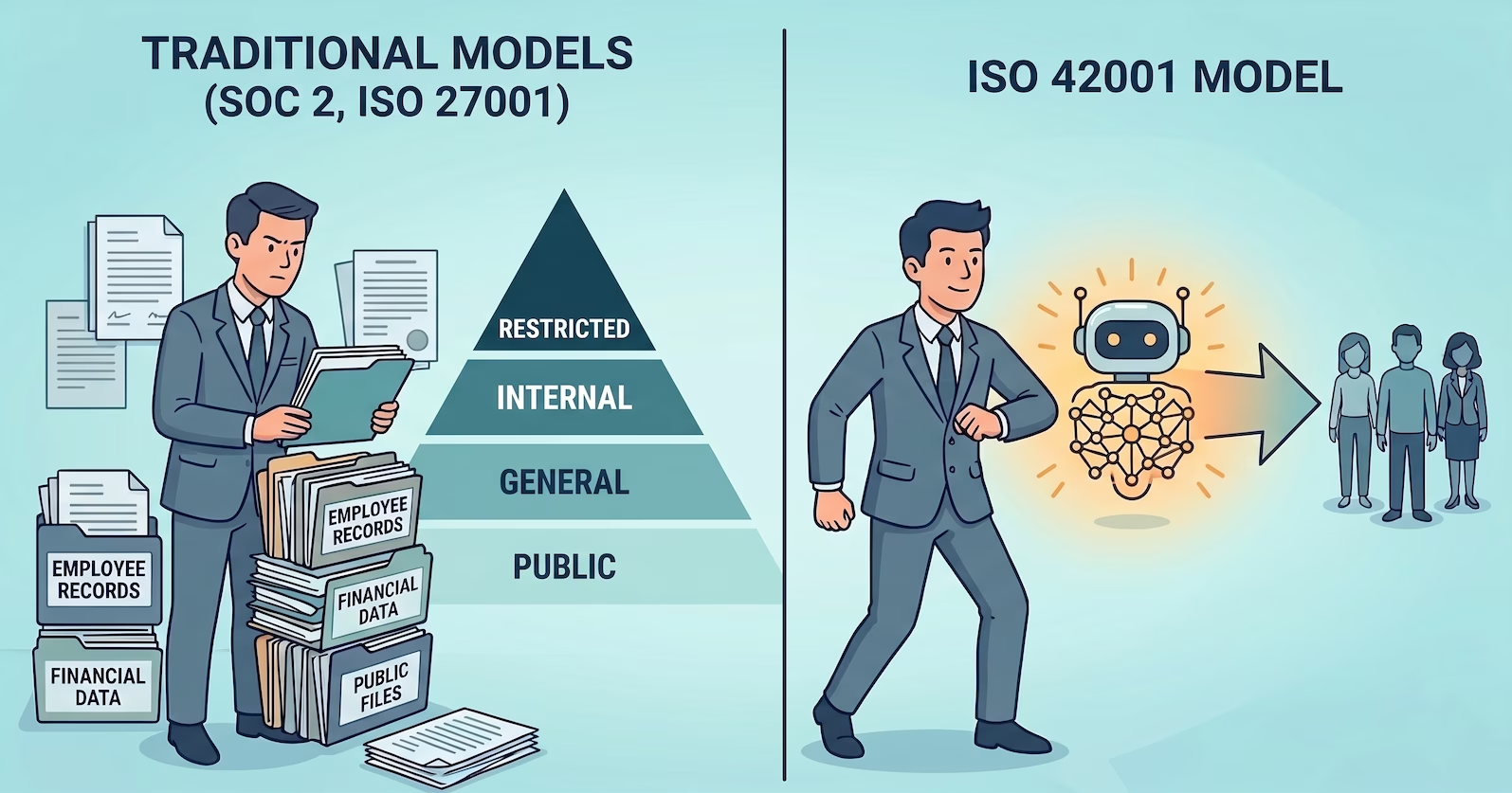
Every traditional compliance framework asks the same opening question. How sensitive is the data, and how well is it protected? SOC 2, ISO 27001, GDPR, HIPAA, PIPEDA. They all start with a classification exercise and work outward from there. Confidential, internal, public. Restricted, regulated, general. The whole machinery of controls assumes that risk lives in the data itself.
ISO 42001 asks a different question. How is AI being used, and what harm could that usage cause? The data classification is almost beside the point. A model trained entirely on public information can still be a high-risk system under ISO 42001 if it makes consequential decisions about people. Surveillance, hiring, credit scoring, healthcare triage. The data was never sensitive. The usage is.
That single reframe explains roughly 80% of why teams who try to bolt ISO 42001 onto their existing information security management system get stuck. The mental model is wrong from the first slide.
This piece is a CTO-level walkthrough of what ISO 42001 actually is, where it overlaps with the frameworks already in place, and where the gap is sharpest. It's the foundation post in a broader ISO 42001 implementation guide cluster, so the goal here is to install the mental model, not the implementation checklist.
The reframe: ISO 42001 governs AI usage, not data classification
Mike Kim, co-founder and CEO of Mycroft.io (a partner GRC platform that we run alongside our engagements), put it bluntly in a recent conversation. ISO 42001 doesn't care about the classification of data being touched.
It's a subtle line that takes a while to land for security teams who have spent a decade in ISO 27001 territory. In ISO 27001, the data asset register is the centre of gravity. Every control ultimately ties back to whether the right information is being protected at the right level. ISO 42001 inherits some of that scaffolding but moves the centre of gravity. The asset under management is not the data; it is the AI system, the way it is built, the way it is deployed, and the people it affects.
That has practical consequences. A recommendation engine trained on entirely public movie reviews can fall under high-risk obligations if it's used to shape what citizens see in a political feed. A bias mitigation control matters even if every input is technically open data. The framework cares about consequence, not classification.
Traditional frameworks vs ISO 42001
SOC 2 / ISO 27001 / GDPR: Protect the data. Start from sensitivity, work outward to controls.
ISO 42001: Govern the usage. Start from AI purpose and impact, work outward to lifecycle controls.
What an AI Management System actually is
ISO 42001 is built on the same management-system spine as ISO 27001. There is a documented scope, a policy, a risk methodology, a treatment plan, internal audits, management reviews, and a continual improvement loop. If you have run an ISMS through certification, the skeleton will feel familiar.
The substance is different. The object being managed is an AI Management System, abbreviated AIMS. The AIMS governs the full lifecycle of AI systems inside an organisation: intent, data sourcing, model training or selection, validation, deployment, monitoring, and eventual retirement. The control set, Annex A of ISO 42001, covers areas that don't exist in 27001 at all: data quality and provenance for training, transparency to affected users, oversight of automated decisions, lifecycle accountability, and impact assessments that consider societal and individual harm.
GRC Engineering, the practitioner community concept that's gained traction over the last two years, frames an AIMS the right way: as a system you operate, instrument, and improve, not a binder you assemble once. Anyone treating ISO 42001 as a documentation exercise is going to fail the audit on operational evidence, the same way teams used to fail SOC 2 Type II for the same reason.
The five AI roles you have to declare
Scoping ISO 42001 is harder than scoping ISO 27001. In an ISMS, the boundary is usually the corporate environment plus a defined set of production systems, and the asset categories are well-trodden. In an AIMS, the first job is to figure out which AI roles the organisation actually plays, because the obligations differ by role.
ISO 42001 names five:
- AI provider. The organisation that develops or supplies the AI system to others.
- AI producer. The organisation that develops AI systems for its own use or for a specific commissioning party.
- AI user. The organisation that deploys an AI system in its operations.
- AI customer. The organisation procuring an AI system from a provider.
- AI subject. The individuals or groups whose data, decisions, or outcomes are affected by the AI.
Most companies play more than one role. A SaaS vendor that uses an OpenAI model inside its product is both an AI user (consuming a third-party model) and an AI provider (offering AI-powered features to its customers). Each role triggers a different cluster of controls, and the relationships between them have to be documented, evidenced, and reviewed.
The scoping trap, in Mike Kim's words
Scoping ISO 42001 is meaningfully harder than scoping ISO 27001, because the same company plays multiple roles in the same AI system.
Mike Kim, co-founder and CEO, Mycroft.io
We see the same pattern in our engagements. Teams that try to write a scope statement in week one are usually rewriting it in week four.
The 20-30% overlap with SOC 2 and ISO 27001
The good news for teams already deep in security compliance: roughly a fifth to a third of an ISO 42001 implementation rides on top of work that's already done. Access control, change management, secure development, vendor management, incident response, business continuity. The security and privacy fundamentals that underpin a competent ISMS or a SOC 2 program carry forward.
This is where the audit once, comply many framing actually holds up. Evidence that satisfies SOC 2 CC6 access controls also satisfies the access-control expectations in ISO 42001 Annex A. The same identity governance program does double duty. The cross-mapping between SOC 2 and ISO 27001 is well established, and ISO 42001 extends that mapping rather than replacing it.
The other 70-80% is genuinely new. Data lineage and provenance for training sets. Model documentation and version control. Bias and fairness assessments. Human-oversight definitions for automated decisions. Stakeholder impact analysis. These have no real analogue in traditional frameworks, and they require a different muscle to build.
Where the gap is most painful
The harder problem is what ISO 42001 quietly assumes.
The hidden assumption that catches teams off guard
ISO 42001 almost assumes security is a solved problem, which is scary.
Mike Kim, co-founder and CEO, Mycroft.io
The framework presumes that the underlying information security program is already in place and operating. It does not re-prove ISO 27001 fundamentals. It does not require a baseline level of vulnerability management, identity governance, or logging maturity before the AI-specific controls land on top. It assumes those are there.
In practice, a lot of teams pursuing ISO 42001 do not have that foundation. They've shipped AI features quickly, sometimes ahead of any formal security program. Then a customer asks for AI governance evidence and the project starts upside down: AIMS controls being built on a security posture that has gaps in patch management, access reviews, and secret handling. That work has to happen anyway. Doing it under ISO 42001 audit pressure is the most expensive way to do it.
This is why our default position on AI governance engagements is to start with the foundation. Build an effective security program first. Map ISO 27001 or SOC 2 onto that foundation. Then layer ISO 42001 on top, where it can actually work as designed. Reverse the order and the controls feel artificial because they are.
What ISO 42001 actually requires you to do differently
Several specific obligations have no obvious parallel in older frameworks.
AI impact assessment. Distinct from a data protection impact assessment under GDPR. The AI impact assessment evaluates potential harms to individuals and to society, including bias, exclusion, and downstream effects on rights. It runs at the system level, not the data set level.
Data provenance and quality controls. Where training data came from, under what consent or licence, with what known biases or representativeness gaps. For models built in-house, this is a documentation burden. For models procured from third parties, it becomes a vendor-management discipline.
Transparency and explainability obligations. Affected users need a defined level of insight into when AI is making or shaping a decision about them. The depth varies by risk category, but the obligation is real.
Human oversight definitions. For each automated decision, the AIMS has to document whether oversight is human-in-the-loop, human-on-the-loop, or human-out-of-the-loop, with the rationale.
Lifecycle controls including retirement. ISO 42001 explicitly covers what happens when a model is decommissioned. Training data, model artefacts, downstream dependencies, customer disclosures. Most ISMS programs do not have a mature model-retirement playbook because they've never needed one.
See where you stand on ISO 42001 in 5 minutes.
Take the ISO 42001 Readiness ScorecardShould you pursue ISO 42001 right now?
The question we get most often, and the one with the least satisfying answer. It depends on who is asking for it and why.
Two patterns show up in conversations with security and engineering leaders.
The first is sales-driven. Enterprise prospects, particularly in regulated industries, are starting to ask AI governance questions in procurement. Sometimes those questions name a framework: ISO 42001, NIST AI RMF, the EU AI Act. Sometimes they're open-ended (describe your AI governance program) and the buyer is happy with a credible written response. In sales-driven cases, certification is rarely the immediate need. A documented AIMS that maps to ISO 42001, paired with a clear roadmap, often clears the procurement gate.
The second is compliance-driven. Operating in regulated sectors, selling into the EU, or being scoped under the EU AI Act as a provider of a high-risk system. Here the calculus shifts. A formal AIMS aligned to ISO 42001 starts to look like a sensible structural choice, because the work has to happen anyway and the framework provides a defensible structure for it. Whether to pursue certification is a separate decision from whether to build to the standard.
The Canadian auditor reality check
As of early 2026, only a small number of companies globally hold an ISO 42001 certificate, and the auditor pool is thin. In Canada specifically, there are currently only two accredited ISO 42001 auditors. Aggressive certification timelines should be pressure-tested against auditor availability before dates get locked in.
That has practical consequences for timelines and scheduling, and we've written separately about the state of ISO 42001 auditors in Canada. Globally the pool is growing, but anyone planning an aggressive certification timeline should pressure-test auditor availability before locking dates.
Most teams are better served by building the AIMS now, evidencing it for sales conversations, and timing certification to when both the auditor market and the internal program are ready. There's a companion piece comparing ISO 42001 vs AIUC-1 vs NIST AI RMF for teams trying to decide which framework to lead with, and which to follow.
The bottom line
ISO 42001 is not a harder version of ISO 27001. It is a different shape of framework, governing a different object, asking a different question. Teams that translate it through a data-protection lens will spend months building controls that don't quite fit and answering audit questions that don't quite land. Teams that internalise the reframe early, that AI governance is about usage and consequence rather than data classification, move through the work in roughly half the time and end up with a program that actually changes how AI gets built and deployed inside the business.
Protect the data is still the right instinct for SOC 2, ISO 27001, GDPR, and every framework built around information assets. Govern the usage is the instinct ISO 42001 demands. The frameworks that come after it will probably inherit the same logic. The teams that learn it now will not have to learn it again.
BUILD ISO 42001 ON A REAL FOUNDATION
An effective security program is the foundation an AIMS sits on. We help you build it before audit pressure forces the order.
Further reading
- ISO 42001 implementation guide for AI-driven SaaS companies
- SOC 2 vs ISO 27001: which framework should lead?
- ISO 42001 vs AIUC-1 vs NIST AI RMF: picking the right AI framework
- Effective Security First: the special report
Frequently asked questions
Is ISO 42001 the same as the EU AI Act?
No. ISO 42001 is a certifiable management-system standard published by ISO; the EU AI Act is binding EU legislation with category-based obligations and penalties. They overlap conceptually, and a well-built ISO 42001 program is a strong scaffolding for EU AI Act readiness, but certifying to one does not satisfy the other.
Do I need ISO 27001 before ISO 42001?
Not strictly. ISO 42001 does not name ISO 27001 as a prerequisite, but it assumes the underlying security program is already operating. In practice, teams without that foundation end up building AIMS controls on top of patch, identity, and logging gaps that surface during the audit anyway.
How is ISO 42001 different from NIST AI RMF?
NIST AI RMF is a voluntary risk-management framework; ISO 42001 is a certifiable management-system standard. RMF gives a vocabulary and a set of practices to apply internally. ISO 42001 lets a third party audit and certify that an organisation actually operates an AI Management System.
How long does ISO 42001 certification take?
Plan on a few months of preparation to stand up a defensible AIMS, then auditor scheduling on top. In Canada the auditor queue is currently the longer pole; locking dates early is more important than compressing the prep timeline.
Who can certify my company for ISO 42001 in Canada?
By our market scan in early 2026, only a small number of accredited bodies in Canada are positioned to certify ISO 42001, and the queue is thin. Companies on tight timelines should confirm auditor availability before committing to a certification date, not after.
Ready to Start Your Compliance Journey?
Get a clear, actionable roadmap with our readiness assessment.
About the Author

Former security architect for Bank of Canada and Payments Canada. 20+ years building compliance programs for critical infrastructure.