
.svg)
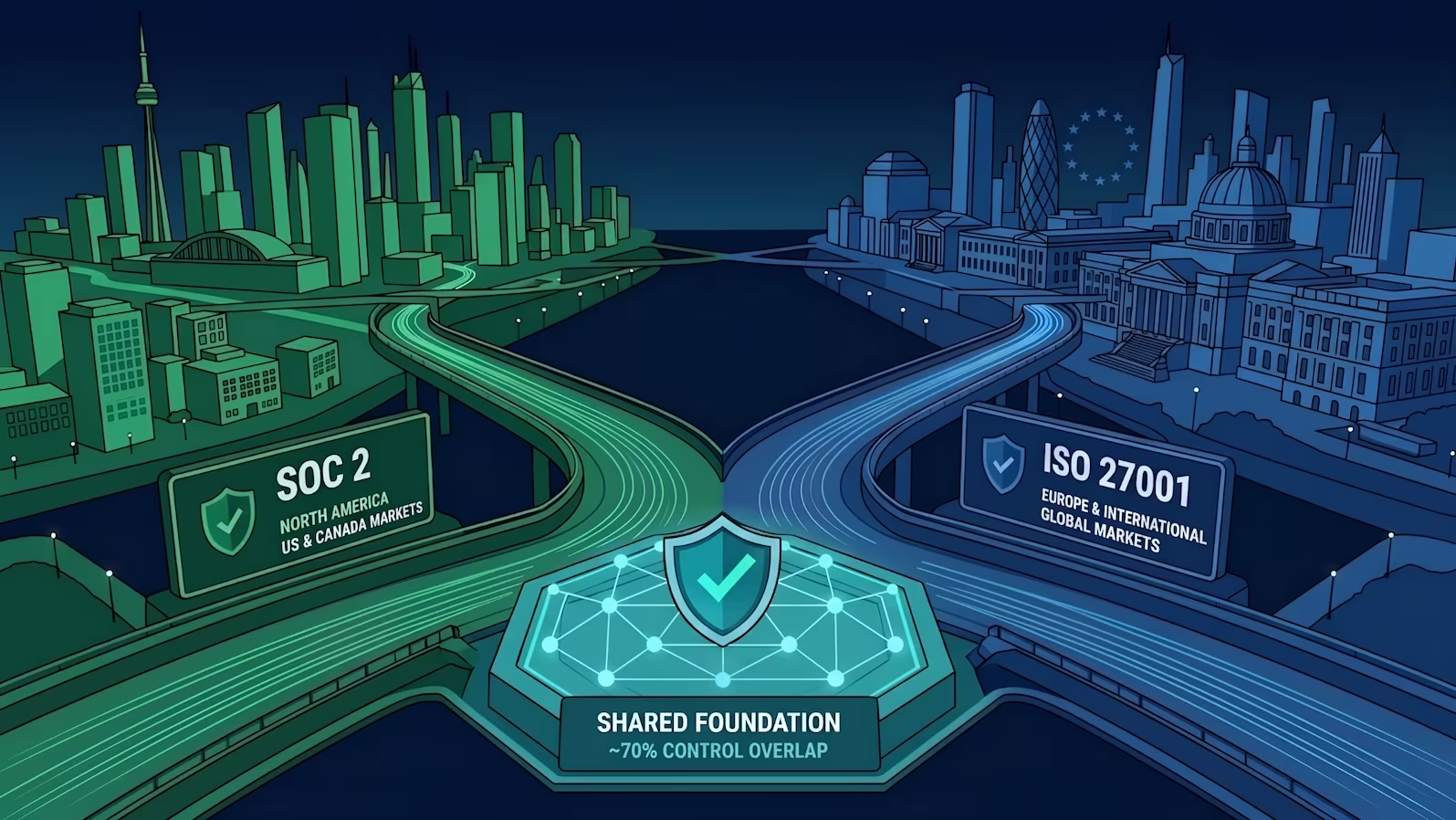
The answer is almost always determined by one thing: who is buying from you and where they are located. US enterprise buyers want SOC 2. EU and government buyers want ISO 27001. Choosing the wrong one first does not just delay certification — it delays the deals certification is meant to unlock.
The Customer-Geography Test: Who Is Buying and Where
The most reliable decision framework is straightforward: map the current customer base and pipeline against geography and buyer type.
North American enterprise buyers. US and Canadian enterprise procurement almost universally expects SOC 2. The report format is embedded in vendor risk programs, security questionnaires, and SaaS procurement workflows across the continent. When a procurement team asks for compliance documentation, they are expecting a SOC 2 report. Providing an ISO 27001 certificate instead creates friction — not because ISO 27001 is unrecognized, but because it does not give the buyer what they actually want.
The difference is structural. SOC 2 produces a 40 to 50-page report describing the control environment in detail: what controls exist, how they were tested, what the auditor found. Enterprise buyers review that document and draw their own risk conclusions. ISO 27001 produces a one or two-page certificate confirming the ISMS meets the standard. Buyers who want to evaluate the control environment cannot do that with a certificate alone.
European and international buyers. ISO 27001 is the dominant standard in EU enterprise procurement, UK government supply chains, and regulated verticals like financial services and healthcare outside North America. For companies expanding into these markets, ISO 27001 is frequently a contract requirement rather than a preference.
Government and public sector. Canadian government contracts, UK public sector procurement, and defence supply chains in multiple jurisdictions increasingly require ISO 27001 as a baseline vendor requirement. For companies targeting federal or provincial government sales in Canada, ISO 27001 often appears earlier in the requirement set than SOC 2.
The Geography Rule in Practice
A software company with most of its revenue from US enterprise buyers and a US enterprise pipeline should start with SOC 2. A company targeting UK NHS procurement or EU financial institutions should start with ISO 27001. The customer base makes the decision — not the frameworks themselves.
What SOC 2 Gets You
SOC 2 is the standard for software companies selling to North American enterprise buyers. In practice, this means three concrete things.
Sales cycle compression. Enterprise procurement teams with a completed vendor questionnaire and a SOC 2 report move faster. The report provides the evidence that security review teams need without back-and-forth on specific controls or custom questionnaire responses.
Security questionnaire coverage. The majority of security questionnaires from US enterprise buyers are structured around SOC 2 Trust Services Criteria. A mature SOC 2 program makes those questionnaires answerable in hours rather than days, and the answers are defensible because they are backed by an auditor's report.
Credibility with buyers who understand the format. US enterprise security teams know what to look for in a SOC 2 report. A clean Type 2 report with no exceptions is a meaningful positive signal. ISO 27001 certification does not provide the same signal because it does not contain the same level of operational detail.
SOC 2 Type I is the faster path to a marketable credential, typically achievable in three to six months from a solid starting point. Type II follows after a minimum six-month observation period and is what most enterprise buyers ultimately require. For a detailed breakdown of the Type I and Type II sequencing decision, the SOC 2 Type 1 vs. Type 2 guide covers the trade-offs in depth.
What ISO 27001 Gets You
ISO 27001 is the international standard for information security management systems. Its value is different from SOC 2, and in several contexts more valuable.
EU and UK market access. ISO 27001 is the dominant compliance credential for enterprise procurement outside North America. Companies expanding into European markets frequently find it listed as a contract requirement.
Government and regulated sector access. Public sector procurement — particularly in Canada, the UK, and EU member states — regularly requires ISO 27001 as a baseline vendor requirement. For defence supply chain work and federal contracts, it often appears before SOC 2 in the requirements list.
Long-term program maturity. ISO 27001 requires building an Information Security Management System with formal governance, management review cycles, internal audits, and a documented continual improvement process. These requirements push organizations toward a more structured security posture than SOC 2 alone typically demands. Companies that complete ISO 27001 tend to have more mature risk management processes regardless of what other certifications they pursue.
Recognition across more than 180 countries. For companies with global expansion plans, ISO 27001 carries recognition in markets where SOC 2 is unknown or uncommon.
ISO 27001 carries additional requirements that go beyond SOC 2 — the Statement of Applicability, formal internal audit program, and management review cycles among them. For most organizations, those requirements reflect sound security governance independently of compliance drivers. The ISO 27001 consulting guide covers what the implementation process looks like from scoping through certification.
The Control Overlap Advantage: Why the Second Certification Is Faster
One of the most important factors in the sequencing decision is what the first certification leaves behind.
SOC 2 and ISO 27001 share roughly 70% of their technical controls. Access control, change management, incident response, network security, and vulnerability management look nearly identical across both frameworks. A company that completes SOC 2 has already built, documented, and tested the majority of what ISO 27001 requires.
~70% Control Overlap
SOC 2 and ISO 27001 share roughly 70% of their technical controls. Whichever certification you build first, you are building the majority of the second at the same time. The incremental work for the follow-on certification is documentation and scoping, not a full rebuild.
The incremental work for the second certification focuses on the areas where the frameworks diverge. ISO 27001 adds requirements around formal ISMS governance, a Statement of Applicability, internal audit programs, and threat intelligence controls. SOC 2 adds specific Trust Services Criteria around availability, confidentiality, and processing integrity that ISO 27001 does not independently address.
Companies that complete SOC 2 Type I and then move to ISO 27001 can compress the second certification significantly. Organizations using a GRC platform from the start, structuring evidence collection against both frameworks simultaneously, find that the second audit is largely a documentation and scoping exercise rather than a new implementation. The SOC 2 vs. ISO 27001 comparison covers the domain-by-domain control mapping in detail.
The Recommendation: Which Framework to Pursue First
Buyers are primarily in the US and Canada
Start with SOC 2. Pursue Type I within the first six months to have a marketable credential, then move through the Type II observation period. Add ISO 27001 once Type II is complete and the pipeline justifies the investment in international market access.
Buyers are primarily in Europe, the UK, or government supply chains
Start with ISO 27001. The certification builds ISMS governance that will make the subsequent SOC 2 program more structured and evidence-complete. US market entry can be bridged with a security posture report while the SOC 2 process runs — a summary document explaining the security program in terms US buyers recognize, buying time during the formal audit process.
Pipeline is split between both markets
Consider a parallel build approach. This is not the same as running two separate programs. It means building against the union of both frameworks from the start, using a single policy set, risk register, and evidence repository that satisfies both. The sequencing then becomes an audit timing question rather than an implementation question. The SOC 2 and ISO 27001 FAQ covers common questions about running combined programs.
Special Case: Getting Both Within 18 Months
For organizations where both certifications are required within a compressed timeline, the strategy looks different.
The most efficient path starts before touching any GRC platform or auditor: build the security program correctly first, then let the certifications follow from it.
In practice, this means working with someone who understands both frameworks and can see the full picture before any scoping decisions are made. The first step is mapping data flows and network architecture — what data you hold, where it moves, what systems touch it, and where your trust boundaries are. Without that map, scoping decisions for both SOC 2 and ISO 27001 are guesswork, and guesswork creates audit findings.
The second step is mapping the security program itself: what controls are already operating, where the gaps are against the union of both frameworks, and what needs to be built versus documented. Most organizations have more in place than they realize. The work is identifying it, structuring it, and filling the genuine gaps rather than rebuilding from scratch.
From there, a single policy set, a unified risk register, and one evidence repository serve both certifications. The frameworks are lenses on the same program, not separate programs. Audit sequencing — SOC 2 Type I first, then ISO 27001 Stage 1 and Stage 2 — becomes a scheduling decision rather than a design decision.
Realistic Timeline: Both Certifications in 10 to 14 Months
Organizations that build a unified security program against the combined SOC 2 and ISO 27001 control set — rather than treating them as separate programs — consistently compress a timeline that would otherwise stretch to 18 to 24 months. The second audit is largely a documentation exercise, not a new implementation.
The Sequencing Decision Is a Revenue Decision
Compliance sequencing feels like a technical question. In practice, it is a revenue question.
The wrong framework first does not just delay certification. It delays the deals that certification is meant to unlock. A company spending 12 months on ISO 27001 while its US enterprise pipeline stalls on missing SOC 2 documentation is not making a technical error — it is making a business planning error.
The framework that opens the most doors in the next 18 months is almost always the right one to pursue first. In most cases, buyer geography makes that choice clear. In the cases where it does not, the parallel build strategy converts a sequencing problem into an implementation challenge that is considerably easier to solve.
Deciding which certification to pursue first is a scoping conversation, not a sales conversation. If the customer base and pipeline are not clearly pointing at one framework, we can map the pipeline against framework requirements and provide a specific recommendation. Book a call to work through the decision.
Already know which framework to pursue? Learn more about ISO 27001 Certification Services or the SOC 2 Accelerator.
Map Your Pipeline to the Right Framework
One effective security program can satisfy both SOC 2 and ISO 27001. We help you decide which to build first.
Frequently Asked Questions
What is the main difference between ISO 27001 and SOC 2?
ISO 27001 is an international standard that certifies an organization's Information Security Management System meets defined requirements. It produces a one or two-page certificate. SOC 2 is an attestation standard used primarily in North America that produces a detailed 40 to 50-page auditor report describing your specific controls and how they were tested. Enterprise buyers in different geographies expect different formats.
Which takes longer to get, ISO 27001 or SOC 2?
Both typically require six to twelve months for a first certification, depending on starting point and program maturity. SOC 2 Type I can be achieved in as little as three to four months with a strong foundation. ISO 27001 has a mandatory two-stage audit process with a gap between Stage 1 and Stage 2. SOC 2 Type II requires a minimum six-month observation period before the audit, making it the longer path to a full audit report.
Do US enterprise buyers accept ISO 27001 instead of SOC 2?
Generally, no. US enterprise procurement workflows are structured around SOC 2 reports. An ISO 27001 certificate is recognized, but it does not provide the detailed control evidence that US security review teams expect. Providing a certificate when a report is expected creates friction in the sales process rather than resolving it. Companies targeting US enterprise buyers should lead with SOC 2.
Can you pursue SOC 2 and ISO 27001 at the same time?
Yes, and for organizations with pipeline in both North American and international markets, a parallel build approach is often the most efficient path. This means building a unified security program against the combined control set of both frameworks from the start, using a single policy set, risk register, and evidence repository. The certifications are then staggered by audit timing rather than implementation timeline.
How much does the second certification cost if you already have the first?
Significantly less than the first. Because SOC 2 and ISO 27001 share roughly 70% of their technical controls, most of the implementation work carries over. The incremental cost for the second certification is primarily the audit fee and the work to address the gaps specific to that framework — typically the Statement of Applicability and internal audit program for ISO 27001, or the availability and processing integrity criteria for SOC 2. Organizations that structured their first program with the second in mind can cut the second certification budget by 40 to 60%.
What is the fastest way to get both SOC 2 and ISO 27001?
Build the security program against the union of both frameworks before engaging either auditor. Map data flows and network architecture first, then identify gaps against the combined control set. A unified policy set, risk register, and evidence repository serves both certifications. Sequence the audits — SOC 2 Type I first, then ISO 27001 Stage 1 and Stage 2 — as a scheduling decision. Organizations using this approach consistently complete both certifications in 10 to 14 months instead of 18 to 24.
Ready to Start Your Compliance Journey?
Get a clear, actionable roadmap with our readiness assessment.
Contact Us
Free Report: The CPCSC Compliance Playbook
Join the waitlist for a free copy when it's released.
About the Author

Former security architect for Bank of Canada and Payments Canada. 20+ years building compliance programs for critical infrastructure.