
.svg)
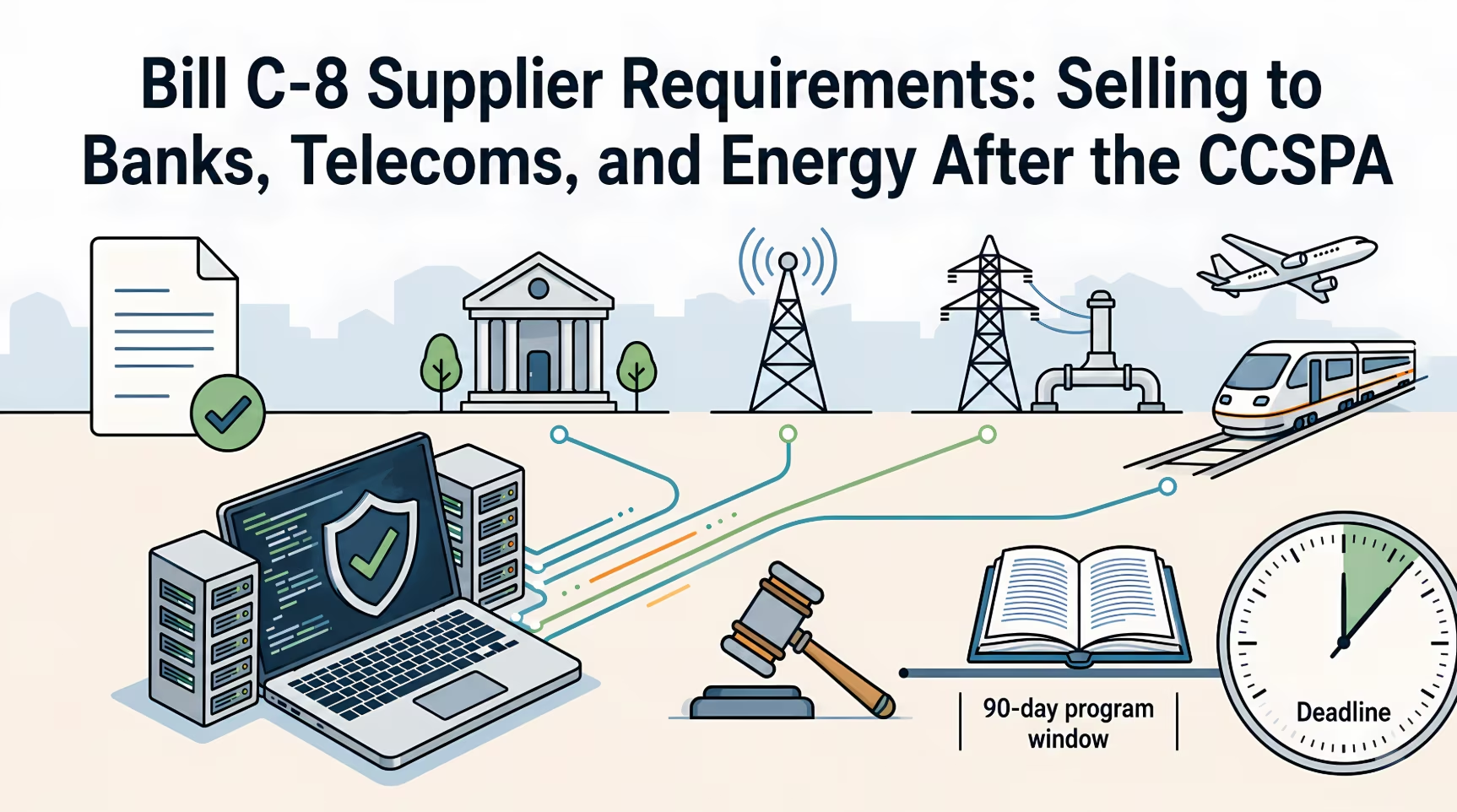
Bill C-8 is law, and its centrepiece, the Critical Cyber Systems Protection Act (CCSPA), places no direct obligations on the software and technology companies that sell into Canada's critical infrastructure sectors. It reaches you anyway, through your customers: for a vendor selling into these sectors, the customer's security review is about to become a gate on your revenue.
Bill C-8 supplier requirements at a glance
- In force: Royal Assent June 16, 2026; the CCSPA is enacted but not yet operative, awaiting a coming-into-force order and Schedule 2 designations
- Who feels it: vendors selling to designated operators in six Schedule 1 sectors (telecom, pipelines and power lines, nuclear, federal transportation, banking, clearing and settlement)
- Why it reaches vendors: operators must identify and mitigate supply-chain and third-party risk, and keep records in Canada proving it, under a due diligence defence
- Contract impact: security questionnaires, incident-notification windows likely 24 to 48 hours, audit and assurance rights, secure development attestations
- Enforcement backdrop: administrative penalties up to $15 million per violation for operators, each continuing day a separate violation
- Operator clock: 90 days from designation to a working cyber security program
What does the CCSPA require of the operators buying from you?
The CCSPA requires each designated operator to establish a cyber security program within 90 days of its class being designated, and the statute names supply-chain and third-party risk as a mandatory element of that program. The program must set out reasonable steps to identify and manage the organization's cyber security risks, including those associated with its supply chain and its use of third-party products and services, to protect its critical cyber systems from compromise, to detect incidents, and to minimize their impact. The CCSPA cyber security program requirements guide breaks down the full obligation set.
Two further duties matter for vendors:
- A standing mitigation obligation that operates independently of the program: as soon as an operator identifies a supply-chain or third-party risk, it must take reasonable steps to mitigate it.
- A record-keeping obligation: the operator must keep records in Canada documenting those mitigation steps, alongside records of its program implementation and every reported incident.
Because the operator's evidence of reasonable steps is, in large part, evidence about its vendors, that documented duty generates paperwork for suppliers.
The enforcement stakes explain why operators will treat this seriously. The CCSPA authorizes administrative monetary penalties of up to $15 million per violation for organizations, and a violation that continues over multiple days counts as a separate violation for each day it continues. Failing to mitigate an identified supply-chain risk is also prosecutable as an offence, and directors and officers who authorize or acquiesce in a violation are personally liable whether or not the organization itself is pursued.
Why the paperwork lands on vendors
The Act pairs its penalties with a due diligence defence, which is precisely why documented vendor management matters to operators: the paper trail of questionnaires, contract clauses, and assessments is the defence.
The CCSPA is enacted but not yet operative. Its obligations come into force on dates set by the Governor in Council, and the 90-day program clock only starts once operator classes are formally designated in Schedule 2 and published in the Canada Gazette. The regulations that will fix incident-reporting windows, program particulars, and penalty schedules are still to come.
The gap between Royal Assent and coming-into-force is the window in which operators build their vendor-risk machinery, and law-firm guidance to operators is consistently to start now. For the full legislative picture, see our guide to Bill C-8 and the Critical Cyber Systems Protection Act.
Which of your customers are likely covered?
Any customer operating in the six Schedule 1 sectors is a candidate for designation:
- Telecommunications services
- Interprovincial or international pipeline and power line systems
- Nuclear energy systems
- Federally regulated transportation systems
- Banking systems
- Clearing and settlement systems
The precise classes of designated operators will be named by Governor in Council order, so no company is formally a designated operator yet. But a vendor whose customer list includes a bank, a telecom carrier, a payments processor connected to national clearing systems, a pipeline operator, or a federally regulated railway or airline should assume the flow-down is coming.
The list can also grow. The Governor in Council may add further federally regulated services and systems to Schedule 1 without new legislation, which means the CCSPA's reach expands by order, not by parliamentary debate. A vendor whose customers sit adjacent to the current six sectors should watch designation orders rather than assume permanent exemption.
Clearing and settlement is a useful reference point: that infrastructure moves more than $400 billion in transactions nightly, and analyses expect the Bank of Canada to act as its regulator under the CCSPA.
Institutions like these already run mature third-party risk programs. What the CCSPA changes is that their vendor scrutiny stops being an internal policy choice and becomes evidence in a statutory compliance file, which removes the discretion a friendly procurement contact once had to wave a vendor through.
What will Bill C-8 supplier requirements look like in a contract?
The statute never mentions vendor contracts; the contract clauses are the operator's chosen instrument for discharging duties the statute does impose. Everything in this section is a practical inference, the same one the major Canadian law firms are drawing in their guidance to operators: a documented, defensible supply-chain risk program means security schedules, questionnaires, and flow-down clauses in vendor agreements.
| Contract clause | What vendors should expect |
| Incident notification in hours, not days | A designated operator must report incidents affecting, or with the potential to affect, its critical cyber systems to the Communications Security Establishment's Cyber Centre within a window regulations will fix and the statute caps at 72 hours, so it cannot accept a vendor clause promising notification without undue delay. Expect defined vendor-notification windows of 24 or 48 hours, obligations to report suspected as well as confirmed incidents, named escalation contacts, and coverage of near misses, since the statutory trigger includes potential interference, not only completed breaches. |
| Right-to-audit and assurance | An operator that must document reasonable mitigation steps wants more than a signed questionnaire. Expect requests for audit rights, penetration test summaries, and independent assurance reports, with the audit right often negotiable down to provide your SOC 2 Type II report annually plus a right to ask follow-up questions. |
| Secure development and product security attestations | Because the operator's duty covers risks from third-party products as well as third-party access, expect questions about secure development lifecycle practices, vulnerability management and disclosure processes, software composition, and patch commitments. Be ready to describe how code moves from commit to production and who can touch it along the way. |
| Evidence on request and record-keeping support | Operators must keep records in Canada documenting mitigation steps, and some of that record is vendor-supplied: certificates, report letters, questionnaire responses, remediation confirmations. Expect contract language obliging the vendor to provide updated evidence periodically and after material changes. |
| Sub-processor and fourth-party visibility | An operator assessing its supply chain will not stop at its direct vendors. Expect questions about sub-processors, hosting providers, and critical dependencies, and clauses requiring notice before material changes to them. |
Telecom vendors face an additional statutory exposure
Part 1 of Bill C-8 amended the Telecommunications Act effective at Royal Assent, and it empowers the Governor in Council and the Minister of Industry to prohibit a telecom provider from using a specified supplier's products or services and to order existing products removed from networks. For that sector, supplier risk extends beyond procurement: the government can order a vendor's products out of the network entirely.
How far does SOC 2 or ISO 27001 get you, and where are the gaps?
An existing SOC 2 Type II report or ISO 27001 certification answers a substantial share of what these customers will ask, which is one more reason those programs pay for themselves in enterprise revenue. Governance, risk assessment, access control, change management, logging and monitoring, incident response capability, business continuity: a vendor with a real program behind either framework can answer these categories with evidence rather than prose. We have mapped how the underlying control families line up in our CCSPA to ISO 27001, NIST CSF, and CPCSC crosswalk.
Four gaps are where deals stall.
| Gap | Where SOC 2 or ISO 27001 falls short |
| Notification speed | SOC 2 and ISO 27001 verify that an incident response process exists and operates; neither commits the vendor to notifying a specific customer within a specific number of hours. That commitment lives in the contract, and a vendor whose incident runbook has never been tested against a 24-hour external notification requirement should not sign one untested. |
| Product security depth | SOC 2's change management criteria touch the development pipeline, but a buyer worried about third-party product risk will probe deeper than a Trust Services mapping: dependency management, build integrity, vulnerability disclosure, secure-by-design evidence. ISO 27001's Annex A gets closer, yet certification scope often excludes the product engineering detail these buyers will ask about. |
| Supply-chain specifics | The questionnaires will ask the vendor the same questions the operator is answering upstream: who are the vendor's own critical suppliers, and how are they assessed? A company that has never formalized its own third-party risk process will find this section empty. |
| Residency and jurisdiction | Operators must keep compliance records in Canada, and several will extend data residency preferences to their vendors. This appears as a question long before it appears as a requirement, but where does our data live and under whose jurisdiction deserves a precise answer. |
The pattern here resembles what defence suppliers discovered when mapping SOC 2 against CPCSC: substantial overlap, with the gaps concentrated in exactly the places the new requirement cares about most. Our SOC 2 to CPCSC mapping guide walks through that exercise, and the method transfers directly.
How does Bill C-8 compare to CPCSC for suppliers?
Bill C-8 is the second supply-chain security gate Canada has built in two years. On the defence side, the Canadian Program for Cyber Security Certification requires suppliers to defence contracts to certify against ITSP.10.171, with supply-chain obligations that flow down through subcontractors. On the critical infrastructure side, the CCSPA obliges designated operators to manage third-party risk and leaves the flow-down to contracts.
| Regime | How it reaches the vendor |
| CPCSC | Certifies the supplier directly: a defence vendor holds its own certification, at a defined level, verified through a defined process. |
| CCSPA | Never touches the vendor; it disciplines the operator, and the vendor feels the discipline second-hand through procurement. |
We compare the two regimes in detail in Bill C-8 vs CPCSC, but the strategic read is the same from either side: for a growing share of the Canadian economy, demonstrable security posture is becoming a condition of being a supplier at all.
That convergence is good news for vendors that prepare once and reuse the work. A security program built on a recognized framework, with evidence organized for external scrutiny, answers the bank's questionnaire, the defence prime's flow-down, and the telecom's security schedule from the same corpus. Compliance stops being a per-customer tax and becomes a single asset that unblocks multiple markets.
What should you prepare this quarter?
The regulations are unwritten and the designation orders unpublished, which makes this quarter the cheapest time to prepare. Six concrete steps:
- Map customer exposure. List every customer and active prospect in the six Schedule 1 sectors, plus any whose parent or key customers sit there. The result shows how much of the pipeline the CCSPA flow-down touches and how urgent the remaining steps are.
- Stress-test incident notification. Take the existing incident response plan and run a tabletop against a hypothetical 24-hour customer notification clause, including the suspected-incident trigger. Record what broke. Decide, before a contract forces the issue, the shortest window the team can honestly commit to.
- Assemble the security package. One folder, current and reusable: SOC 2 report or ISO 27001 certificate, penetration test summary, questionnaire answer bank, sub-processor list, insurance certificates, secure development overview. If evidence lives in a GRC platform such as Vanta, Drata, or Secureframe, build the export now; the platform holds the evidence, but the package that procurement reads still has to be curated.
- Pre-negotiate the contract positions. Decide in advance what the company can accept on audit rights, notification windows, and attestations, and what the fallback offers are. A vendor that responds to a security schedule in days, with reasoned redlines, reads as lower-risk than one that goes silent for three weeks.
- Close the named gaps. Product security evidence, an internal third-party risk process, and a data residency answer are the recurring holes in otherwise solid SOC 2 and ISO 27001 programs. Each is a bounded project, not a rebuild.
- Watch the Canada Gazette. Coming-into-force orders, Schedule 2 designations, and draft regulations will land there first. The incident-reporting window in particular, anywhere up to the 72-hour cap, will calibrate what operators demand from vendors.
The compliance waves we have worked through, from SOC 2 in enterprise SaaS procurement to CPCSC in the defence supply chain, followed the same sequence: procurement requirements arrived ahead of enforcement, and the suppliers who could answer them early won the deals that stalled for everyone else. Bill C-8 hands prepared vendors that same head start, this time across banking, telecom, energy, and transportation. The security review is becoming the revenue gate for Canada's critical infrastructure market, and the gate is opening first for the companies holding their evidence ready.
For vendors that want an existing SOC 2 or ISO 27001 program re-cut to what operator customers will ask for, Truvo's Bill C-8 compliance service starts with an exposure read and a gap analysis.
Turn the Security Review Into Revenue
Truvo helps Canadian vendors build an effective security program that answers every buyer's questionnaire from one evidence corpus.
Frequently Asked Questions
Does Bill C-8 apply to companies that only sell to critical infrastructure operators?
Not directly. The CCSPA places obligations on designated operators, not their vendors. But because operators must identify and mitigate supply-chain risk and keep records in Canada proving it, they push those requirements into vendor contracts through questionnaires, audit rights, and incident-notification clauses. Suppliers feel Bill C-8 second-hand, through procurement.
Which of my customers are covered by the CCSPA?
Any customer in the six Schedule 1 sectors is a candidate: telecommunications, interprovincial or international pipelines and power lines, nuclear energy, federally regulated transportation, banking, and clearing and settlement systems. No organization is a designated operator until the Governor in Council names its class in Schedule 2, so watch designation orders rather than assume permanent exemption.
How fast will contracts require vendors to report incidents?
Designated operators must report to the Cyber Centre within a window the statute caps at 72 hours, so they cannot accept vague vendor promises. Expect defined vendor-notification windows of 24 or 48 hours, an obligation to report suspected as well as confirmed incidents, and coverage of near misses, since the statutory trigger includes potential interference.
Does a SOC 2 or ISO 27001 report answer these requirements?
Largely, yes. Either framework covers governance, access control, change management, logging, incident response, and business continuity with evidence. The gaps are notification speed, product security depth, the vendor's own supply-chain process, and data residency, which is exactly where these buyers probe hardest.
How is Bill C-8 different from CPCSC?
CPCSC certifies the supplier directly: a defence vendor holds its own certification at a defined level, verified through a defined process. The CCSPA never touches the vendor; it disciplines the operator, and the vendor feels the requirement second-hand through procurement contracts. Both make demonstrable security a condition of winning regulated Canadian revenue.
What should a vendor do before the regulations land?
Map which customers sit in the six sectors, stress-test incident response against a 24-hour notification clock, assemble a current security evidence package, pre-negotiate contract positions on audit rights and notification windows, close the product security, third-party risk, and residency gaps, and watch the Canada Gazette for designation orders and the reporting window.
If customers in banking, telecommunications, energy, or transportation are starting to ask harder security questions, that is the CCSPA flow-down arriving early. We run a vendor readiness assessment that maps an existing SOC 2 or ISO 27001 program against the requirements designated operators will push into contracts, and returns a gap list with the notification, product security, and evidence items ranked by deal impact. Book a scoping call to see whether it fits.
Ready to Start Your Compliance Journey?
Get a clear, actionable roadmap with our readiness assessment.
Contact Us
Free Report: The CPCSC Compliance Playbook
Join the waitlist for a free copy when it’s released.
About the Author

Former security architect for Bank of Canada and Payments Canada. 20+ years building compliance programs for critical infrastructure.