










Assess

Cybersecurity risk assessment services

A rated risk register with likelihood, impact, an owner and a treatment decision on every risk, built from your own systems and mapped to the ISO 27001, SOC 2 or NIST requirement that asked for the assessment.

Ali Aleali

Ali Aleali, CISSP, CCSP

Co-Founder & Principal Consultant

Former security architect for Bank of Canada and Payments Canada. CISSP, CCSP, more than twenty years in enterprise security. Leads every engagement.

Connect on LinkedIn

What a cybersecurity risk assessment covers

One method, aligned to ISO/IEC 27005 and NIST SP 800-30 Rev 1, applied to the clause or criterion that asked for the assessment.

icon-6

Scope and risk criteria agreed first

Assets, systems, data and third parties named, plus the likelihood scale, the impact scale and the acceptance threshold, as ISO 27001 clause 6.1.2 requires before any risk is rated.

icon-7

Threats and vulnerabilities from your environment

Identified per in-scope asset with the people who operate each system, so every entry in the register describes a system your team recognizes.

icon-3

Likelihood and impact rated on your scale

Each risk rated against the business impact your leadership already uses, with the reasoning written next to the rating so a second assessor reaches the same result.

icon-5

A treatment decision on every risk

Mitigate, transfer, avoid or accept, each with a named owner, a target date and a review date, and residual risk approved by the risk owner as clause 6.1.3 requires.

icon-2

Mapped to the requirement that asked for the assessment

ISO 27001 clauses 6.1.2, 6.1.3 and 8.2 and the Statement of Applicability, SOC 2 CC3.1 to CC3.4, ISO 42001 AI risk and impact assessment, ITSP.10.171 risk assessment controls, or the HIPAA security risk analysis.

icon-9

Handed over with the method

The register and the written procedure behind the register, so your team repeats the next annual or change-driven review with the same criteria.

Assess, Build, Operate, applied to cybersecurity risk

Scope and timeline are agreed in writing before the engagement starts. The method follows NIST SP 800-30 Rev 1 and ISO/IEC 27005, led by a senior architect with more than twenty years of enterprise security experience.

01

Assess

Which assets, which systems, which third parties, which risk criteria, and who holds authority to accept risk. Access happens inside your environment and Truvo takes no custody of production data.

02

Build

Threats and vulnerabilities identified per in-scope asset, rated for likelihood and impact, with the reasoning recorded next to each rating.

03

Operate

Treatment decisions, owners and review dates agreed with the people who carry them. The register and the procedure go into your GRC platform for the next review.

Deliverables of a cybersecurity risk assessment

A register an auditor can sample and a business owner can defend, plus the method to keep the register current.

  • Scope statement and risk criteria: likelihood scale, impact scale, acceptance threshold

  • Rated risk register with the reasoning behind each rating

  • Risk treatment plan with an owner, target date and review date on every risk

  • Accepted risks recorded with who accepted them and when

  • Mapping to the clause or criterion that required the assessment, including Statement of Applicability input

  • Written risk assessment procedure for the next review

Four questions a cybersecurity risk assessment answers

An auditor and a board ask the same four questions of the same document.

When a cybersecurity risk assessment is the right engagement

The request usually arrives as one line in an audit plan or a customer security review. The answer is a rated register that a named person in your business has signed.

Frequently asked questions

A cybersecurity risk assessment includes five parts. Scope and risk criteria: the assets, systems, data and third parties covered, plus the likelihood scale, the impact scale and the threshold above which a risk needs treatment. Identification: the threats and vulnerabilities that apply to each in-scope asset, gathered with the people who operate those systems. Analysis: a likelihood and impact rating for every risk, with the reasoning written next to the rating. Treatment: a decision to mitigate, transfer, avoid or accept each risk, with a named owner and a date. Documentation: the risk register, the risk treatment plan and the procedure used, kept as evidence. The steps follow ISO/IEC 27001:2022 clauses 6.1.2 and 6.1.3, with method guidance from ISO/IEC 27005 and NIST SP 800-30 Rev 1.

Each engagement answers a separate question and produces a separate document. A cybersecurity risk assessment answers which risks your organization carries, how likely and how damaging each one is, and who has decided what to do about each one. The output is a rated risk register with a treatment plan. A security capability assessment measures the maturity of your security capabilities, around 19 of them, and produces a current state report with a sequenced remediation plan. A readiness and gap assessment measures the distance between your controls and one framework, such as SOC 2 or ISO 27001, and produces a gap list and a realistic audit date. Truvo offers all three and recommends one on the scoping call based on what the auditor, customer or board asked for.

ISO/IEC 27001:2022 sets the requirements: clause 6.1.2 for the risk assessment process, including risk criteria, risk owners and results that are consistent and comparable, clause 6.1.3 for risk treatment and the Statement of Applicability, and clause 8.2 for performing assessments at planned intervals. ISO/IEC 27005 gives guidance on how to carry out the assessment, with both event-based and asset-based identification. NIST SP 800-30 Rev 1 describes four steps: prepare, conduct, communicate and maintain. SOC 2 places the requirement in the AICPA Trust Services Criteria CC3.1 to CC3.4, covering objectives, risk identification and analysis, fraud risk and significant change. ISO/IEC 42001 adds an AI risk assessment and an AI system impact assessment. CPCSC inherits the risk assessment controls in ITSP.10.171, and the HIPAA Security Rule requires a risk analysis at 45 CFR 164.308(a)(1)(ii)(A). One method satisfies all of them, so adding a second framework later is mapping work.

Once a year, and again whenever something significant changes. ISO 27001 clause 8.2 requires risk assessments at planned intervals and when significant changes are proposed or occur, and certification auditors ask for the dated record of the last assessment. SOC 2 CC3.4 requires the entity to identify and assess changes that could significantly affect internal control, and in our experience a Type 2 auditor expects a risk assessment performed within the review period. An annual cycle timed to the audit calendar meets both. Significant changes include a new product line, a new cloud provider or critical vendor, an acquisition, an AI system entering production, and a security incident.

Scope drives the cost. Six factors set the effort: the number of in-scope systems, applications and data stores, the number of third parties that hold your data or access your systems, how many frameworks the register maps to, whether a current asset inventory and a prior register exist, whether AI systems are in scope and need an ISO 42001 impact assessment, and how quickly risk owners are available for the treatment decisions. Scope and timeline are agreed in writing before the engagement starts, so the fee follows from a known scope.

Six documents: a scope statement with the risk criteria, a rated risk register with the reasoning behind each rating, a risk treatment plan with an owner and dates on every risk, a record of accepted risks with who accepted each one, a mapping to the clause or criterion that required the assessment, and the written procedure for the next review. Where ISO 42001 is in scope, an AI system impact assessment is added. The register is loaded into your GRC platform so the auditor reads one source.

A GRC platform such as Vanta, Drata or Secureframe holds the register and suggests a starting library of risks. The service decides which of those risks apply to your environment, rates them against your business impact, and records why leadership accepted the risks leadership accepted. In one SOC 2 preparation we supported, risk entries were split between the platform and a spreadsheet, two people had logged the same MFA risk separately, and several remediated risks still showed as open. The finished register goes back into the platform as the single record the auditor reads.

ISO/IEC 42001 asks for two assessments where ISO 27001 asks for one. The AI risk assessment in clause 6.1.2 covers risk to the organization, in the familiar way. The AI system impact assessment in clause 6.1.4 covers the consequences for the people and groups an AI system affects, which brings a different set of stakeholders, and teams extending an existing ISO 27001 management system often miss this second assessment. Where an AI management system is in scope, Truvo produces both, and the register records which AI system each risk attaches to so a model change has a clear set of affected risks.

The timeline follows the number of in-scope systems and how much documentation already exists, and the timeline is set before the engagement starts. A senior security risk assessment consultant leads the work from scoping to handover. From your side, the engagement needs the people who operate the systems for the identification work and whoever holds authority to accept risk for the treatment decisions. Access to the risk approver is the usual cause of delay: a register is complete only once accepted risks carry a signature from someone in your organization.

Access happens inside your environment, in your platforms and in the third-party systems you grant access to. Truvo does not take custody of, store or host your production data or personal information for a risk assessment. For teams whose own customers ask the same question in a security review, the engagement records this as part of the evidence.

Talk to the architect who would do the work

A 30-minute call. We look at your environment and say plainly whether we can help and what it would take.

From the blog: cybersecurity risk assessment and risk registers

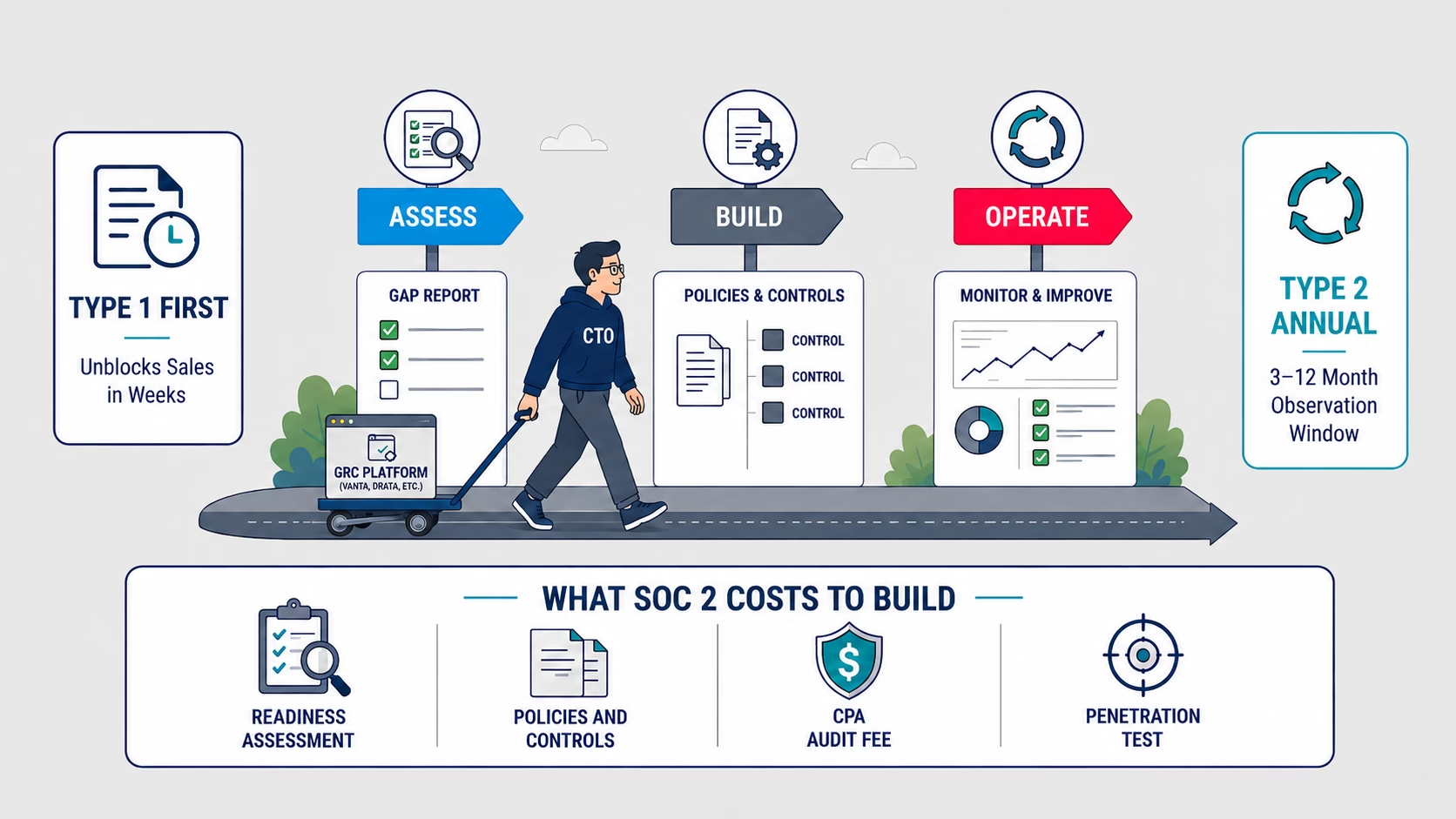
SOC 2 Compliance for SaaS: The CTO's Guide

TL;DR: SOC 2 compliance for a B2B SaaS company is a sales requirement before it is a security exercise: enterprise buyers use the report to clear ...
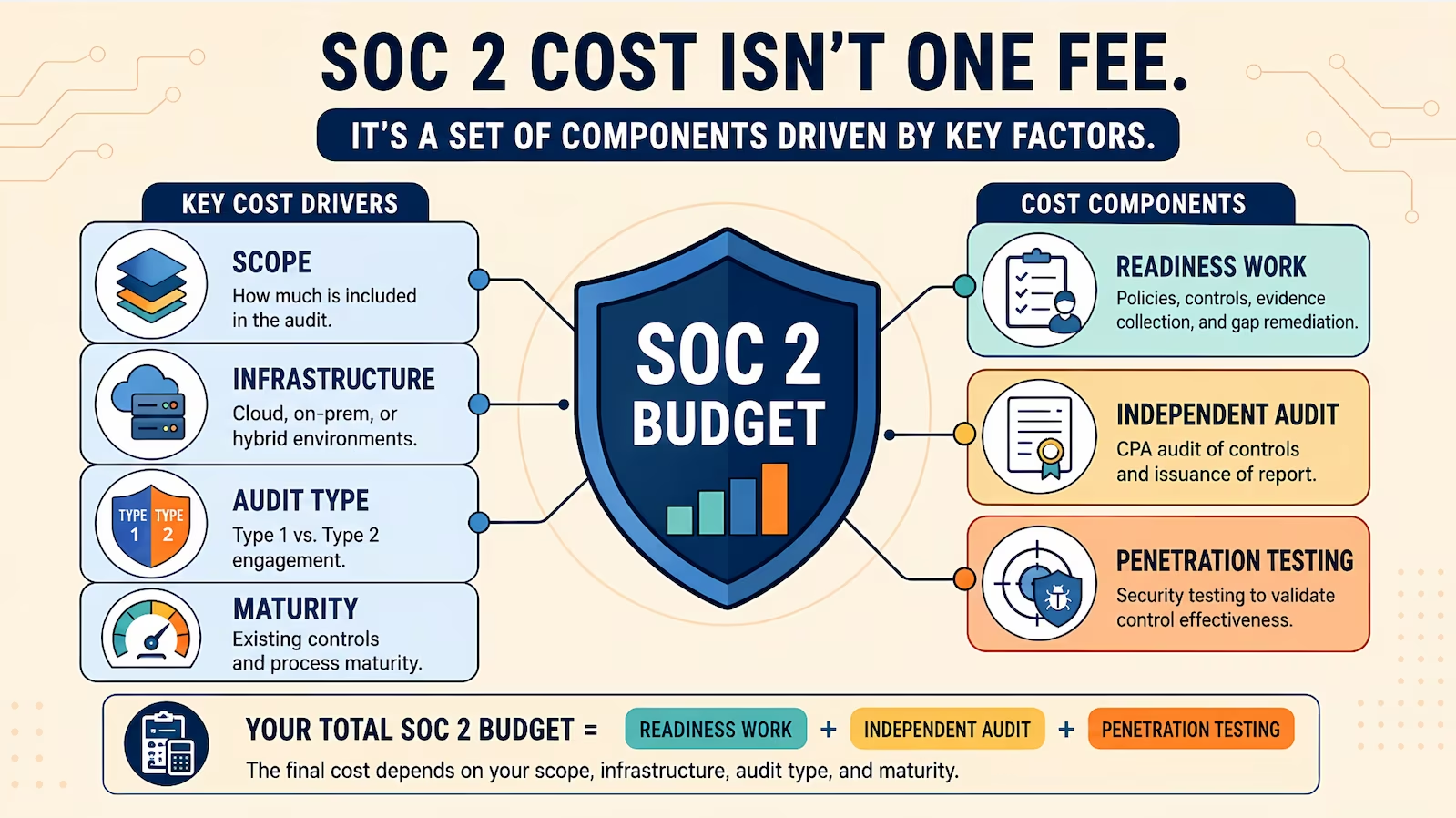
SOC 2 Cost 2026: Real Price Ranges by Line Item

A SOC 2 audit fee alone costs roughly $7,500 to $100,000 or more in 2026, depending on report type, company size and the audit firm, with published ...
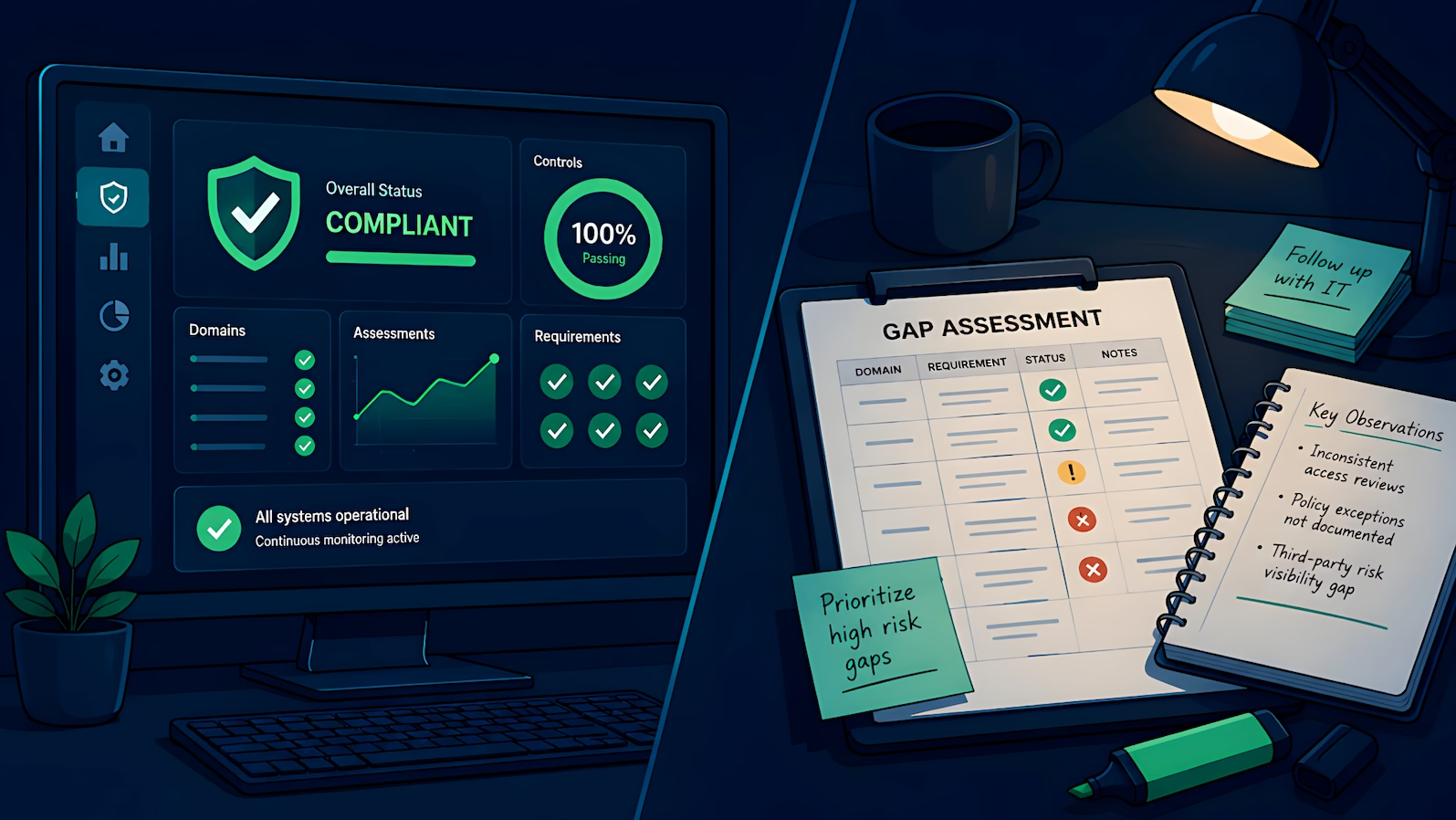
What a SOC 2 Readiness Assessment Includes (With or Without Drata)

A SOC 2 readiness assessment and Drata solve different problems. The assessment tells you whether your control environment is adequate before the ...