
.svg)
The moment that usually exposes a security program is not the audit. It is a simple question asked in a meeting.
"Who actually reviews user access at the end of each quarter, and where do you put the evidence?"
The room goes quiet. Someone glances at the CTO. The CTO glances at the GRC platform. The platform shows a pending task that has been pending for nine weeks. The policy is real. The practice is not.
The core idea
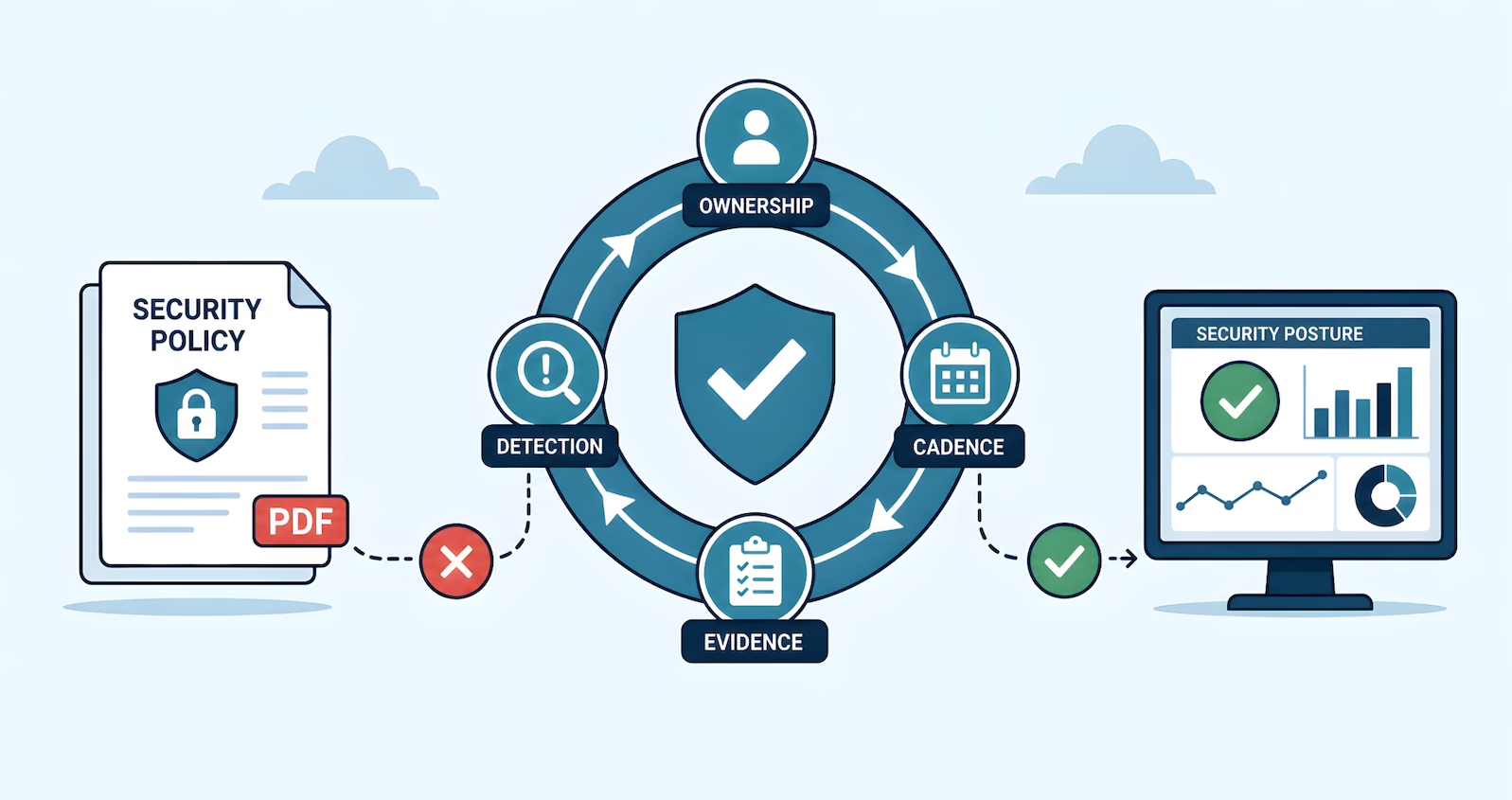
A policy is a statement of intent. Operationalization is what turns intent into something that happens on a Tuesday whether anyone is watching or not. The distance between those two things is where most compliance programs actually live.
The five-question test
You can pressure-test any policy in five minutes. Pick one: access reviews, change management, vendor risk, patching. Then ask:
- Who owns this? A name, not a role. If the answer is security or IT or the platform, the policy is not operationalized.
- When does it run? A cadence, not a guess. As needed is not a cadence. When someone has time is not a cadence.
- What triggers it? A specific event, not memory. A calendar, a workflow rule, a ticket that fires on a date. If the only trigger is human recollection, the policy will eventually stop running.
- Where does evidence live? A specific location, not somewhere in Drive. If the team has to think about it, the auditor is going to spend an afternoon hunting through folders.
- Who notices when it does not happen? A real detection mechanism. If the answer is we would notice or our auditor would catch it, the policy will quietly slip for two quarters before anyone realizes.
If any of those answers are missing, that is the gap. Usually it is one or two, not all five at once. The owner exists but the cadence is informal. The cadence exists but the evidence is scattered. Each gap is small. Together they are why audits fail and why breaches happen on a random Tuesday.
A worked example: access reviews
Access reviews are the textbook case. Almost every framework requires them. Almost nobody runs them properly. SOC 2 CC6.2 asks for periodic review of user access. ISO 27001 A.5.15 says the same thing in different words. The policy is easy to write. The practice is where it falls apart.
Here is what an unoperationalized access review looks like. The policy says user access is reviewed quarterly. Someone exports a user list, looks at it for ten minutes, and emails the auditor saying it was reviewed. There is no record of who was removed, why, or when. The next quarter, nobody remembers it is time.
Here is the operationalized version. A ticket auto-creates on the first business day of March, June, September, and December. It is assigned to the IT manager by name. The attached procedure says: pull the access list from the identity provider, compare to the active HR roster, flag anyone in identity who is not in HR, flag access that falls outside current role, route to each system owner for sign-off, document removals in a linked ticket, store the final report in a designated folder in the GRC platform. A workflow rule escalates to the CTO if the ticket is open more than 14 days. The next review is created the day this one closes.
Four hours to design, two hours a quarter to run
Same policy. Different practice. The auditor finds a clean trail every single time. The difference is design work that most teams skip because the policy feels finished when the PDF is signed.
Where this fails most often
The pattern is not specific to access reviews. It repeats across every recurring activity a security program depends on.
- Vendor risk reviews. The policy says vendors are reassessed annually. In practice, the assessment happens at onboarding and never again, because nothing triggers the recurrence.
- Change management. The policy says production changes follow an approval workflow. In practice, emergency changes bypass it, and emergency expands to mean anything we are in a hurry on.
- Incident response tabletops. The policy says the plan is tested annually. In practice, the plan was tested the year it was written and has not been touched since.
- Business continuity tests. The policy commits to an annual recovery exercise. Backups run nightly; nobody has ever restored from one.
- Vulnerability remediation SLAs. The policy says criticals are patched in 14 days. In practice, the scanner produces a report, the report goes to a shared inbox, and the SLA is measured against whatever the team eventually got around to.
- Security awareness training. The policy says every employee completes training annually. The platform is configured, training is assigned, completion rate has been at 60% for two years because nobody owns the followups.
The policy is fine in each case. The procedure behind it is missing.
How to retrofit without rewriting the policy library
If the company already has a complete policy set, the work is not rewriting the policies. It is writing the procedures that should have supported them from the start.
Pick one policy at a time. The urge to do all thirty in parallel is strong. Resist it. Start with the policies that map to the most material controls or the ones auditors are most likely to test. Access reviews, change management, vendor risk, and incident response are usually the right starting set.
For each, write a one-page operating procedure. Plain language. Numbered steps. Named systems. Named outputs. The procedure is a runbook, not another policy. Anyone who picks it up should be able to execute it.
Assign an owner by name, and confirm they have the bandwidth. Ownership without time is theater.
Pick a cadence and put it in a system that fires events. Not a shared document. A calendar, a workflow, a ticket queue.
Decide where evidence lives, tag it the same way every time, and stick to it. Auditors should never have to ask twice.
Add the slip detector. A workflow escalation, a dashboard widget, a recurring agenda item in a leadership meeting. Something that surfaces a missed cadence without requiring anyone to remember.
The full argument for an effective security program
Effective Security First is our field report on the gap between polished policies and working practice, and how the teams who close it actually operate. Download the PDF.
When tooling should show up
The instinct for technical teams is to reach for automation first. Buy the GRC platform. Configure the workflow engine. Stand up the SOAR. Then design the process around what the tool can do.
This almost always produces the same outcome: a configured tool sitting on top of a process that does not exist, generating dashboards nobody looks at. The tool did not create a program. It papered over the absence of one.
Tooling should be installed after the practice exists. The practice can run on a calendar invite, a spreadsheet, and an email folder for a few quarters. That is fine. Once the cadence is reliable, the owner is clear, and the evidence is consistent, automation becomes straightforward. The tool replaces the calendar invite with a workflow rule, the spreadsheet with a database, and the email folder with a controlled repository. It accelerates a working process.
Automation does not create rigor. It scales rigor that already exists.
Frequently Asked Questions
We have policies but nothing is happening. Where do we start?
Pick the policy that maps to the most material control. For most companies that is access reviews, change management, or incident response. Write a one-page operating procedure for it. Assign a named owner. Put the cadence in a system that fires events, not in someone's memory. Decide where evidence lives. Run it once. Then move to the next one.
Will a GRC platform handle operationalization for us?
No. The platform automates evidence collection once the practice exists. It does not design the practice. Owner, cadence, procedure, evidence location, slip detection are decisions that have to be made by people.
How do auditors actually test for operationalization?
They sample. The auditor picks a quarter and asks to see the access review for that quarter: the artifact, the approver, the date, the changes that resulted. If the policy says quarterly and evidence shows two reviews in the past year, that is a finding. Auditors are not testing the policy. They are testing the practice.
Who owns operationalization in a small team?
It has to be a real person, not a function. In a team of fifteen, the same person can own four or five recurring activities as long as the bandwidth is real and the cadences are spaced so they do not collide. If nobody has the bandwidth, that is when a fractional security team or an operate engagement starts to make sense.
Ready to Start Your Compliance Journey?
Get a clear, actionable roadmap with our readiness assessment.
Contact Us
Free Report: The CPCSC Compliance Playbook
Join the waitlist for a free copy when it’s released.
About the Author

Former security architect for Bank of Canada and Payments Canada. 20+ years building compliance programs for critical infrastructure.