
.svg)
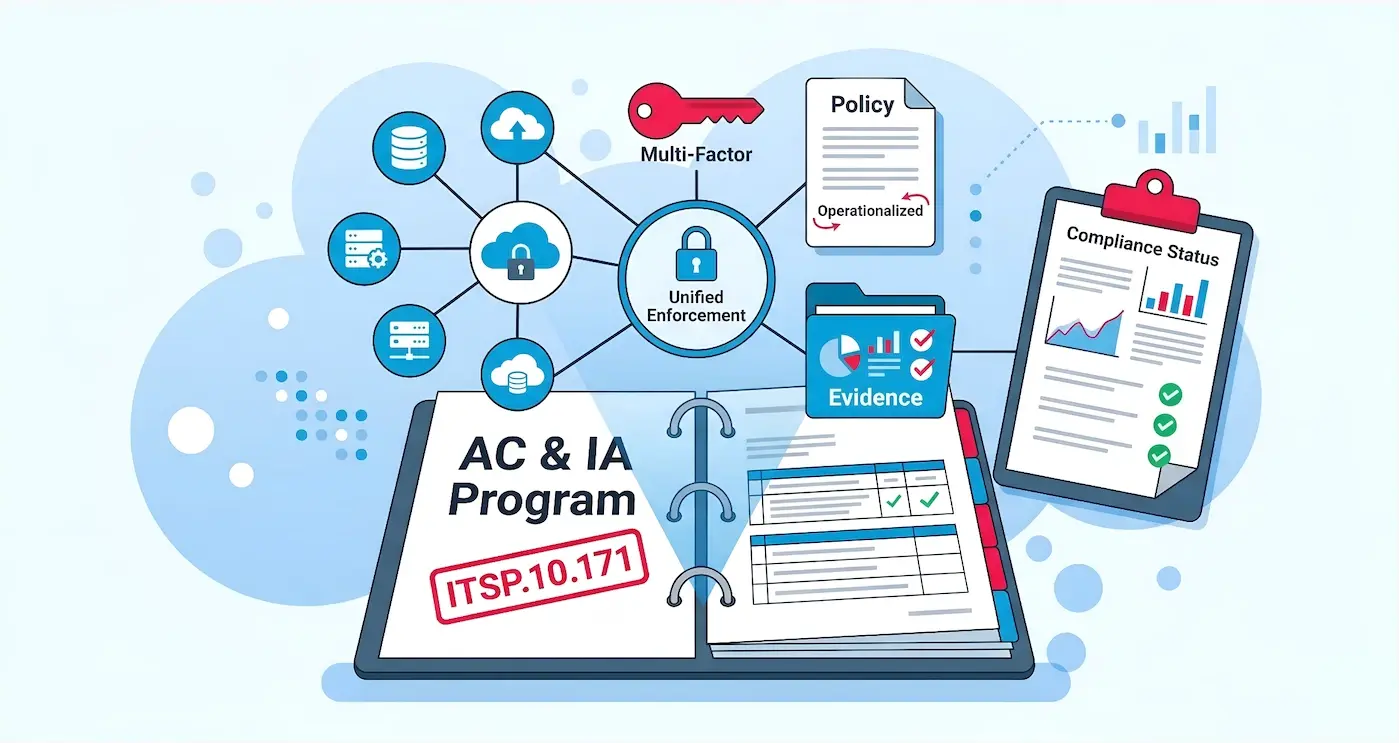
Every security program has access controls of some kind. Password policies exist, MFA is probably enabled somewhere, and someone has a spreadsheet that tracks who has admin access. The challenge with ITSP.10.171 is not that organizations lack access controls entirely. It is that the standard requires a level of documentation, enforcement, and operational consistency that most informal practices do not reach.
Access Control (AC) and Identification and Authentication (IA) together form one of the largest and most operationally intensive portions of the ITSP.10.171 standard. AC is among the largest families, covering everything from least privilege enforcement to information flow control. IA adds the identity function: how users and devices prove they are who they claim to be before gaining access.
Both families are expected to be part of the CPCSC Level 1 self-assessment, and they carry significant weight at Level 2 where third-party assessors will look for operational evidence, not just documented policies. For organizations building toward CPCSC certification, these two families deserve early attention because they touch nearly every system in scope and because gaps here tend to cascade into other control families like Audit and Accountability, Configuration Management, and System and Communications Protection.
Framework Overlap
SOC 2 CC6 covers logical and physical access controls. ISO 27001:2022 Annex A addresses access control across controls A.5.15 through A.5.18. CMMC Level 1 includes access control requirements drawn from the same NIST 800-171 lineage. Organizations with existing certifications are not starting from zero, but the ITSP.10.171 assessment objectives are specific enough that having MFA enabled does not satisfy the requirement on its own.
The Access Control (AC) Family in ITSP.10.171
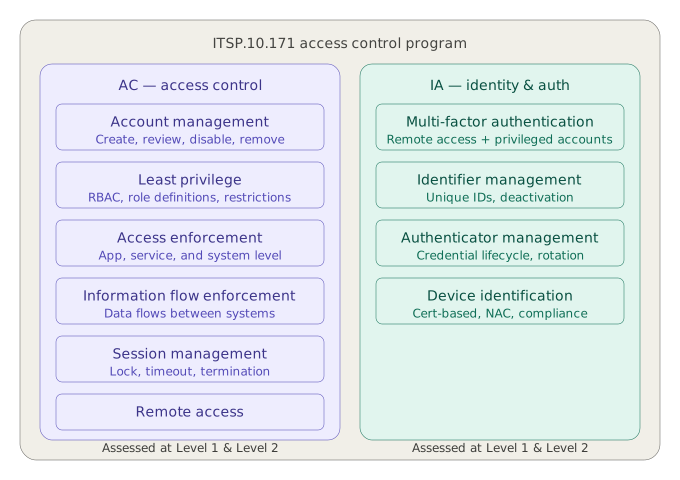
The AC family in ITSP.10.171 defines how organizations control who can access what, under what conditions, and through what mechanisms. It spans several distinct control areas, each with its own assessment objectives.
Account Management
The standard requires formal processes for creating, modifying, monitoring, disabling, and removing accounts. This includes defining account types (privileged, non-privileged, system, service, guest), assigning account managers, establishing conditions for group and role membership, and reviewing accounts on a defined frequency.
The operational expectation is that every account in scope has a documented purpose, an assigned owner, and a review cycle. Orphaned accounts, accounts that persist after personnel changes, and accounts with undefined purposes are findings during assessment.
Least Privilege
Least privilege enforcement requires that users receive only the minimum access necessary to perform their assigned functions. The standard expects organizations to restrict privileged functions to specific personnel, prevent non-privileged users from executing privileged functions, and limit authorization to access security-relevant information.
A Common Pattern to Avoid
Organizations where multiple team members share elevated access because everyone needs it to do their job, without a formal analysis of what each role actually requires. ITSP.10.171 expects role-based access control (RBAC) with documented role definitions, not informal trust.
Access Enforcement
Access enforcement controls define the mechanisms that actually implement the access decisions. The standard expects that information system access is enforced at the application, service, and system levels, consistent with the organization's access control policy. This is where identity providers, directory services, and application-level permissions come together.
Information Flow Enforcement
This is where the standard goes beyond what many commercial security programs cover. Information flow enforcement requires documented controls on how specified information moves between systems, networks, and security domains. It is not sufficient to control who can log in; the standard expects controls on where information can flow once a user is authenticated.
For organizations handling specified information, this means documented policies and technical controls governing data transfers between environments (development, staging, production), between internal networks and external systems, and between different classification levels of information. Network segmentation, data loss prevention, and documented data flow diagrams all contribute to satisfying these requirements.
Session Management
Session controls require defined session lock and termination conditions. The standard expects automatic session locks after a period of inactivity, session termination after defined conditions are met, and controls that prevent session hijacking. The specific timeout values should align with the organization's risk assessment and the sensitivity of the information being accessed.
Remote Access
Remote access controls require authorization, monitoring, and encryption of all remote access sessions. The standard expects that remote access is authorized before it is provisioned, that remote sessions are monitored and logged, and that cryptographic mechanisms protect the confidentiality and integrity of remote connections.
For organizations with distributed teams or remote workforce models, this is not a new concept. The ITSP.10.171 requirement is that the authorization and monitoring are documented and evidence-based, not just that a VPN is in place.
The Identification and Authentication (IA) Family
The IA family addresses how organizations verify the identity of users and devices before granting access. While AC defines what access is permitted, IA defines how the system confirms that the entity requesting access is legitimate.
Updated April 14, 2026 — Final CPCSC Level 1 Requirements
Are you ready for CPCSC Level 1?
Take the scorecard to find out.
Multi-Factor Authentication
MFA is a baseline expectation for access to systems that process or store specified information. The standard requires MFA for all remote access and for privileged accounts, using at least two of the three authentication factors: something you know, something you have, or something you are.
MFA Coverage Matters
MFA must apply consistently across all systems in scope, including legacy systems, third-party applications, and infrastructure management interfaces, not just the primary application or cloud console. Partial coverage is a common assessment finding.
Identifier Management
Identifier management requires formal processes for assigning, managing, and deactivating user identifiers. Each individual must have a unique identifier, shared identifiers must be documented and justified, and identifiers must be deactivated after a defined period of inactivity.
The unique identifier requirement has direct implications for incident response. When every action in the environment can be attributed to a specific individual, investigation and remediation become substantially more effective. When actions trace back to a shared account, the forensic trail ends at a group of people rather than an individual.
Authenticator Management
Authenticator management covers the lifecycle of credentials: initial distribution, lost or compromised authenticator handling, credential rotation, and protection of authenticators at rest. The standard expects defined processes for each phase, not just a password policy that specifies complexity requirements.
This includes protection of service account credentials, API keys, and other non-human authenticators. The standard treats these with the same rigor as human credentials, which means documented storage, rotation schedules, and access restrictions on who can retrieve or modify them.
Device Identification and Authentication
This is one of the less intuitive requirements for organizations accustomed to user-centric identity models. The standard expects organizations to identify and authenticate devices, not just users, before granting access to specified information. This means the system should be able to confirm that a connecting device is a known, authorized endpoint before permitting access to controlled data.
In practice, this can be addressed through certificate-based device authentication, device compliance policies in endpoint management platforms, or network access control (NAC) solutions that verify device identity and posture before granting network access. The key is that the organization has a mechanism to distinguish between an authorized device and an unknown one, and that this distinction is enforced before access is granted.
Where Existing Programs Create a Head Start
Organizations with existing security certifications carry meaningful overlap into the AC and IA families of ITSP.10.171. The head start is real, but it is not complete.
Common Gaps That Surface During Assessment
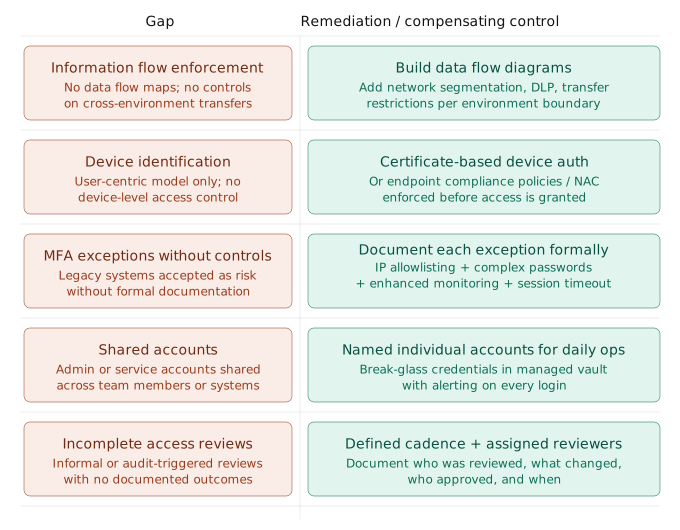
The AC and IA families are where the distance between having access controls and meeting ITSP.10.171 assessment objectives becomes visible. Several gaps appear consistently across organizations preparing for certification.
Information Flow Enforcement
This is the gap that surprises organizations with otherwise mature access control programs. Commercial security frameworks typically focus on who can access systems. ITSP.10.171 also requires documented controls on how information moves between systems once access is granted. Organizations that have never mapped their data flows for specified information, or that lack technical controls preventing unauthorized data transfers between environments, will need to build this capability.
Where to Start
Build a data flow diagram that traces where specified information enters the environment, where it is processed and stored, and where it can be transmitted. From that diagram, identify where technical controls (network segmentation, DLP, transfer restrictions) are needed and where policy controls (documented procedures, approval workflows) apply.
Device Identification
User-centric identity models are the norm in commercial environments. The ITSP.10.171 requirement to identify and authenticate devices represents a capability that many organizations have not implemented formally. The gap is not necessarily that organizations lack the technical tools; endpoint management platforms and certificate-based authentication can address the requirement. The gap is that device identification has not been defined as a security control, documented, and enforced as a condition of access.
MFA Exceptions Without Compensating Controls
Not every system in scope supports MFA natively. Legacy applications, certain infrastructure management interfaces, and some third-party integrations may lack MFA capabilities. The correct approach is not to ignore these exceptions or to simply note them as accepted risks without further action.
MFA exceptions require formal documentation in the organization's risk register, with compensating controls defined for each exception. Compensating controls typically include:
- Enforced password complexity requirements exceeding the standard baseline
- IP allowlisting that restricts access to known network ranges
- Enhanced monitoring and alerting on authentication events for the affected system
- Session timeout enforcement
The key is that each exception is individually assessed, documented, and compensated, not grouped into a blanket acceptance.
Shared Accounts Breaking Attribution
Small teams develop a practical reliance on shared administrative accounts. A single AWS root account, a shared infrastructure management login, or a common service account used for daily operations creates efficiency in the short term. Under ITSP.10.171, it creates an attribution problem that affects multiple control families.
Attribution Risk
When a shared account is compromised or involved in an incident, the organization cannot determine which individual's session was affected, which undermines both the incident response and the forensic investigation. The IA family requires unique identifiers, and the AU family requires audit records that identify the individual responsible for each auditable event.
The operational model that satisfies the standard is named accounts for daily use, with shared credentials restricted to documented break-glass scenarios. Break-glass accounts should have alerting configured on every login, with logged justification required for each use. The credentials themselves should be stored in a managed vault with access logging, not in a shared document or chat channel.
Incomplete Access Reviews
The standard expects periodic access reviews with documented evidence of who was reviewed, what changes were made, and who approved the review. Organizations that conduct access reviews informally, or that review access only when prompted by an audit, will need to establish a defined review cadence with documented outcomes.
Implementation Approach
Building ITSP.10.171 access control and identity management capabilities is most effective when approached as a program extension rather than a checkbox exercise. The following sequence reflects the order that produces the most value earliest.
For organizations building their CPCSC compliance program across all 17 control families, the ITSP.10.171 explainer provides context on how AC and IA fit within the broader standard, and the CPCSC overview guide covers the certification program structure and timelines.
Updated April 14, 2026 — Final CPCSC Level 1 Requirements
Are you ready for CPCSC Level 1?
Take the scorecard to find out.
Frequently Asked Questions
Does ITSP.10.171 require MFA for all user accounts?
MFA is required for all remote access and all privileged accounts accessing systems that process or store specified information. The standard does not mandate MFA for every account in the organization, but the practical scope is broad: any account that can reach specified information through a remote connection or that holds elevated privileges must use multi-factor authentication. Where MFA cannot be implemented due to system limitations, the organization must document the exception with compensating controls.
How does ITSP.10.171 handle shared or service accounts?
The standard requires unique identifiers for all users so that actions can be attributed to specific individuals. Shared accounts are not prohibited outright, but they must be documented, justified, and restricted to specific scenarios such as break-glass emergency access. Each use of a shared account should be logged and monitored, and the organization must demonstrate that daily operations are conducted through individually assigned accounts. Service accounts require defined owners, documented purposes, and credential management procedures.
What is device identification and authentication under ITSP.10.171?
Device identification requires organizations to verify the identity of devices, not just users, before granting access to specified information. This means the system must be able to distinguish between an authorized endpoint and an unknown device. Implementation options include certificate-based device authentication, endpoint compliance policies, or network access control solutions. The requirement ensures that even if valid user credentials are presented, access is denied if the device itself is not recognized and authorized.
How do SOC 2 CC6 controls map to ITSP.10.171 access control requirements?
SOC 2 CC6 covers logical and physical access controls including user provisioning, authentication, and access removal, which map to several ITSP.10.171 AC and IA requirements. Organizations with SOC 2 reports will find meaningful overlap in access policy documentation, MFA implementation, and user access reviews. The primary gaps are in information flow enforcement, device identification, and the specificity of documentation that ITSP.10.171 assessment objectives require. SOC 2 provides a strong foundation, but ITSP.10.171 requires targeted extension in areas that commercial frameworks address less prescriptively.